Cold calling in Brussels: a dense, bilingual market of service firms
For sales teams that call into the Brussels-Capital Region: where the companies are, who decides, and how to handle French, Dutch and English on the same list.
Brussels had 122,725 active VAT-registered enterprises at the end of 2024, and 81.7% of them had no employees (Statbel via IBSA). The region counted 727,732 jobs in 2023, led by public administration and professional services (ICN via IBSA). The region is officially bilingual, French and Dutch, so call each prospect in their own language.
- Professional, scientific and technical30,604
- Wholesale and retail trade15,839
- Construction12,591
- Information and communication9,078
- Real estate8,693
- Health and social work6,935
B2B calling in Brussels means calling into a small, dense region full of service companies, with two official languages and a lot of English on top. Statbel counted 122,725 active VAT-registered enterprises at the end of 2024, and 81.7% of them had no employees, according to IBSA. The same source counts 727,732 jobs in the region in 2023. Your list will hold thousands of one-person firms and a smaller group of offices where a manager decides. Split them before you call.
The economy of the Brussels-Capital Region
Brussels is a city economy. It has 1,255,795 residents on 1 January 2025 on only 162 square kilometres, and a GDP of 103.3 billion euro in 2023, or 82,052 euro per resident, against 50,622 euro for Belgium (IBSA, Mini-Bru 2026). That gap exists because many people who work in Brussels live in Flanders or Wallonia.
Jobs follow the role of the capital. Of the 727,732 jobs in 2023, IBSA lists:
- Public administration: 126,373 jobs, the largest group.
- Professional, scientific and technical services: 98,598, of which 59,697 are self-employed.
- Health and social work: 74,072.
- Administrative and support services: 62,557, including staffing, cleaning and security.
- Trade: 56,442, and finance and insurance: 48,649.
On top of that come the international institutions. IBSA counts 41,775 people working for the European institutions at the end of 2024, plus 7,268 in embassies and diplomatic posts. They are rarely your buyers, but they create demand for lawyers, consultants, event venues, hotels, caterers and public affairs firms.
The Eurostat business statistics show the same picture by establishment. In 2024 the region had 30,604 local units in professional services, of which 13,865 are head offices and management consultancies. Financial services had only 2,201 local units but 53,560 people working in them. Information and communication counted 9,078 local units, 6,012 of them in IT services. Agriculture and public administration are not in that dataset, so the chart above covers the business economy only.
Where the companies are
The region has 19 municipalities, and each business district has its own buyer.
- European Quarter and Leopold Quarter (City of Brussels, Etterbeek): law firms, consultancies, public affairs agencies, federations and NGOs.
- Northern Quarter near Brussels-North station: large offices of public bodies, banks and energy companies, with facility and procurement teams.
- Avenue Louise and the city centre: head offices, banks, insurers, real estate firms and boutique advisers.
- Anderlecht, Forest and the canal zone: workshops, wholesale, construction firms and logistics around the port and the industrial areas.
- Woluwe and Evere: international company offices and tech firms close to the airport side.
Many companies that matter for Brussels sit just outside the region, in Flemish Brabant and Walloon Brabant. Decide up front whether your list stops at the regional border or follows the commuter belt.
Who to call and what to ask
With so many one-person firms, the owner is often the only person to call. In offices with staff, it pays to target a role, not a name:
- Managing director or founder at firms below about 20 people: signs everything.
- Office manager or facility manager: workplace, cleaning, catering, security and furniture.
- HR manager: staffing, training and payroll services.
- CFO or finance manager: insurance, financing and fleet.
- Managing partner at law firms and consultancies.
Discovery questions that fit Brussels:
- In which language do you prefer to work with suppliers: French, Dutch or English?
- Do you work from one office in Brussels, or also from sites in Flanders or Wallonia?
- Who in your team decides on this, and is that done here or at a head office abroad?
- Has your office or your way of working changed since you moved to hybrid work?
- Which of your clients are European or international organisations, and what do they ask of you?
For lists made of very different firms, a sharp ideal customer profile saves more time than any script.
Calling in Brussels: language, networks and rules
Language. The Brussels-Capital Region is officially bilingual, French and Dutch. In practice many companies work mainly in French, a part in Dutch, and international firms often in English. Call in the language of the prospect. A neutral opening such as "Bonjour, goedendag" lets the other person choose, and you switch at once. Write your script in both languages, with the same structure, so every caller can switch without losing the thread. The guide to cold call opening lines helps you keep that opening short.
Where owners meet. BECI is the Brussels chamber of commerce and employers' organisation. Voka runs a network for the Brussels metropolitan area, and UNIZO represents the self-employed and SMEs. hub.brussels is the regional agency for entrepreneurship. Their events are good places to learn what local owners worry about before you call them.
Rules. Before you call, check every Belgian number against the Bel-me-niet-meer list, Ne m'appelez plus in French. The list also covers business numbers, and you may not call numbers on it or people who have objected. This is general information, not legal advice. Read our guide to cold calling rules in Belgium and the Netherlands before you plan a campaign.
A first week of calling in Brussels
- Day 1: build one list. Pick one segment, for example consultancies with 5 to 50 people in the European Quarter. Add the language of each company as a field.
- Day 2: write two scripts. French and Dutch, with English answers to the common objections.
- Days 3 and 4: call in blocks. Two blocks of 90 minutes, mid-morning and mid-afternoon. Note who answers and in which language.
- Day 5: follow up. Send what you promised, plan every call back and read the reasons for "not now".
Want to see how such a week looks in one screen? Try the demo.
One calling workspace for teams in Brussels
Real screens from the app. Call from your own phone, log every call with one key and see your numbers per caller and campaign.
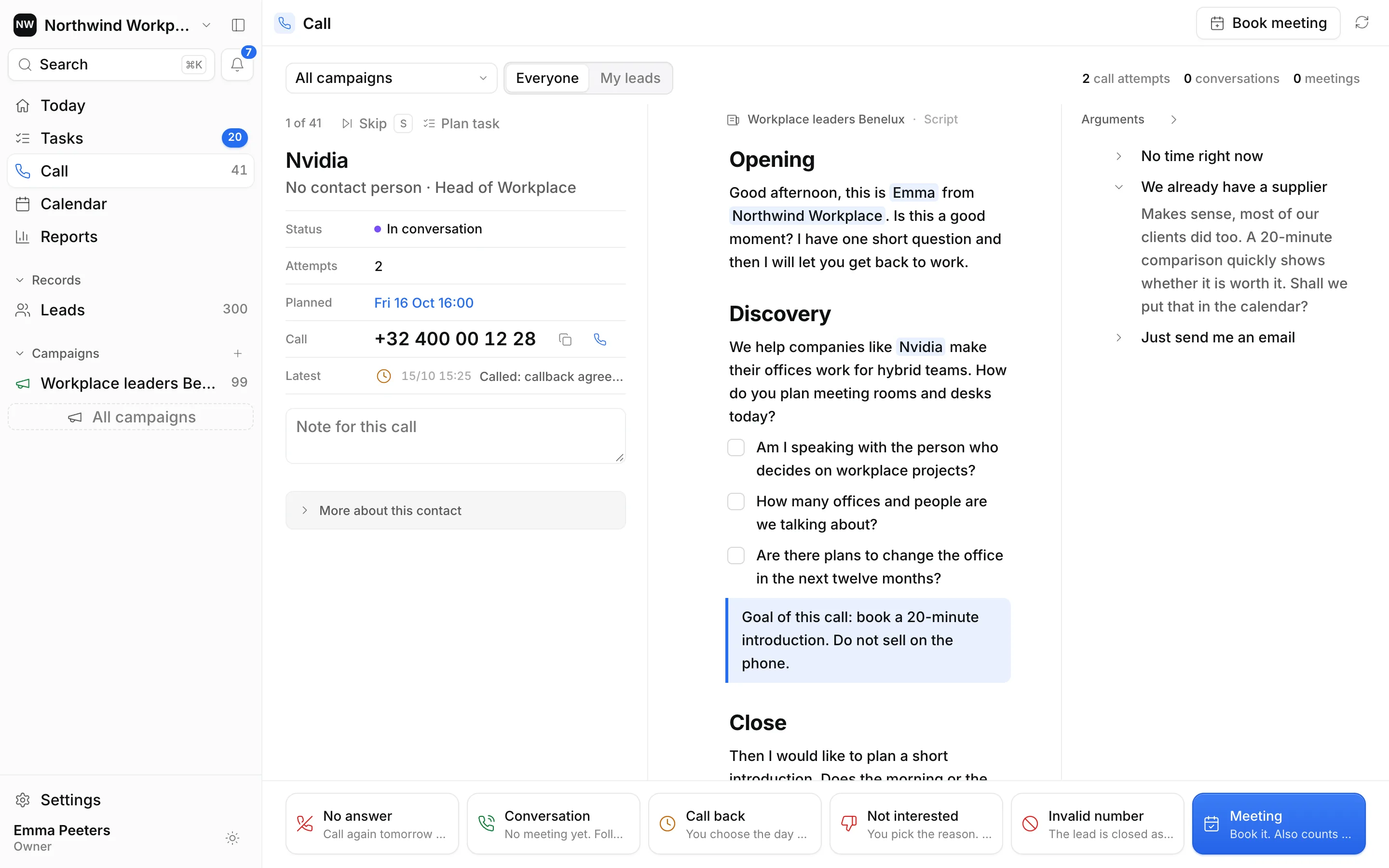
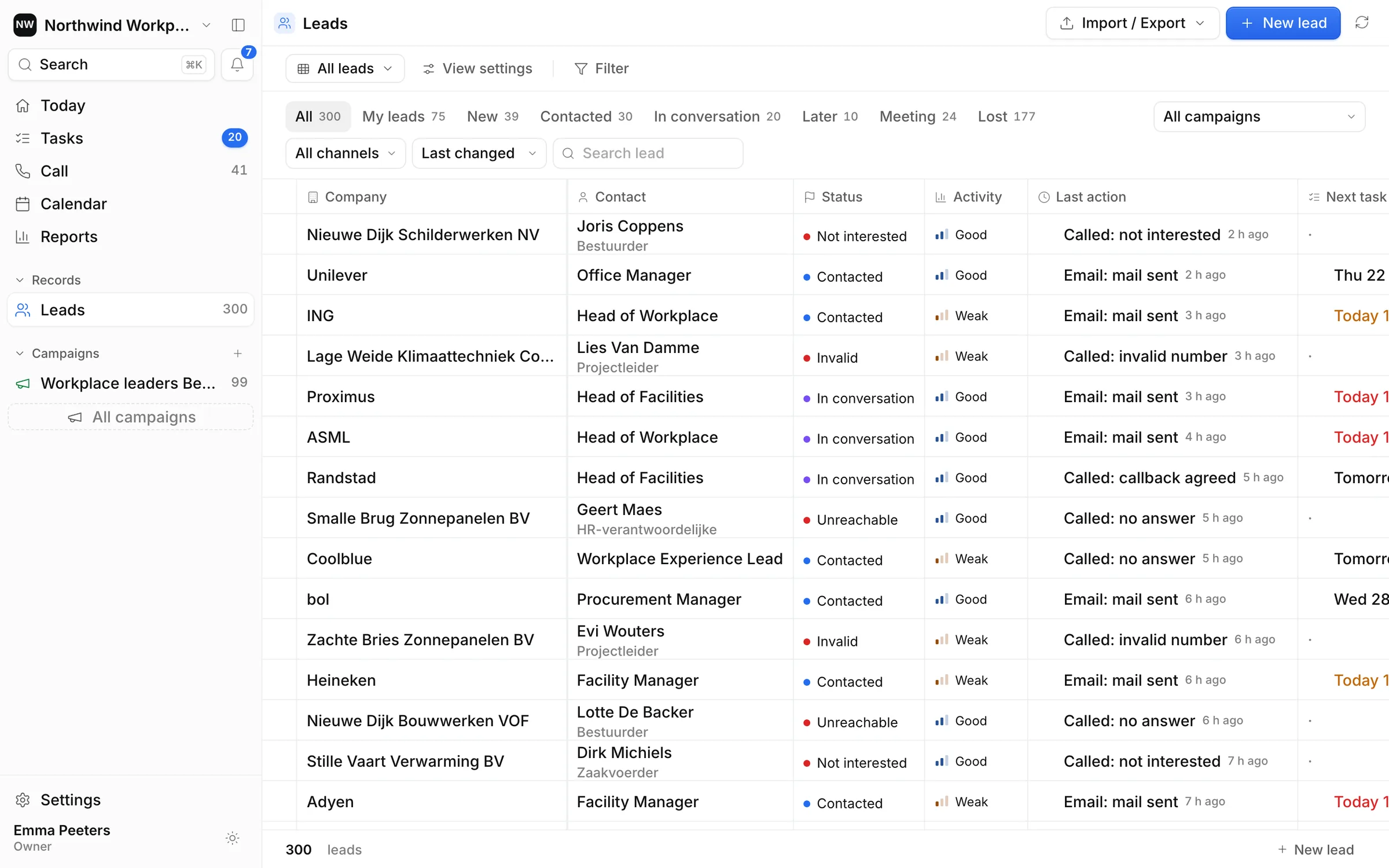
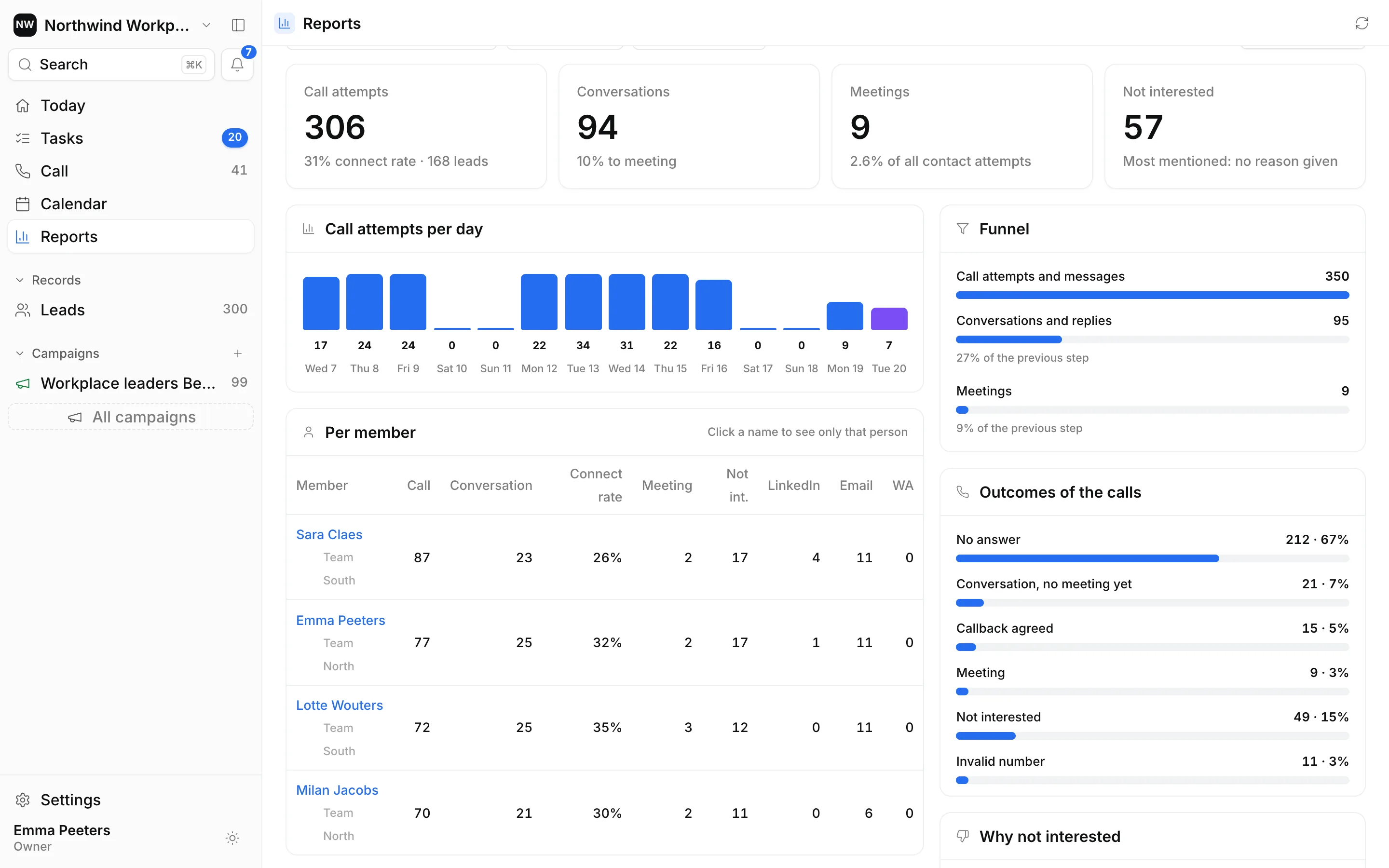
Real screens from the Ringlane app with demo data. No affiliation with the companies shown.
Industries to call in Brussels
Grow your consultancy beyond the partners' network
How consultancy and advisory firms in Belgium and the Netherlands can call new clients, time the call around change and keep long advisory cycles moving.
Business events and venuesFill your event calendar with corporate clients you called yourself
How event agencies, venues and congress centres in Belgium and the Netherlands can call corporate buyers, time the call to event calendars and follow up.
Commercial cleaningBe on the shortlist when a cleaning contract comes up for renewal
How commercial cleaning companies in Belgium and the Netherlands can call facility managers, time calls around contract ends and follow up every lead.
Frequently asked questions
Should I cold call Brussels companies in French or in Dutch?
How many companies are there in Brussels?
Which sectors are largest in Brussels?
Can I call Belgian business numbers without consent?
Who should I call at a Brussels SME?
Sources
- IBSA (perspective.brussels): Mini-Bru 2026, key figures for the Brussels-Capital Region
- Eurostat: Local units and employment by NUTS 2 region and NACE Rev. 2 (sbs_r_nuts2021)
- BECI: Brussels Enterprises Commerce and Industry, the Brussels chamber of commerce
- hub.brussels: Brussels Agency for Entrepreneurship
- Voka: Brusselse metropool
- UNIZO: organisation for the self-employed and SMEs