Cold calling in West Flanders: food, machine builders and the coast
West Flanders is the most industrial province of Flanders by share of jobs: food factories, machine builders and textile firms, most of them family-owned, plus the port of Zeebrugge and a coast full of hospitality. Here is who to call and what to ask.
West Flanders had 1,234,664 residents on 1 January 2025 and a GDP of 64.6 billion euro in 2024 (Eurostat). Its food industry employed 21,534 people and its machine builders 11,424 in 2024, more than in any other Flemish province (Eurostat). Most of these firms are owner-led and buy on trust.
- Professional, scientific and technical22,632
- Wholesale and retail trade20,188
- Construction19,748
- Accommodation and food service8,662
- Administrative and support services8,249
- Health and social work7,606
B2B calling in West Flanders means calling into the most industrial province of Flanders, where many factories are still run by the family that founded them. The province had 1,234,664 residents on 1 January 2025 and a GDP of 64.6 billion euro in 2024. In 2024 its food industry employed 21,534 people and its machine builders 11,424, more than in any other Flemish province, according to Eurostat. West Flemish buyers take their time. The first call opens a relationship; it rarely closes a deal.
The economy of West Flanders
Manufacturing accounts for 18.8% of the 462,795 jobs that Eurostat counts in local units in the province in 2024, the highest share of the five Flemish provinces. Three industries stand out.
- Food. 1,317 local units with 21,534 jobs, from vegetable processing to meat and bakery. That is the largest food workforce of the five Flemish provinces.
- Machines. 322 local units with 11,424 jobs, plus 8,229 jobs in fabricated metal products. Machine builders and metalworkers form the second industrial pillar.
- Textiles and interiors. 426 local units with 7,180 jobs in textiles, twice the number in East Flanders, plus furniture (3,116 jobs), wood (4,076) and plastics (5,467). This is the Kortrijk and Waregem cluster of carpets, technical textiles and furniture.
The coast adds a very different economy. Accommodation and food service count 8,662 local units, the fourth largest section in the province. In the ports, Zeebrugge is part of Port of Antwerp-Bruges, which handled 3,186,000 new cars across its sites in 2025; Zeebrugge alone received 466,089 cruise passengers. The port of Ostend handled 1 million tonnes of goods in 2025, according to Statistiek Vlaanderen.
Behind the factories sits a large service and building layer: 22,632 local units in professional services, 20,188 in trade and 19,748 in construction. Staffing agencies employ 32,965 people, many of them in production work.
The chart above counts local units in Eurostat's structural business statistics for 2024. That dataset leaves out agriculture and public administration, so farms and growers are not counted in it.
Where the companies are
- Kortrijk, Waregem and Harelbeke: textiles, furniture, machine builders and the service firms that work for them, close to Lille.
- Roeselare, Izegem and Tielt: food processing, machinery and agricultural equipment.
- Bruges and Zeebrugge: the port, logistics, services and tourism.
- Ostend and the coast: hotels, restaurants, maritime firms and port services.
- Ypres and Poperinge: agri-food, vegetable processing and builders in the Westhoek.
Who to call and what to ask
At family-owned manufacturers, the managing director decides and often the second generation runs operations. Ask for the production manager, the technical director or the purchasing manager when you sell into the plant. In food, add the quality manager. At the coast, call the owner or general manager of the hotel or restaurant group.
Questions that fit West Flanders:
- Which of your customers abroad is growing fastest, and what do they ask of you?
- Where is your production most dependent on one experienced person?
- How do you handle the peaks in your season, and what breaks first?
- Which supplier have you worked with longest, and why do you stay?
- What would we need to show before you would consider a visit?
The first sentence decides whether a busy owner keeps listening. See our guide to cold call opening lines.
Calling in West Flanders: practical notes
- Language. Call in Dutch. Firms in the south of the province trade with northern France and Wallonia, so some buyers switch to French with customers; follow the language of the person who answers. West Flemish is a strong dialect; speak calm standard Dutch and do not imitate it.
- Trust before price. Expect "we have worked with the same supplier for twenty years". Ask what that supplier does well, and plan the next call. Our guide on handling sales objections covers this answer.
- Voka West Flanders. Voka West Flanders is the provincial chamber, one of the Voka chambers that together unite more than 18,000 businesses. Its events are where West Flemish owners meet; go to listen and learn.
- UNIZO has local branches for smaller firms, builders and the self-employed.
- Seasons. Coastal businesses are hard to reach in summer and at holiday peaks. Call them in the quiet months.
- Rules. Calling businesses is allowed in Belgium, but first check your numbers against the Bel-me-niet-meer list, which also covers business numbers, and honour every objection. See our summary of the cold calling rules in Belgium and the Netherlands; it is general information, not legal advice.
A first week of calling in West Flanders
- Day 1: one list. For example 100 food and machine firms around Roeselare and Tielt. Leave the coast for another week.
- Day 2: a script that asks before it tells. One opening line, three questions, and a visit or call back as the ask.
- Days 3 and 4: two calling blocks a day, early morning and early afternoon.
- Day 5: follow-up. Send what you promised and plan the second conversation for everyone who listened.
To see how a calling block and its follow-up look in Ringlane, open the demo.
One calling workspace for teams in West Flanders
Real screens from the app. Call from your own phone, log every call with one key and see your numbers per caller and campaign.
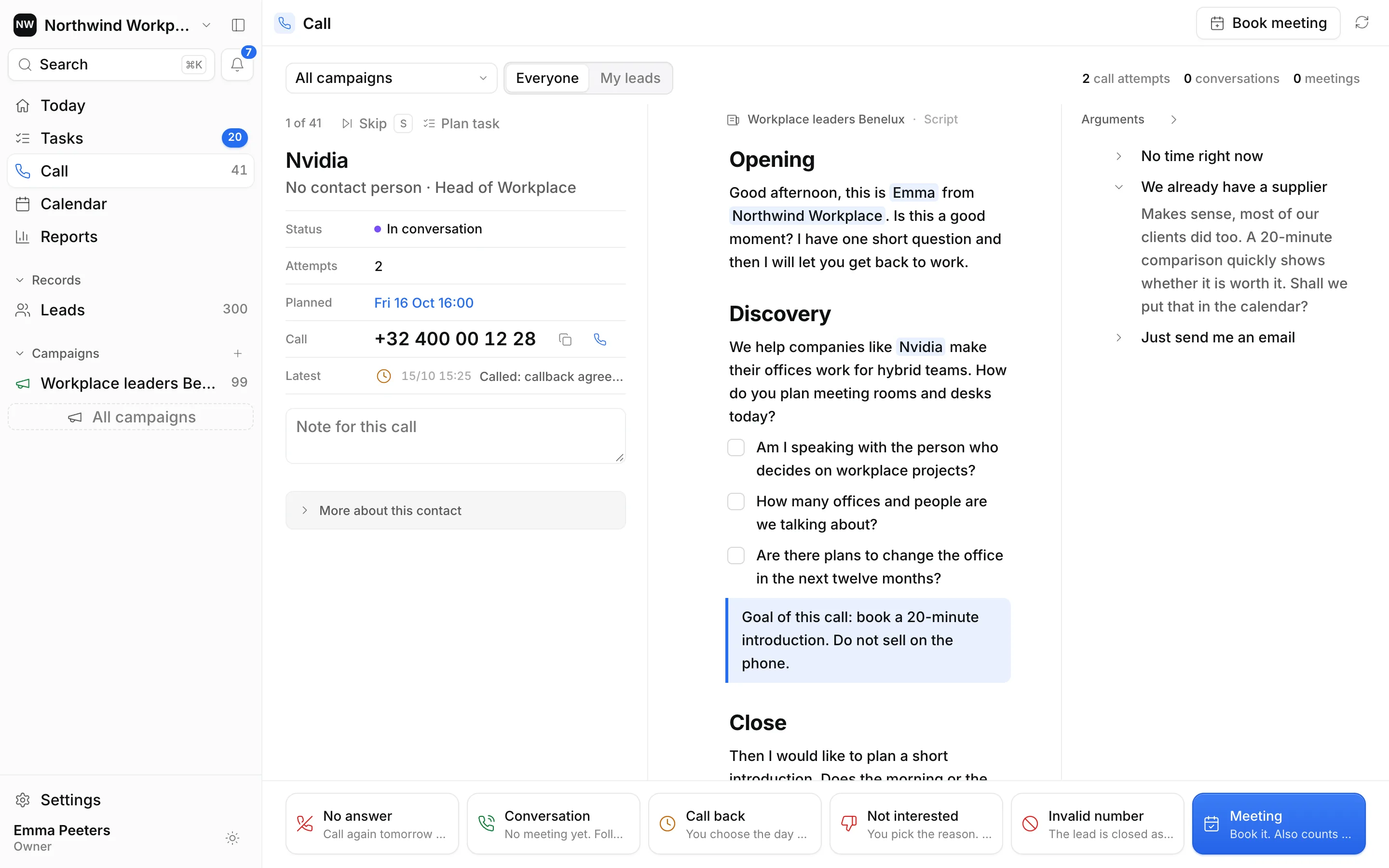
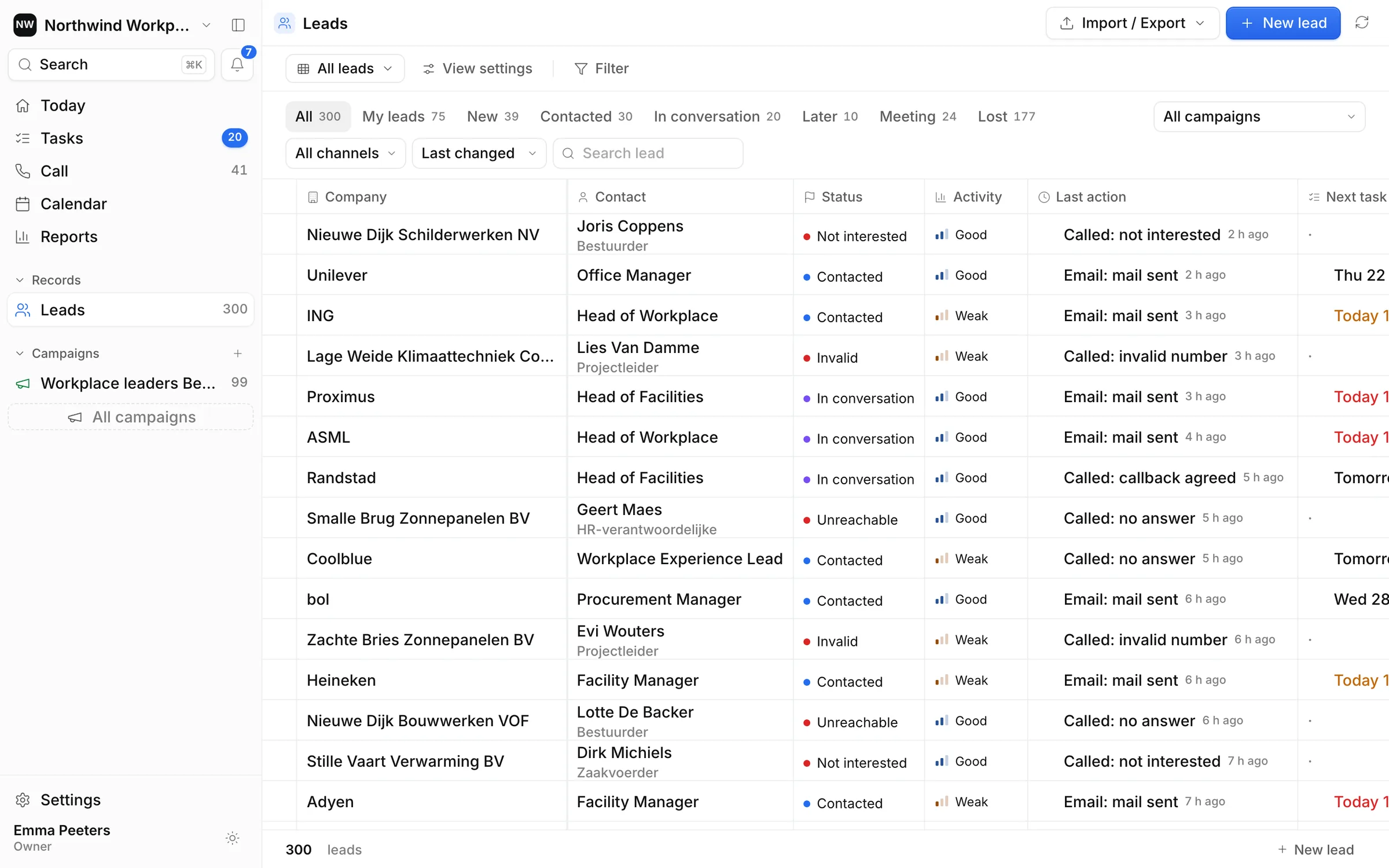
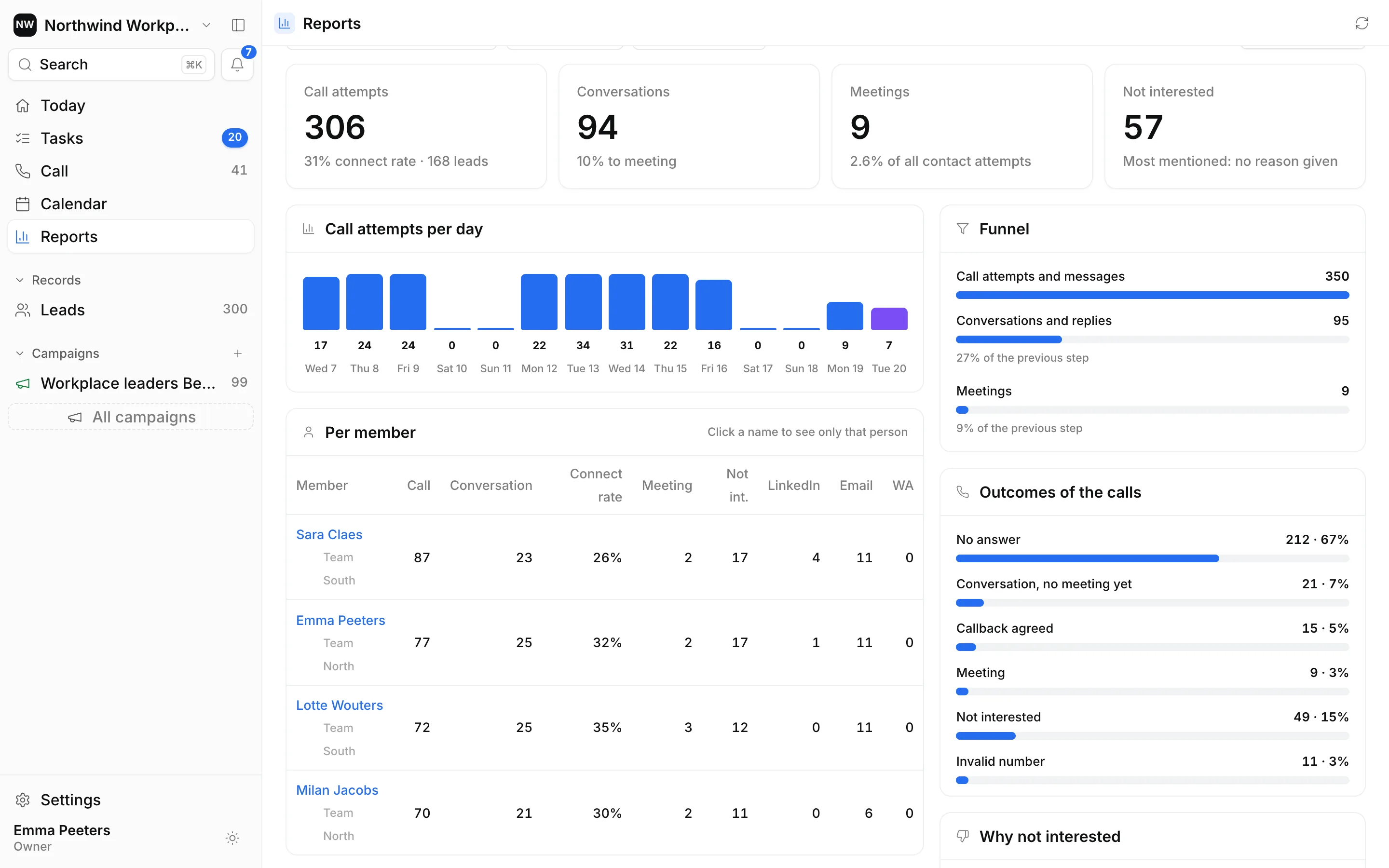
Real screens from the Ringlane app with demo data. No affiliation with the companies shown.
Industries to call in West Flanders
Get on the supplier list before the next project is quoted
How manufacturers and subcontractors in Belgium and the Netherlands can call buyers and engineers, get on the supplier list and follow up a long sales cycle.
Printing and packagingWin new print and packaging accounts with buyers you called yourself
How printers and packaging producers in Belgium and the Netherlands can call buyers, use the new EU packaging rules as a reason, and follow up every lead.
Workwear and PPEWin workwear and PPE accounts by calling when the risk analysis changes
How workwear, PPE and garment rental suppliers in Belgium and the Netherlands can call safety and purchasing managers, time the call and follow up each lead.
Frequently asked questions
Does cold calling work for B2B sales in West Flanders?
Which industries are strongest in West Flanders?
Which cities matter most for B2B calling in West Flanders?
Where do business owners in West Flanders meet?
Should I call West Flemish companies in Dutch or French?
Sources
- Eurostat: Enterprises and local units by NUTS 2 region and NACE Rev.2 activity (sbs_r_nuts2021)
- Eurostat: Population on 1 January by NUTS 2 region (demo_r_d2jan)
- Eurostat: Gross domestic product by NUTS 2 region (nama_10r_2gdp)
- Port of Antwerp-Bruges: Factsheet throughput figures 2025
- Statistiek Vlaanderen: Zeehavens, goederentrafiek
- Voka: West-Vlaanderen
- Voka: Organisation chart of the Voka chambers of commerce
- FPS Economy: Guidelines on direct marketing by telephone (9 February 2026, in French)