Grow your consultancy beyond the partners' network
For management, HR, finance and operations consultants in Belgium and the Netherlands: who to call, which moments make advice relevant, and how to follow up a cycle that can take months.
Consultancy is sold on trust, so most firms grow through the network of their partners. That network has limits: it ages, it is busy, and it is the same network your competitors know. Calling companies that go through a change is a way to meet decision makers you would never meet at a reception, as long as the call is about their situation and not about your firm.
The market: a crowded field of mostly independent advisers
The supply side is enormous. According to Eurostat business statistics for 2023, Belgium had 69,932 enterprises in management consultancy, a group that also includes public relations, and the Netherlands 165,656. Most are independents: 58,617 in Belgium and 152,939 in the Netherlands had zero or one person employed. Only 583 Belgian and 1,373 Dutch consultancy firms had 10 or more people. The same Eurostat series counts 114,120 persons employed in Belgian management consultancy and 188,009 in the Netherlands.
For a buyer, that means choice and suspicion at the same time. In a Gartner survey of 632 B2B buyers, 61% preferred to buy without a sales rep and 73% said they actively avoid suppliers who send irrelevant outreach. A consultant who calls has to bring an insight, not a brochure.
The public sector is a large buyer, but under pressure. The Dutch central government reports that external hire fell to 13.1% of personnel spending in 2025, down from 15.4% in 2024, still above its 10% norm, mainly because of demand for ICT specialists and temporary projects. Public work is usually bought through tenders and framework agreements, which a calling team cannot shortcut.
In private companies, decisions sit high. The owner or CEO decides on strategy and organisation, the CFO on finance projects, the HR director on people topics. Larger assignments often go through a selection with two or three firms and a proposal.
Who you call and what you ask
- Owner, CEO or managing director: strategy, growth, organisation and succession.
- CFO or finance director: finance processes, reporting, cost programmes.
- HR director: organisation design, leadership, change.
- COO or operations director: processes, supply chain, efficiency.
- Executive assistant: not a decision maker, but often the key to the agenda.
Trigger events: a new CEO or director, a merger or acquisition, a reorganisation, fast growth or a downturn, new regulation, a project that failed, a succession question, and the budget round for next year.
Discovery questions that work in consultancy:
- What is the one change that takes most of your attention this year?
- What have you already tried, internally or with advisers, and what happened?
- What does it cost you if this stays the same for another year?
- When do you decide on budgets for next year, and who is involved?
- What would an adviser need to bring to be worth a first meeting?
A first sentence that works
Open with the change, not with your methods. For example: "I am calling because you announced the acquisition of a competitor, and I wanted to ask how you are bringing the two teams together." It is about something the director is living through right now. If the answer is "we handle that ourselves", ask what would make them bring in outside help, and when they look at that again. Often the honest answer is a moment: after the summer, at the budget round, when the first results are in. That moment becomes the next call. Do not send a long proposal after a first call; a short note with one relevant insight keeps the door open.
Questions like these follow SPIN selling, and a teaching angle works well with executives; see the Challenger Sale applied to cold calling.
What slows a calling team down in this sector
- Gatekeepers. Executive assistants protect the agenda. Be clear, brief and honest about why you call, and ask when to call back.
- Trust takes time. Few executives hire an adviser after one call. The first goal is an exploratory meeting.
- Partners have no time. Billable work wins over new business. A junior caller who books meetings for partners needs a good script.
- Timing and budgets. "Not this year" often means "ask me in the budget round". Plan that call.
- Tenders in the public sector. Government work runs through formal procedures; calling helps you understand needs, not skip the procedure.
How Ringlane works for consultancy firms
Real screens from the app, with what each feature does in this industry.
Your lists, in one place
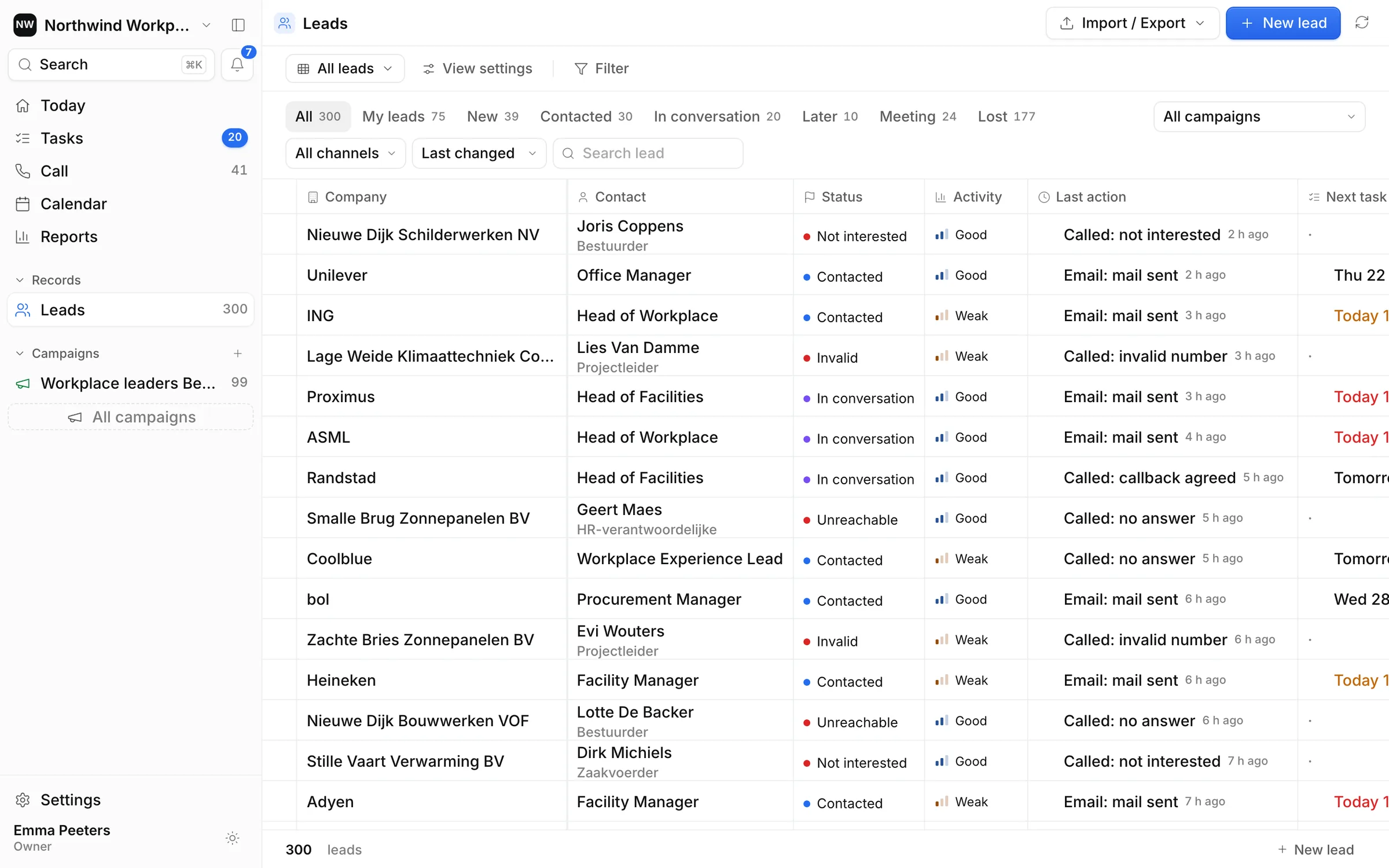
Import Excel, CSV or a Bizzy export into a campaign. Every lead shows its status, last action and next task.
In this industry: Import a Bizzy export of companies by size, sector and region into a campaign per offer, for example a reorganisation track or a finance review, so partners and callers share one list and see who still needs a first attempt.
One screen for the call
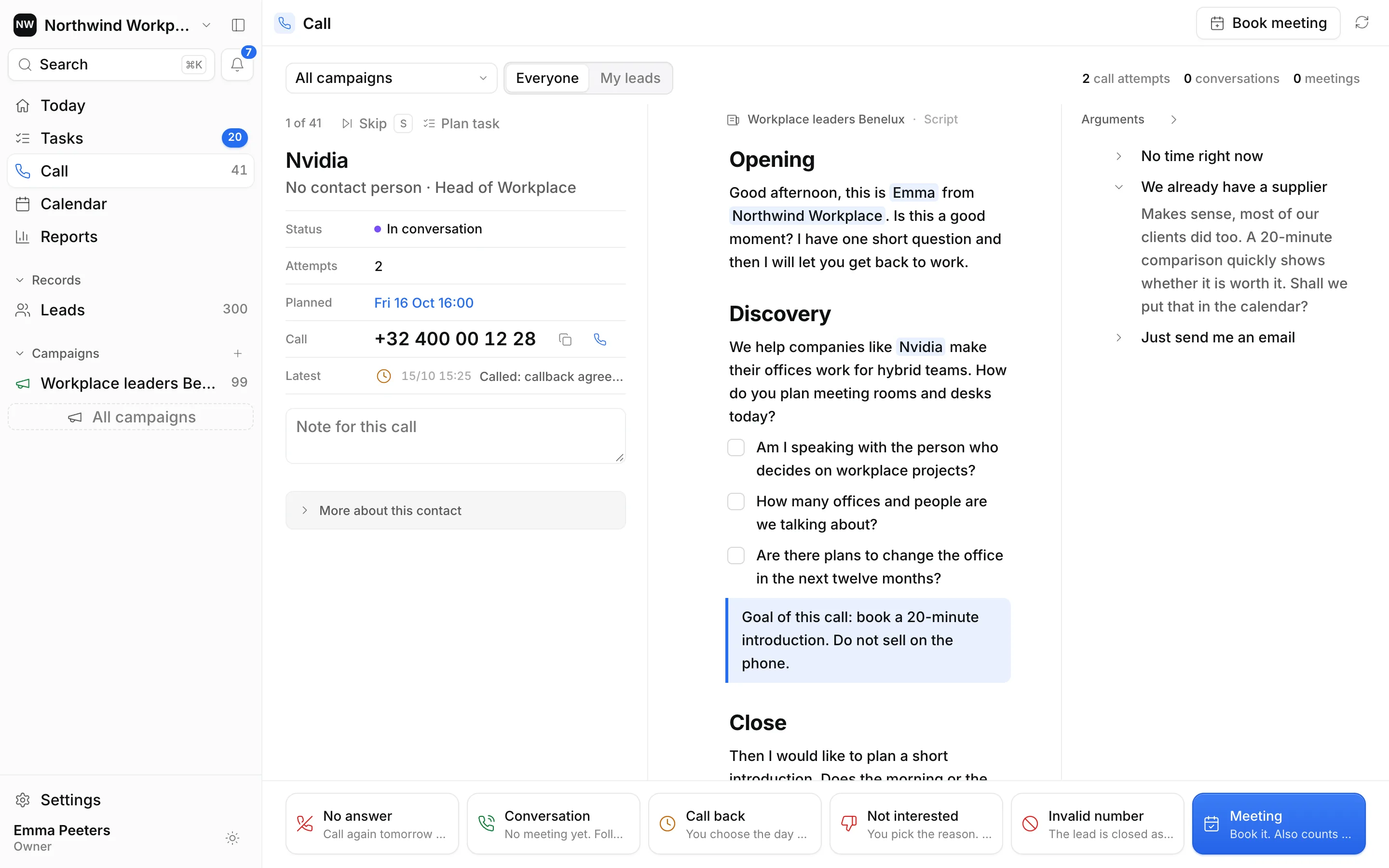
The lead on the left, the script in the middle with the company name and your own name filled in. Click the number to call from your own phone.
In this industry: Put the questions about current challenges, recent changes, earlier advisers and the decision process in the script, so a junior caller can open the conversation the way a partner would.
The answer to every objection
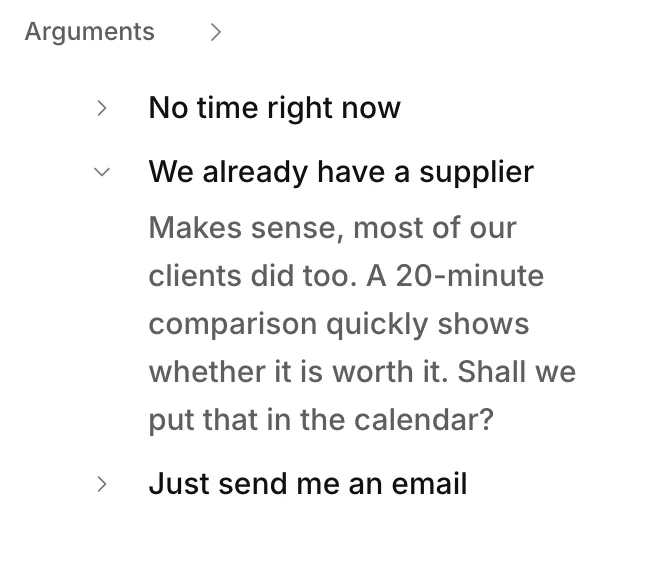
Common objections sit in a panel next to the script, so the right answer is one click away.
In this industry: Keep the answers to "we work with a big firm", "we do this ourselves" and "not this year" next to the script, so a caller asks about timing and budget instead of ending the call.
One key per call, the next step planned
N (not reached) plans a new attempt the next working day, G (conversation) a follow-up call in three days, T (call back) the moment you pick. A records a meeting; X (not interested, with a reason) and O (invalid number) close the lead.
In this industry: Executives are hard to reach. N plans the next attempt for the next working day, T lets you call back at the moment their assistant names, and X with a reason shows why companies say no.

Follow-up on every channel
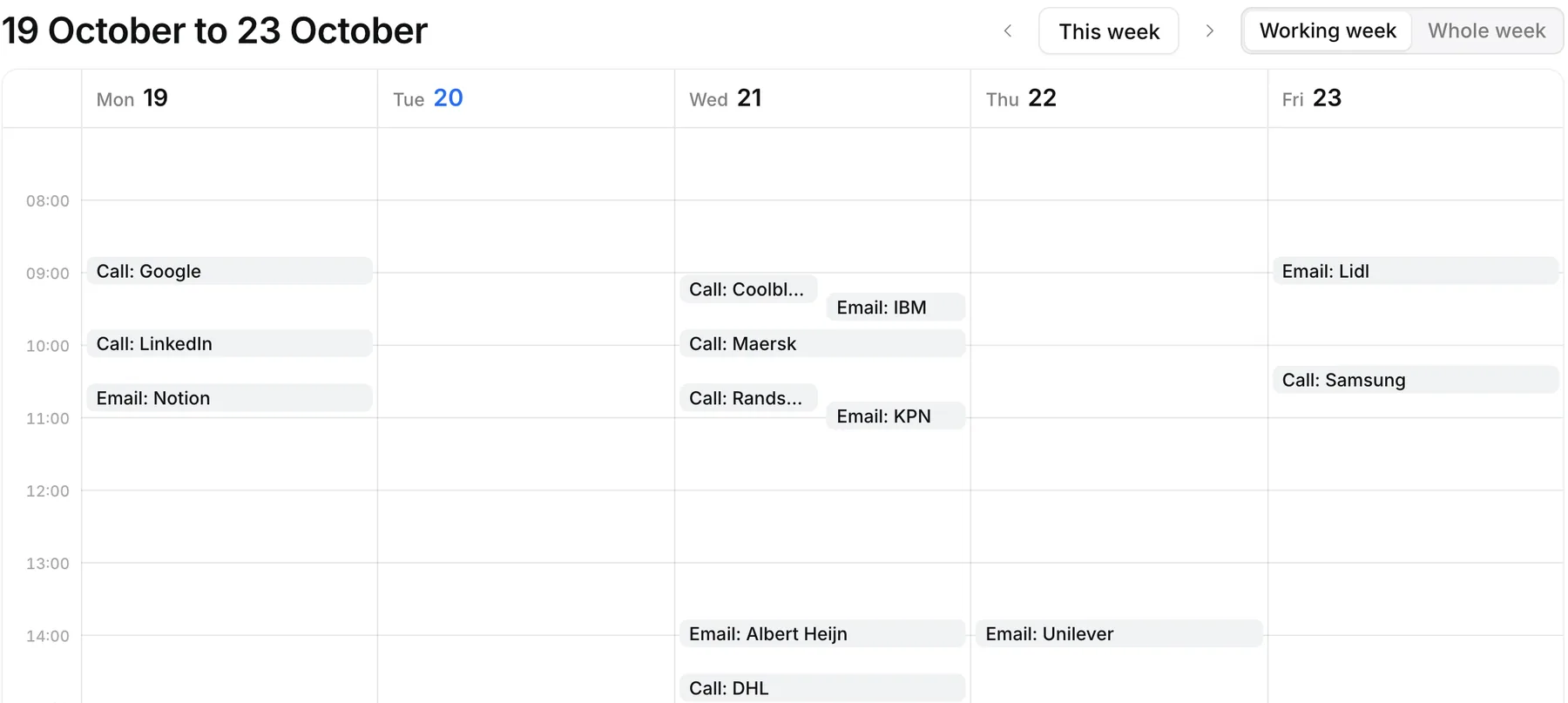
Calls and emails land in your week. You write emails in Ringlane and send them from your own Gmail; LinkedIn and WhatsApp you send yourself and log by hand. The Today view puts overdue call-backs first.
In this industry: After a conversation, send a short note or a relevant article from your own Gmail and see it next to the call history, then plan the next call around the moment they mentioned.
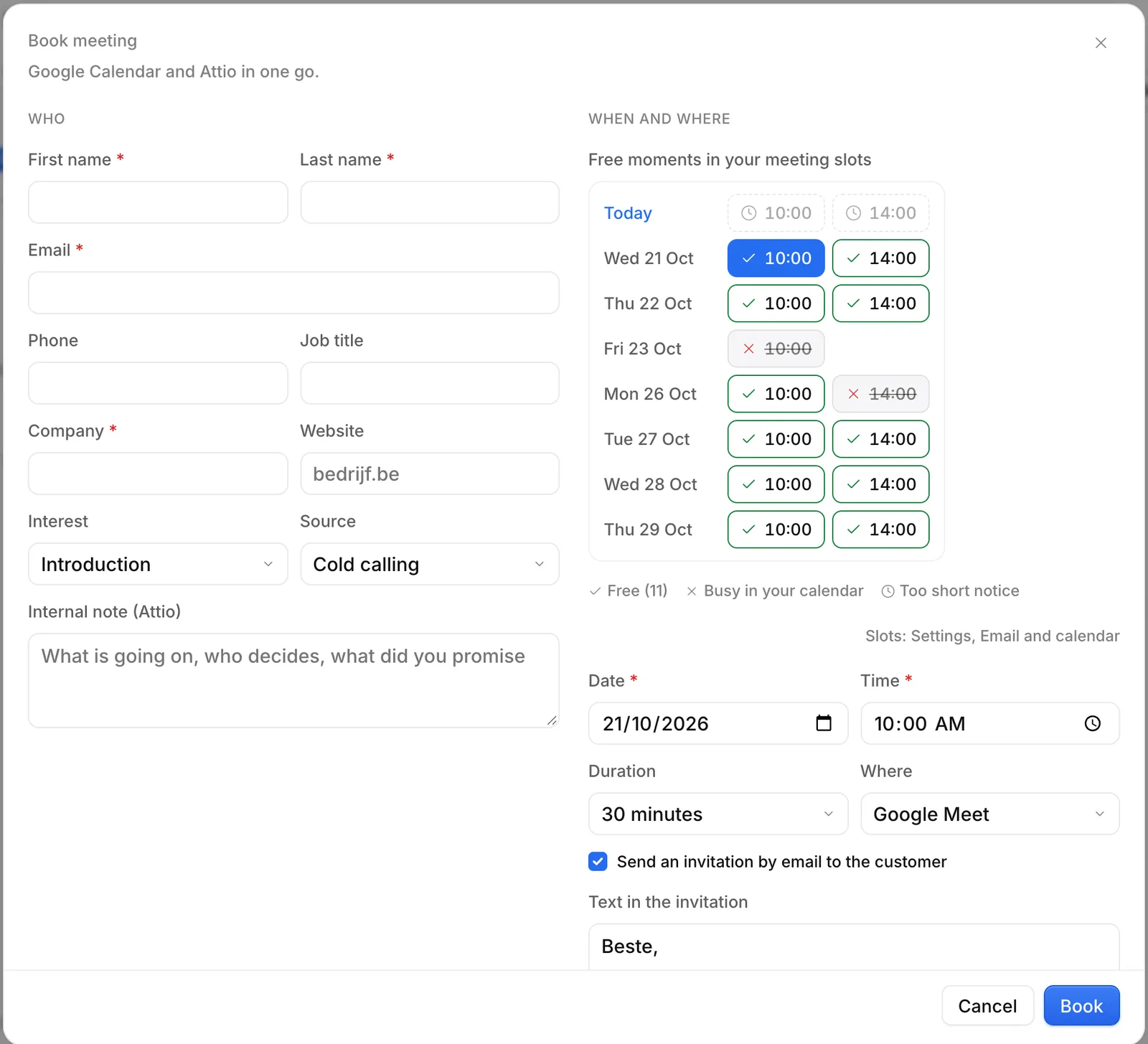
Book while they are on the line
Ringlane shows your free moments in Google Calendar, adds a Google Meet link and sends the invitation. Booked meetings go to Attio.
In this industry: When a director agrees to an exploratory meeting, book it in Google Calendar with a Meet link and an invitation while they are on the line, and the meeting goes to Attio.
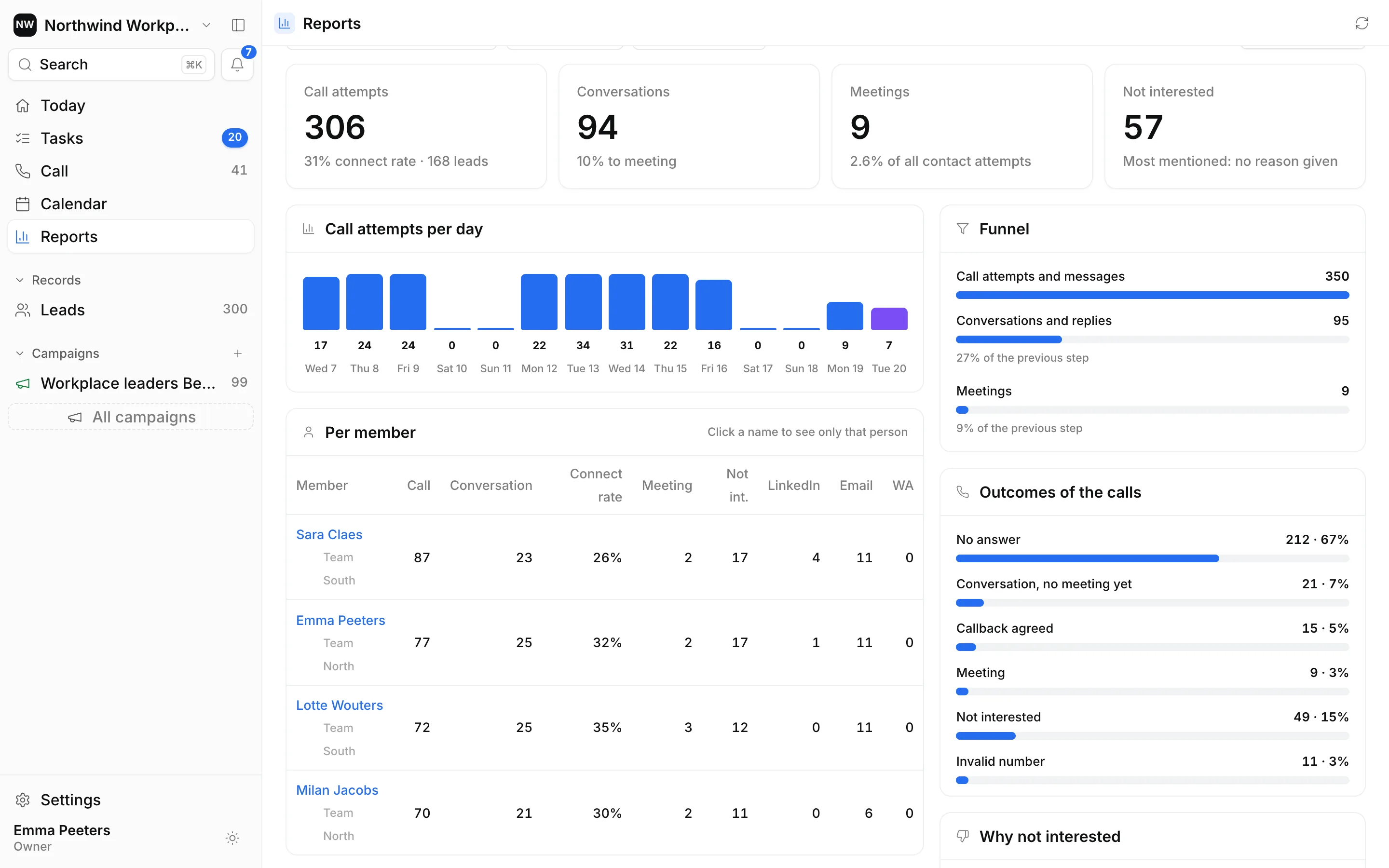
Your numbers, per caller and campaign
Call attempts, connect rate, conversations, meetings, the funnel and the reasons for "not interested", per person, team and campaign.
In this industry: Compare campaigns per offer and per caller or partner, and read the reasons for not interested to see whether it is timing, budget or the offer itself.
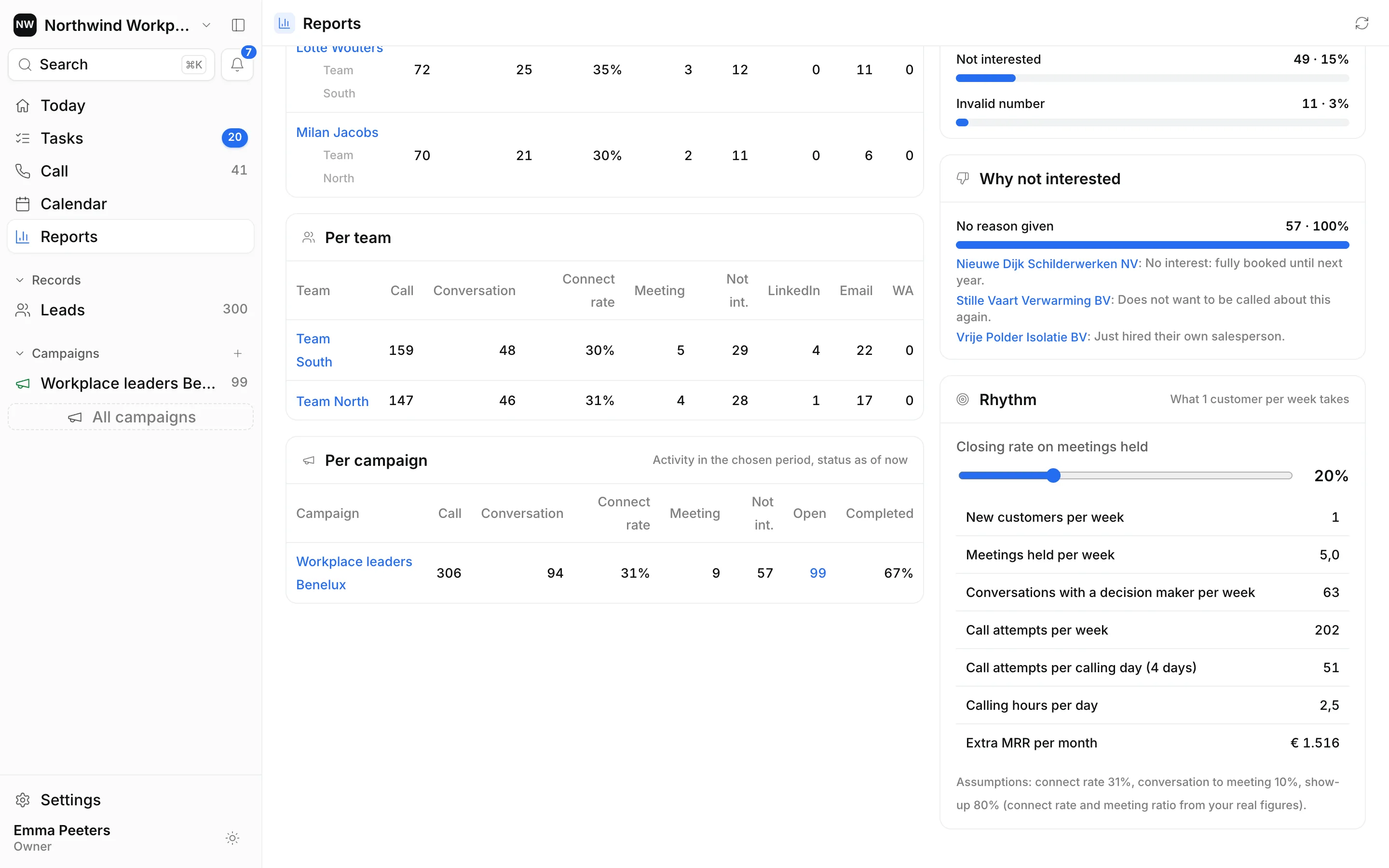
What one new customer takes
Based on your own rates, Ringlane calculates how many calls per week and per day one new customer per week takes.
In this industry: Fill in your own rates and see how many calls per week one new client per week takes, or translate it to one new client per month for a smaller firm.
Real screens from the Ringlane app with demo data. No affiliation with the companies shown.
What it can bring you: efficiency, money and more
One new client can mean a series of assignments. The table below is an example with assumed numbers, not a forecast. It assumes one caller with 400 call attempts a month for the partners, and a first assignment worth an assumed €40,000.
| Step (example, assumed rates) | Assumed rate | Per month |
|---|---|---|
| Call attempts | 400 | |
| Conversations with a decision maker | 15% of attempts | 60 |
| Exploratory meetings | 10% of conversations | 6 |
| New clients | 20% of meetings | 1 |
| Assumed value of a first assignment | €40,000 |
Your rates will differ, and with long cycles the client in the last row may sign months later. What you can measure is how many conversations turn into meetings per offer and per caller, and which reasons for not interested keep coming back.
Efficiency matters most for partners whose hours are billable. When each call ends with one key and the follow-up call is planned, nobody has to remember who said "call me after the summer". If logging and planning take a minute per call today, 400 calls is close to seven hours a month. Measure your own time before and after, read how to follow up a sales lead, and try the flow in the demo.
Frequently asked questions
Does cold calling work for consultants?
How many consultancy firms are there in Belgium and the Netherlands?
Who should a consultancy call?
When is a good moment to call a prospect?
Does Ringlane record or summarise calls?
Sources
- Eurostat: Enterprises by size class and NACE Rev.2 activity (sbs_sc_ovw), 2023
- Eurostat: Enterprises by detailed NACE Rev.2 activity and special aggregates (sbs_ovw_act), 2023
- Rijksoverheid: Rijksoverheid wordt efficiënter en effectiever, minder externe inhuur (20 May 2026)
- MarketScreener: Gartner Sales Survey Finds 61% of B2B Buyers Prefer a Rep-Free Buying Experience (Gartner press release, June 2025)
All industries
- Accounting firms
- Business events and venues
- Business finance
- Commercial cleaning
- Commercial real estate
- Commercial solar and energy
- Corporate catering
- Corporate training
- Fleet, leasing and EV charging
- HR and payroll services
- HVAC and building services
- Industrial manufacturing
- Insurance brokers
- IT services and MSPs
- Logistics and transport
- Marketing agencies
- Office furniture and workplace
- Printing and packaging
- Recruitment and staffing
- SaaS and software
- Security services
- Telecom and connectivity
- Wholesale and distribution
- Workwear and PPE