Cold calling in Groningen: from the city to Eemshaven and Delfzijl
For owners and sales managers who sell to companies in the province of Groningen: where the companies are, which sectors are large, and what to ask now that gas extraction has ended.
The province of Groningen had 71,980 business establishments on 1 January 2026 (CBS, provisional) and 601,286 inhabitants, 244,427 of them in the city of Groningen. Groningen Seaports handled a record 15.7 million tonnes in 2025. Gas extraction from the Groningen field ended for good on 19 April 2024.
- Professional, scientific and technical14,167
- Wholesale and retail trade11,222
- Health and social work8,626
- Construction7,833
- Arts, sport and recreation5,076
- Education4,435
B2B calling in Groningen means one large city and a long tail of smaller towns and port areas. The province had 71,980 business establishments on 1 January 2026 (CBS, provisional), and the city of Groningen held 244,427 of the province's 601,286 inhabitants. Outside the city, the ports of Eemshaven and Delfzijl handled a record 15.7 million tonnes in 2025. A good calling plan treats those as two different markets.
The economy of Groningen
Groningen is a service economy with an industrial coast. In the Eurostat count of local units for 2024, professional, scientific and technical services lead with 14,167 units, followed by trade (11,222), health and social care (8,626) and construction (7,833). Health and social care is also the largest employer in that dataset, with 63,662 people working in it in 2024. Manufacturing counts fewer units (2,925) but still employs 19,578 people.
Three developments shape the province right now:
- The end of gas. Gas extraction from the Groningen field ended for good on 19 April 2024, when the act ending extraction took effect. Damage repair, reinforcement of homes and buildings, and the move to other energy sources keep construction and installation firms busy for years.
- The ports. Groningen Seaports reports 15.7 million tonnes handled in 2025, a record, with LNG making up about a third. It counted 7,595 direct and 6,508 indirect jobs in 2024.
- Knowledge and IT. The university, the university medical centre and the Zernike Campus make the city a centre for research, health and software. CBS counts 3,610 establishments in information and communication, 5.0% of the total and close to the national share of 5.3%.
Farming still matters too: CBS counts 3,610 establishments in agriculture, forestry and fishing, 5.0% of all establishments against 3.1% for the Netherlands as a whole.
Where the companies are
- City of Groningen. Head offices, IT and software firms, consultancies, accountants, healthcare organisations and education. Zernike Campus in the north of the city combines university research with start-ups and scale-ups.
- Eemshaven and Delfzijl (Eemsdelta). Chemistry, energy, data centres, port logistics and maritime services. Eemsdelta had 44,846 inhabitants on 1 January 2026, but the companies here are often larger than the town size suggests.
- The rest of the province. Construction and installation companies, agricultural businesses, food processing and local service firms, spread across the towns and villages of the countryside.
Build separate lists for the city and the coast. A software reseller and a port service provider will not use the same script.
Who to call and what to ask
In a province with many small firms, the owner usually decides. At port and industry companies, the decision is spread over more people.
- Owner or managing director at service firms, builders and installers.
- Operations or site manager at port, energy and industrial companies.
- Office or practice manager at healthcare organisations and professional firms.
- Purchasing or facility manager at larger organisations in the city.
Discovery questions that fit Groningen:
- How has the end of gas extraction changed your workload or your customers?
- Are you hiring at the moment, and how hard is it to find people in the region?
- Do you work mainly for customers in the north, or across the country?
- What projects around Eemshaven or Delfzijl are you involved in, or bidding for?
- Who besides you is involved when you choose a supplier for this?
For a structure that turns these questions into a call, read how to write a cold calling script.
Calling in Groningen
Business in Groningen is done in Dutch. You will hear the regional accent and sometimes Gronings, but calls and proposals are in standard Dutch. At international companies on the campus and in the port, English is common. Say why you call in one sentence and ask a real question; owners of small firms often answer the phone themselves and have little time.
Places to learn about the local market and meet owners:
- VNO-NCW MKB Noord, the employers' and entrepreneurs' organisation for Groningen, Friesland and Drenthe, which got a new director on 1 September 2026.
- NOM, the investment and development agency for the Northern Netherlands, with a focus on sectors such as energy, agri and food, and maritime.
- KVK events and local business clubs in the city and in the Eemsdelta.
You may call Dutch companies with legal personality, such as a BV or NV, without prior consent. Since 1 July 2026 you need prior consent for sales calls to sole traders and partnerships such as a vof, and you must honour objections and handle contacts' personal data under the GDPR. This is general information, not legal advice. Read the cold calling rules for Belgium and the Netherlands for the basics.
A first week of calling in Groningen
- Day 1: the list. Pick one segment, for example installers in the countryside or IT firms in the city. Filter out one-person businesses: since 1 July 2026 you need their prior consent for a sales call. Use an ideal customer profile to decide.
- Day 2: the script. Write one opening that names a local reason to talk, and the five questions above.
- Days 3 to 4: calling blocks. Two blocks of 90 minutes per day. Builders and installers are easier to reach early in the morning; office-based firms later in the morning.
- Day 5: follow-up. Send what you promised, plan every call back and read your notes for patterns.
Want to see the calling screen first? Try the demo.
One calling workspace for teams in Groningen
Real screens from the app. Call from your own phone, log every call with one key and see your numbers per caller and campaign.
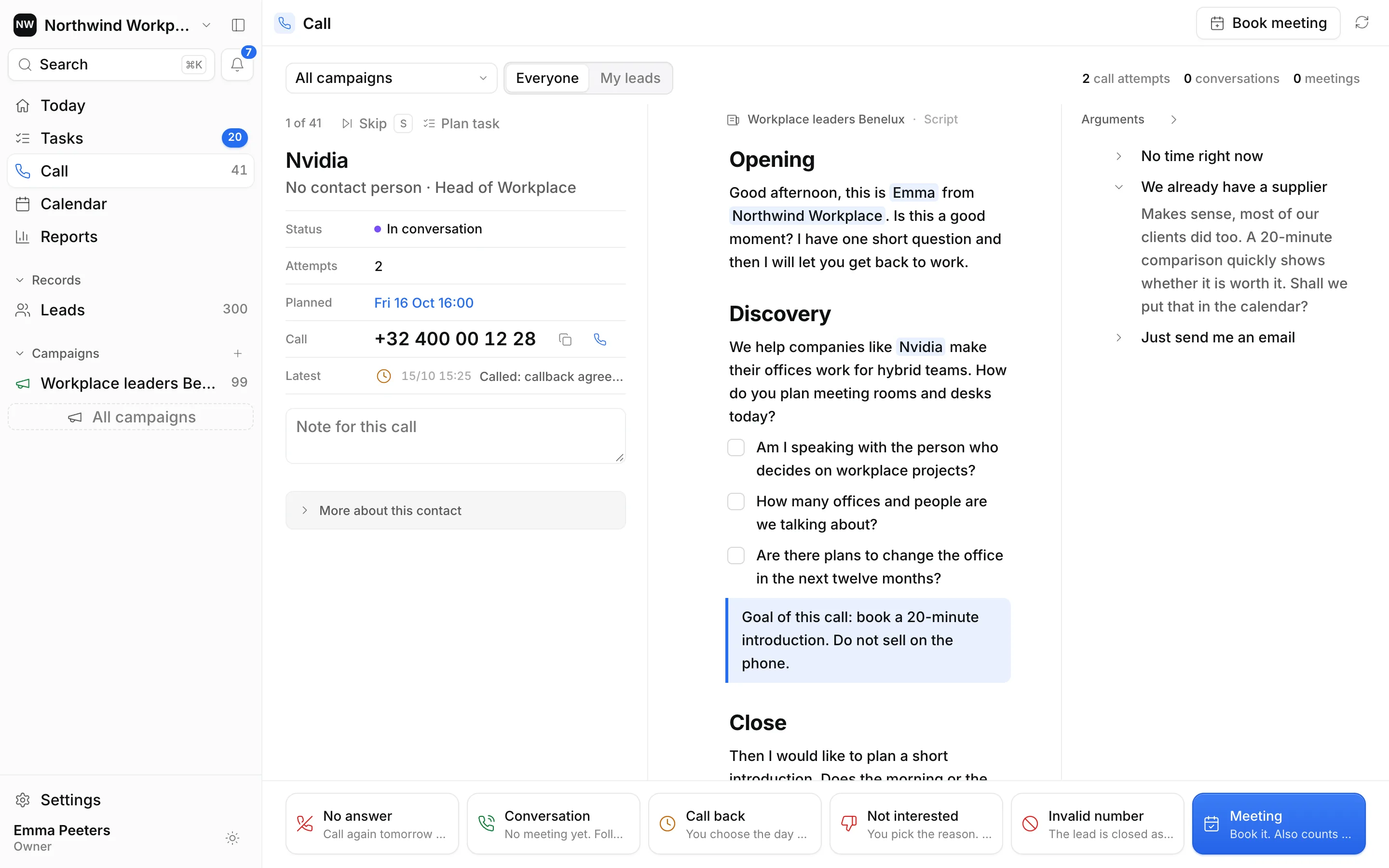
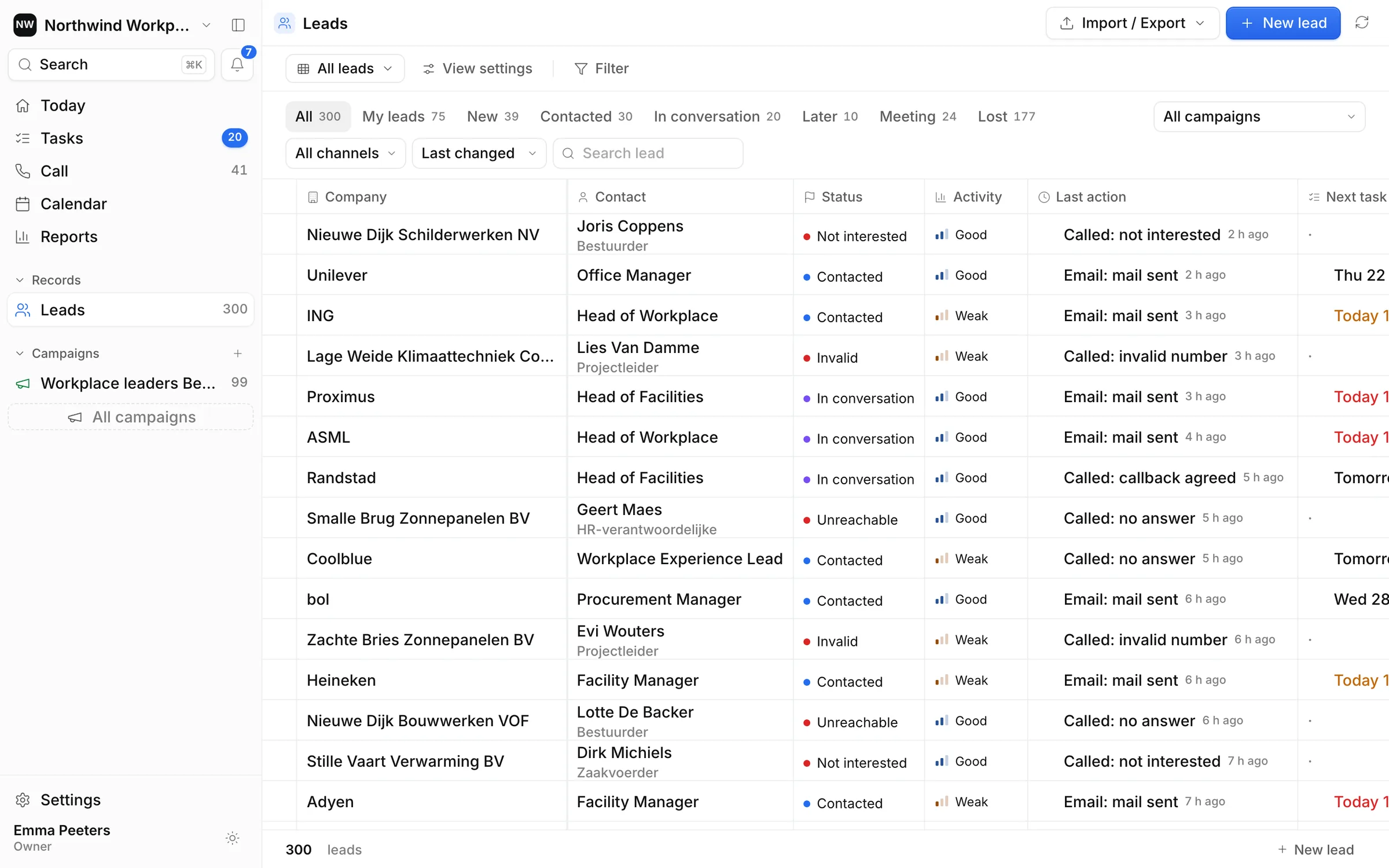
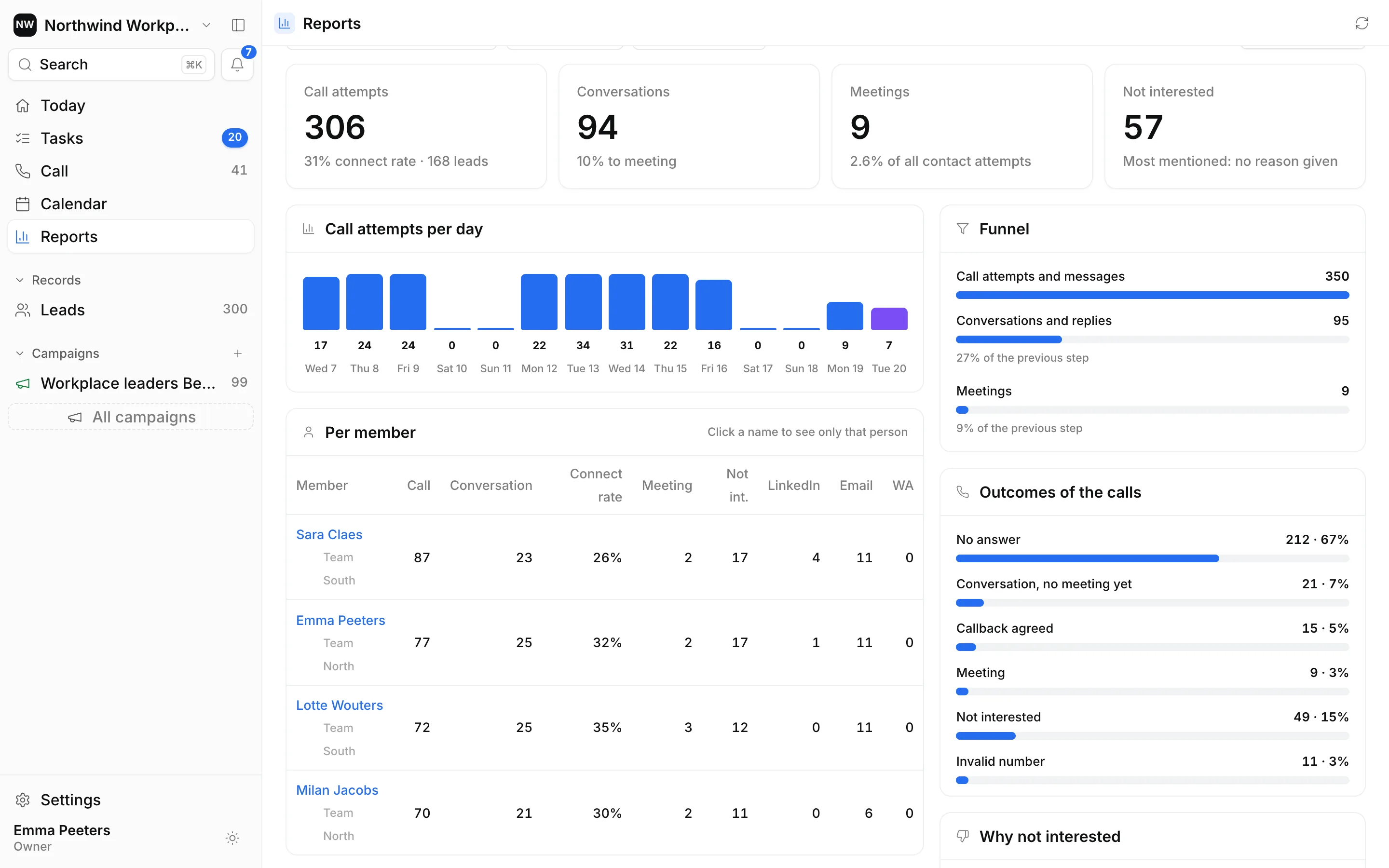
Real screens from the Ringlane app with demo data. No affiliation with the companies shown.
Industries to call in Groningen
Win managed service contracts with calls you plan and follow up
How IT service providers and MSPs in Belgium and the Netherlands can call SMEs, time the call around NIS2 and contract ends, and follow up every lead.
HVAC and building servicesReach building owners before their old system or a new rule forces a choice
How HVAC installers in Belgium and the Netherlands can call facility managers, time calls around label C, F-gas rules and old systems, and follow up every lead.
Logistics and transportFill your trucks and warehouses with shippers you called yourself
How hauliers, forwarders and 3PLs in Belgium and the Netherlands can call shippers, time the call around tenders and follow up every lead on schedule.
Frequently asked questions
How many companies are there in the province of Groningen?
Where are most companies in Groningen located?
What does the end of gas extraction mean for B2B sales in Groningen?
Which language should I use when calling companies in Groningen?
Is cold calling businesses in Groningen allowed?
Sources
- CBS StatLine: Vestigingen van bedrijven; bedrijfstak, regio (table 81578NED), 1 January 2026
- CBS StatLine: Bevolking op 1 januari; geslacht, leeftijd en regio (table 03759ned), 1 January 2026
- Eurostat: Enterprises by NUTS 2 region and NACE Rev. 2 activity (sbs_r_nuts2021), 2024
- Groningen Seaports: annual report 2025, summary
- Energietransitie.nl: Gaswinning Groningen (end of extraction on 19 April 2024)
- NOM, investment and development agency for the Northern Netherlands
- Dutch IT Channel: Anna Noorda appointed director of VNO-NCW MKB Noord (13 August 2026)
- ACM: Vanaf 1 juli strengere regels voor telemarketing (June 2026)