Cold calling in Ghent and East Flanders: port, industry and tech
East Flanders combines heavy industry in the Ghent port with one of the busiest IT and services scenes in Belgium, and a ring of family firms from Aalst to the Flemish Ardennes. Here is who to call and what to ask.
East Flanders had 1,586,436 residents on 1 January 2025 and a GDP of 78.3 billion euro in 2024 (Eurostat). The Ghent part of North Sea Port handled just over 31 million tonnes in 2025, 6% more than in 2024 (Statistiek Vlaanderen). Volvo Car Gent, the last car plant in Belgium, built more than 186,000 cars in 2024 (Volvo Cars).
- Professional, scientific and technical30,204
- Construction22,017
- Wholesale and retail trade20,927
- Administrative and support services9,726
- Health and social work9,075
- Information and communication7,844
B2B calling in East Flanders means working two very different markets from one base: heavy industry in the Ghent port, and a dense layer of service and tech firms in and around Ghent. The province had 1,586,436 residents on 1 January 2025 and a GDP of 78.3 billion euro in 2024, according to Eurostat. The Ghent part of North Sea Port handled just over 31 million tonnes in 2025, 6% more than a year earlier. Choose your market first, then your list.
The economy of East Flanders
The port of Ghent is the industrial heart. Since the merger with Vlissingen and Terneuzen it is part of North Sea Port, a port that crosses the Dutch border. Two plants dominate the canal zone. Volvo Car Gent, the only car plant left in Belgium, built more than 186,000 cars in 2024 and expected the EX30, whose production started in April 2025, to bring its workforce to almost 6,600. The steelworks on the canal is the other anchor.
The Eurostat business statistics for 2024 show the weight of that industry. Car and trailer production employs 11,849 people in East Flanders, more than in the other four Flemish provinces combined. Basic metals employ 6,628. Food production is the largest industrial employer with 17,725 people in 1,270 local units. Textiles, the historic trade of Ghent and the Flemish Ardennes, still employs 3,576 people.
The service side is just as large. Professional, scientific and technical services count 30,204 local units, construction 22,017 and trade 20,927. IT services have 5,791 local units with 16,901 jobs, the third largest IT cluster among the Flemish provinces after Antwerp and Flemish Brabant. Engineering and architecture firms count 5,250 local units. Staffing agencies employ 36,244 people, a sign of how much the port and the plants rely on flexible labour.
The chart above counts local units in Eurostat's structural business statistics for 2024. That dataset leaves out agriculture and public administration, so farms and growers are not counted in it.
Where the companies are
- Ghent: the port and canal zone for industry and logistics; the city and the ring for IT firms, agencies, consultancies and the university spin-offs around the science parks.
- Aalst and the Dender valley: food, logistics and services, with good links to Brussels.
- Sint-Niklaas and the Waasland: manufacturing, distribution along the E17 and many family firms; part of the Antwerp-Waasland chamber.
- Lokeren and Dendermonde: logistics and mid-sized industry between Ghent, Antwerp and Brussels.
- Oudenaarde and Ronse: the Flemish Ardennes, with textile and industrial firms, close to the language border.
- Eeklo and the Meetjesland: agri-food, builders and small industry in the north-west.
Who to call and what to ask
In the port and at the large plants, suppliers deal with procurement, maintenance and facility managers, and a plant or site manager signs larger projects. Many smaller suppliers around those plants are owner-led and buy quickly when it helps them win or keep a contract with a big customer. In Ghent's tech and services scene, call the founder or managing partner at firms under 50 people, and the head of operations or the CFO above that.
Questions that fit East Flanders:
- How much of your revenue depends on one or two large customers in the port?
- What changed when your largest customer changed its production plans?
- Where does your team lose time on work that does not bill?
- Are you finding the people you need, or do you rely on agencies?
- When do you plan your budget for next year, and who sits at the table?
Pick your hours with care, because plant staff and office staff answer at different times. Our guide on the best time to cold call covers the patterns.
Calling in East Flanders: practical notes
- Language. Call in Dutch. Tech firms and international groups often work in English internally. Around Ronse, on the language border, French is common; follow the language of the person who answers.
- Two Voka chambers. Voka East Flanders covers Ghent, Aalst, Oudenaarde and Eeklo. The Waasland around Sint-Niklaas belongs to Voka Antwerp-Waasland. The Voka chambers together unite more than 18,000 businesses; their events are where owners meet and discuss the local agenda.
- UNIZO has local branches for smaller firms and the self-employed across the province.
- Cross-border. North Sea Port links Ghent with Zeeland. If you sell to port firms, expect some buyers to sit in Terneuzen or Vlissingen, with Dutch habits and Dutch rules.
- Rules. Calling businesses is allowed in both countries, but the rules differ: in Belgium the Bel-me-niet-meer list also covers business numbers, and in the Netherlands sole traders and partnerships need to have given prior consent since 1 July 2026. See our summary of the cold calling rules in Belgium and the Netherlands; it is general information, not legal advice.
A first week of calling in East Flanders
- Day 1: one list. Either suppliers in the Ghent canal zone, or IT and service firms in Ghent. Not a mix.
- Day 2: a short script with two questions from above and one ask for a meeting.
- Days 3 and 4: two calling blocks a day. Early for industry, mid-morning for offices.
- Day 5: follow-up and numbers. Plan each call back and count how many calls it took to get one conversation.
Our guide on how many calls it takes to win a customer helps you set a realistic weekly target. To see a calling block in Ringlane, open the demo.
One calling workspace for teams in East Flanders
Real screens from the app. Call from your own phone, log every call with one key and see your numbers per caller and campaign.
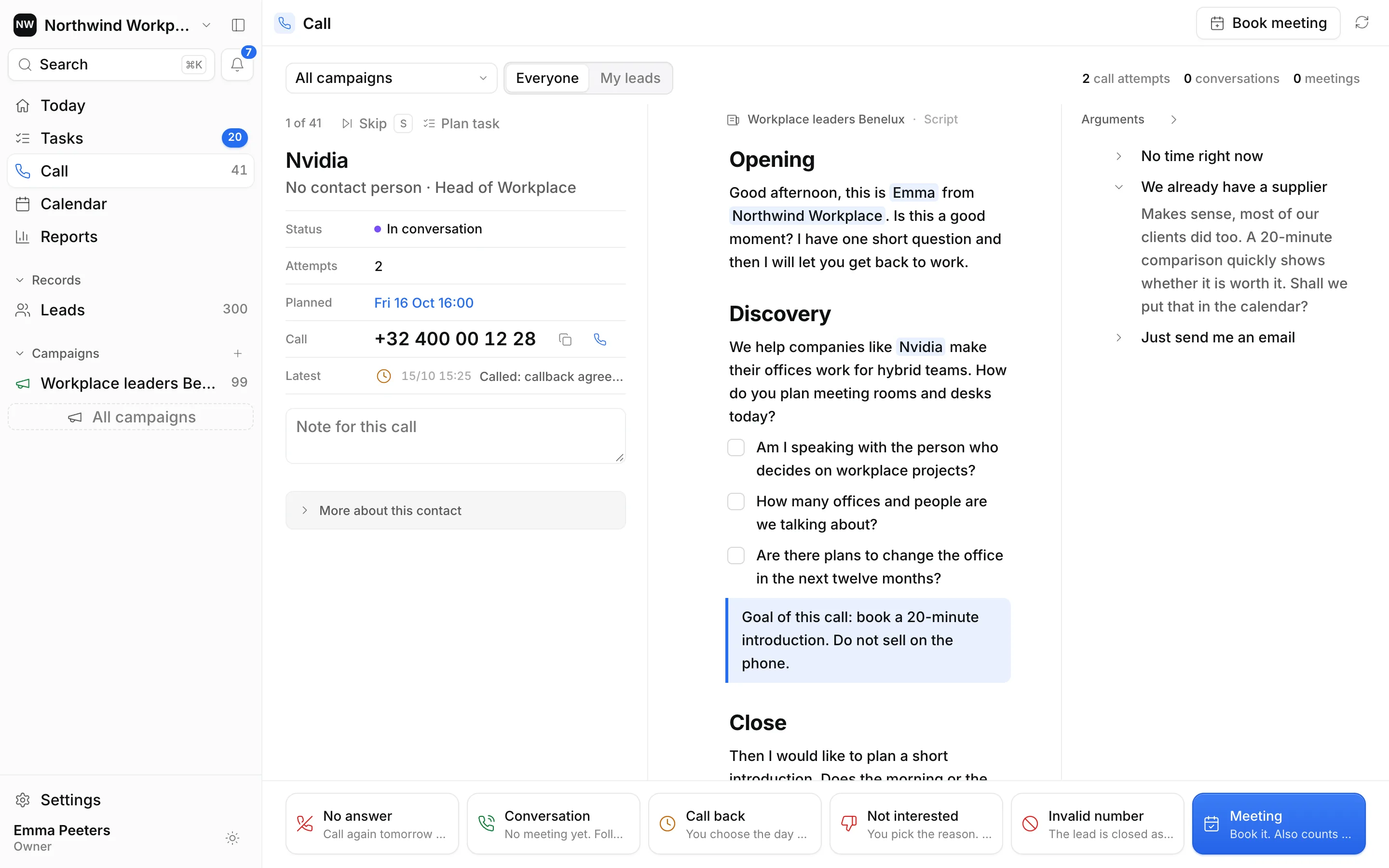
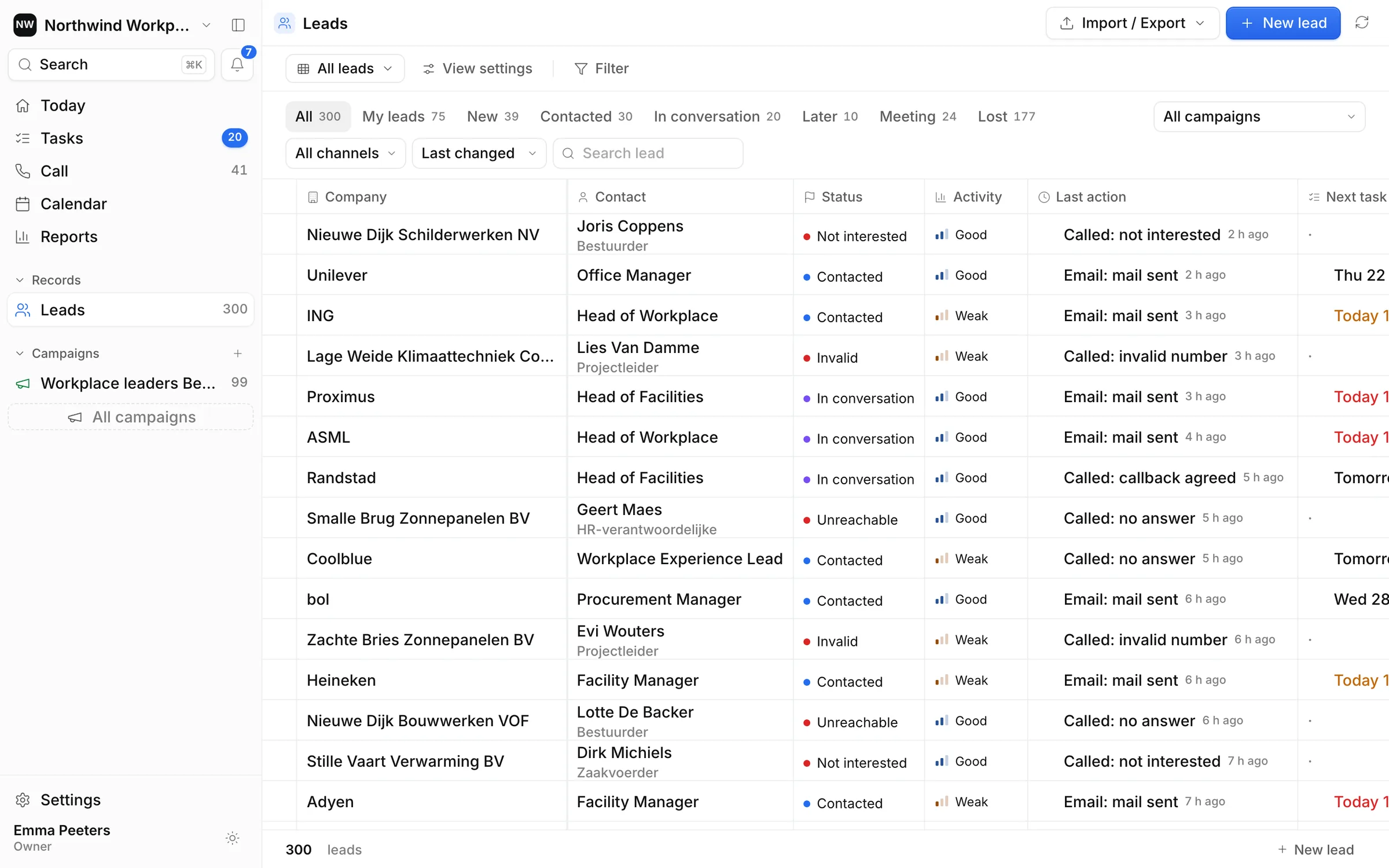
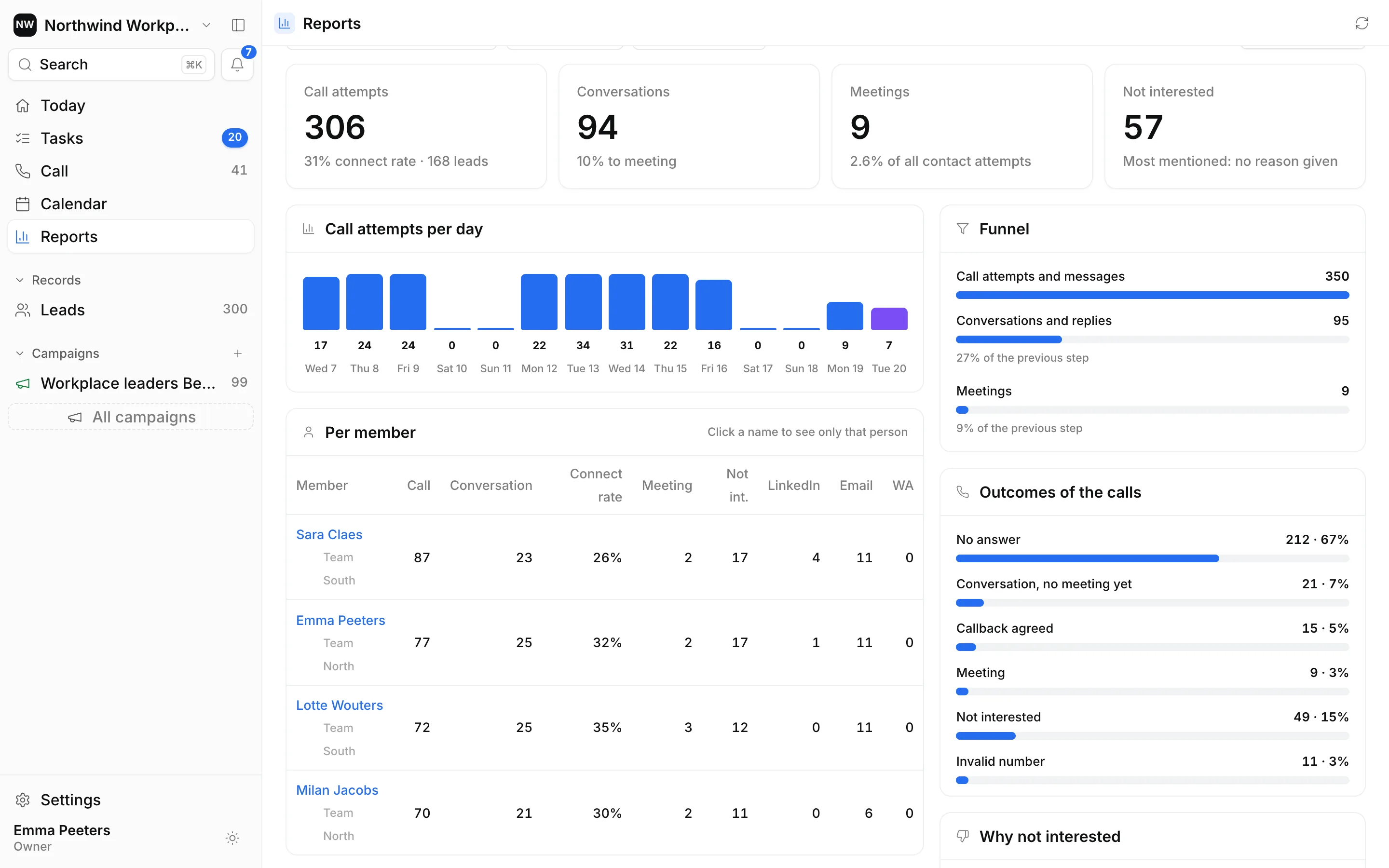
Real screens from the Ringlane app with demo data. No affiliation with the companies shown.
Industries to call in East Flanders
Get on the supplier list before the next project is quoted
How manufacturers and subcontractors in Belgium and the Netherlands can call buyers and engineers, get on the supplier list and follow up a long sales cycle.
IT services and MSPsWin managed service contracts with calls you plan and follow up
How IT service providers and MSPs in Belgium and the Netherlands can call SMEs, time the call around NIS2 and contract ends, and follow up every lead.
Recruitment and staffingWin new client companies with calls timed to their hiring needs
How recruitment and staffing agencies in Belgium and the Netherlands can call employers, time calls around hiring needs and new rules, and follow up every lead.
Frequently asked questions
Is cold calling a good way to win B2B customers in Ghent?
Which sectors are largest in East Flanders?
What is North Sea Port?
Which Voka chamber covers East Flanders?
In which language should I call companies in East Flanders?
Sources
- Eurostat: Enterprises and local units by NUTS 2 region and NACE Rev.2 activity (sbs_r_nuts2021)
- Eurostat: Population on 1 January by NUTS 2 region (demo_r_d2jan)
- Eurostat: Gross domestic product by NUTS 2 region (nama_10r_2gdp)
- Statistiek Vlaanderen: Zeehavens, goederentrafiek
- Volvo Cars: Production of the EX30 starts in Volvo Car Gent (press release, 25 April 2025)
- Voka: Oost-Vlaanderen
- Voka: Antwerpen-Waasland
- Voka: Organisation chart of the Voka chambers of commerce