Fill your event calendar with corporate clients you called yourself
For event agencies, venues and congress centres in Belgium and the Netherlands: who books corporate events, when a call lands, and how to follow up until the date is signed.
Every company with staff and clients holds events: a new year reception, a kick-off, a client day, a product launch, a training day off site. Most of them went somewhere last year and will go somewhere next year. New business for an event agency or a venue is about being the name they think of when they start looking, and that moment comes months before the event itself.
The market: many organisers, events in every company
The supply side is fragmented. Eurostat business statistics count 2,092 enterprises in Belgium and 1,552 in the Netherlands in 2023 whose main activity is organising conventions and trade shows (NACE 82.30). Most are very small. On 1 October 2026, CBS counted 1,790 Dutch businesses in this activity (provisional figures), of which 1,435 were one-person businesses and 70 had 10 or more people working. Venues, caterers, hotels and audiovisual companies sell into the same budgets.
The region is strong in international meetings. According to the 2024 ICCA ranking, the Netherlands hosted 295 international association meetings and kept eighth place in the world, with 94 in Amsterdam. The UIA, which counts differently, put Brussels first among cities in 2024 with 388 international meetings, about 7% of 8,859 worldwide. These rankings cover association congresses, not the company events most agencies and venues live on.
Companies also use events to learn. In the European training survey, Eurostat reports for 2020 that 36.9% of Belgian and 46.1% of Dutch enterprises with 10 or more persons employed used conferences, workshops, trade fairs or lectures as a form of staff training. That is a buyer group worth calling: HR and learning teams who need a room, a programme and a day that works.
Decisions follow the event. A small company often lets the owner or an office manager choose on trust and price. Larger companies compare several venues or agencies, ask for a proposal and involve marketing, HR and finance. Big conferences may go through purchasing with a formal request for proposals.
Who you call and what you ask
The people who book corporate events:
- Marketing or communication manager: client events, launches, trade fair presence.
- HR manager: staff parties, kick-offs, training days and team days.
- Office manager or executive assistant: shortlists venues and often makes the first call.
- Event manager: at larger companies and associations, owns the conference calendar.
- Owner or managing director: at smaller companies, the one who decides.
Trigger events that make the call relevant: an annual event that returns on a fixed date, a new marketing or HR manager, a merger or a new office, a product launch, a company anniversary, an event that disappointed last time, and a venue that closed or became too small.
Discovery questions that work in this sector:
- Which events do you organise every year, and when do you start looking for a place?
- How many guests do you expect, and what format do you have in mind?
- What went well last time, and what would you change?
- Who decides on the venue or agency, and who holds the budget?
- Which dates are fixed, and which can still move?
Event buyers plan in seasons, so timing matters: read the best time to cold call.
What slows a calling team down in this sector
- The familiar place. "We always go to the same venue" is common. The real question is whether it still fits the guest count and the goal.
- Long lead times. Big events are booked many months ahead. If you call when the date is close, the choice is already made.
- Several decision makers. The assistant who shortlists is rarely the one who signs. Marketing, HR and finance may all have a say.
- Seasonal peaks. The end of the year and the start of the year are busy for events and quiet for buying conversations.
- Price comparisons. Proposals are easy to compare per guest. A good conversation is about the goal of the event, not only the price.
How Ringlane works for event agencies and venues
Real screens from the app, with what each feature does in this industry.
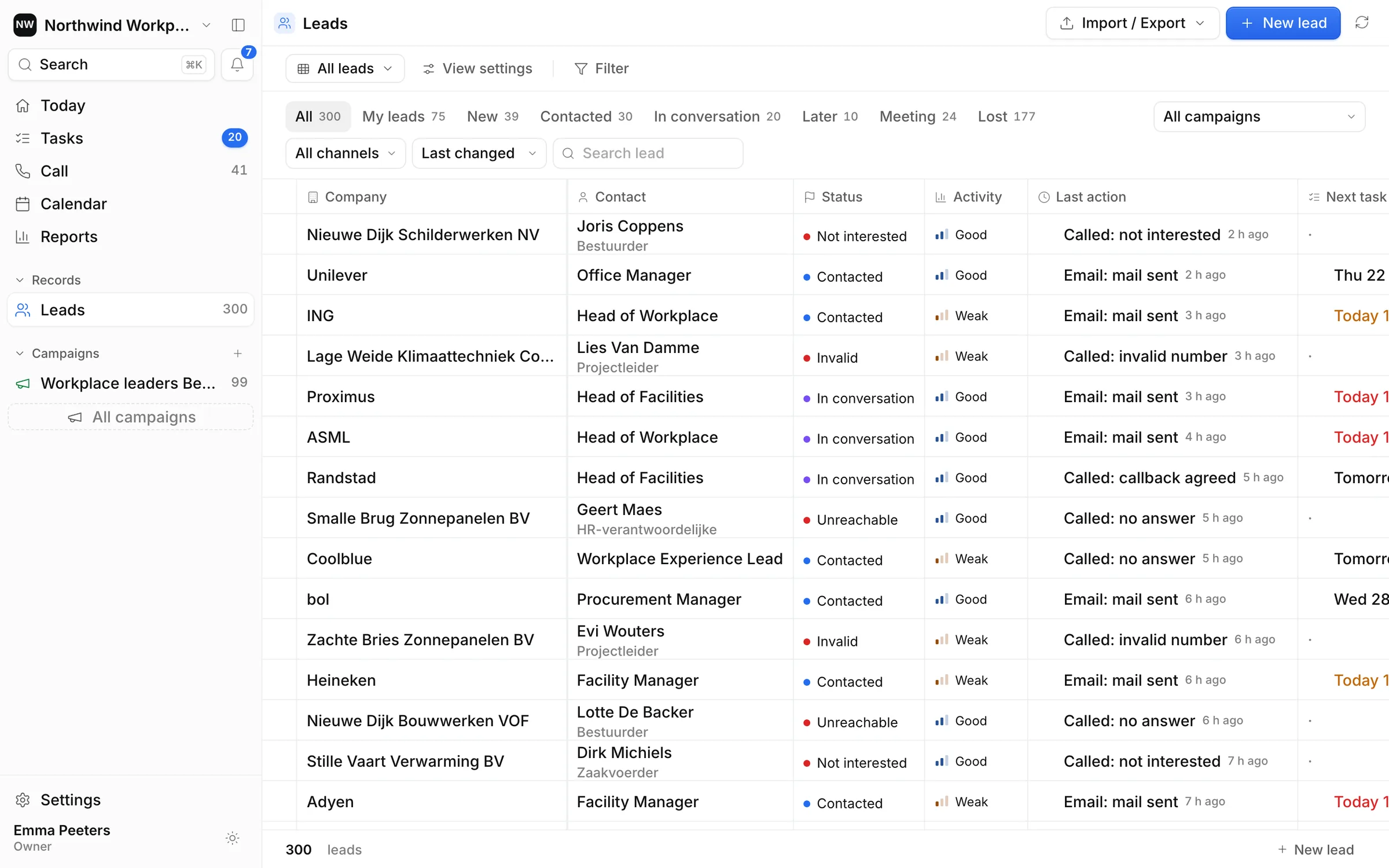
Your lists, in one place
Import Excel, CSV or a Bizzy export into a campaign. Every lead shows its status, last action and next task.
In this industry: Import a Bizzy export of companies by region and size into one campaign per event type, for example staff parties, product launches or conferences, so each caller works one clear list.
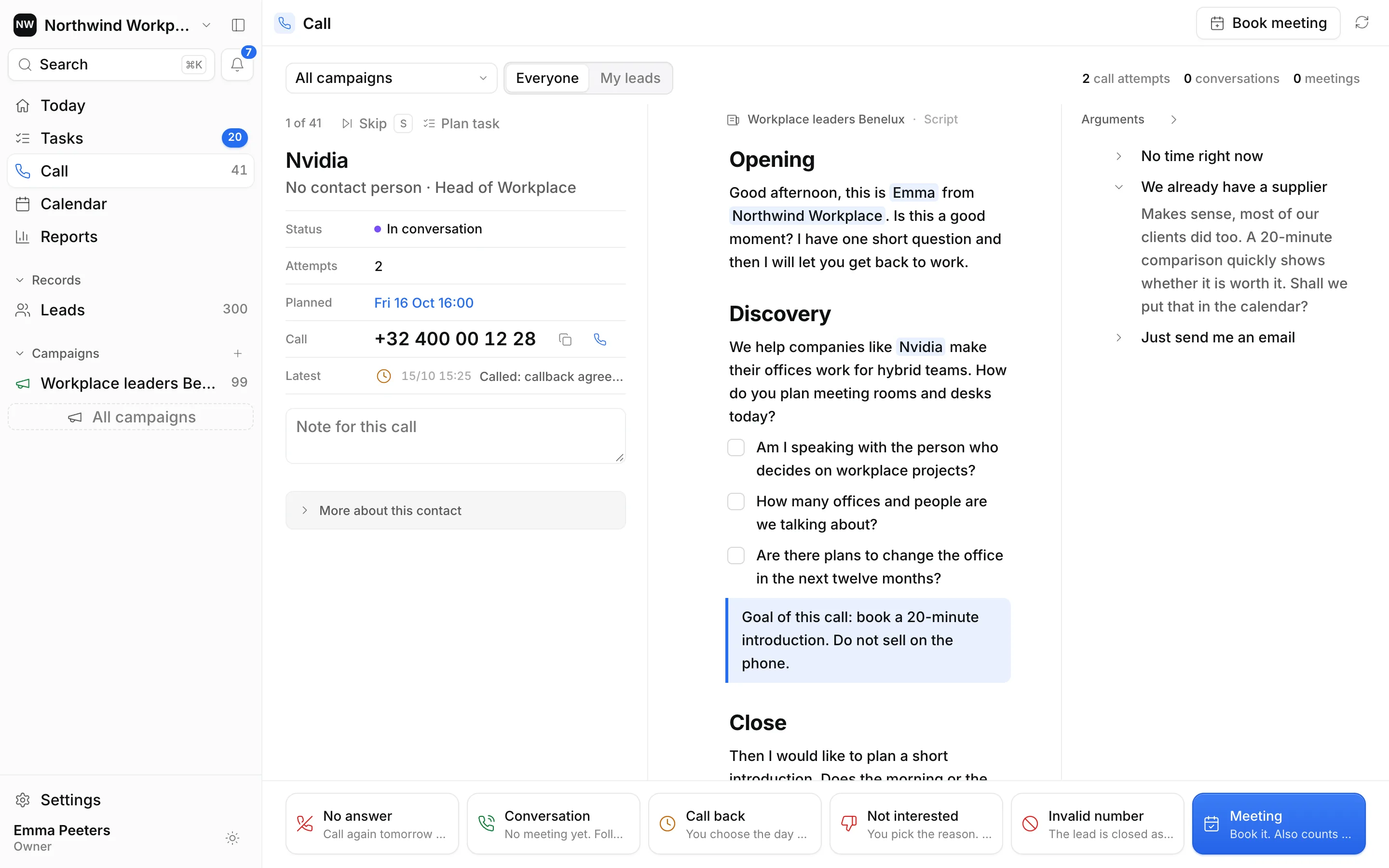
One screen for the call
The lead on the left, the script in the middle with the company name and your own name filled in. Click the number to call from your own phone.
In this industry: Put the questions about the next event, the number of guests, the date window and the budget owner in the script, so every caller asks them in every call.
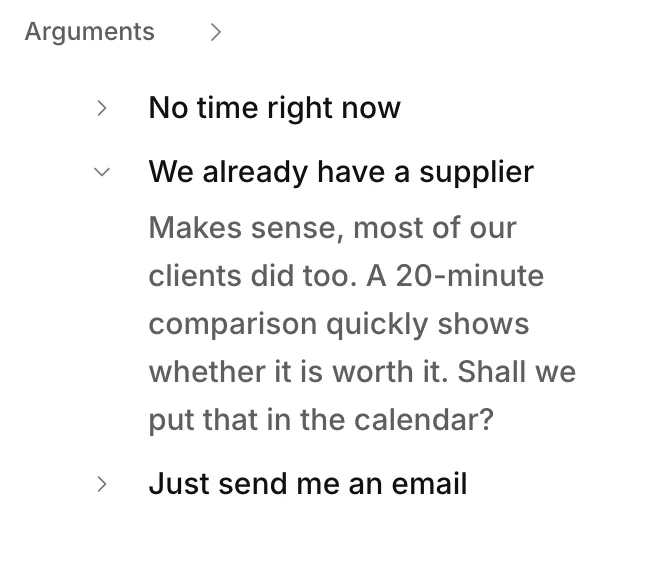
The answer to every objection
Common objections sit in a panel next to the script, so the right answer is one click away.
In this industry: Keep the answers to "we always go to the same place" and "we organise it ourselves" next to the script, so a caller can ask what went wrong last time instead of hanging up.
One key per call, the next step planned
N (not reached) plans a new attempt the next working day, G (conversation) a follow-up call in three days, T (call back) the moment you pick. A records a meeting; X (not interested, with a reason) and O (invalid number) close the lead.
In this industry: Event buyers are often assistants or marketing managers with full agendas. N plans a new attempt for the next working day, and T lets you call back at the moment they name.

Follow-up on every channel
Calls and emails land in your week. You write emails in Ringlane and send them from your own Gmail; LinkedIn and WhatsApp you send yourself and log by hand. The Today view puts overdue call-backs first.
In this industry: After a conversation, send floor plans, a sample programme or available dates from your own Gmail and see them next to the call history, so nobody sends the same brochure twice.
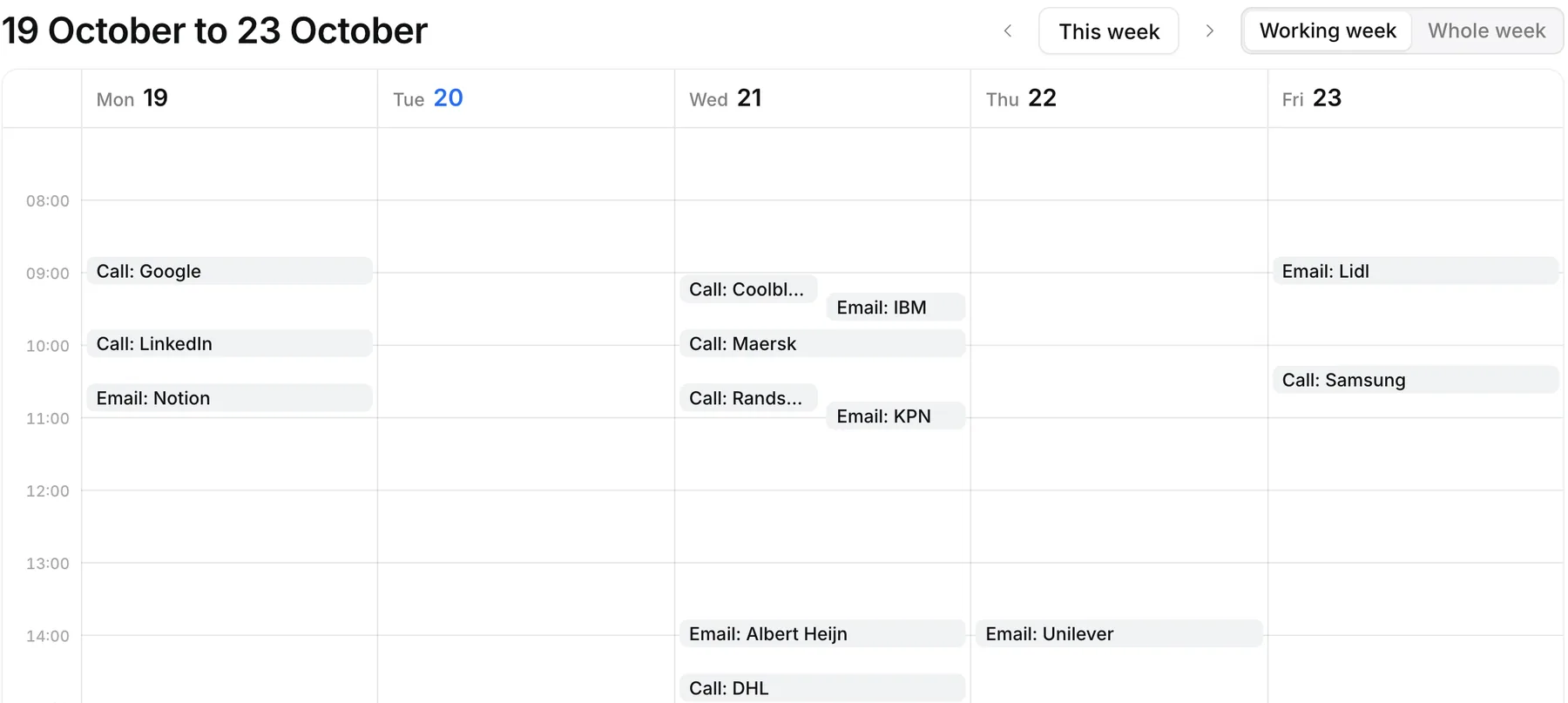
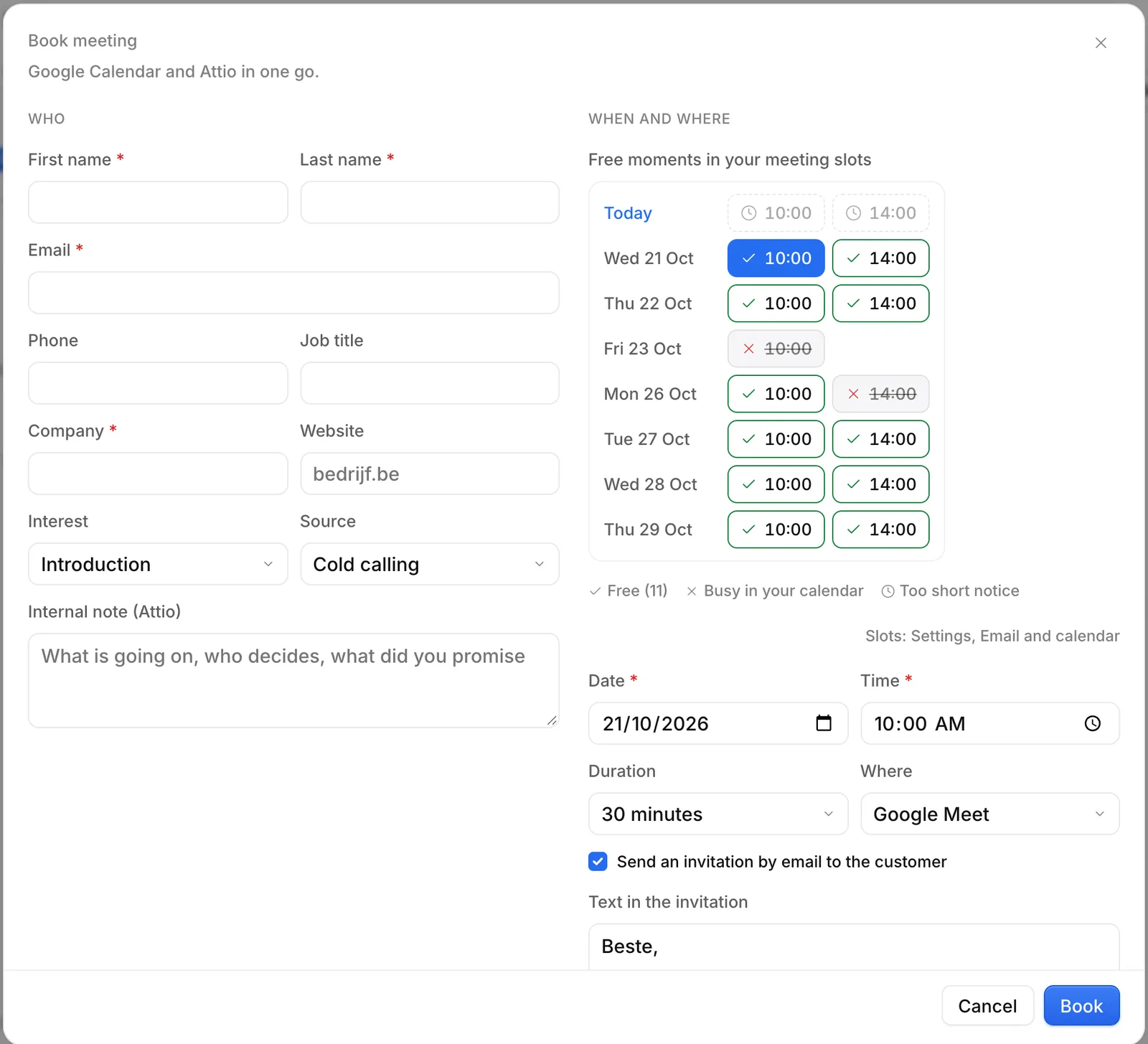
Book while they are on the line
Ringlane shows your free moments in Google Calendar, adds a Google Meet link and sends the invitation. Booked meetings go to Attio.
In this industry: When a buyer agrees to a site visit or a briefing, book it in Google Calendar with a Meet link while they are still on the line, then hand the meeting to Attio.
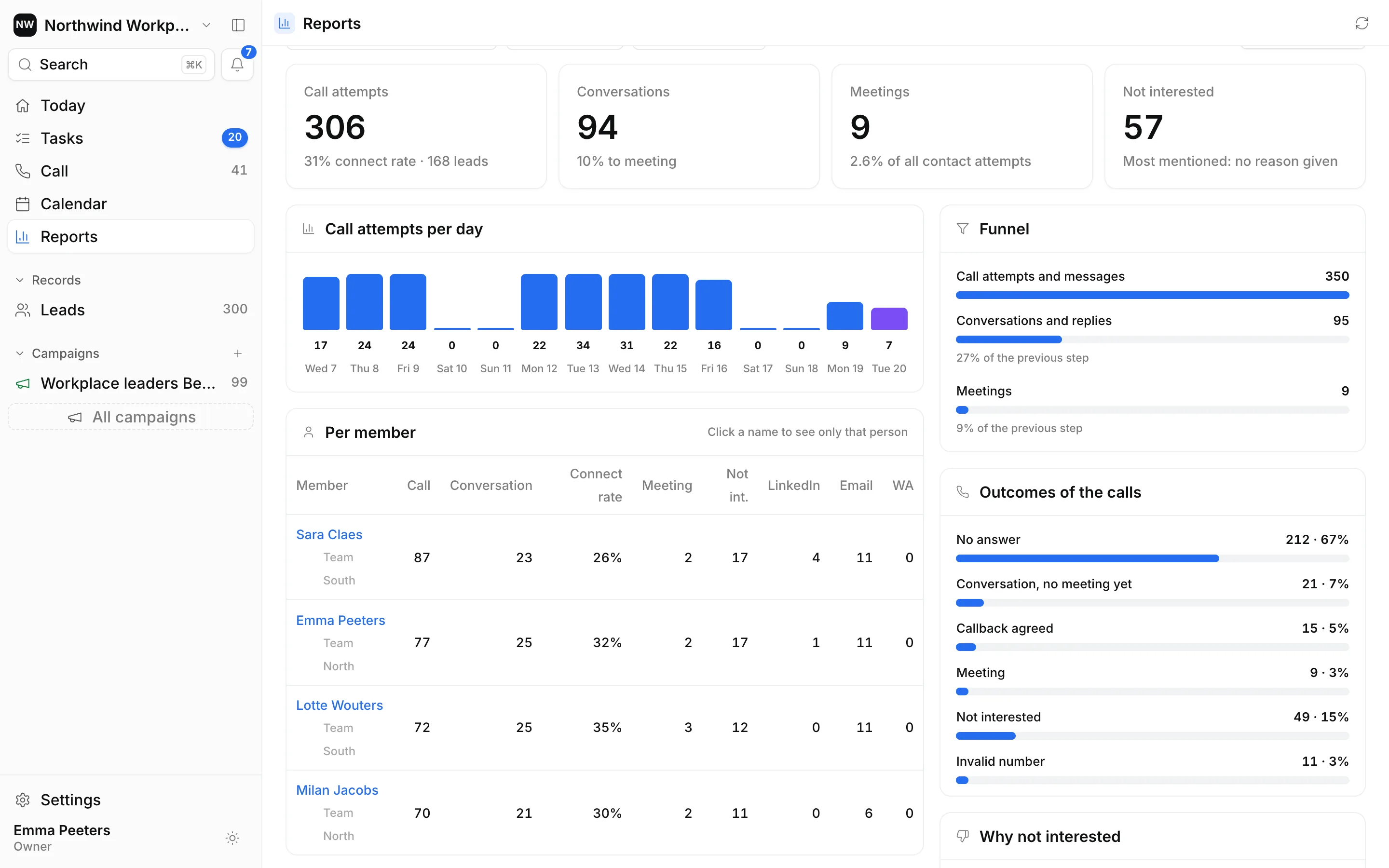
Your numbers, per caller and campaign
Call attempts, connect rate, conversations, meetings, the funnel and the reasons for "not interested", per person, team and campaign.
In this industry: Compare campaigns per event type and read the reasons for not interested, to see whether timing, budget or an existing venue blocks you most.
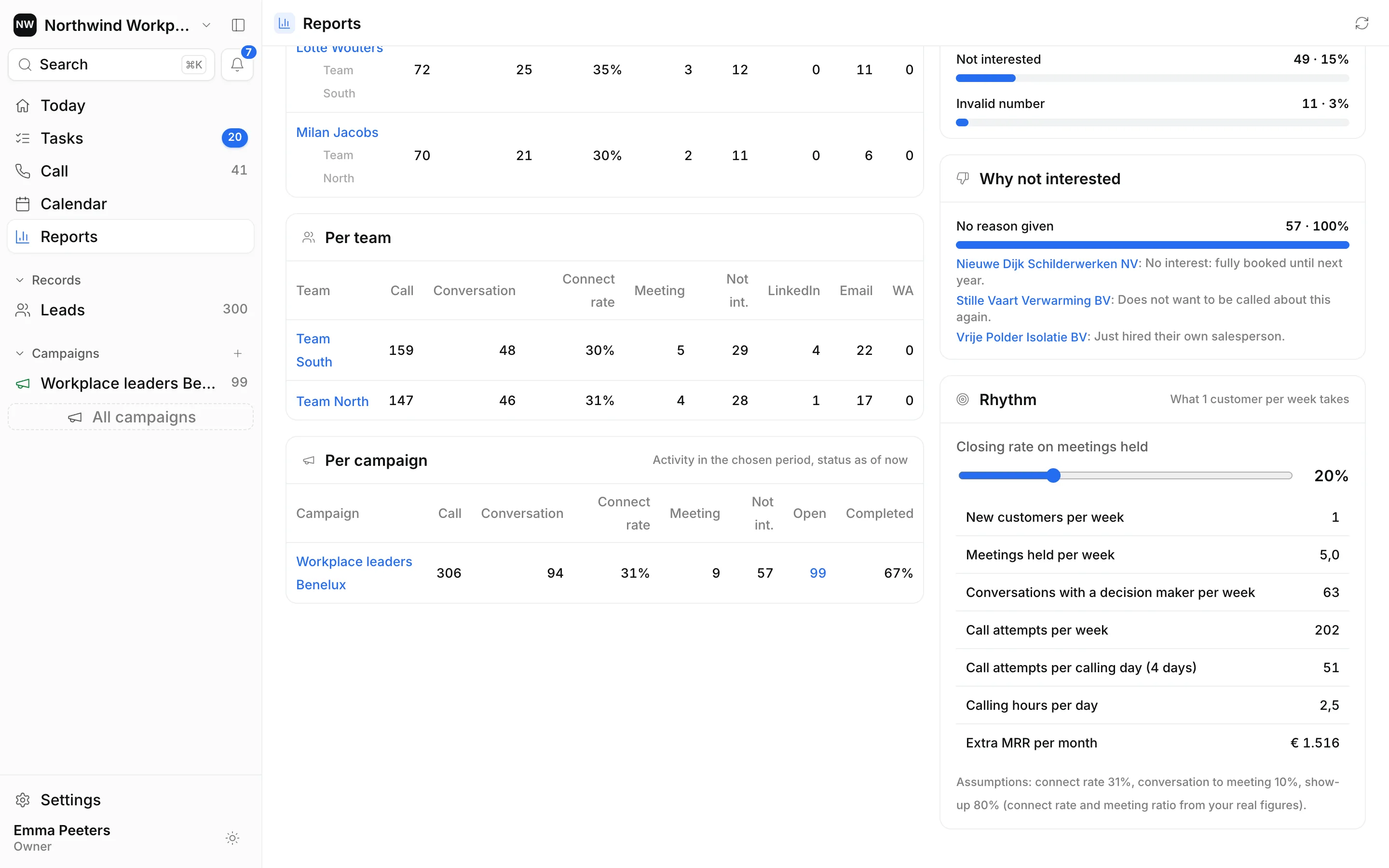
What one new customer takes
Based on your own rates, Ringlane calculates how many calls per week and per day one new customer per week takes.
In this industry: Fill in your own rates and see how many calls per week one new client per week takes, so you can plan the calling months before the busy event seasons.
Real screens from the Ringlane app with demo data. No affiliation with the companies shown.
What it can bring you: efficiency, money and more
For an event agency or venue, the measurable step is the site visit or briefing. What you can track is how many calls lead to a conversation, how many conversations to a visit, and how many visits to a signed event.
Example with assumed numbers: one caller, one month, and an assumed value of 15,000 euros for one corporate event. These are not benchmarks; replace them with your own figures.
| Step | Assumption | Result |
|---|---|---|
| Call attempts | 30 per day, 20 working days | 600 |
| Conversations | 18% of attempts | 108 |
| Site visits or briefings | 15% of conversations | 16 |
| Signed events | 1 in 4 visits | 4 |
| Value | 4 x 15,000 euros (assumed) | 60,000 euros |
Efficiency is something you can measure too. Time how long it takes today to note an outcome and plan the next step. If one key and an automatically planned follow-up save two minutes per attempt, 600 attempts save about 20 hours a month. Check that against your own week rather than taking it on trust.
The bigger gain is often in the follow-up. A buyer who said "call me in March about the summer event" is worth a lot if somebody calls in March. Read how to ask for the meeting and how to follow up sales leads, or try it yourself in the interactive demo.
Frequently asked questions
Does cold calling work for event agencies and venues?
Who books corporate events?
How big is the meetings market in Belgium and the Netherlands?
When is the best time to call about a corporate event?
Does Ringlane send brochures or reminders to prospects automatically?
Sources
- Eurostat: Enterprises by detailed NACE Rev.2 activity (sbs_ovw_act), NACE 82.30 Organisation of conventions and trade shows, 2023
- CBS StatLine: Bedrijven; bedrijfstak (81589NED), SBI 8230 Organisatie van congressen, beurzen, 4th quarter 2026, provisional
- I amsterdam: Amsterdam solidifies top position in 2024 ICCA ranking
- Travel Tomorrow: Brussels hosts more international meetings than any other city (UIA 2024 figures, June 2025)
- Eurostat: Enterprises providing training by type of training and size class (trng_cvt_01s), CVTS 2020
All industries
- Accounting firms
- Business finance
- Commercial cleaning
- Commercial real estate
- Commercial solar and energy
- Consultancy
- Corporate catering
- Corporate training
- Fleet, leasing and EV charging
- HR and payroll services
- HVAC and building services
- Industrial manufacturing
- Insurance brokers
- IT services and MSPs
- Logistics and transport
- Marketing agencies
- Office furniture and workplace
- Printing and packaging
- Recruitment and staffing
- SaaS and software
- Security services
- Telecom and connectivity
- Wholesale and distribution
- Workwear and PPE