Cold calling in Antwerp: from port logistics to the Kempen
The province of Antwerp is the largest economy in Flanders, built around the port and a dense layer of service firms. Here is who to call, what to ask and how the region is organised.
Antwerp is the most populous Flemish province, with 1,947,973 residents on 1 January 2025 and a GDP of 117.8 billion euro in 2024 (Eurostat). Port of Antwerp-Bruges handled 266.5 million tonnes in 2025. Most establishments are small service firms, but logistics, wholesale and chemicals drive the large buying centres.
- Professional, scientific and technical39,787
- Wholesale and retail trade28,342
- Construction21,822
- Health and social work11,329
- Administrative and support services11,183
- Information and communication10,993
B2B calling in the province of Antwerp means calling into the largest economy in Flanders. The province had 1,947,973 residents on 1 January 2025 and a GDP of 117.8 billion euro in 2024, both according to Eurostat. Most of the companies you will reach are small service firms, but the big buying centres sit around the port, in wholesale and in chemicals. A good Antwerp list is narrow: one segment, one city or business park, one question that fits.
The economy of the province of Antwerp
The port sets the rhythm. Port of Antwerp-Bruges handled 266.5 million tonnes of maritime cargo in 2025, 4.1% less than a year earlier. The drop came from bulk; containers grew slightly to 13.6 million TEU. The United States became the port's largest trade partner that year. Statistiek Vlaanderen counts almost 299 million tonnes for all Flemish seaports together, so the merged port, which includes Zeebrugge, handles the large majority.
Around the docks sits the chemical cluster. Eurostat counts 19,125 people working in 180 local units of the chemical industry in the province in 2024, more than in the other four Flemish provinces combined. Warehousing and transport support employ 25,796 people in 1,752 local units. Wholesale employs 49,239 people in 9,923 local units.
By number of establishments, the picture is different. Professional, scientific and technical services lead with 39,787 local units, followed by trade (28,342) and construction (21,822). Within professional services, 20,365 units are head offices and management consultancies, often small management companies run by one director. Staffing agencies employ 41,293 people. For a caller that means two very different markets: thousands of small firms where the owner decides, and a few hundred large sites with procurement, plant managers and site directors.
The chart above counts local units in Eurostat's structural business statistics for 2024. That dataset leaves out agriculture and public administration, so farms and growers are not counted in it.
Where the companies are
- Antwerp city and the port area: forwarders, shipping agents, terminal operators, chemical sites on both banks of the Scheldt, plus the head offices of banks, insurers and service firms in the city centre and along the ring road.
- Mechelen: between Antwerp and Brussels, with business parks along the E19 and a mix of IT firms, distribution and services.
- The Kempen (Geel, Turnhout, Herentals, Mol): manufacturing, metalworking, construction and logistics along the Albert Canal and the E313, mostly family-owned firms.
- The southern rim (Boom, Willebroek, Lier): logistics parks and distribution centres that serve both Antwerp and Brussels.
Who to call and what to ask
Match the role to the segment. At a forwarder or terminal, call the operations or customs manager for anything that touches daily work, and the managing director for contracts. At chemical sites, maintenance, safety and procurement managers buy services; the plant manager signs larger projects. In wholesale, the commercial director and the logistics manager decide together. In the Kempen, the owner usually still decides alone.
Questions that fit the Antwerp mix:
- How has the shift in trade with the United States and China changed your volumes this year?
- Which part of your operation still depends on one person who knows how it works?
- When does your current contract for this service end, and who decides on the renewal?
- Do you buy this per site, or centrally for the whole group?
- What would make a supplier from outside the port area worth a first meeting?
Build the segment before you call. Our guide on the ideal customer profile helps you decide which part of this market to start with.
Calling in Antwerp: practical notes
- Language. Call in Dutch. In international groups around the port, purchasing and management often work in English; follow the language of the person who answers.
- Two Voka chambers. Voka Antwerp-Waasland covers the city, the port and the Waasland across the Scheldt. Voka Mechelen-Kempen covers Mechelen and the Kempen. Together the Voka chambers unite more than 18,000 businesses. Their events are where owners meet; go to listen and learn the local agenda.
- UNIZO has local branches for smaller firms and the self-employed, which matters in the Kempen.
- Timing. Port and logistics contacts start early and are hard to reach around shift changes. Office-based firms in the city answer best mid-morning.
- Rules. Calling businesses is allowed in Belgium, but first check your numbers against the Bel-me-niet-meer list, which also covers business numbers, and honour every objection. Read our summary of the cold calling rules in Belgium and the Netherlands; it is general information, not legal advice.
A first week of calling in Antwerp
- Day 1: one list. For example 150 forwarders and logistics firms in the port area, or 150 metalworking firms in the Kempen. Not both.
- Day 2: a short script. One opening line, three of the questions above, one clear ask for a meeting.
- Days 3 and 4: two calling blocks a day of 60 to 90 minutes, mid-morning and early afternoon.
- Day 5: follow-up. Send what you promised, plan every call back, and read which answers came back most.
The full sequence is in our guide to the outbound sales process. To see how a calling block looks in Ringlane, open the demo.
One calling workspace for teams in Antwerp
Real screens from the app. Call from your own phone, log every call with one key and see your numbers per caller and campaign.
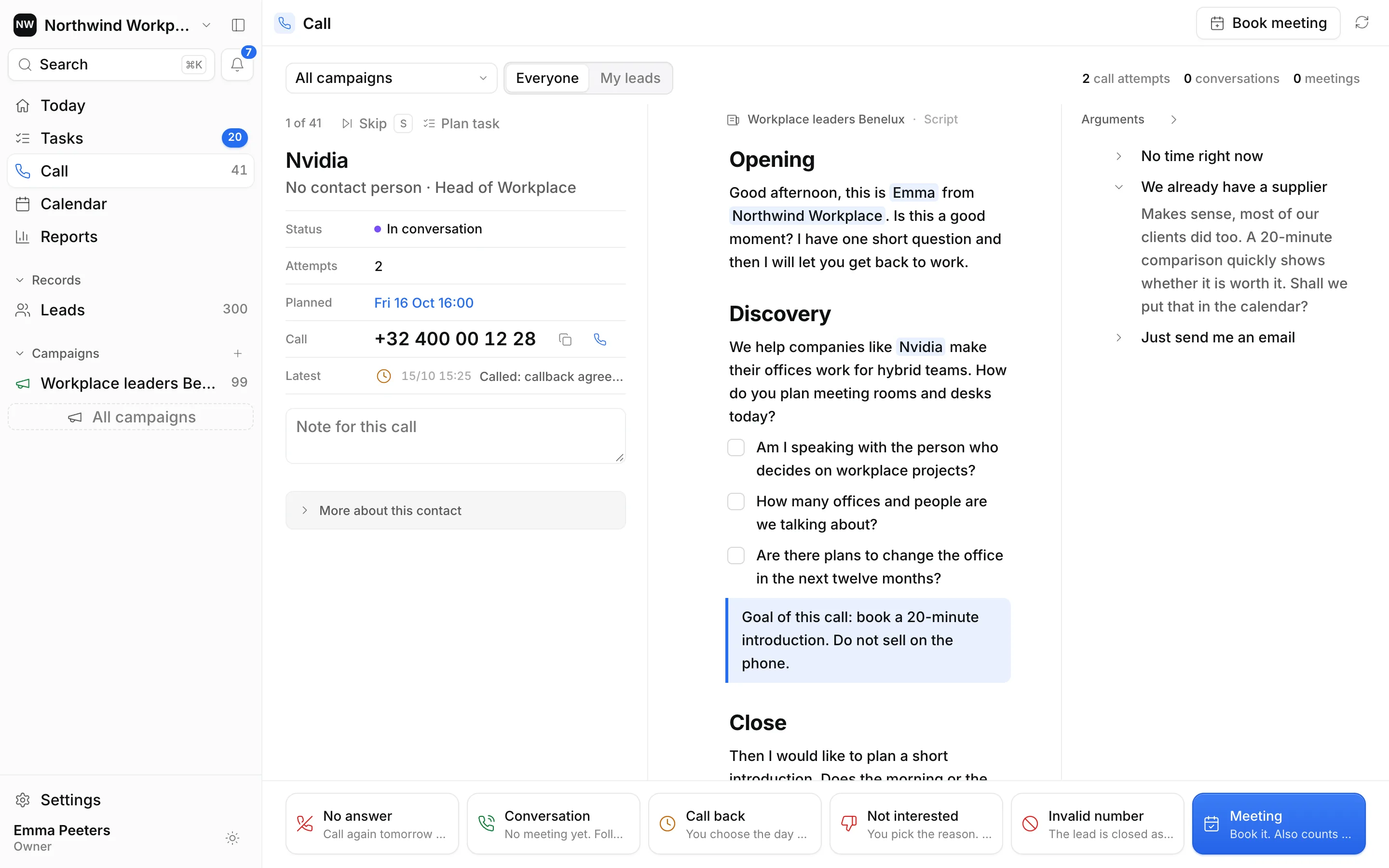
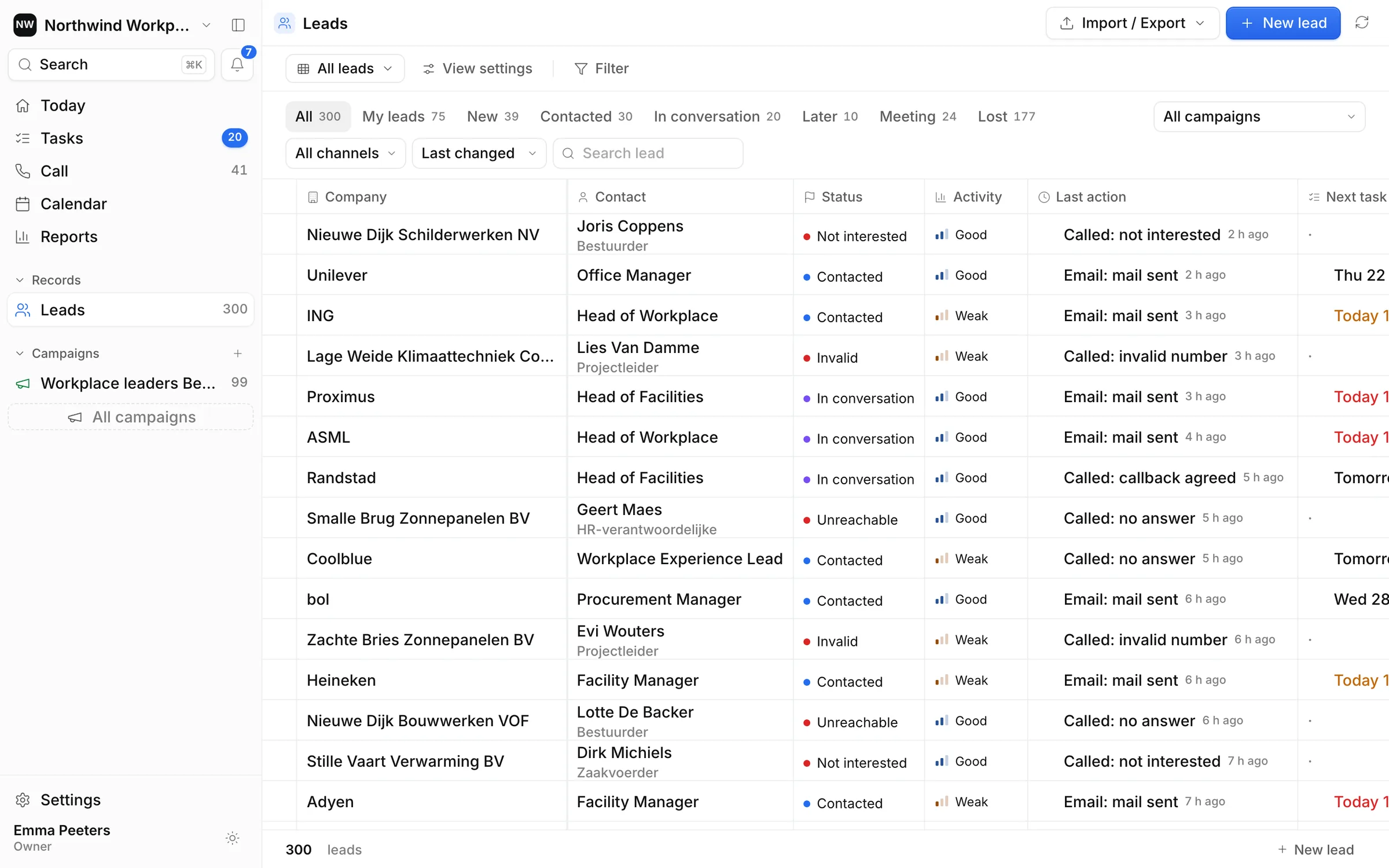
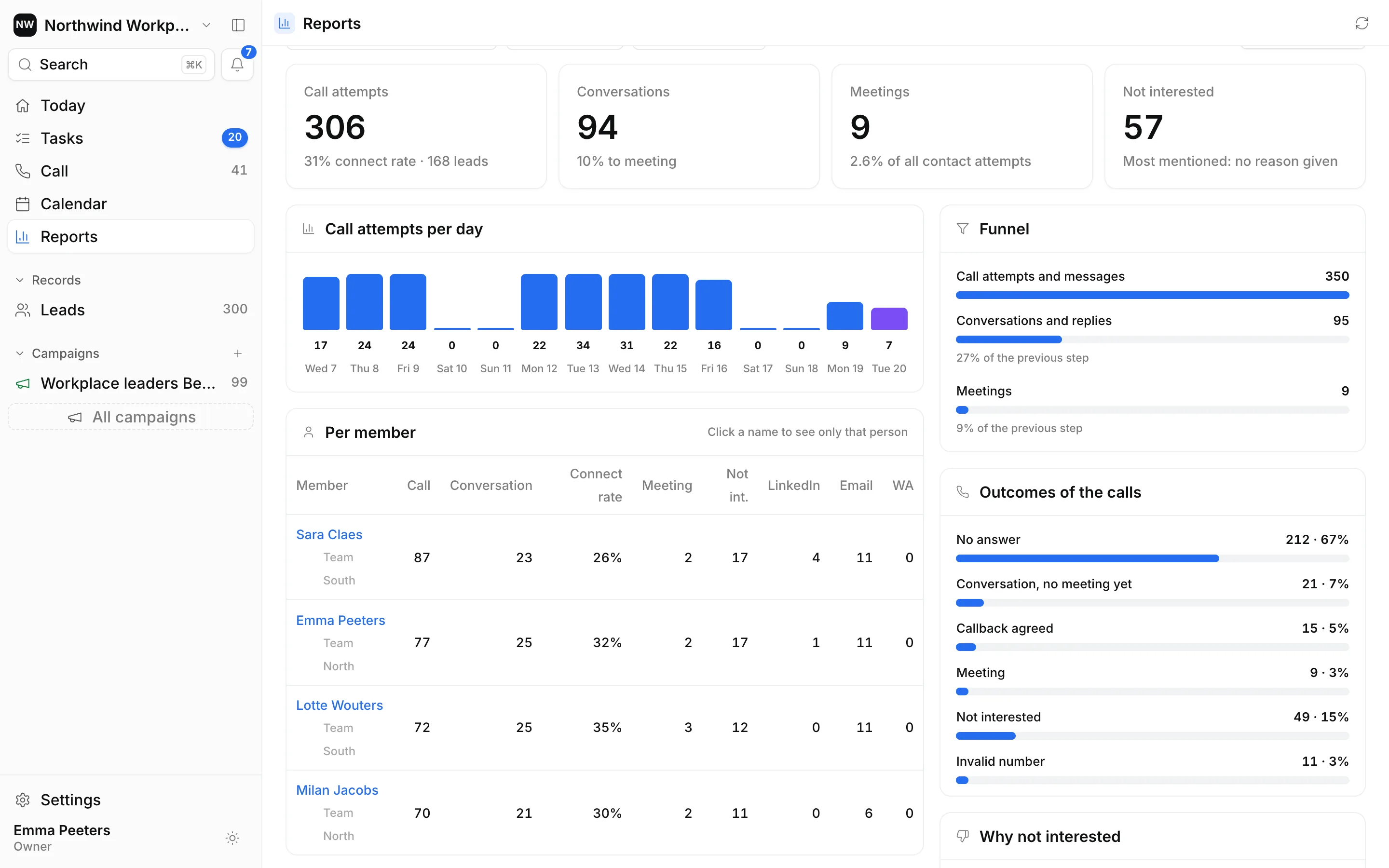
Real screens from the Ringlane app with demo data. No affiliation with the companies shown.
Industries to call in Antwerp
Fill your trucks and warehouses with shippers you called yourself
How hauliers, forwarders and 3PLs in Belgium and the Netherlands can call shippers, time the call around tenders and follow up every lead on schedule.
Wholesale and distributionOpen new trade accounts, not just take orders from the old ones
How wholesalers and distributors in Belgium and the Netherlands can call new trade accounts, get past the current supplier and follow up every lead on time.
Industrial manufacturingGet on the supplier list before the next project is quoted
How manufacturers and subcontractors in Belgium and the Netherlands can call buyers and engineers, get on the supplier list and follow up a long sales cycle.
Frequently asked questions
Is cold calling a good way to find B2B customers in Antwerp?
Which sectors are largest in the province of Antwerp?
In which language should I call companies in Antwerp?
Where do business owners in Antwerp meet?
Are there rules for calling businesses in Belgium?
Sources
- Eurostat: Enterprises and local units by NUTS 2 region and NACE Rev.2 activity (sbs_r_nuts2021)
- Eurostat: Population on 1 January by NUTS 2 region (demo_r_d2jan)
- Eurostat: Gross domestic product by NUTS 2 region (nama_10r_2gdp)
- Port of Antwerp-Bruges: Factsheet throughput figures 2025
- Statistiek Vlaanderen: Zeehavens, goederentrafiek
- Voka: Antwerpen-Waasland
- Voka: Mechelen-Kempen
- Voka: Organisation chart of the Voka chambers of commerce