Fill your trucks and warehouses with shippers you called yourself
For hauliers, forwarders and warehouse operators in Belgium and the Netherlands: who to call at a shipper, when the call is relevant, and how to keep every lane conversation moving.
Most shippers already have a carrier, a forwarder or a warehouse partner. That makes new business in logistics a game of timing: you need to be known before the next tender, the next contract renewal or the next time a carrier fails to deliver. A calling team that reaches the right logistics manager at the right moment can win lanes that never reach a public tender.
The market: many small carriers, a smaller group of real buyers
Transport is a crowded market on the supply side. According to Eurostat business statistics for 2023, Belgium had 20,623 enterprises in transport and storage and the Netherlands 69,647. Most are very small: in Belgium 12,974 and in the Netherlands 53,459 of them had zero or one person employed. Only 2,338 Belgian and 3,743 Dutch transport enterprises had 10 or more people. In land transport alone, the count was 13,374 in Belgium and 37,741 in the Netherlands; in warehousing and support activities 3,841 and 14,416.
The sector is large in jobs too. The same Eurostat series counts 231,145 persons employed in Belgian transport and storage in 2023 and 448,161 in the Netherlands. Road dominates: Belgian federation Febetra says road transport accounts for 70% of goods transport. Dutch federation TLN has 4,500 members.
Pressure is high. Trans.INFO reports Statbel figures of 524 bankruptcies in Belgian transport and storage in the first seven months of 2026, 13.9% more than the 460 in the same period of 2025. For a shipper, a failing carrier is a reason to look for a new one. For you, it is a reason to be on their list already.
On the buying side, decisions follow company size. A small manufacturer or wholesaler often lets the owner or operations manager pick a carrier on trust and price. Larger shippers run a transport tender, compare rates per lane and involve purchasing and finance. In the Netherlands, zero-emission zones for city logistics have applied in the first municipalities since 1 January 2025, which adds a question about fleet and emissions to many conversations.
Who you call and what you ask
The people who decide on transport and warehousing:
- Logistics manager or supply chain manager: owns carrier choice and service levels at mid-sized and larger shippers.
- Purchasing or procurement manager: runs the tender and the rate comparison.
- Operations manager or plant manager: feels every late pick-up, often the best first conversation.
- Owner: at smaller companies, the one who signs.
Trigger events that make the call relevant: a transport contract that ends in the coming months, a new site or warehouse, a new product line or export market, a carrier that went bankrupt or stopped a lane, peak season planning, and new demands on emissions in city deliveries.
Discovery questions that work in this sector:
- Which lanes or flows do you run most often, and how many loads per week?
- When does your current transport or warehousing contract end, and how will you choose for the next period?
- What went wrong with a carrier in the last year, and what did it cost you?
- Do you need extra capacity in peak periods, and who arranges that today?
- Who else is involved when you compare carriers: purchasing, finance, the plant?
A first sentence that works
Open with the shipper, not with your fleet. For example: "I am calling because you ship to Germany several times a week, and I wanted to ask how you arrange capacity in peak periods." It shows you looked at their business and asks about a moment they recognise. If the answer is "we have a carrier", ask when that contract is reviewed and offer to call back before then. Write the date down as the next task, because that call is the one that counts. Avoid starting with a rate: a rate without a lane, a volume and a service level invites a comparison you cannot win on the phone.
For more on how buyers move through such a decision, see how B2B buyers buy.
What slows a calling team down in this sector
- The incumbent carrier. "We have someone" is the most common answer. The real question is when that contract is reviewed.
- Tenders and framework contracts. Larger shippers buy transport in rounds. Between rounds, the door is mostly closed, so the follow-up has to be planned months ahead.
- People on the floor. Logistics and operations managers spend much of the day in the warehouse or with planners. You need several attempts and a call back at the moment they name.
- Price first. Rate comparisons per lane make it hard to talk about reliability. A good script steers the conversation to what a missed delivery costs.
- Seasonality. Peak periods are when shippers feel capacity gaps most, and also when they have the least time to talk.
The timing of the call matters as much as the list: read the best time to cold call.
How Ringlane works for logistics and transport companies
Real screens from the app, with what each feature does in this industry.
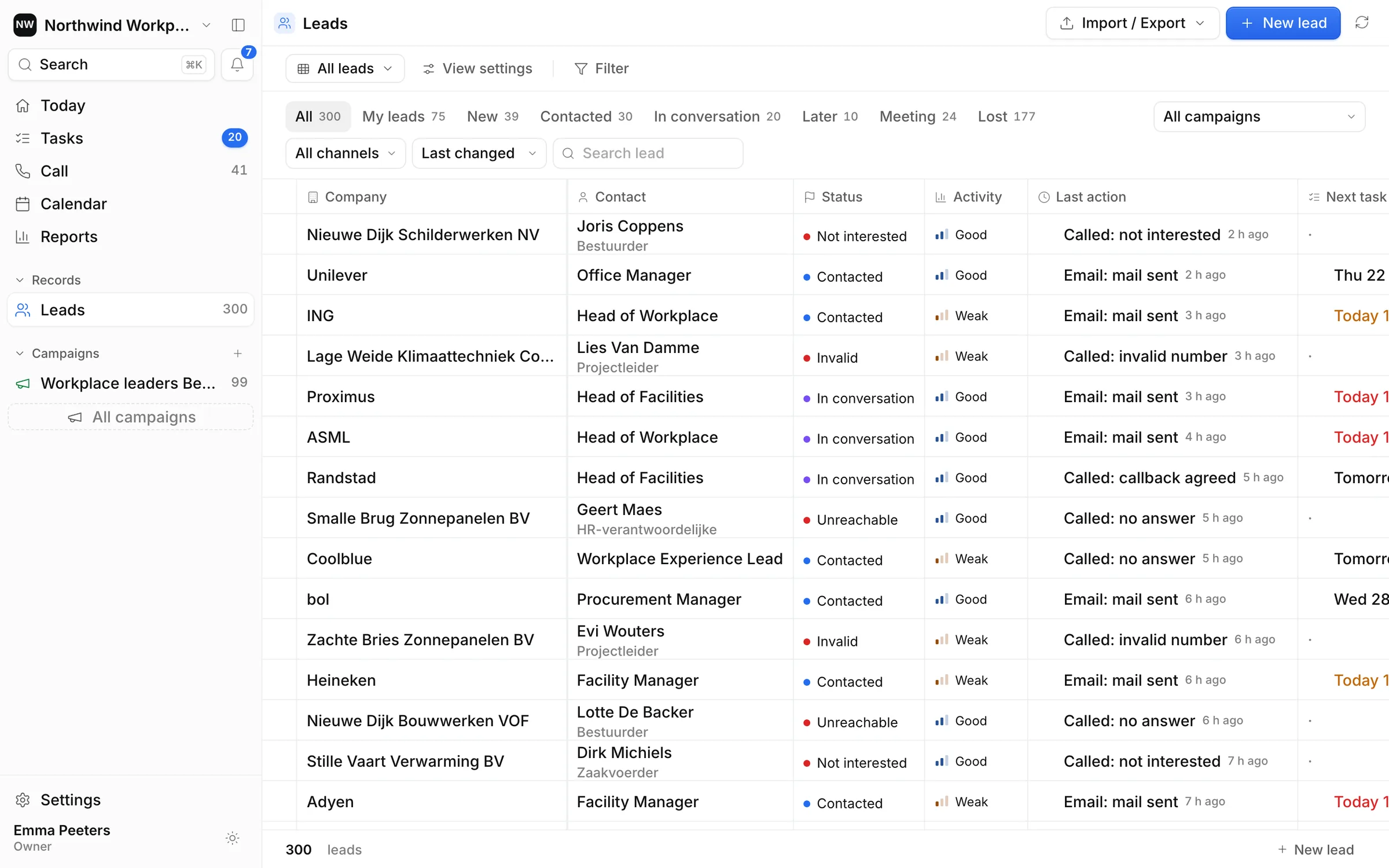
Your lists, in one place
Import Excel, CSV or a Bizzy export into a campaign. Every lead shows its status, last action and next task.
In this industry: Import a Bizzy export of shippers by region and activity into one campaign per lane or per warehouse, so a caller sees at a glance which shippers still need a first attempt.
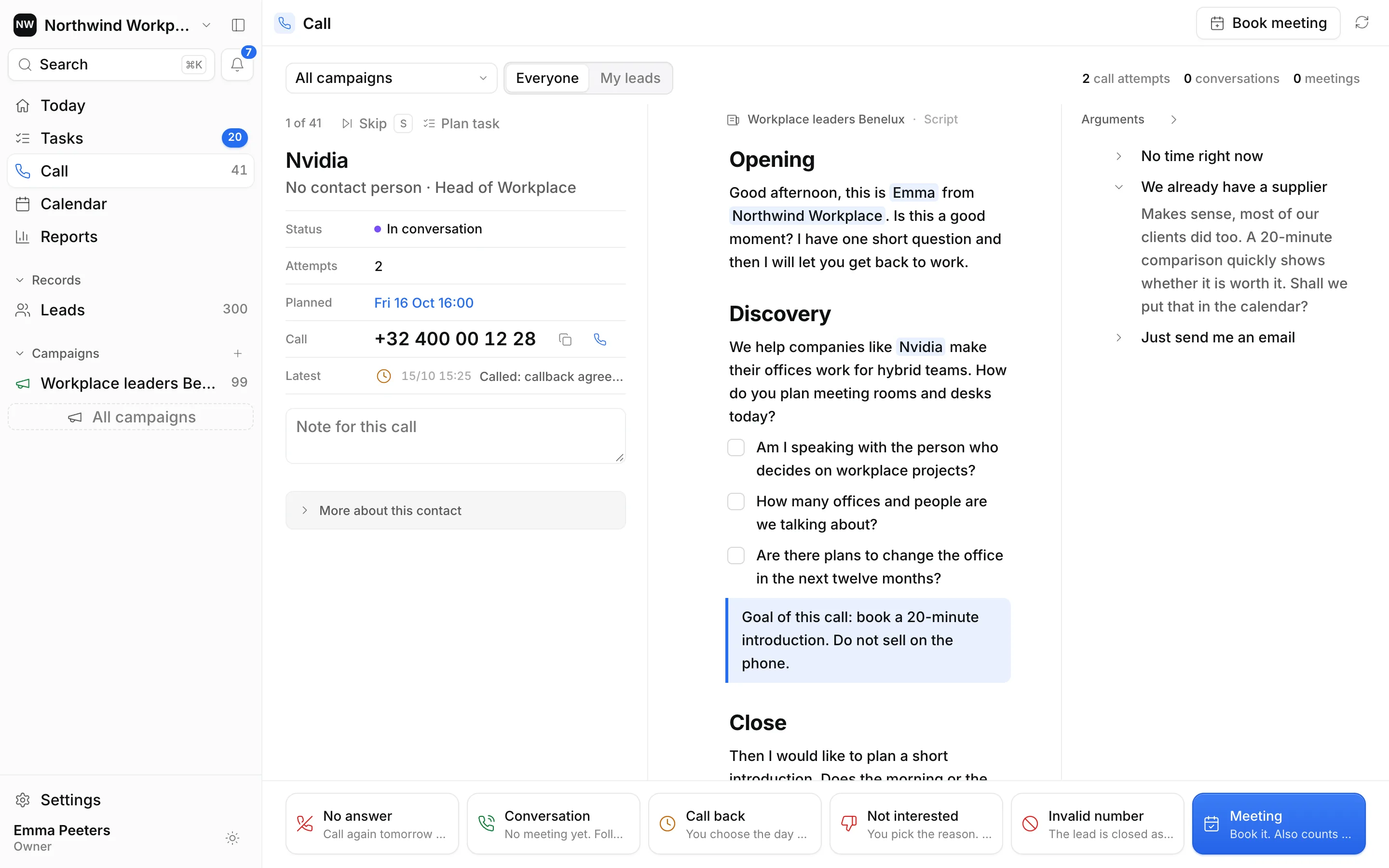
One screen for the call
The lead on the left, the script in the middle with the company name and your own name filled in. Click the number to call from your own phone.
In this industry: Put the questions about volumes, lanes, frequency and contract end date in the script, so every caller asks the same things.
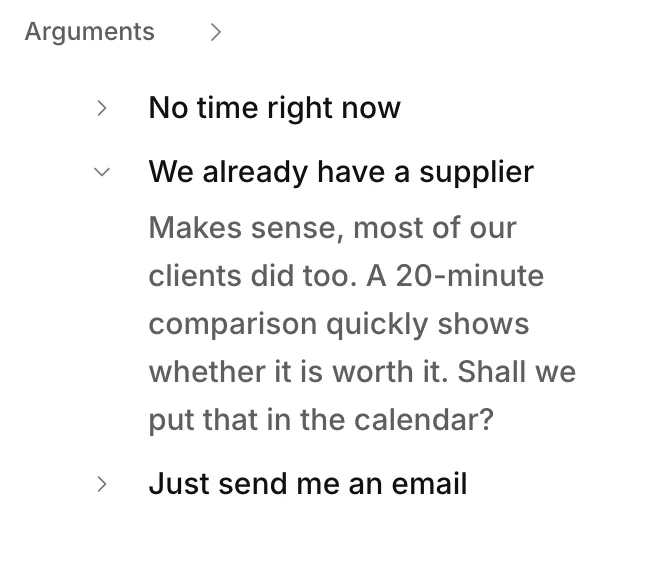
The answer to every objection
Common objections sit in a panel next to the script, so the right answer is one click away.
In this industry: Keep the answers to "we already have a carrier" and "we only work by tender" next to the script, so a caller turns a polite no into a question about the next tender.
One key per call, the next step planned
N (not reached) plans a new attempt the next working day, G (conversation) a follow-up call in three days, T (call back) the moment you pick. A records a meeting; X (not interested, with a reason) and O (invalid number) close the lead.
In this industry: Planners and logistics managers are often on the floor. N plans the next attempt for the next working day, and T lets you call back at the quiet moment they name.

Follow-up on every channel
Calls and emails land in your week. You write emails in Ringlane and send them from your own Gmail; LinkedIn and WhatsApp you send yourself and log by hand. The Today view puts overdue call-backs first.
In this industry: After a conversation, send the rate request or a short capability note from your own Gmail and see it next to the call history, so the next caller knows what was promised.
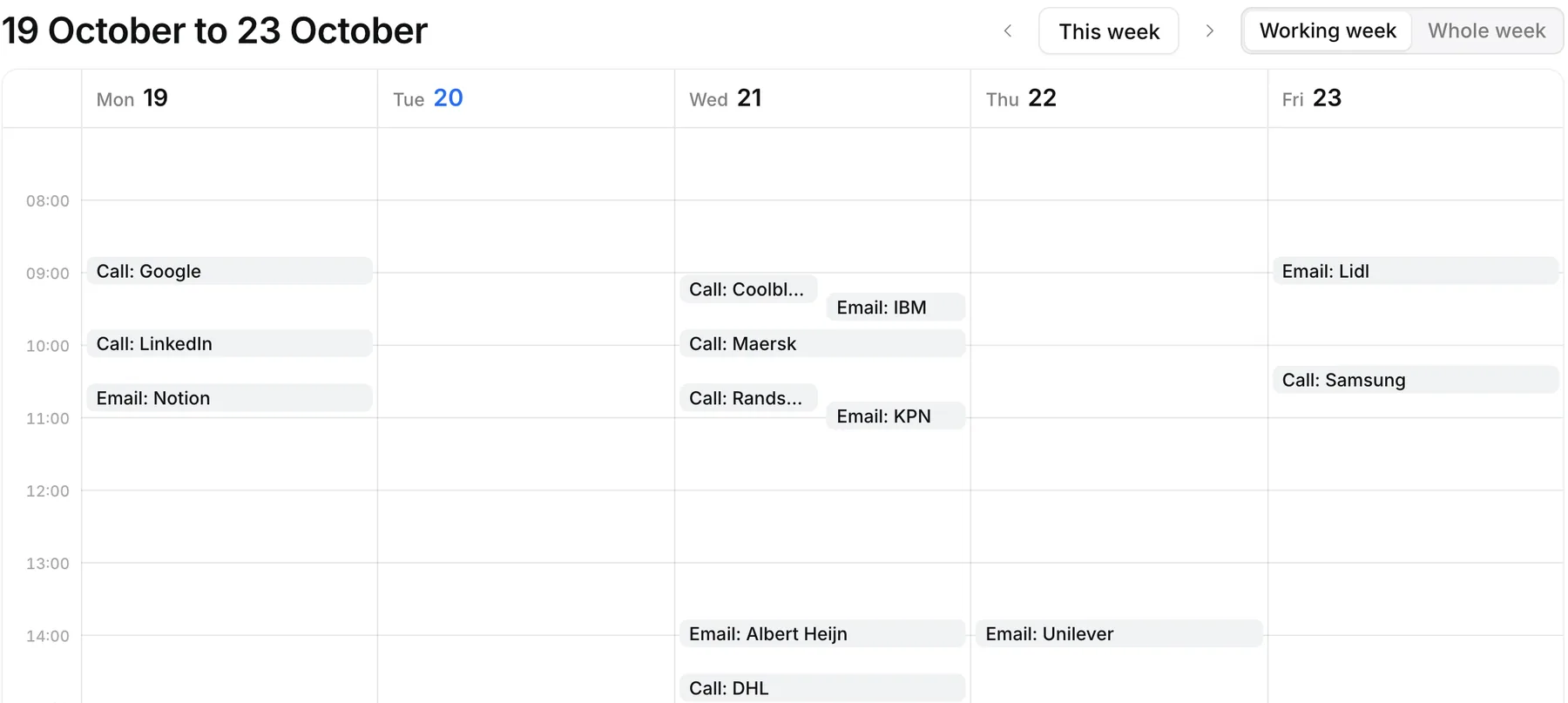
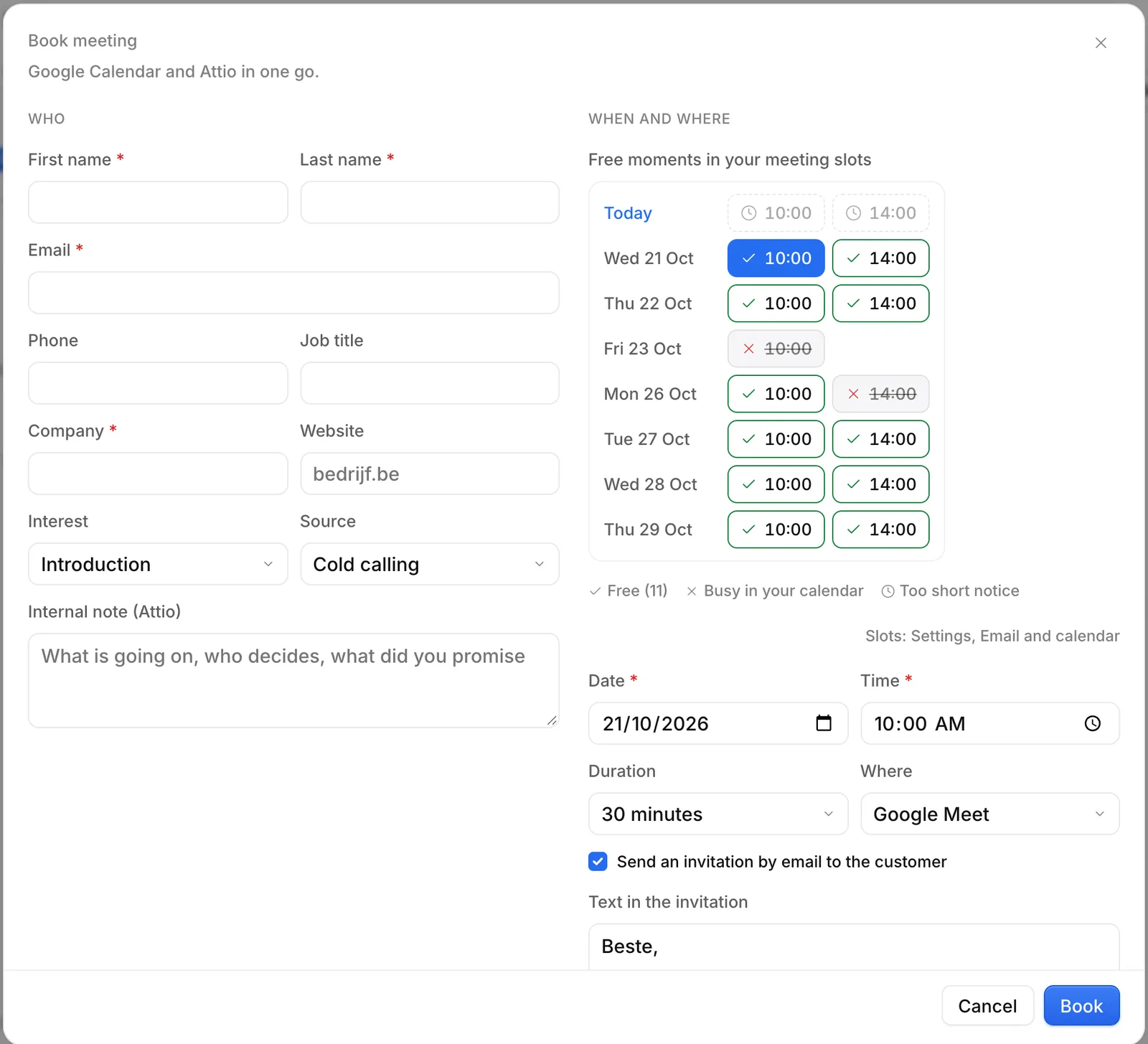
Book while they are on the line
Ringlane shows your free moments in Google Calendar, adds a Google Meet link and sends the invitation. Booked meetings go to Attio.
In this industry: When a logistics manager agrees to a visit or a call about the next tender, book it in Google Calendar with a Meet link while they are still on the line.
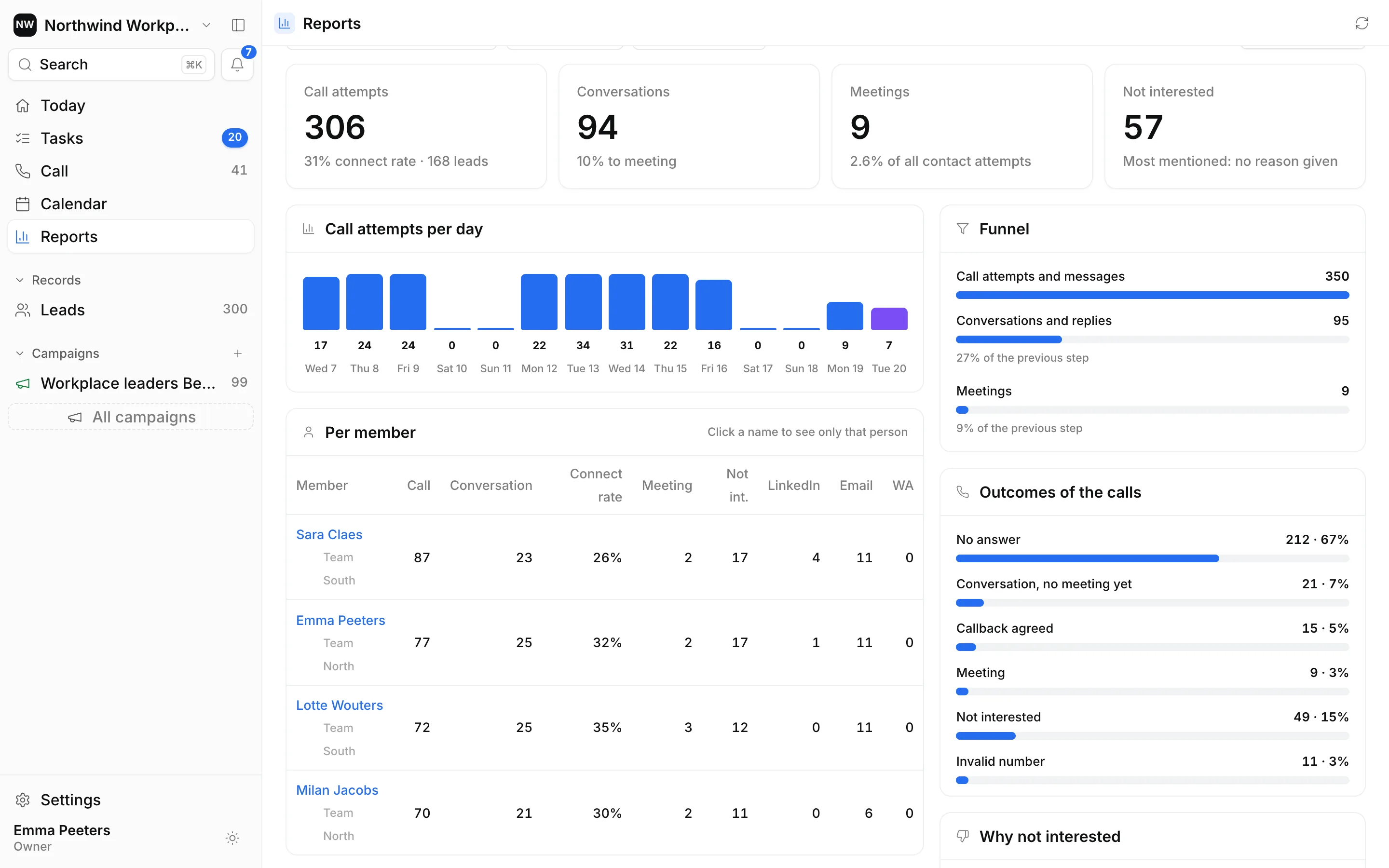
Your numbers, per caller and campaign
Call attempts, connect rate, conversations, meetings, the funnel and the reasons for "not interested", per person, team and campaign.
In this industry: Compare connect rates and meetings per campaign, for example road freight versus warehousing, and read the reasons for not interested to see which lane or service does not land.
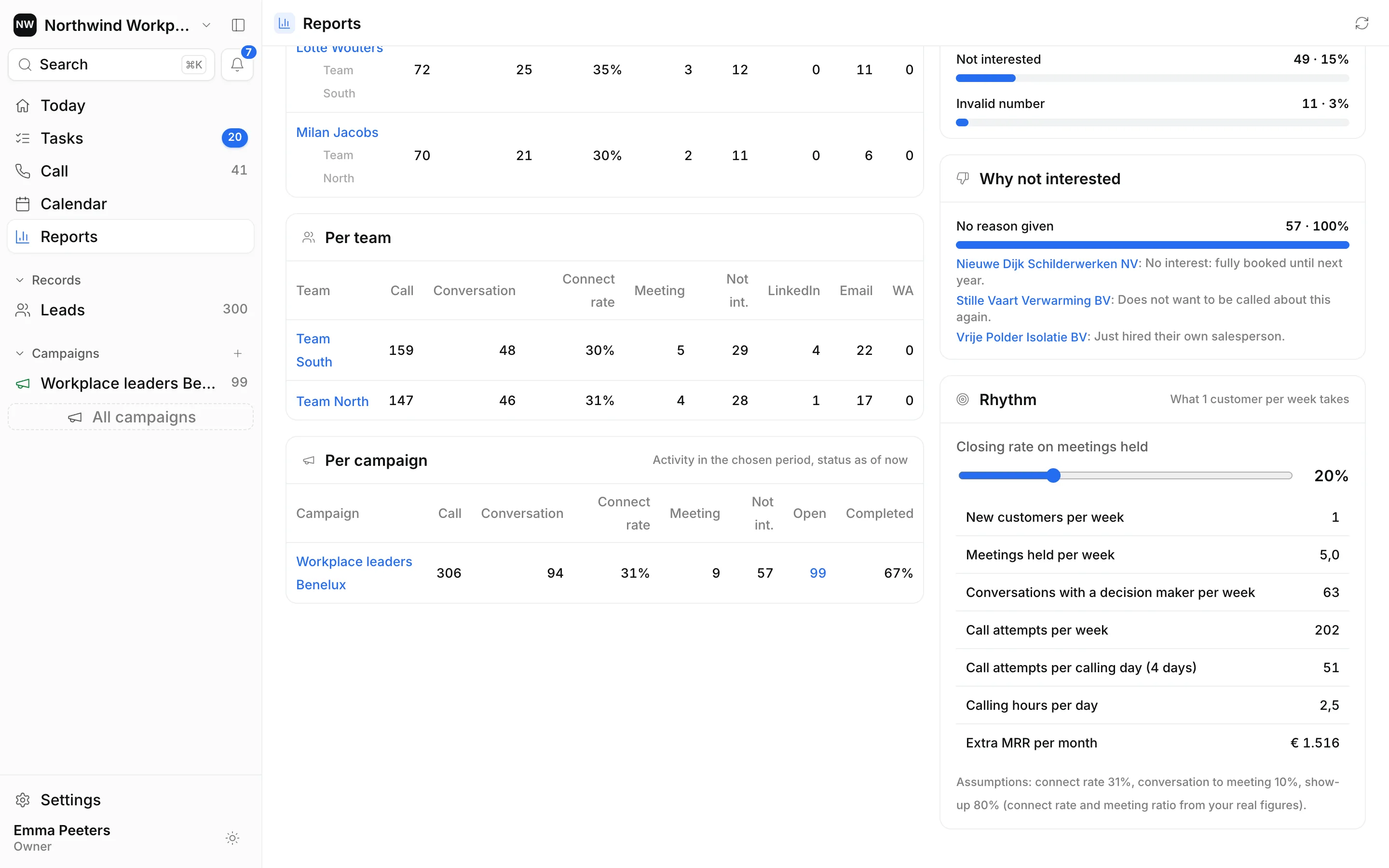
What one new customer takes
Based on your own rates, Ringlane calculates how many calls per week and per day one new customer per week takes.
In this industry: Fill in your own rates and see how many calls per week one new shipper per week takes, a number a sales manager can plan a team around.
Real screens from the Ringlane app with demo data. No affiliation with the companies shown.
What it can bring you: efficiency, money and more
The value of one new shipper depends on lanes and volumes. The table below is an example with assumed numbers, not a forecast. It assumes a team that makes 800 call attempts a month, and a new shipper worth an assumed €60,000 in transport revenue per year.
| Step (example, assumed rates) | Assumed rate | Per month |
|---|---|---|
| Call attempts | 800 | |
| Conversations with a decision maker | 20% of attempts | 160 |
| Meetings or rate requests | 8% of conversations | 13 |
| New shippers | 20% of meetings | 2 to 3 |
| Assumed revenue per new shipper | €60,000 per year |
Your own numbers will differ. What you can measure is where your funnel leaks: a low connect rate points to call timing, a low conversation to meeting rate points to the script or the offer.
Efficiency is the other gain. When the outcome of a call is one key and the next attempt is planned for you, there is less to type and less to remember. If logging and planning take a minute per call today, 800 calls is more than 13 hours a month. Measure your own time before and after. Follow-up is where most lanes are won, so read how to follow up a sales lead and try the flow in the demo.
Frequently asked questions
Does cold calling work for transport and logistics companies?
Who should a haulier or forwarder call at a shipper?
How many transport companies are there in Belgium and the Netherlands?
When is the best moment to call a shipper?
Does Ringlane dial numbers or record calls?
Sources
- Eurostat: Enterprises by detailed NACE Rev.2 activity and special aggregates (sbs_ovw_act), 2023
- Eurostat: Enterprises by size class and NACE Rev.2 activity (sbs_sc_ovw), 2023
- Febetra: About Febetra (road transport share of goods transport in Belgium)
- TLN: About TLN (4,500 members)
- Trans.INFO: Belgian transport bankruptcies, with Statbel figures for January to July 2026
- Op weg naar ZES: zero-emission zones for city logistics in the Netherlands
All industries
- Accounting firms
- Business events and venues
- Business finance
- Commercial cleaning
- Commercial real estate
- Commercial solar and energy
- Consultancy
- Corporate catering
- Corporate training
- Fleet, leasing and EV charging
- HR and payroll services
- HVAC and building services
- Industrial manufacturing
- Insurance brokers
- IT services and MSPs
- Marketing agencies
- Office furniture and workplace
- Printing and packaging
- Recruitment and staffing
- SaaS and software
- Security services
- Telecom and connectivity
- Wholesale and distribution
- Workwear and PPE