Get on the supplier list before the next project is quoted
For manufacturers, machine builders and subcontractors in Belgium and the Netherlands: who to call at an industrial customer, when a call is relevant, and how to keep a long cycle on track.
Industrial customers do not change suppliers on a whim. A new supplier has to be qualified, a part has to fit a drawing, and the timing has to match a project or a new product. That is exactly why calling works here when it is done with patience: the manufacturer that is known and qualified before the next request for quotation gets to quote.
The market: a few thousand companies with real buying power
According to Eurostat business statistics for 2023, Belgium had 42,355 manufacturing enterprises and the Netherlands 85,945. Most are micro companies: 37,424 in Belgium and 77,419 in the Netherlands had fewer than 10 people employed. The group with buying departments is smaller: 4,931 Belgian and 8,526 Dutch manufacturers had 10 or more people, and 1,468 and 2,434 had 50 or more. The same Eurostat series counts 519,209 persons employed in Belgian manufacturing and 768,937 in the Netherlands.
The technology industry carries much of it. Belgian federation Agoria represents more than 2,000 technology companies with over 321,000 employees, 70% of them small and medium companies. Dutch federation FME has 2,100 members with 230,000 employees, a combined turnover of €145 billion and €80 billion in exports.
Investment plans set the pace for many suppliers. In its spring survey, CBS found that Dutch manufacturers expect to invest 3% less in 2026 than in 2025, with the metal industry expecting the largest drop at 19%, while refineries and chemicals expect 5% more. For a calling team that means sharper targeting: call the subsectors that are still investing first.
Buying decisions are shared. Purchasing negotiates and keeps the approved supplier list, engineering and quality decide whether a part or process is acceptable, and production feels the delivery problems. At smaller manufacturers, the owner often makes the final call.
Who you call and what you ask
- Purchasing manager or strategic buyer: owns the supplier list, prices and contracts.
- Engineering or R&D manager: designs the part and chooses materials and processes.
- Production or plant manager: feels late deliveries and capacity gaps first.
- Quality manager: qualifies new suppliers and runs audits.
- Owner or managing director: at smaller companies, the decision maker.
Trigger events: a new product or project, a supplier with capacity or quality problems, a wish for a second source, a new plant or production line, an investment plan, a change in purchasing staff, and trade fairs where a buyer saw your stand.
Discovery questions that work for industrial customers:
- Which parts or processes do you buy in today, and from how many suppliers?
- Where do you have capacity or delivery problems with a current supplier?
- Which new products or projects are coming up in the next twelve months?
- What does a new supplier need to get on your list: certificates, samples, an audit?
- Who besides you decides: engineering, quality, the plant manager?
A first sentence that works
Open with their production, not your machine park. For example: "I am calling because you build machines with a lot of sheet metal parts, and I wanted to ask how you handle peaks with your current suppliers." It is specific, it is about their world, and it invites a real answer. If the buyer says "send me something", ask for a drawing of a part they buy often, so you can quote on something real. A quote on their own part is worth more than any brochure, and it gives you a reason for the follow-up call. Note who else needs to see the quote, so engineering and quality are not a surprise later.
Questions like these follow the logic of SPIN selling: situation, problem, implication, need.
What slows a calling team down in this sector
- Approved supplier lists. Getting on the list takes samples, test orders and sometimes an audit. Plan for that from the first call.
- Long cycles. From first call to first order can take months. Without planned follow-up, the lead is forgotten.
- More than one decision maker. Purchasing, engineering and quality each need their own reason.
- People away from their desk. Production and engineering managers are on the floor or in meetings. Expect several attempts per lead; see how many calls it takes to win a customer.
- Investment cycles. When a subsector cuts investment, projects are postponed. Your list has to follow the market.
How Ringlane works for industrial manufacturers
Real screens from the app, with what each feature does in this industry.
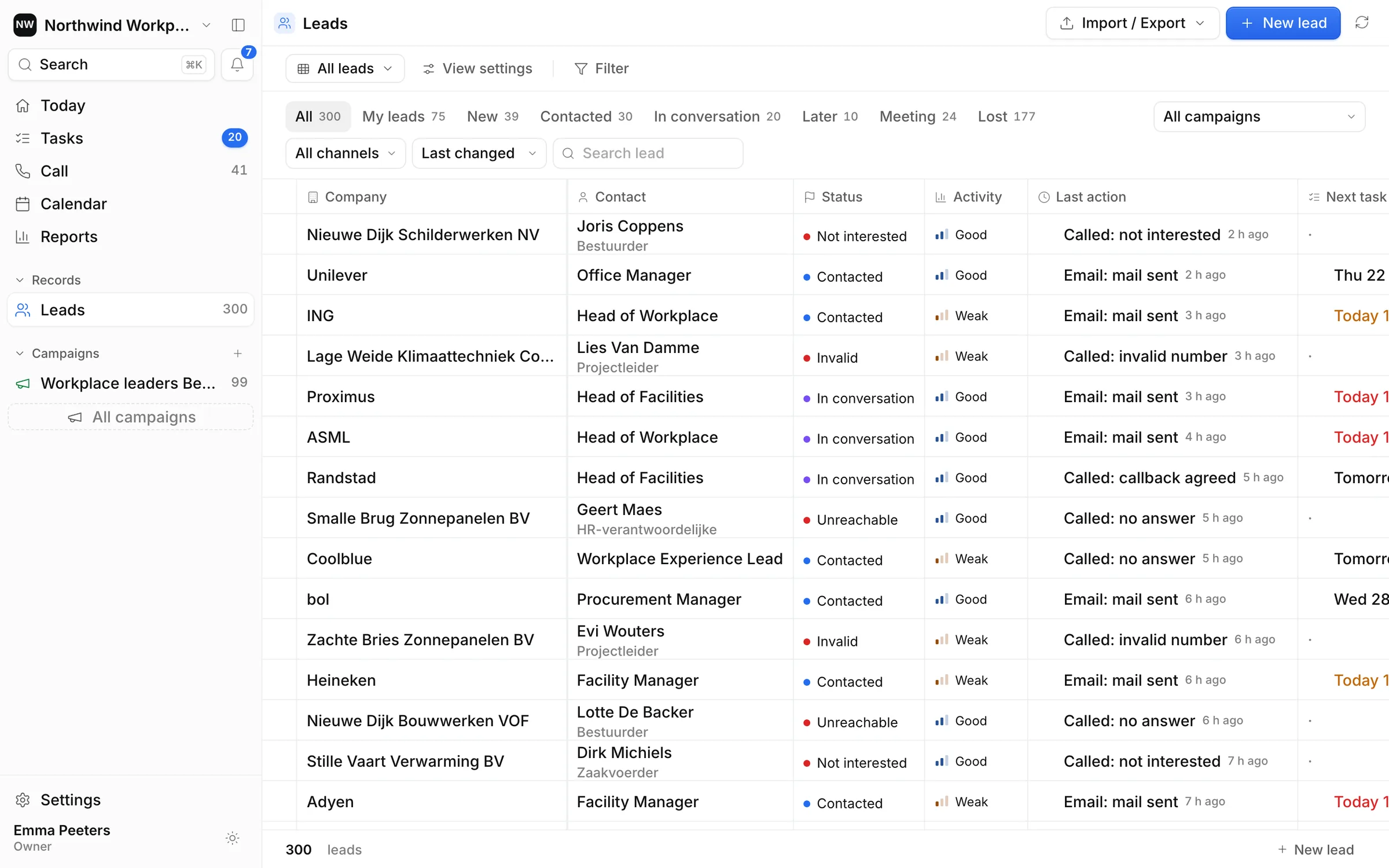
Your lists, in one place
Import Excel, CSV or a Bizzy export into a campaign. Every lead shows its status, last action and next task.
In this industry: Import a Bizzy export of manufacturers by activity and size into campaigns per market, for example machine builders or food producers, so each caller knows which companies still need a first attempt.
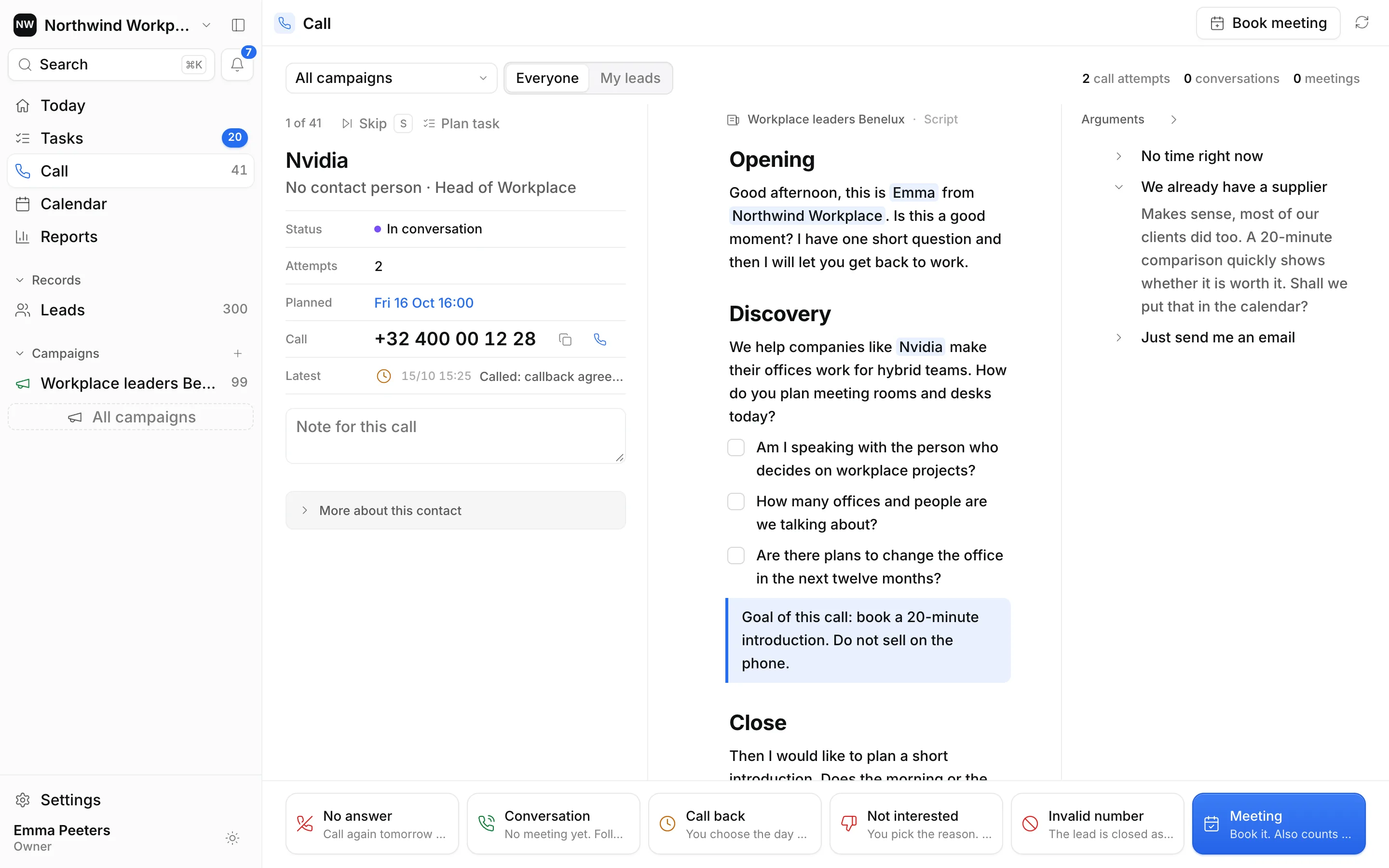
One screen for the call
The lead on the left, the script in the middle with the company name and your own name filled in. Click the number to call from your own phone.
In this industry: Put the questions about current suppliers, volumes, materials, certifications and the next project in the script, so every caller qualifies the same way.
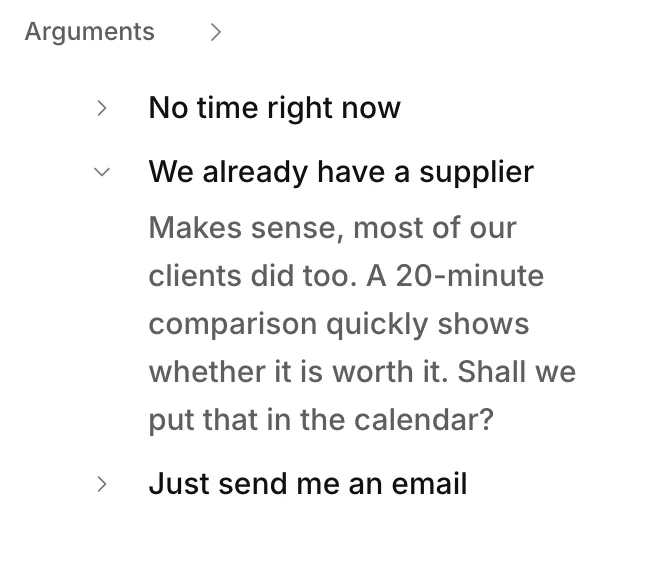
The answer to every objection
Common objections sit in a panel next to the script, so the right answer is one click away.
In this industry: Keep the answers to "we have approved suppliers" and "send us your brochure" next to the script, so a caller can ask for a test order, a drawing to quote or a visit instead.
One key per call, the next step planned
N (not reached) plans a new attempt the next working day, G (conversation) a follow-up call in three days, T (call back) the moment you pick. A records a meeting; X (not interested, with a reason) and O (invalid number) close the lead.
In this industry: Production and engineering managers are rarely at their desk. N plans the next attempt for the next working day, and T lets you call back exactly at the time they give.

Follow-up on every channel
Calls and emails land in your week. You write emails in Ringlane and send them from your own Gmail; LinkedIn and WhatsApp you send yourself and log by hand. The Today view puts overdue call-backs first.
In this industry: After a conversation, send the request for a drawing or your certificate overview from your own Gmail, see it next to the call history, and let G plan the follow-up call three days later.
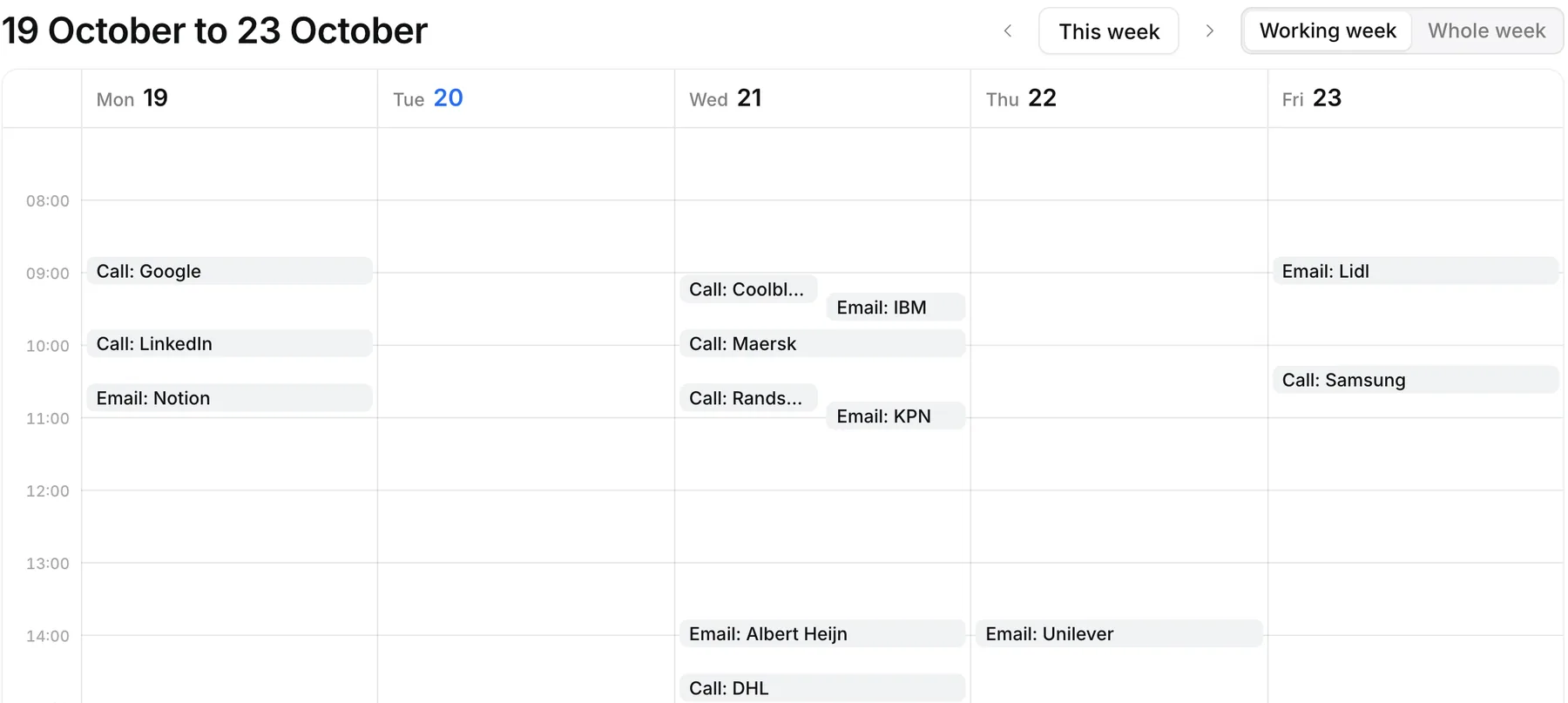
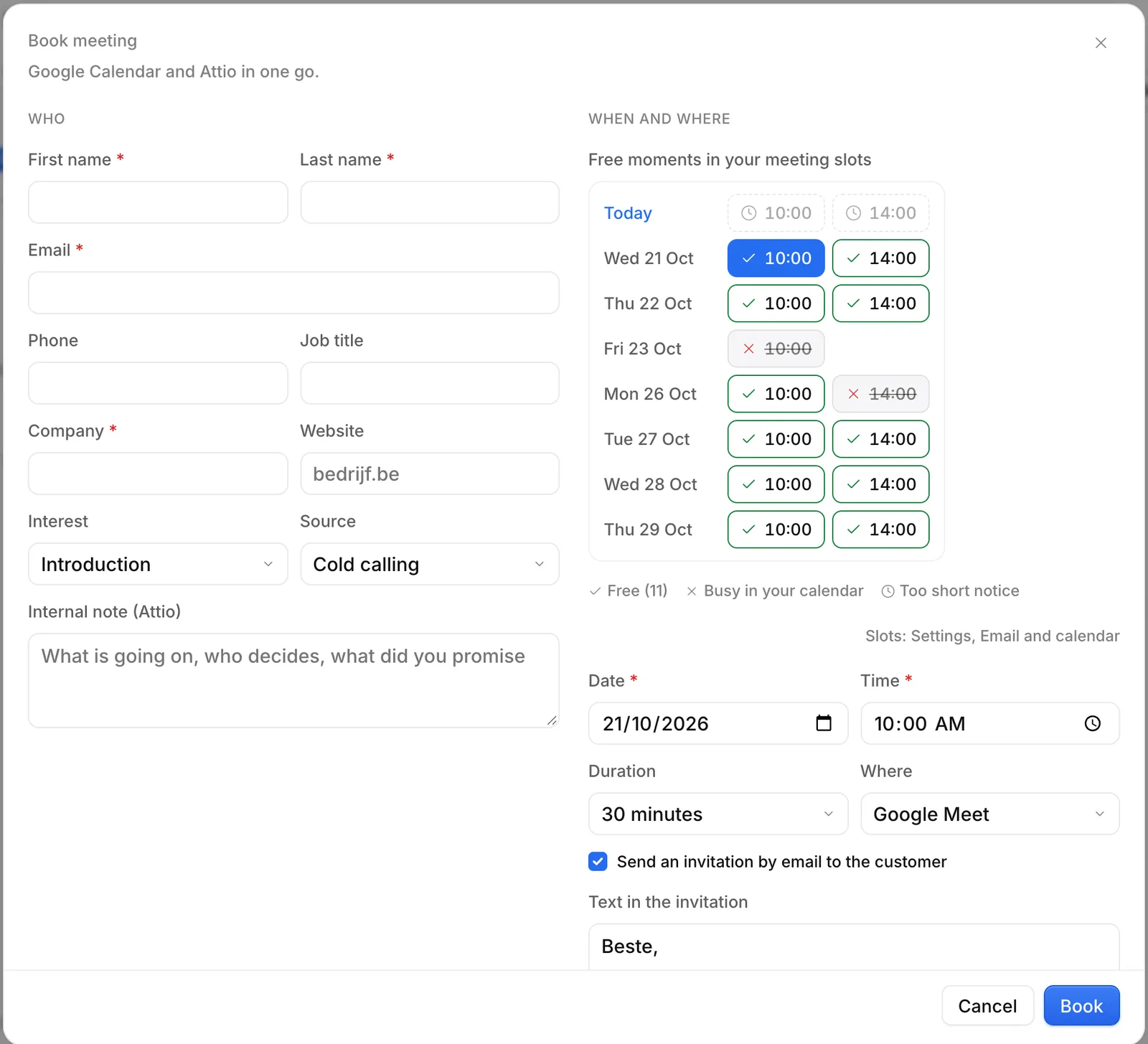
Book while they are on the line
Ringlane shows your free moments in Google Calendar, adds a Google Meet link and sends the invitation. Booked meetings go to Attio.
In this industry: When a buyer or engineer agrees to a plant visit or a technical call, book it in Google Calendar with a Meet link while they are still on the line, and the meeting goes to Attio.
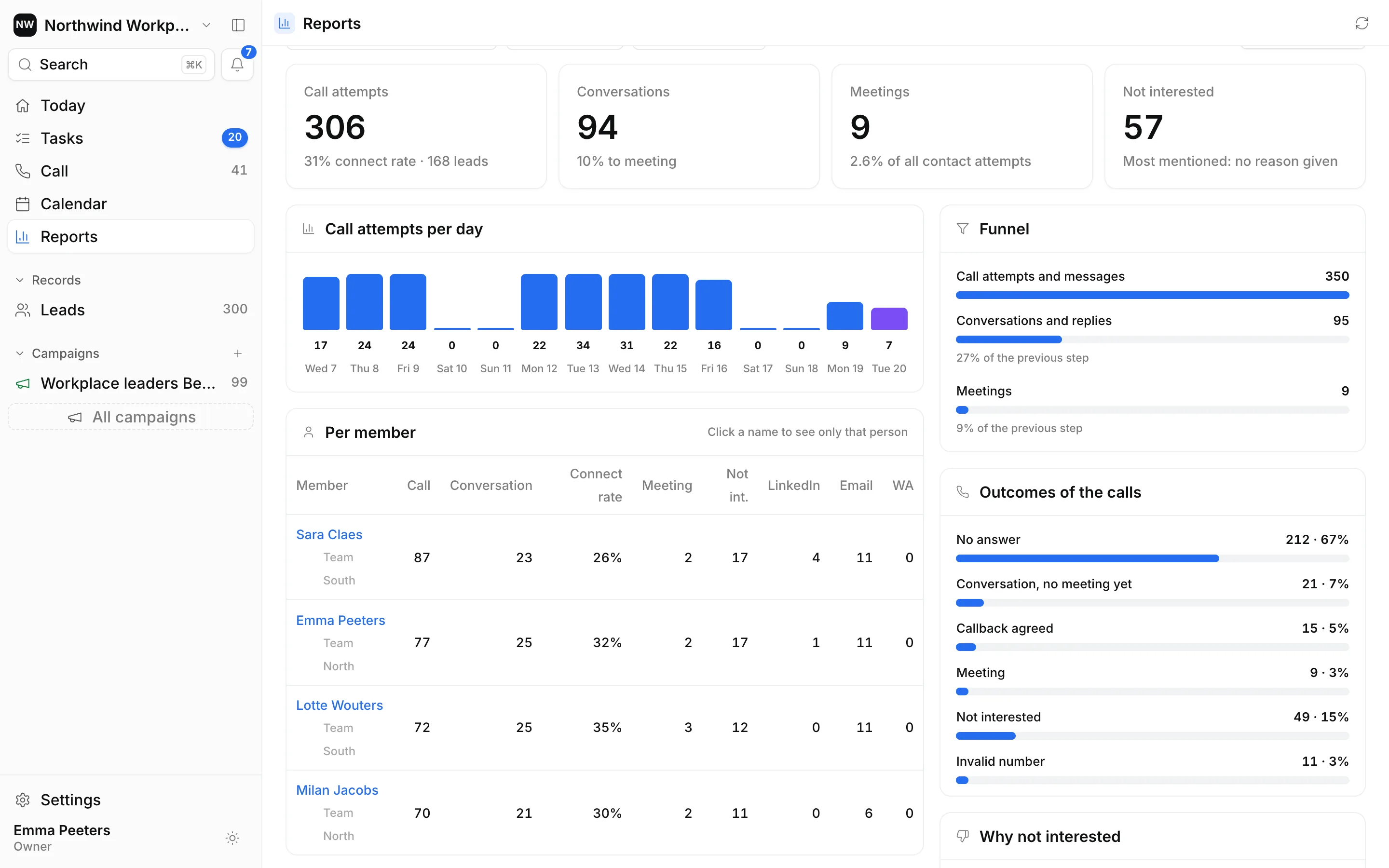
Your numbers, per caller and campaign
Call attempts, connect rate, conversations, meetings, the funnel and the reasons for "not interested", per person, team and campaign.
In this industry: Compare campaigns per target market, and read the reasons for not interested to see whether it is capacity, certification or price that stops buyers.
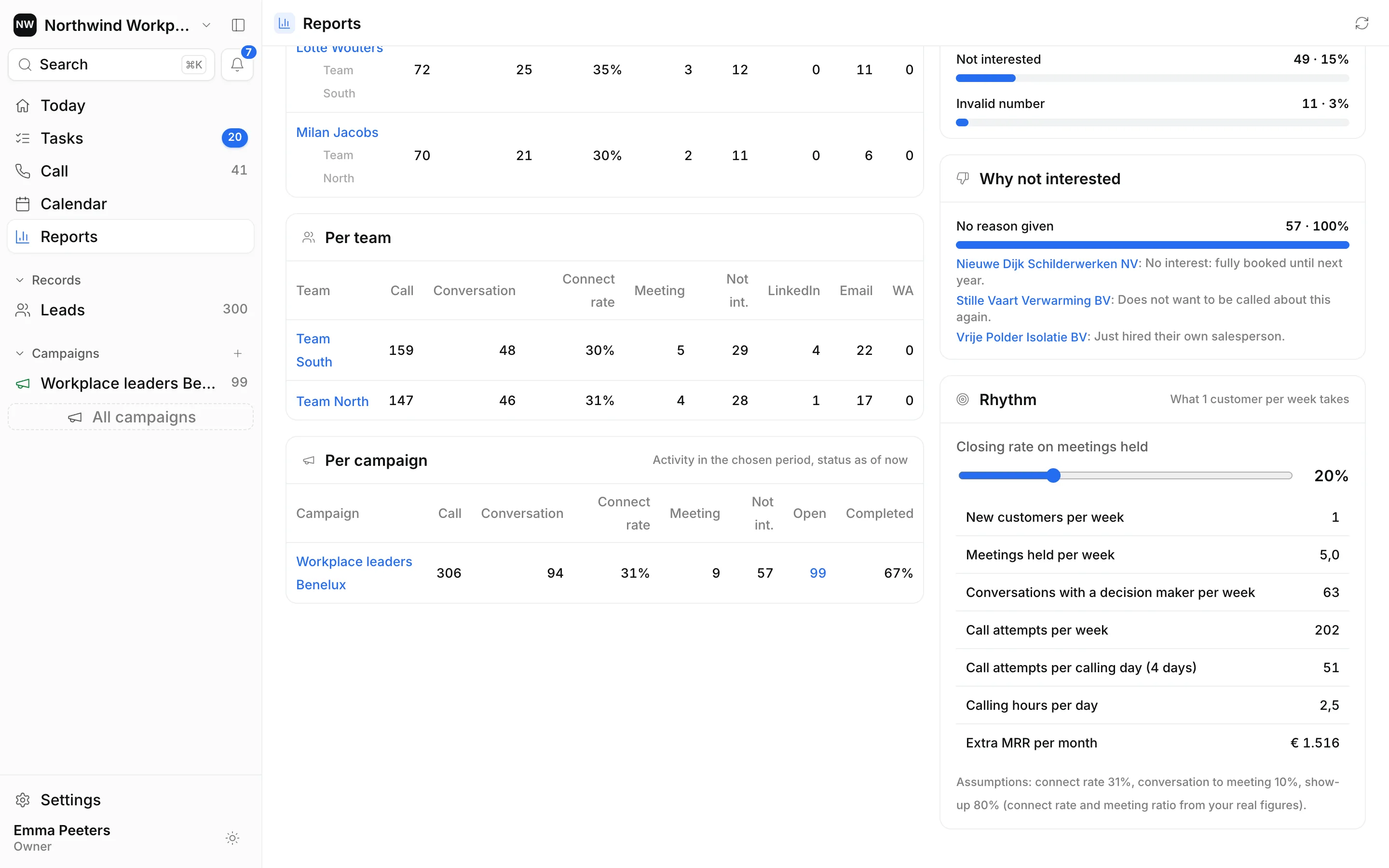
What one new customer takes
Based on your own rates, Ringlane calculates how many calls per week and per day one new customer per week takes.
In this industry: Fill in your own rates and see how many calls per week one new industrial customer per week takes, or use it to see what one per month would ask of the team.
Real screens from the Ringlane app with demo data. No affiliation with the companies shown.
What it can bring you: efficiency, money and more
One new industrial customer can be worth years of repeat orders. The table below is an example with assumed numbers, not a forecast. It assumes one caller with 500 call attempts a month and an assumed €80,000 in orders per year from one new customer. Because the cycle is long, the customers in the last row may come months after the calls.
| Step (example, assumed rates) | Assumed rate | Per month |
|---|---|---|
| Call attempts | 500 | |
| Conversations with a buyer or engineer | 20% of attempts | 100 |
| Visits, technical calls or drawings to quote | 10% of conversations | 10 |
| New customers with a first order | 15% of those | 1 to 2 |
| Assumed orders per new customer | €80,000 per year |
Your rates will differ. What you can measure is the share of conversations that leads to a drawing or a visit, per market and per caller, and how long each step takes.
The efficiency gain is in keeping a long cycle tidy. When every outcome is one key and the next attempt or follow-up call is planned for you, nobody needs a separate list of who to call back in three weeks. Measure how long logging takes today and compare. For the bigger picture, read how to set up an outbound sales process and try the flow in the demo.
Frequently asked questions
Does cold calling work in industrial manufacturing?
How many manufacturing companies are there in Belgium and the Netherlands?
Who do you call at an industrial customer?
Why is the sales cycle so long in manufacturing?
Does Ringlane connect to an ERP or my CRM?
Sources
- Eurostat: Enterprises by size class and NACE Rev.2 activity (sbs_sc_ovw), 2023
- Eurostat: Enterprises by detailed NACE Rev.2 activity and special aggregates (sbs_ovw_act), 2023
- Agoria: Over Agoria (members and employees)
- FME: Over FME (members, employees, turnover and exports)
- CBS: Industrie verwacht minder te investeren in 2026 (18 June 2026)
All industries
- Accounting firms
- Business events and venues
- Business finance
- Commercial cleaning
- Commercial real estate
- Commercial solar and energy
- Consultancy
- Corporate catering
- Corporate training
- Fleet, leasing and EV charging
- HR and payroll services
- HVAC and building services
- Insurance brokers
- IT services and MSPs
- Logistics and transport
- Marketing agencies
- Office furniture and workplace
- Printing and packaging
- Recruitment and staffing
- SaaS and software
- Security services
- Telecom and connectivity
- Wholesale and distribution
- Workwear and PPE