Open new trade accounts, not just take orders from the old ones
For wholesalers and distributors in Belgium and the Netherlands: who to call at a reseller, installer or kitchen, what opens the conversation, and how to follow up until the first order.
Wholesale sales teams spend most of their day on existing customers: orders, quotes, delivery questions. Reorders move online, and new accounts are left to chance or to the field reps. Yet every wholesaler loses customers each year to closures, buying groups and competitors, so someone has to open new trade accounts. A focused calling block is often the cheapest way to do it.
The market: a wide field, a small top
Wholesale is one of the largest business sectors in both countries. According to Eurostat business statistics for 2023, Belgium had 44,888 wholesale enterprises and the Netherlands 82,653. Most are very small: 30,606 in Belgium and 51,062 in the Netherlands had zero or one person employed. Only 3,946 Belgian and 8,182 Dutch wholesalers had 10 or more people. The same Eurostat series counts 226,394 persons employed in Belgian wholesale and 557,730 in Dutch wholesale.
The market is moving again. CBS reports that Dutch wholesale and trade intermediation turnover was 0.9% higher in 2025 than in 2024, with ICT equipment up 5.5%, food up 3.6% and industrial machinery up 2.4%, while agricultural products fell 3.6%.
Ordering is increasingly digital. In Eurostat's 2025 e-commerce figures, 56% of Belgian and 47% of Dutch wholesale enterprises with 10 or more people had e-commerce sales. Buyers share that preference: in a Gartner survey of 632 B2B buyers, 61% preferred a buying experience without a sales rep, and 73% said they actively avoid suppliers who send irrelevant outreach. The lesson for a calling team: the reorder belongs online, the first conversation needs to be relevant.
Who decides depends on the customer. A shop owner, installer or restaurant owner often chooses a supplier alone. Larger customers have a purchasing manager or category buyer, sometimes bound to a buying group or framework agreement, and the technical or operations manager has a say in product choice.
Who you call and what you ask
- Owner: of a shop, installation company, workshop or restaurant. Buys on trust, service and price.
- Purchasing manager or category buyer: at larger resellers, chains and manufacturers.
- Technical, operations or kitchen manager: decides which product or brand is used.
- Branch or store manager: at chains, often the first contact and the one who complains about deliveries.
Trigger events: a new shop, branch or project; a supplier that drops a brand or raises minimum orders; delivery problems or stock-outs at the current supplier; a price increase; a new product range you can add; a change of owner or buyer.
Discovery questions that work for wholesale:
- Which product groups do you buy most often, and how often do you order?
- What would you change about your current supplier if you could: delivery time, stock, minimum order, service?
- When did you last run out of a product, and what did that cost you?
- Do you buy through a buying group or framework agreement, and for which groups are you free to choose?
- Who else decides on a new supplier?
A first sentence that works
Open with something the buyer recognises. For example: "I am calling because we supply installers in your region from stock, next day, and I wanted to ask how that works for you today." It names a concrete benefit and asks a question instead of reading a catalogue. If the answer is "we are happy with our supplier", ask which product group they would like a second source for. That is a small step, and small steps are how trade accounts start. Keep the price list for after the conversation: send it with a short email that repeats what they told you, so the first order is easy to place.
A sharp target list makes these calls far more relevant; see how to define your ideal customer profile.
What slows a calling team down in this sector
- Loyal relationships. Trade customers often buy from the same supplier for years. You rarely win the whole account at once; aim for one product group.
- Price lists and conditions. The conversation turns to discounts fast. Answers on delivery and stock belong in the script; see how to handle sales objections.
- Buying groups and framework agreements. Part of the volume is locked. Ask which groups are still open.
- Inside sales is busy with orders. Prospecting loses to the phone that rings with an order. Fixed calling blocks protect it.
- Busy hours. Shops, installers and kitchens are hard to reach at opening, lunch or service. Call back at the hour they name.
How Ringlane works for wholesalers and distributors
Real screens from the app, with what each feature does in this industry.
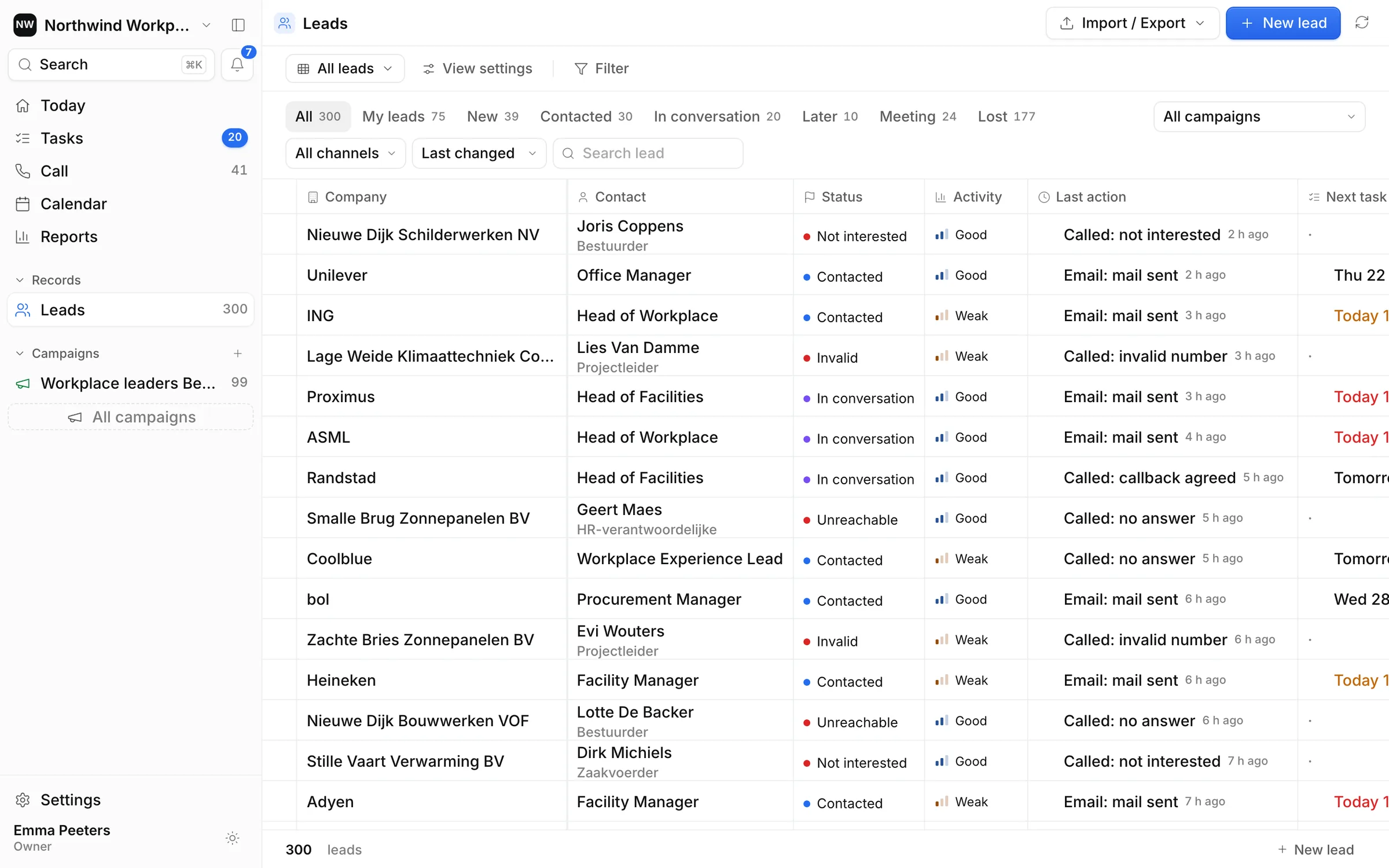
Your lists, in one place
Import Excel, CSV or a Bizzy export into a campaign. Every lead shows its status, last action and next task.
In this industry: Import a Bizzy export of retailers, installers or caterers per region into a campaign per product group, so each caller works a clean list and sees which accounts still need a first attempt.
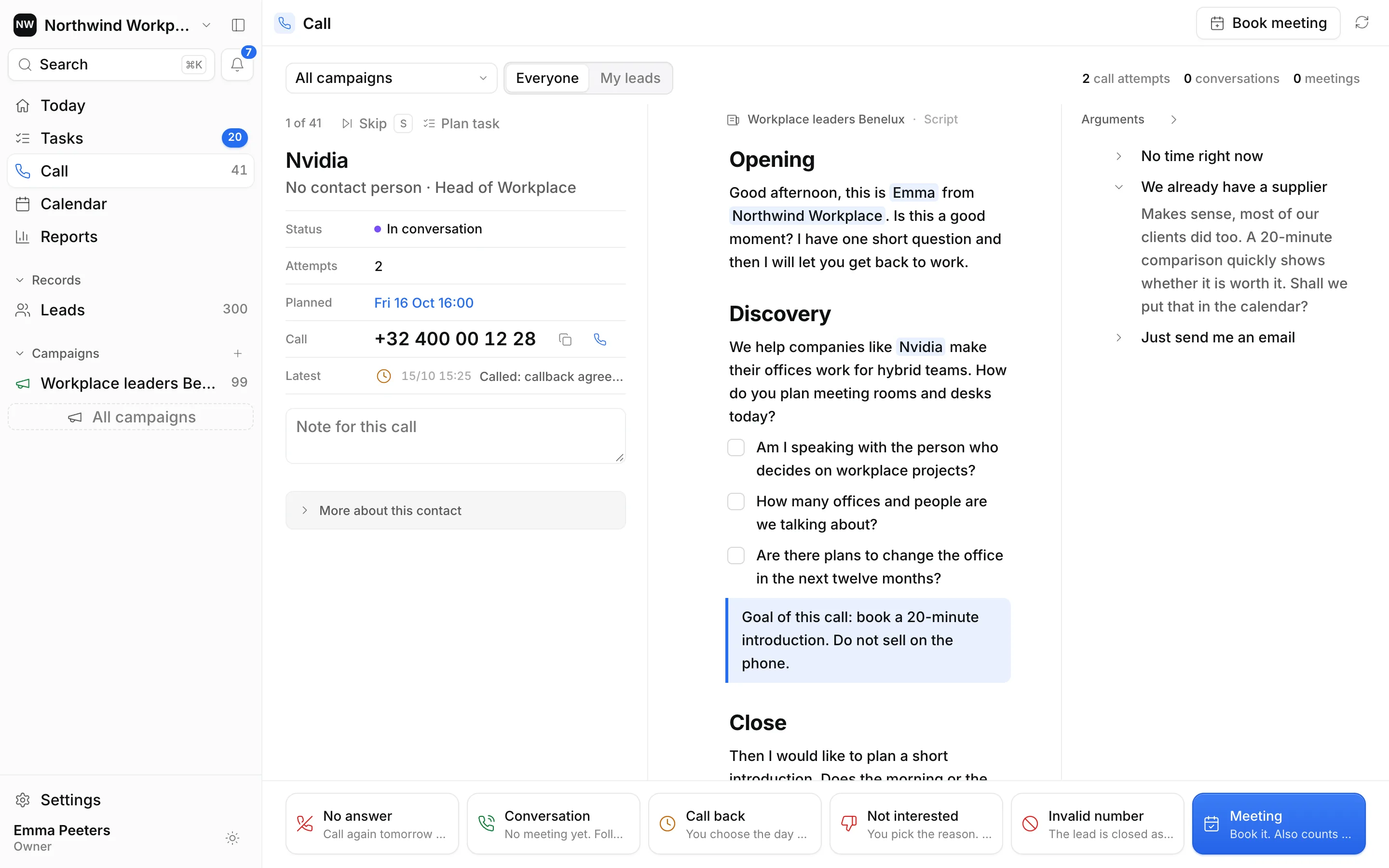
One screen for the call
The lead on the left, the script in the middle with the company name and your own name filled in. Click the number to call from your own phone.
In this industry: Put the questions about current supplier, order frequency, delivery needs and range in the script, so inside sales asks them on every call and the answers stay with the account.
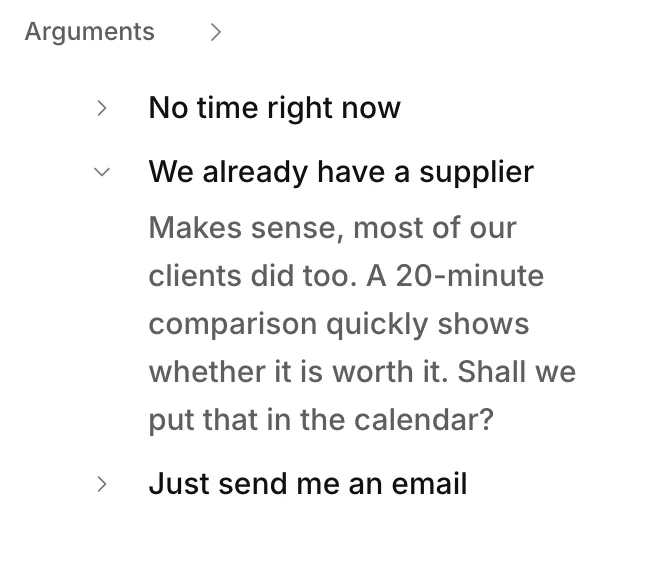
The answer to every objection
Common objections sit in a panel next to the script, so the right answer is one click away.
In this industry: Keep the answers to "we already buy from someone" and "your prices are higher" next to the script, so a caller can move the talk to delivery, stock and service.
One key per call, the next step planned
N (not reached) plans a new attempt the next working day, G (conversation) a follow-up call in three days, T (call back) the moment you pick. A records a meeting; X (not interested, with a reason) and O (invalid number) close the lead.
In this industry: Shop owners and chefs are hard to reach at busy hours. N plans a new attempt for the next working day, and T lets you call back in the quiet hour they name.

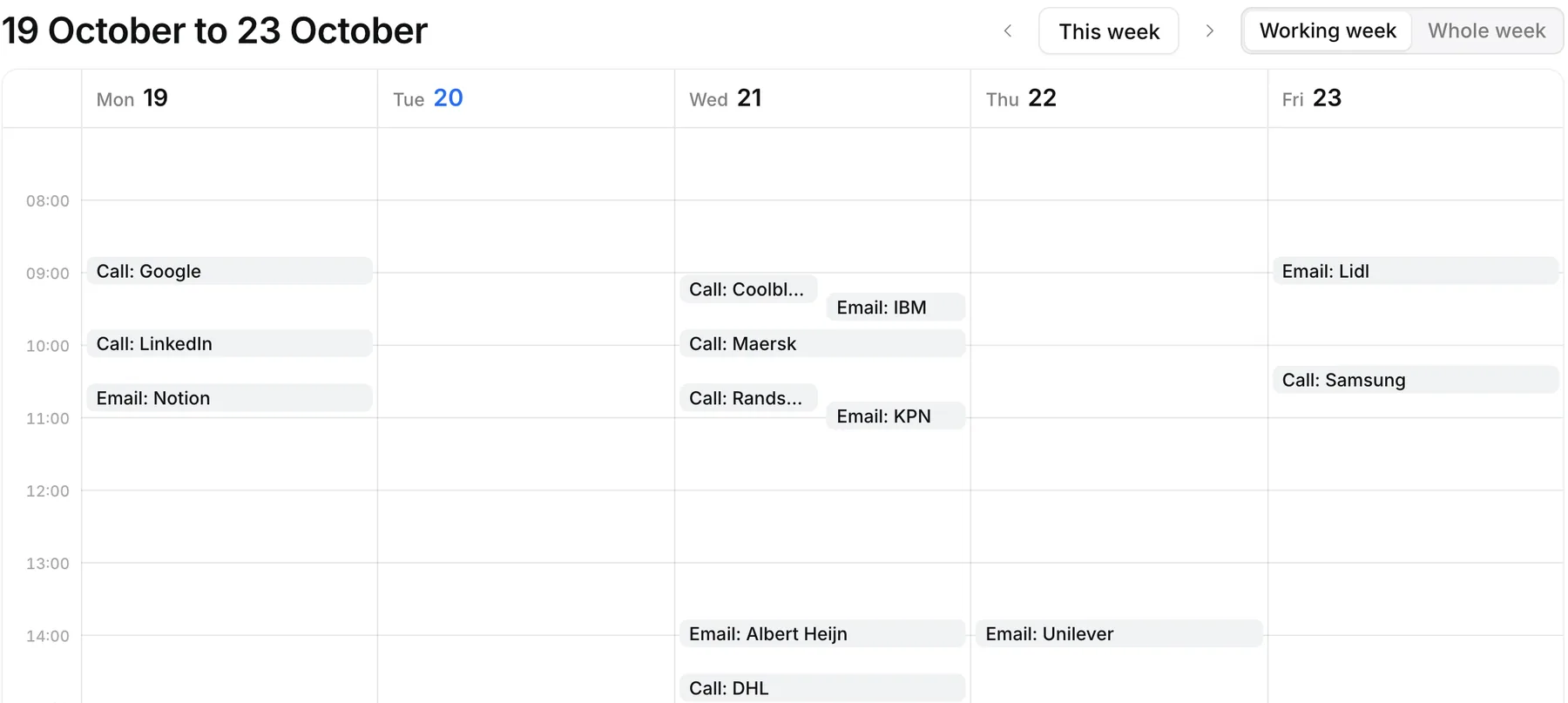
Follow-up on every channel
Calls and emails land in your week. You write emails in Ringlane and send them from your own Gmail; LinkedIn and WhatsApp you send yourself and log by hand. The Today view puts overdue call-backs first.
In this industry: After a conversation, send the price list or account opening form from your own Gmail and see it next to the call history, so nobody sends it twice or forgets it.
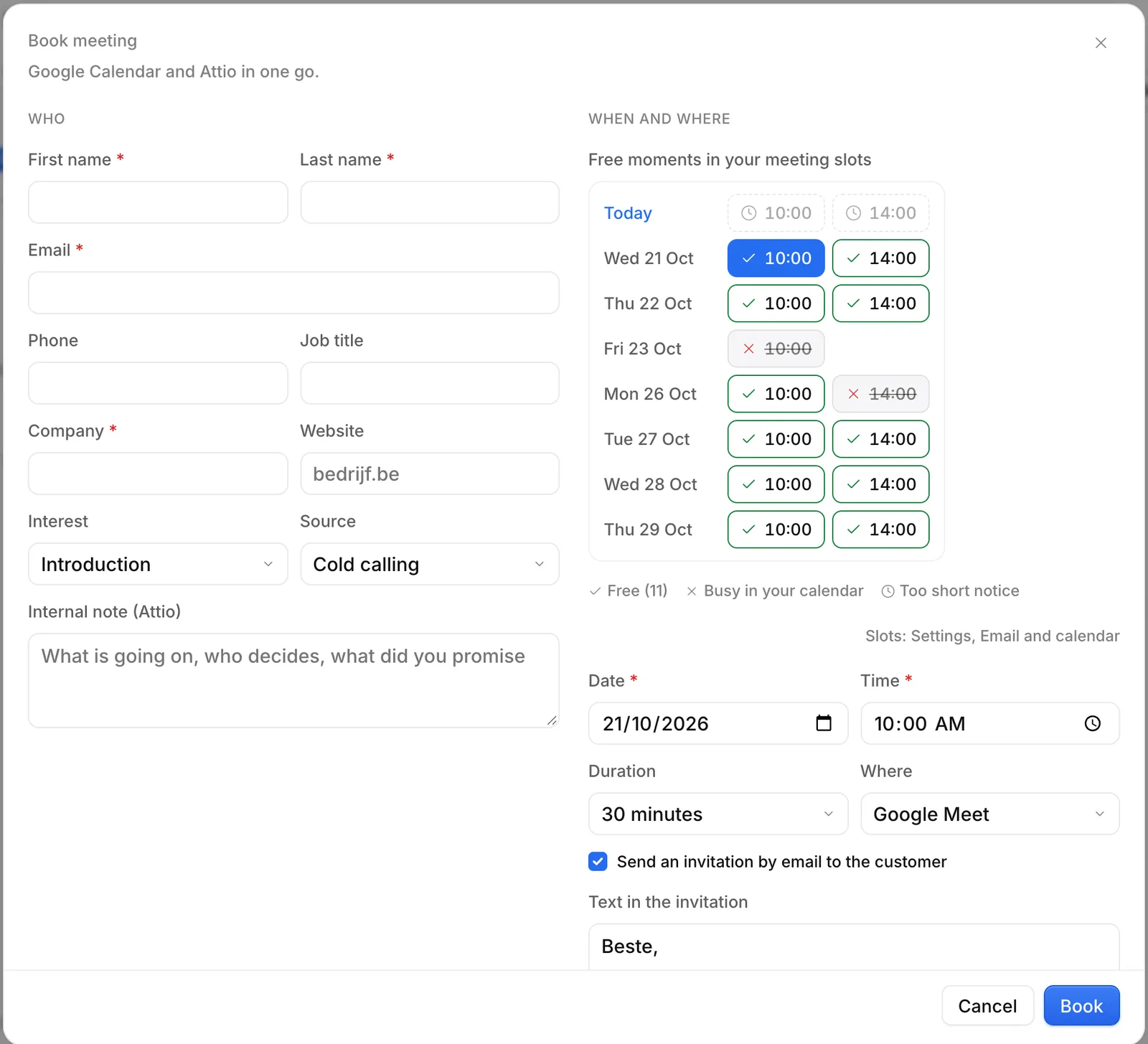
Book while they are on the line
Ringlane shows your free moments in Google Calendar, adds a Google Meet link and sends the invitation. Booked meetings go to Attio.
In this industry: When a buyer agrees to a visit from the account manager or a showroom visit, book it in Google Calendar with an invitation while they are still on the phone.
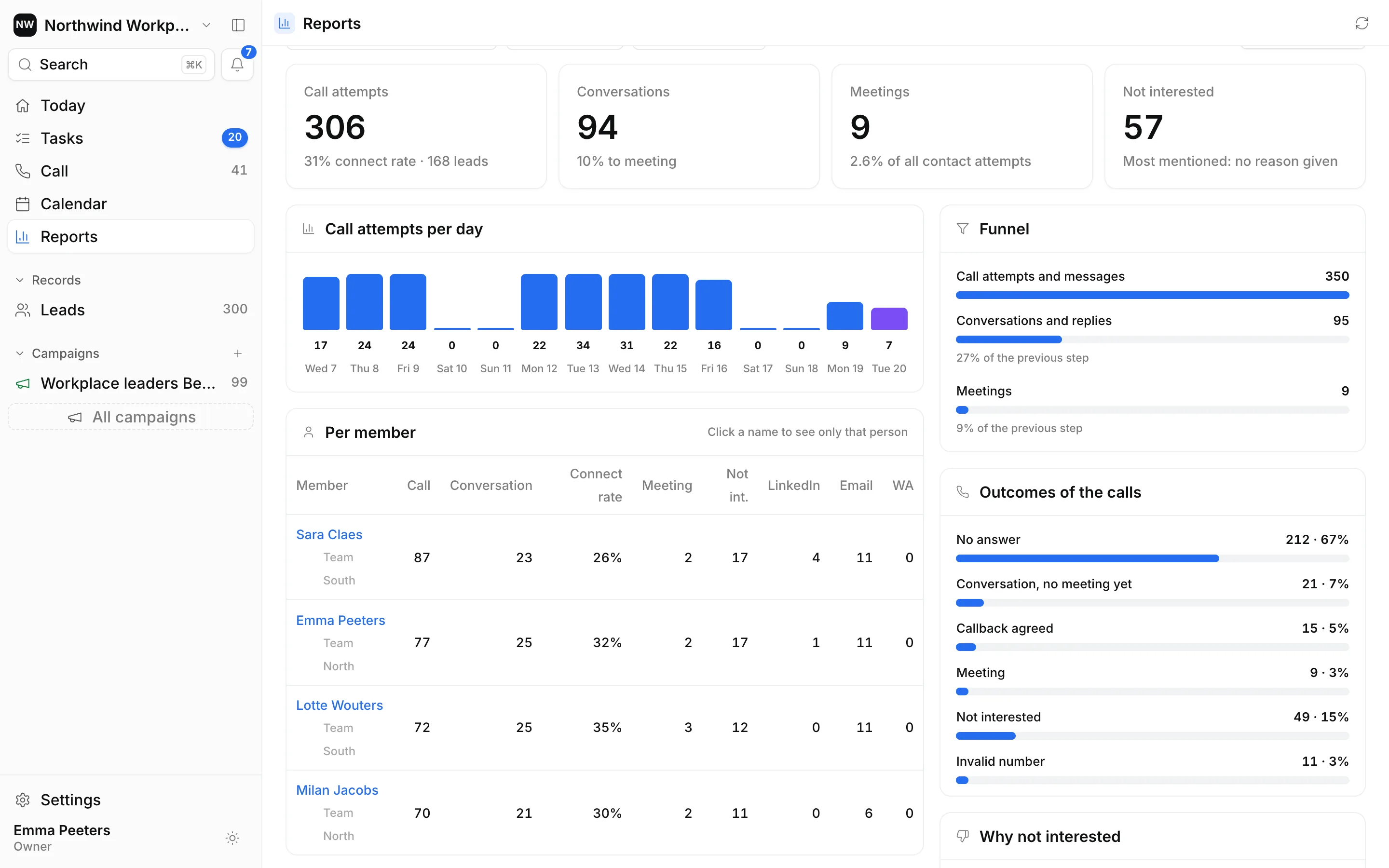
Your numbers, per caller and campaign
Call attempts, connect rate, conversations, meetings, the funnel and the reasons for "not interested", per person, team and campaign.
In this industry: Compare campaigns per product group or region, and read the reasons for not interested to see whether price, range or the current supplier is what stops a first order.
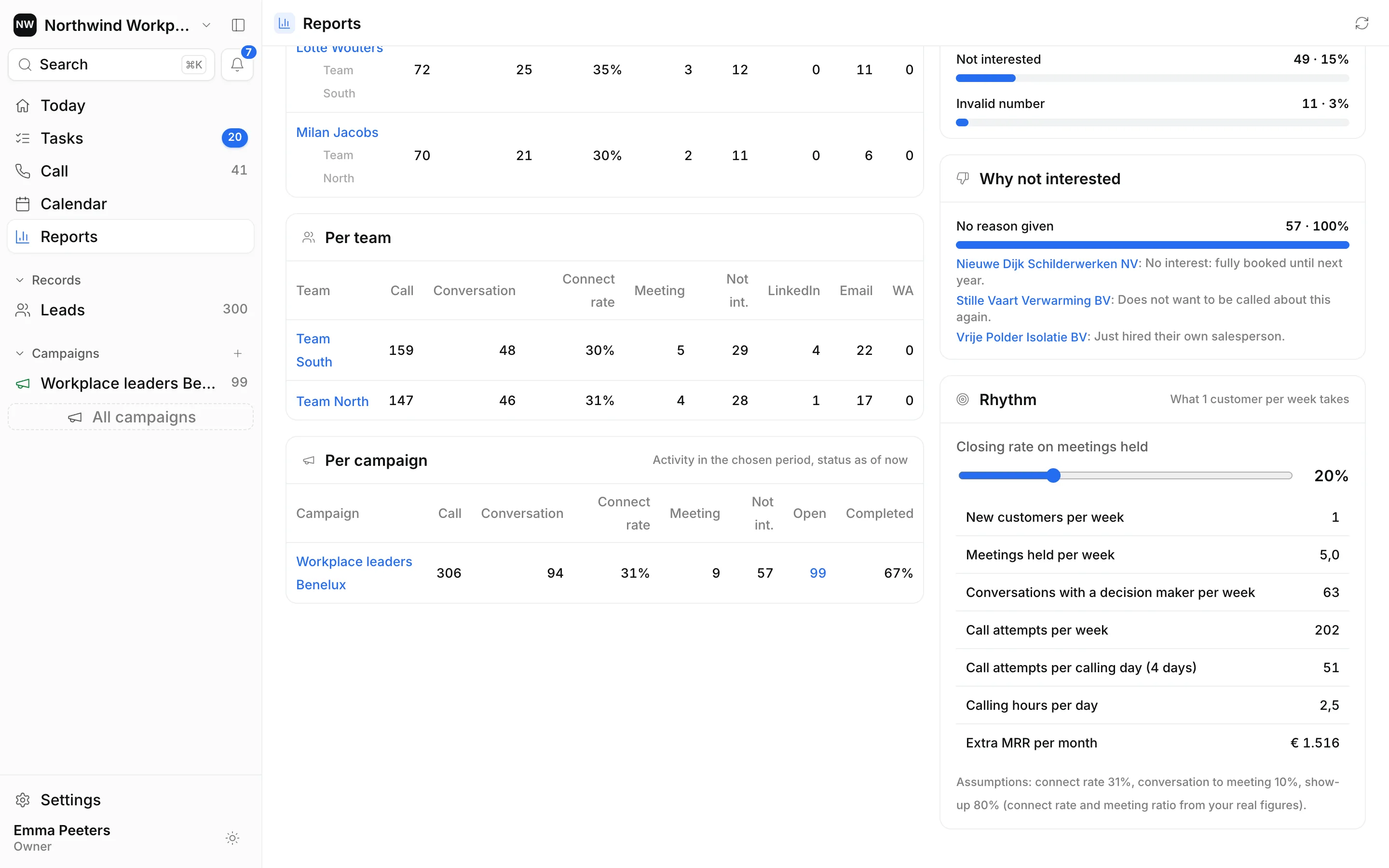
What one new customer takes
Based on your own rates, Ringlane calculates how many calls per week and per day one new customer per week takes.
In this industry: Fill in your own rates and see how many calls per week one new trade account per week takes, so inside sales can plan prospecting next to order handling.
Real screens from the Ringlane app with demo data. No affiliation with the companies shown.
What it can bring you: efficiency, money and more
A new trade account is worth its repeat orders over the years. The table below is an example with assumed numbers, not a forecast. It assumes one inside sales person who makes 600 call attempts a month in fixed blocks, and a new account that buys for an assumed €25,000 per year.
| Step (example, assumed rates) | Assumed rate | Per month |
|---|---|---|
| Call attempts | 600 | |
| Conversations with a buyer | 30% of attempts | 180 |
| Visits, samples or price lists requested | 10% of conversations | 18 |
| New trade accounts with a first order | 25% of those | 4 to 5 |
| Assumed purchases per new account | €25,000 per year |
Your rates will differ. What you can measure is the conversion at each step per product group and per caller, and the reasons customers give for saying no.
The efficiency gain is in the admin. When each call ends with one key and the next attempt or follow-up call is planned for you, there is less to type and less to remember. If logging and planning take a minute per call today, 600 calls is ten hours a month. Measure your own time before and after. Read how to follow up a sales lead, then try the flow in the demo.
Frequently asked questions
Does cold calling still work for wholesalers?
How many wholesalers are there in Belgium and the Netherlands?
Who do you call at a potential trade customer?
How do you get past "we already have a supplier"?
Can Ringlane send price lists automatically?
Sources
- Eurostat: Enterprises by size class and NACE Rev.2 activity (sbs_sc_ovw), 2023
- Eurostat: Enterprises by detailed NACE Rev.2 activity and special aggregates (sbs_ovw_act), 2023
- Eurostat: E-commerce sales of enterprises by NACE Rev.2 activity (isoc_ec_eseln2), 2025
- CBS: Omzet groothandel bijna een procent toegenomen (20 March 2026)
- MarketScreener: Gartner Sales Survey Finds 61% of B2B Buyers Prefer a Rep-Free Buying Experience (Gartner press release, June 2025)
All industries
- Accounting firms
- Business events and venues
- Business finance
- Commercial cleaning
- Commercial real estate
- Commercial solar and energy
- Consultancy
- Corporate catering
- Corporate training
- Fleet, leasing and EV charging
- HR and payroll services
- HVAC and building services
- Industrial manufacturing
- Insurance brokers
- IT services and MSPs
- Logistics and transport
- Marketing agencies
- Office furniture and workplace
- Printing and packaging
- Recruitment and staffing
- SaaS and software
- Security services
- Telecom and connectivity
- Workwear and PPE