Win workwear and PPE accounts by calling when the risk analysis changes
For suppliers of workwear, personal protective equipment and garment rental in Belgium and the Netherlands: who decides, which moments make a call relevant, and how to follow up until the current contract ends.
Workwear and protective equipment are bought because the law and the work demand them. Every employer with risky work needs them, which makes the market large but also crowded. Most buyers already have a supplier, often with a framework contract or a rental and laundry service. The suppliers that win new accounts are the ones that call when something changes: a new risk analysis, a new site, a complaint about fit, or a contract that is about to end.
The market: a legal duty for every employer with risky work
In Belgium, the employer pays. According to the Federal Public Service Employment, the employer bears the cost of providing personal protective equipment and of its maintenance, cleaning, disinfection, repair and timely replacement. PPE is only used when collective or organisational measures cannot reduce the risk enough, it must meet EU Regulation 2016/425, and the employer asks the prevention adviser for advice. For ordinary work clothing, Securex summarises that the employer provides it free of charge from the first day, owns it, maintains it and renews it in time; a Royal Decree of 11 June 2023 clarified these rules from 1 August 2023.
In the Netherlands, article 8.3 of the Arbobesluit requires enough PPE for employees exposed to a hazard, its use, and its maintenance, repair, cleaning and replacement. The Arbowet gives collective protection priority over individual measures. This summary is general information, not legal advice.
The core buyers are construction, industry and transport. In Belgium, Statbel counted 4,001 construction companies and 4,896 industrial companies with 10 or more employees in 2023, plus 22,466 construction companies with 1 to 4 employees. In the Netherlands, the CBS business register counts 5,570 construction businesses, 8,285 industrial businesses and 3,515 transport businesses with 10 or more working persons on 1 October 2026 (provisional). The same register lists 510 wholesalers of workwear, of which 40 have 10 or more working persons.
Who you call and what you ask
- Prevention adviser or safety manager (QHSE): owns the risk analysis and the choice of protection.
- Purchasing manager: negotiates price, framework contracts and delivery.
- Operations, plant or site manager: hears every complaint about comfort, fit and wear.
- Owner: decides at smaller companies, often together with the foreman.
- HR or marketing: involved when clothing carries the company brand.
Moments that make a call relevant:
- A new or updated risk analysis, after an incident, a new machine or new substances.
- Hiring or a new season: new employees need complete kits quickly.
- A new site or a new client with stricter safety requirements.
- The end of a supply, rental or laundry contract.
- A rebranding: new logos mean new clothing for everyone.
Discovery questions that work in this sector:
- How many people work on site or in production, and in how many locations?
- Which risks from your risk analysis does clothing or PPE need to cover?
- Who supplies you today, and do they also handle laundry and repairs?
- What do employees complain about most: fit, comfort, durability or delivery times?
- When does your current agreement end, and who signs the next one?
The answers to the second and fourth question are often the opening for a fitting session: a risk the current kit does not cover well, or a complaint the site manager hears every week.
A short, well-ordered script keeps these questions natural. See how to write a cold calling script.
What slows a calling team down in this sector
- Framework contracts and price pressure. Purchasing often compares on unit price. You need to get to the safety and comfort questions before price ends the call.
- Decisions split between safety and purchasing. The person who chooses is rarely the person who signs. Notes on both save the next call.
- People on the floor. Prevention and site managers are hard to reach at a desk. Repeated attempts at the right hour matter.
- Rental and laundry lock-in. Companies with a garment service switch only at the end of the contract. That date is worth more than any pitch.
- Seasons. Construction holidays and year end slow decisions. Plan call blocks around them.
How Ringlane works for workwear and PPE suppliers
Real screens from the app, with what each feature does in this industry.
Your lists, in one place
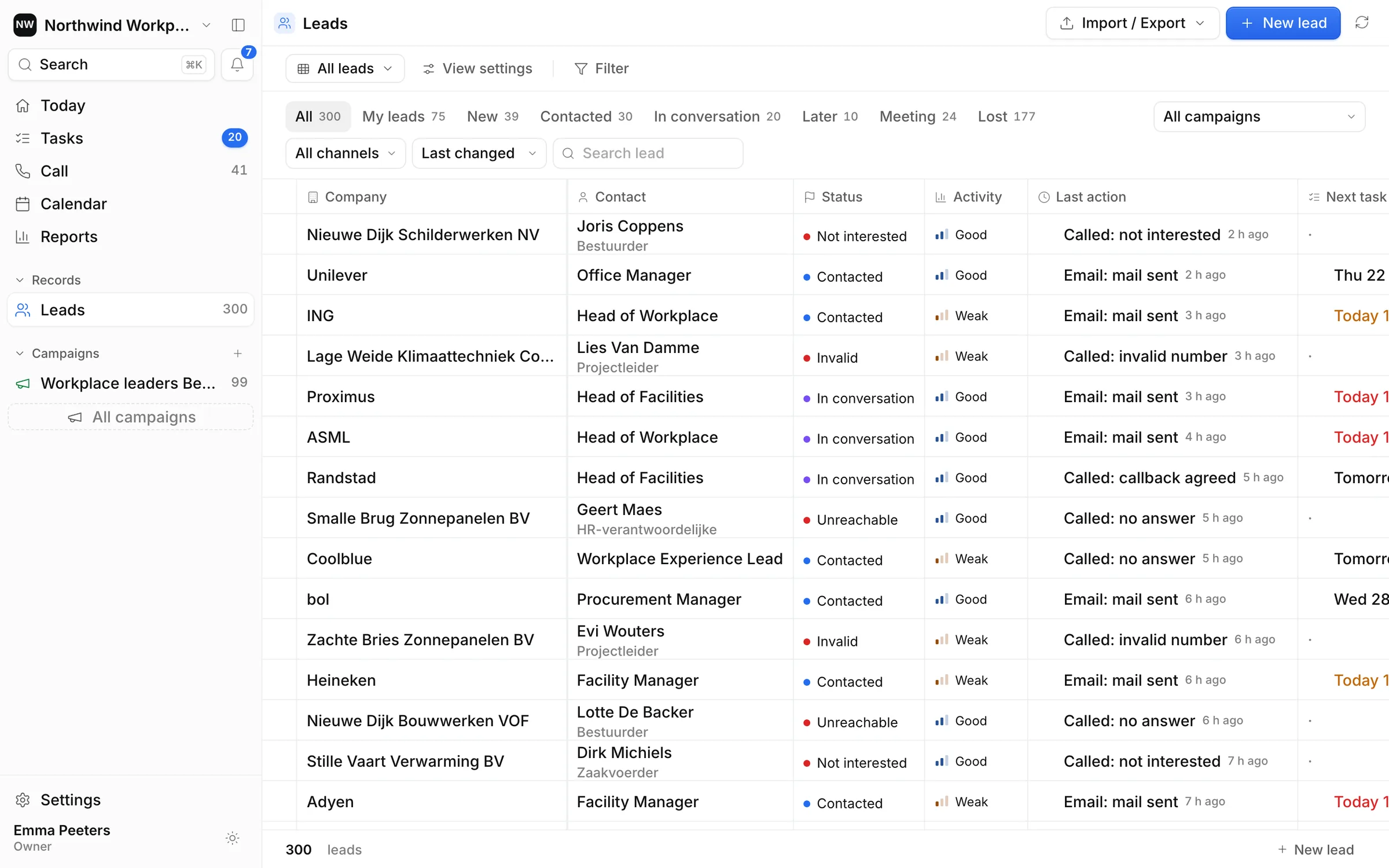
Import Excel, CSV or a Bizzy export into a campaign. Every lead shows its status, last action and next task.
In this industry: Import a Bizzy export of construction, manufacturing and transport companies with 10 or more employees into separate campaigns, because the risks, the clothing and the decision makers differ per sector.
One screen for the call
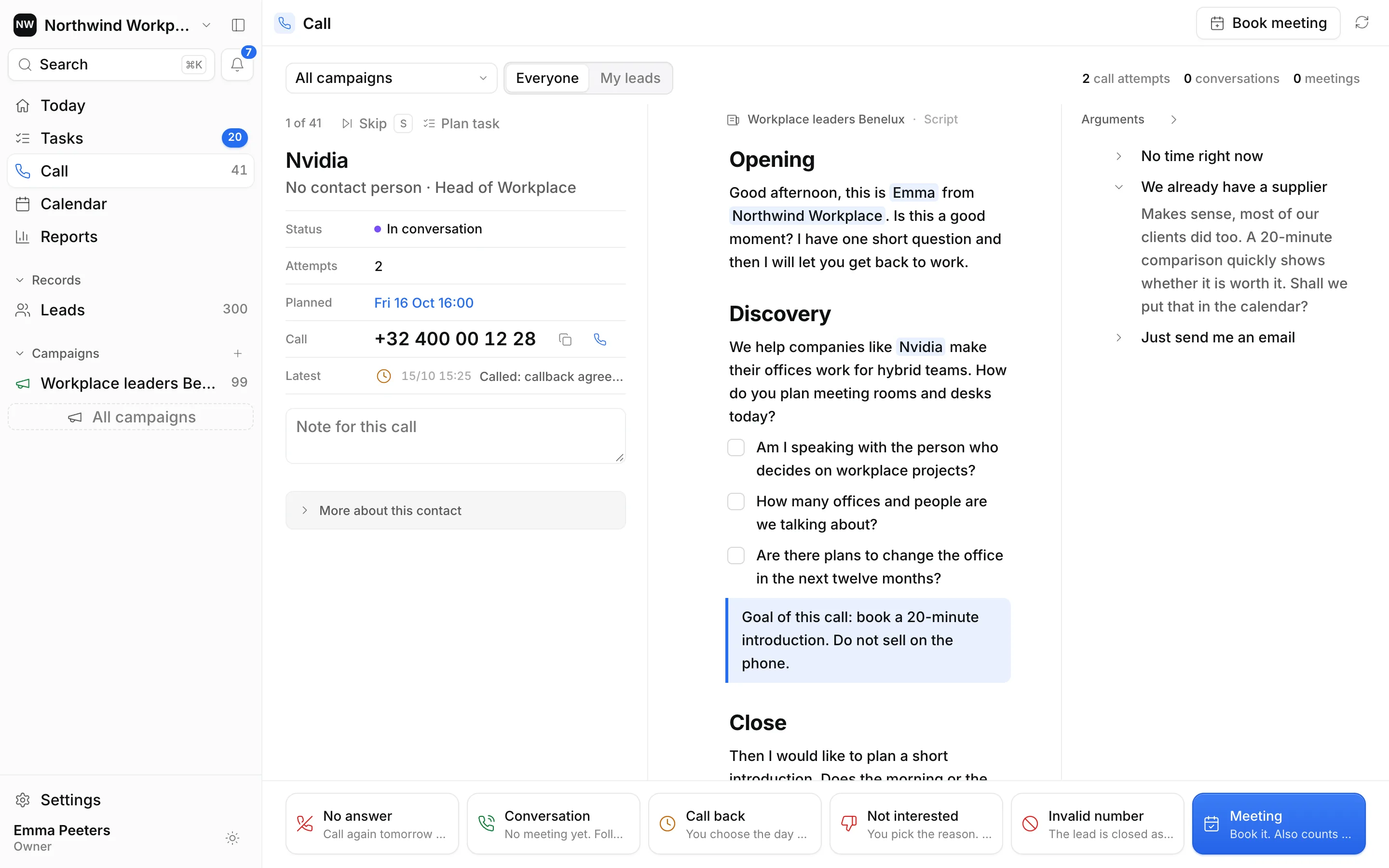
The lead on the left, the script in the middle with the company name and your own name filled in. Click the number to call from your own phone.
In this industry: Put the questions about headcount on site, the risks from the risk analysis, the current supplier, laundry and the contract end in the script, so every caller asks them.
The answer to every objection
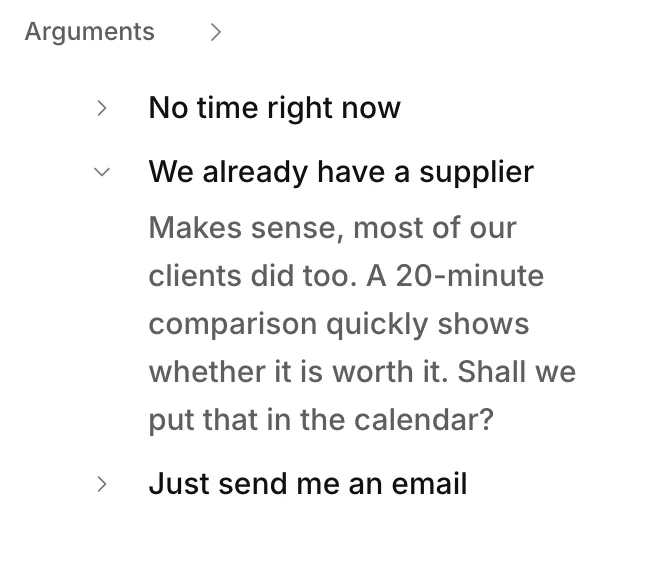
Common objections sit in a panel next to the script, so the right answer is one click away.
In this industry: Keep answers ready to "we buy on price", "our supplier also does the laundry" and "the site manager chooses", each ending in a question about who signs off on PPE and when the contract ends.
One key per call, the next step planned
N (not reached) plans a new attempt the next working day, G (conversation) a follow-up call in three days, T (call back) the moment you pick. A records a meeting; X (not interested, with a reason) and O (invalid number) close the lead.
In this industry: Prevention and site managers are often on the shop floor. N plans a new attempt the next working day; T lets you call back at the time they give, for example early in the morning.

Follow-up on every channel
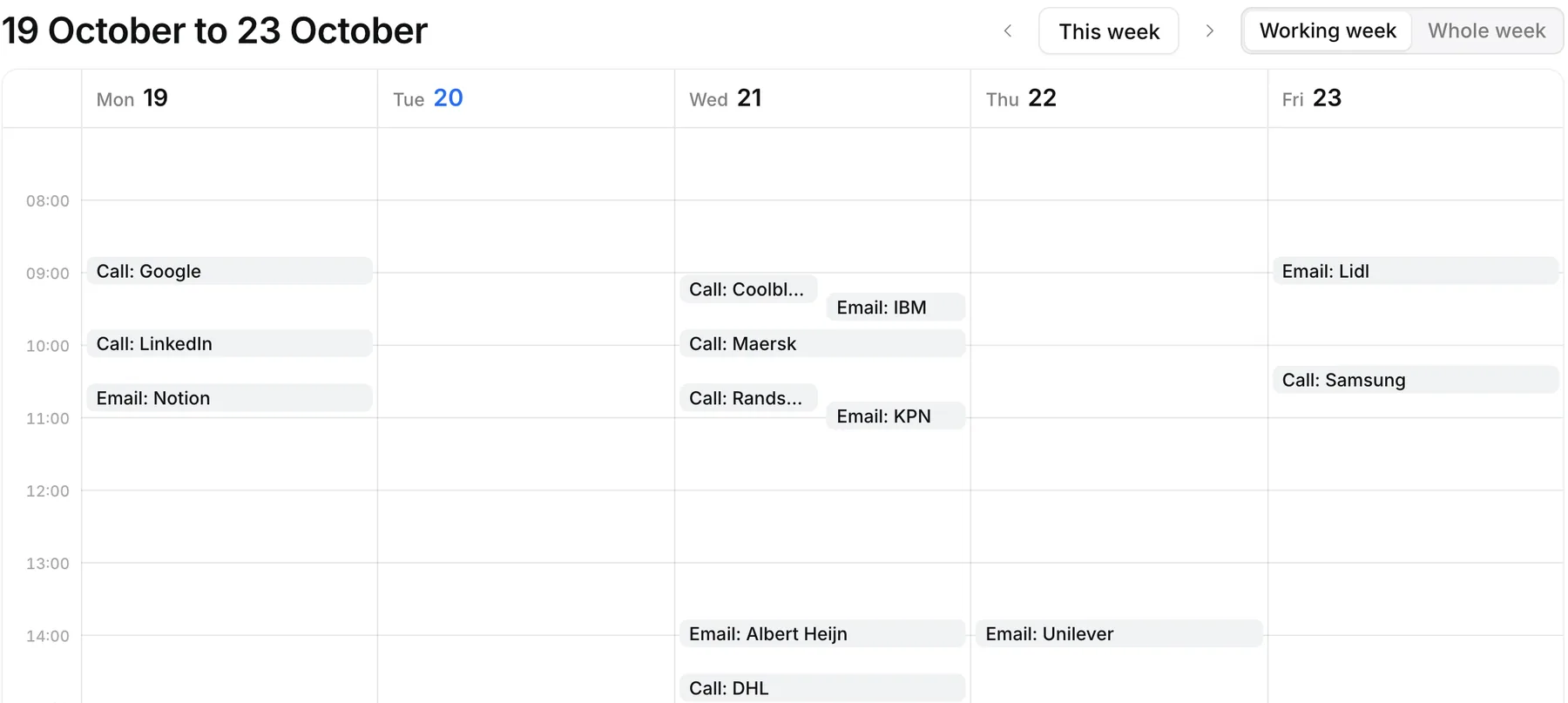
Calls and emails land in your week. You write emails in Ringlane and send them from your own Gmail; LinkedIn and WhatsApp you send yourself and log by hand. The Today view puts overdue call-backs first.
In this industry: After a conversation, send your size kit offer or a product sheet from your own Gmail and see it in the lead history, so the next call starts where the last one ended.
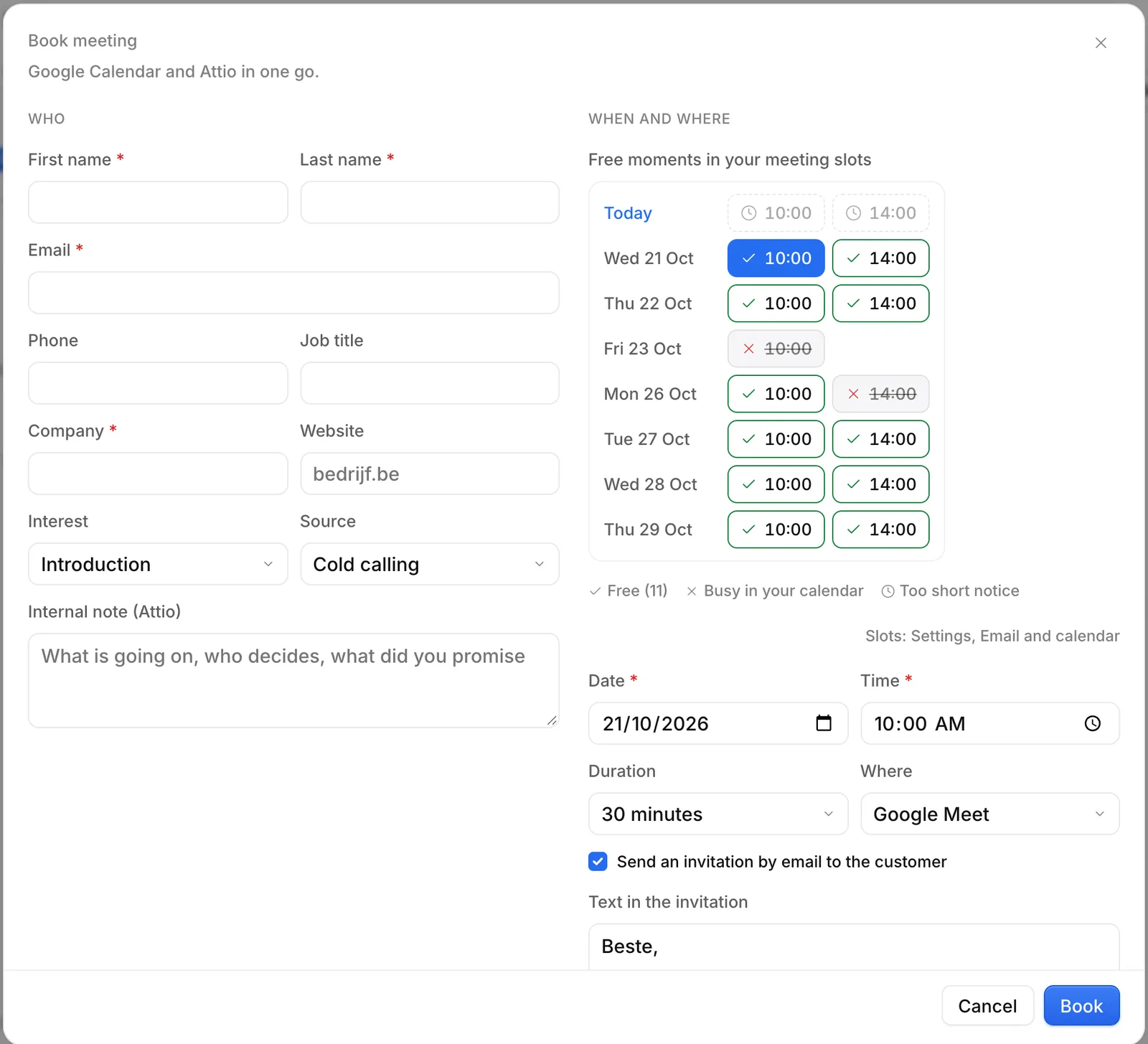
Book while they are on the line
Ringlane shows your free moments in Google Calendar, adds a Google Meet link and sends the invitation. Booked meetings go to Attio.
In this industry: When a safety or purchasing manager agrees to a fitting session or a site visit, book it in Google Calendar while they are on the line; the meeting goes to Attio.
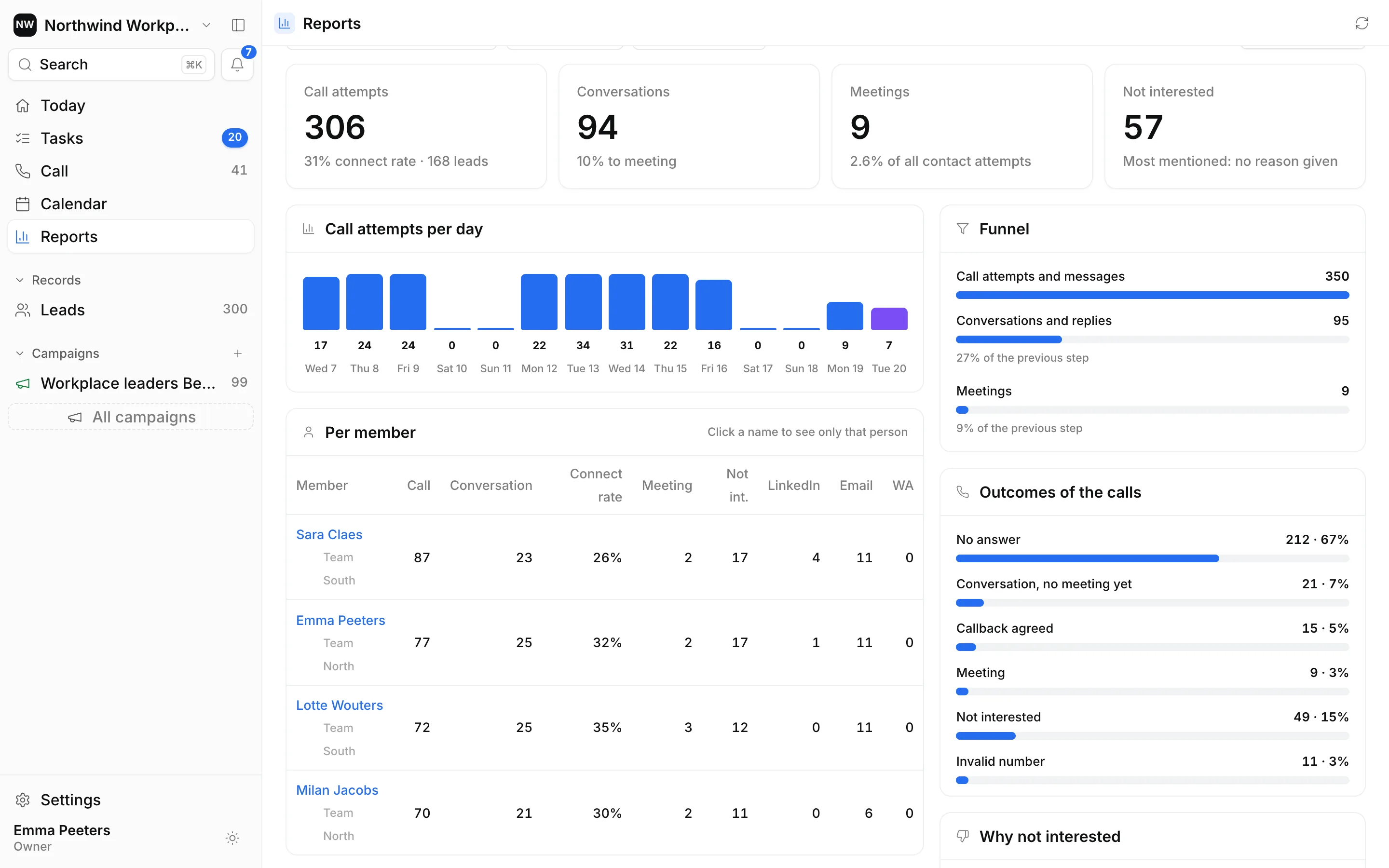
Your numbers, per caller and campaign
Call attempts, connect rate, conversations, meetings, the funnel and the reasons for "not interested", per person, team and campaign.
In this industry: Compare the construction, manufacturing and transport campaigns and read the reasons for not interested. If "framework contract until next year" dominates, plan those leads for the renewal.
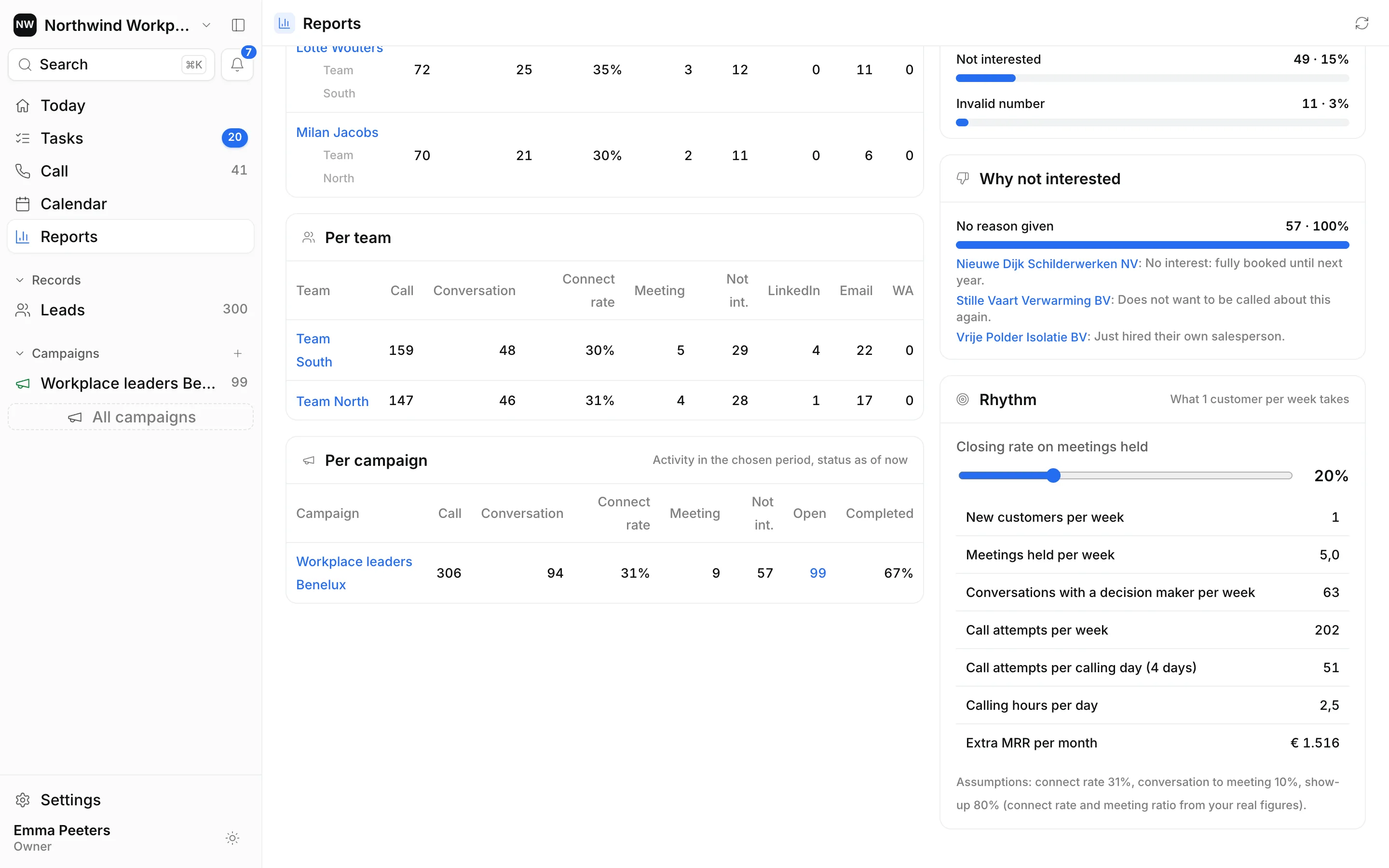
What one new customer takes
Based on your own rates, Ringlane calculates how many calls per week and per day one new customer per week takes.
In this industry: Enter your own connect and meeting rates and see how many calls per week one new account per week takes, so the team can plan around construction holidays and year end.
Real screens from the Ringlane app with demo data. No affiliation with the companies shown.
What it can bring you: efficiency, money and more
A workwear account returns every year for replacements, new hires and sizes, so one extra account is recurring business. The table below is an example with assumed numbers, not a forecast. Replace every figure with your own.
| Example with assumed numbers: one caller, one month | Value |
|---|---|
| Call attempts | 400 |
| Conversations with a decision maker (assumed 25%) | 100 |
| Fittings or site visits booked (assumed 8% of conversations) | 8 |
| New accounts (assumed 25% of meetings) | 2 |
| Value of one account (assumed 80 employees at 300 euro per person per year, over 3 years) | 72,000 euro |
In this example, two new accounts a month are worth 144,000 euro in revenue over three years. Your own numbers will differ, which is why it helps to measure them. See how many calls it takes to win one customer.
Efficiency is the other half. Measure for one week how long your team spends after each call on notes, contract dates and remembering which site manager to call back. Logging the outcome with one key, with the next call already planned, removes most of that. A company whose rental contract ends next spring is then in the calendar in time. Read how to follow up leads for a simple cadence.
Want to see the calling screen first? Try the demo.
Frequently asked questions
Who decides on workwear and PPE at a company?
Who pays for workwear and PPE in Belgium?
What does Dutch law say about PPE?
How many potential customers are there?
How many calls does it take to win one workwear account?
Sources
- FPS Employment (werk.belgie.be): Persoonlijke beschermingsmiddelen
- Securex: Werkkledij, duidelijkere bepalingen (Royal Decree of 11 June 2023)
- Wetten.overheid.nl: Arbeidsomstandighedenbesluit, article 8.3
- Wetten.overheid.nl: Arbeidsomstandighedenwet
- Statbel: Demography of enterprises with employees, by NACE and size class, 2023 (Bestat)
- CBS StatLine: Bedrijven; bedrijfsgrootte en rechtsvorm (table 81589NED)
All industries
- Accounting firms
- Business events and venues
- Business finance
- Commercial cleaning
- Commercial real estate
- Commercial solar and energy
- Consultancy
- Corporate catering
- Corporate training
- Fleet, leasing and EV charging
- HR and payroll services
- HVAC and building services
- Industrial manufacturing
- Insurance brokers
- IT services and MSPs
- Logistics and transport
- Marketing agencies
- Office furniture and workplace
- Printing and packaging
- Recruitment and staffing
- SaaS and software
- Security services
- Telecom and connectivity
- Wholesale and distribution