Win new print and packaging accounts with buyers you called yourself
For commercial printers, label printers and packaging producers in Belgium and the Netherlands: who buys print and packaging, when a call lands, and how to follow up until the first order.
Every company that sells a physical product needs packaging, labels and print, and almost all of them already have suppliers. New business for a printer or packaging producer is about being the better option at the moment a buyer looks again: a new product, a rebrand, a supplier that misses a deadline, or new rules that force a change of material. In 2026 that last reason reaches across the whole EU.
The market: fewer printers, more pressure on packaging
The Belgian printing sector is consolidating. According to Febelgra, based on social security data, the graphic sector without newspaper printers counted 567 employers in 2024, against 614 in 2023 and 938 in 2014. Of these, 410 were printers, 134 prepress firms and 23 finishing firms, together employing 7,454 people. Federation figures count employers; Eurostat business statistics also count businesses without staff and find 4,113 enterprises in printing and related services in Belgium and 2,771 in the Netherlands in 2023. In the wider printing division, only 166 Belgian and 280 Dutch enterprises had 10 or more persons employed.
Packaging producers are fewer and larger. The same Eurostat series counts 100 Belgian and 171 Dutch enterprises making corrugated paper and paperboard packaging, and 108 Belgian and 153 Dutch enterprises making plastic packing goods in 2023. The volumes are large: Eurostat reports 166.7 kg of packaging waste per inhabitant in Belgium and 168.5 kg in the Netherlands in 2023, against 177.8 kg in the EU.
Rules are changing what buyers ask for. The EU Packaging and Packaging Waste Regulation entered into force on 11 February 2025 and generally applies from 12 August 2026. It sets recyclability performance grades from 2030, and packaging must be recyclable at scale from 2035. This is general information, not legal advice. For a packaging supplier, that is a reason to call that is about the buyer's problem, not your machine park.
Decisions follow the product. A small brand owner picks a printer on quality, speed and price. Food producers and manufacturers involve purchasing, quality, marketing and sometimes the retailer, test materials on their own lines and switch suppliers only after a trial. Larger accounts run supplier reviews and framework agreements.
Who you call and what you ask
The people who decide on print and packaging:
- Purchasing manager or buyer: owns the supplier list, prices and contracts.
- Packaging engineer or packaging manager: chooses materials and tests them on the line.
- Product or brand manager: drives new products, rebrands and design changes.
- Marketing or communication manager: buys brochures, displays and promotional print.
- Owner: at smaller producers and brands, the one who decides.
Trigger events that make the call relevant: the EU packaging rules and a review of materials, a new product or product line, a rebrand, rising volumes or a new export market, a supplier with long lead times or quality problems, a retailer's demand, and a supplier review or framework agreement that ends.
Discovery questions that work in this sector:
- Which packaging or print do you buy most, and in what volumes?
- How are you preparing for the new EU packaging rules, and which materials are under review?
- What went wrong with a supplier in the last year: lead time, quality, price?
- Which new products or changes are planned for the coming year?
- Who tests and approves a new material or supplier?
New rules are a chance to teach the buyer something they did not know: read the challenger sale in cold calling, and turn these questions into a cold calling script.
What slows a calling team down in this sector
- The incumbent supplier. Switching packaging means new tests, new artwork and risk on the line. Buyers do not switch for a small price difference.
- Price per unit. Quotes are compared per thousand pieces. A good conversation is about lead times, waste, recyclability and the cost of a missed delivery.
- Several decision makers. Purchasing, quality, marketing and production all have a say, and samples go back and forth.
- Long trials. From a first sample to a first order can take months. The follow-up has to be planned, or it is forgotten.
- Peak periods. Seasonal products and year-end campaigns keep buyers busy when you most want to talk.
How Ringlane works for printers and packaging companies
Real screens from the app, with what each feature does in this industry.
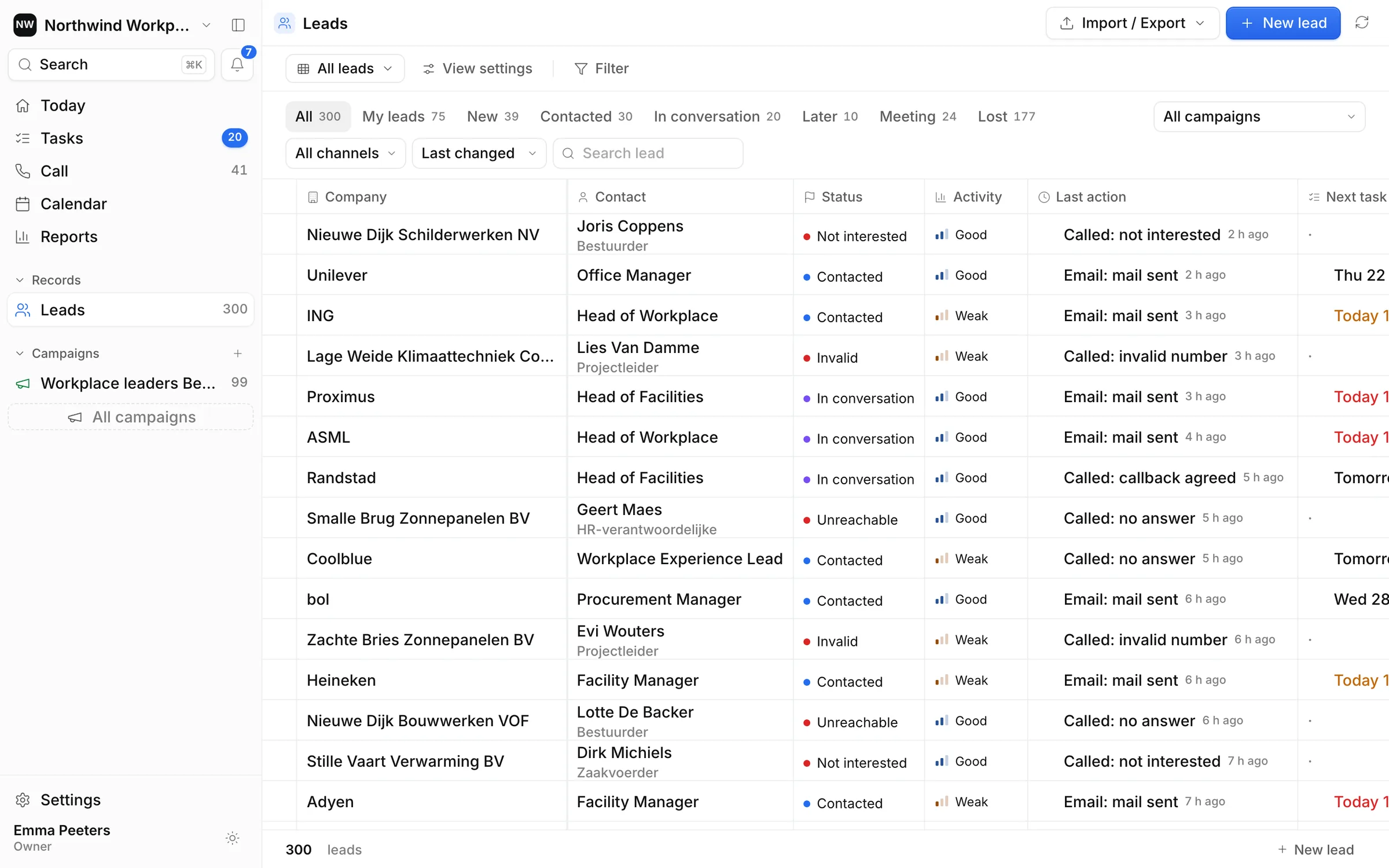
Your lists, in one place
Import Excel, CSV or a Bizzy export into a campaign. Every lead shows its status, last action and next task.
In this industry: Import a Bizzy export of food producers, brands, e-commerce companies or manufacturers by region into one campaign per product, such as folding boxes, labels or marketing print, so each caller works one clear list.
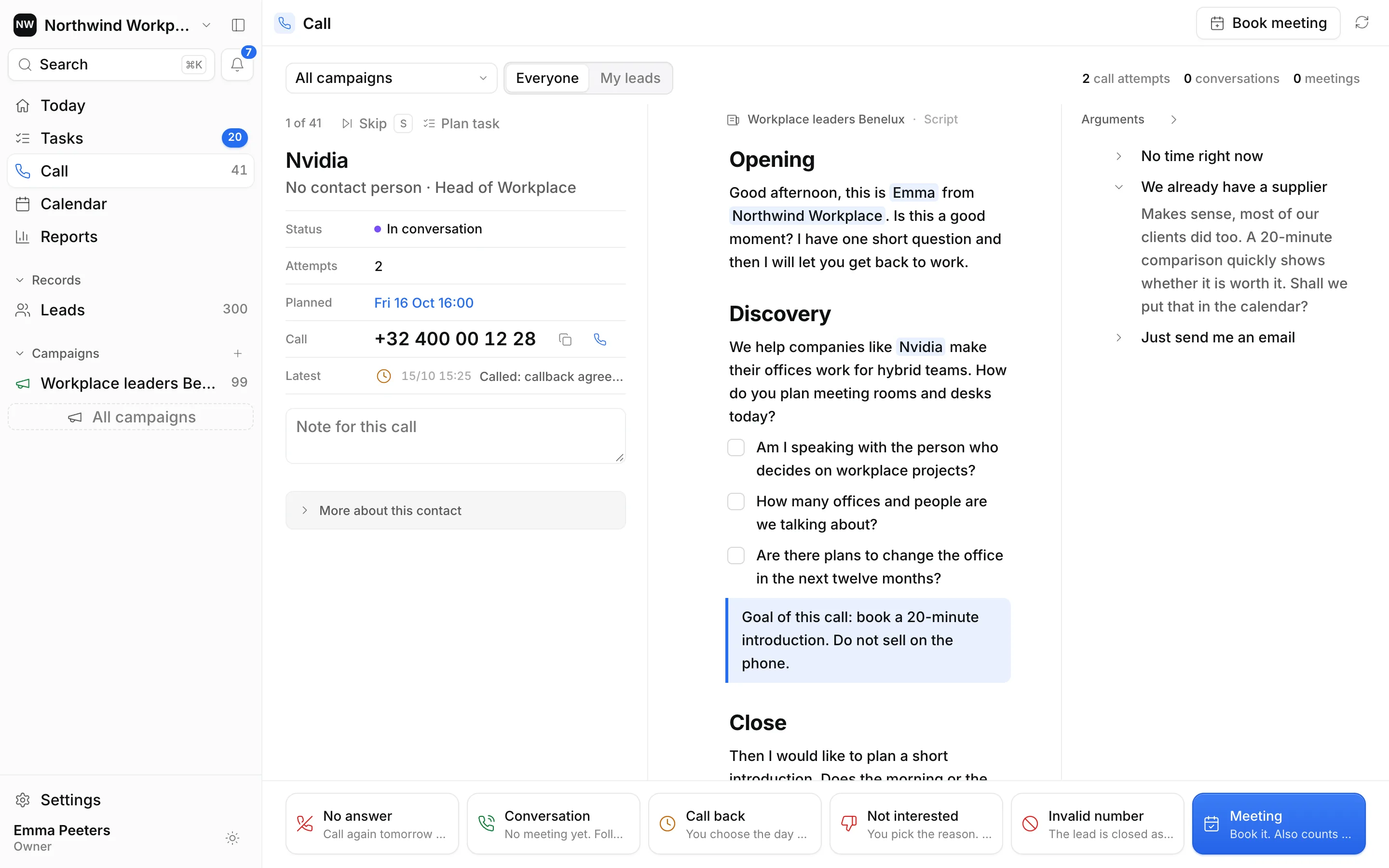
One screen for the call
The lead on the left, the script in the middle with the company name and your own name filled in. Click the number to call from your own phone.
In this industry: Put the questions about volumes, current supplier, materials and the plans for the new EU packaging rules in the script, so every caller asks them in every call.
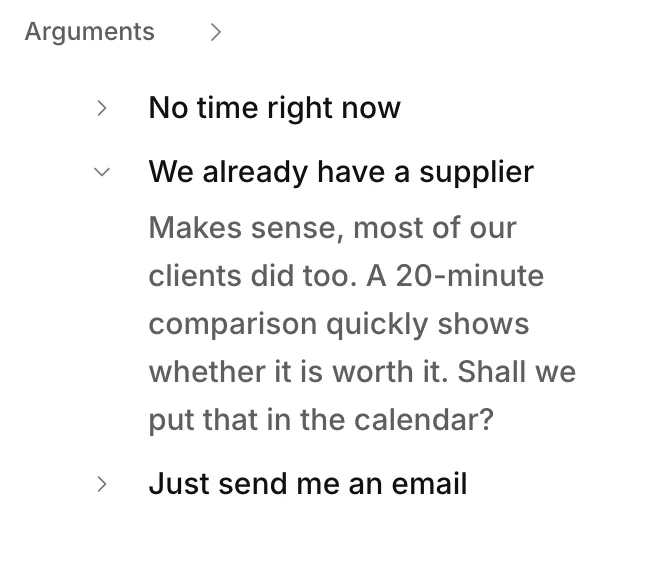
The answer to every objection
Common objections sit in a panel next to the script, so the right answer is one click away.
In this industry: Keep the answers to "we are happy with our supplier" and "you are too expensive" next to the script, so a caller can ask about lead times, recyclability or a trial run instead of hanging up.
One key per call, the next step planned
N (not reached) plans a new attempt the next working day, G (conversation) a follow-up call in three days, T (call back) the moment you pick. A records a meeting; X (not interested, with a reason) and O (invalid number) close the lead.
In this industry: Buyers and packaging managers are often in production meetings. N plans the next attempt for the next working day, and T lets you call back at the moment they name.

Follow-up on every channel
Calls and emails land in your week. You write emails in Ringlane and send them from your own Gmail; LinkedIn and WhatsApp you send yourself and log by hand. The Today view puts overdue call-backs first.
In this industry: After a conversation, send a sample request, a material note or a quote from your own Gmail and see it next to the call history, so a colleague knows which samples were promised.
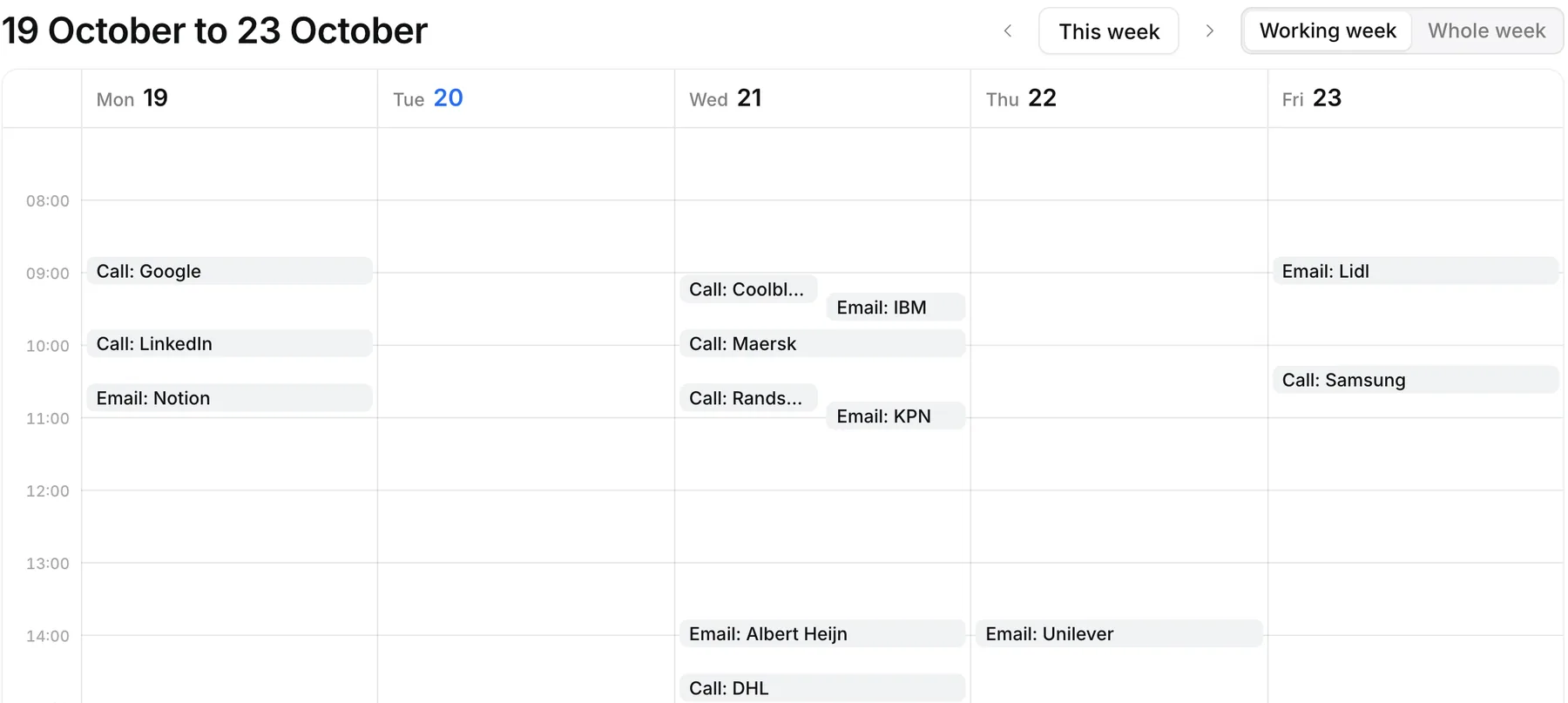
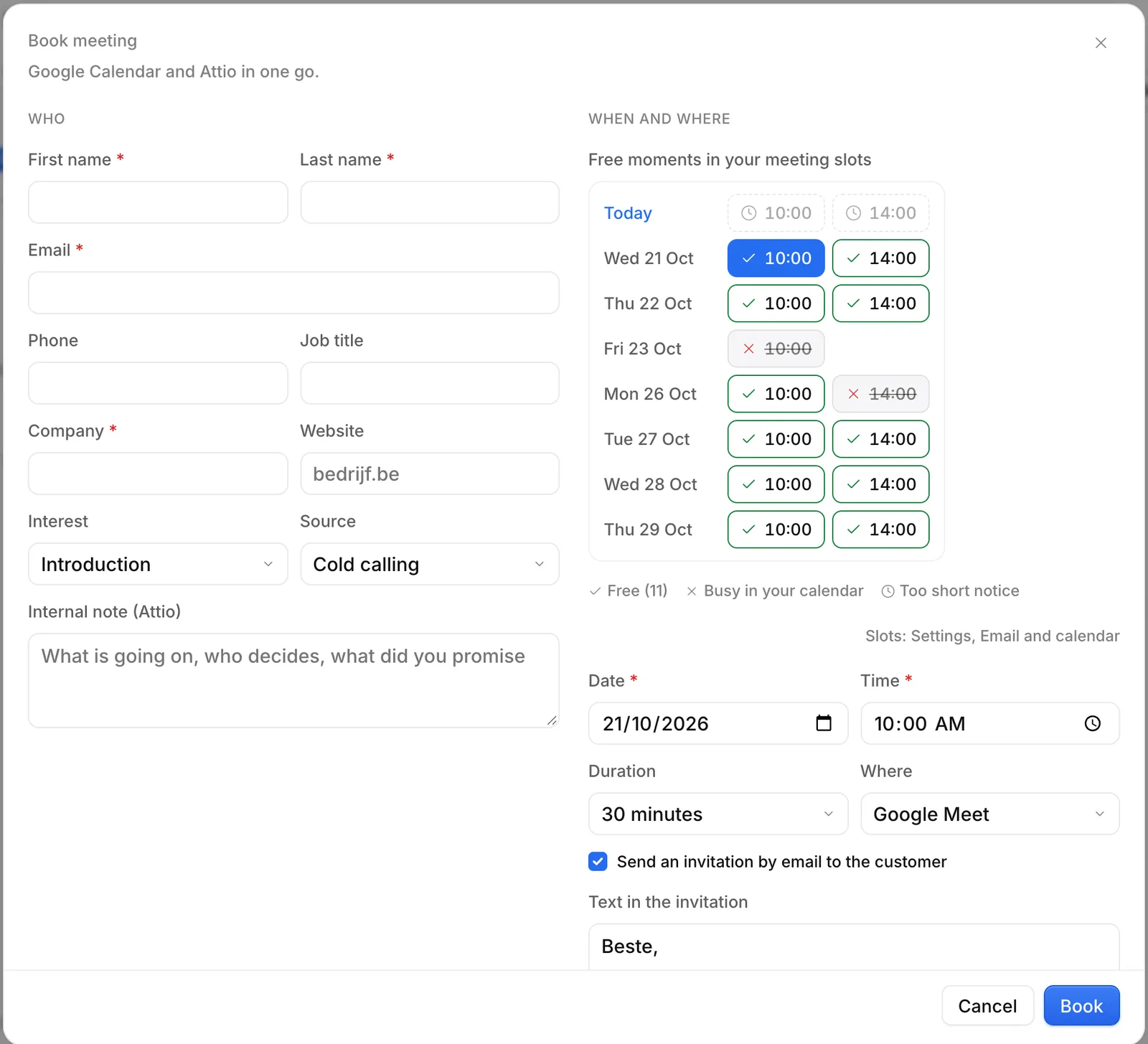
Book while they are on the line
Ringlane shows your free moments in Google Calendar, adds a Google Meet link and sends the invitation. Booked meetings go to Attio.
In this industry: When a buyer agrees to a meeting or a visit to the plant, book it in a free slot in Google Calendar and send the invitation while they are still on the line, then hand it to Attio.
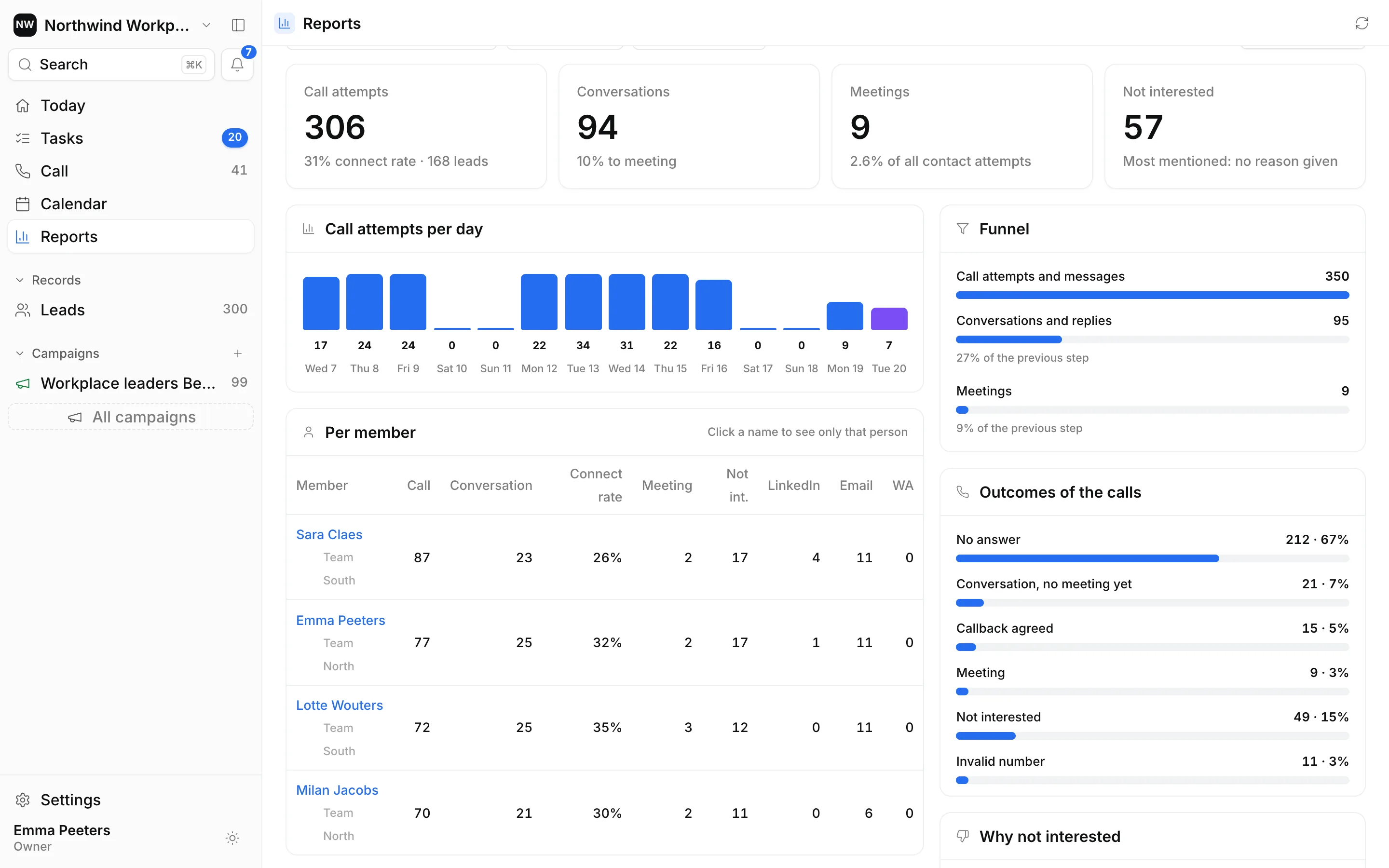
Your numbers, per caller and campaign
Call attempts, connect rate, conversations, meetings, the funnel and the reasons for "not interested", per person, team and campaign.
In this industry: Compare campaigns per product or per sector and read the reasons for not interested, to see whether an existing supplier, price or timing blocks you most.
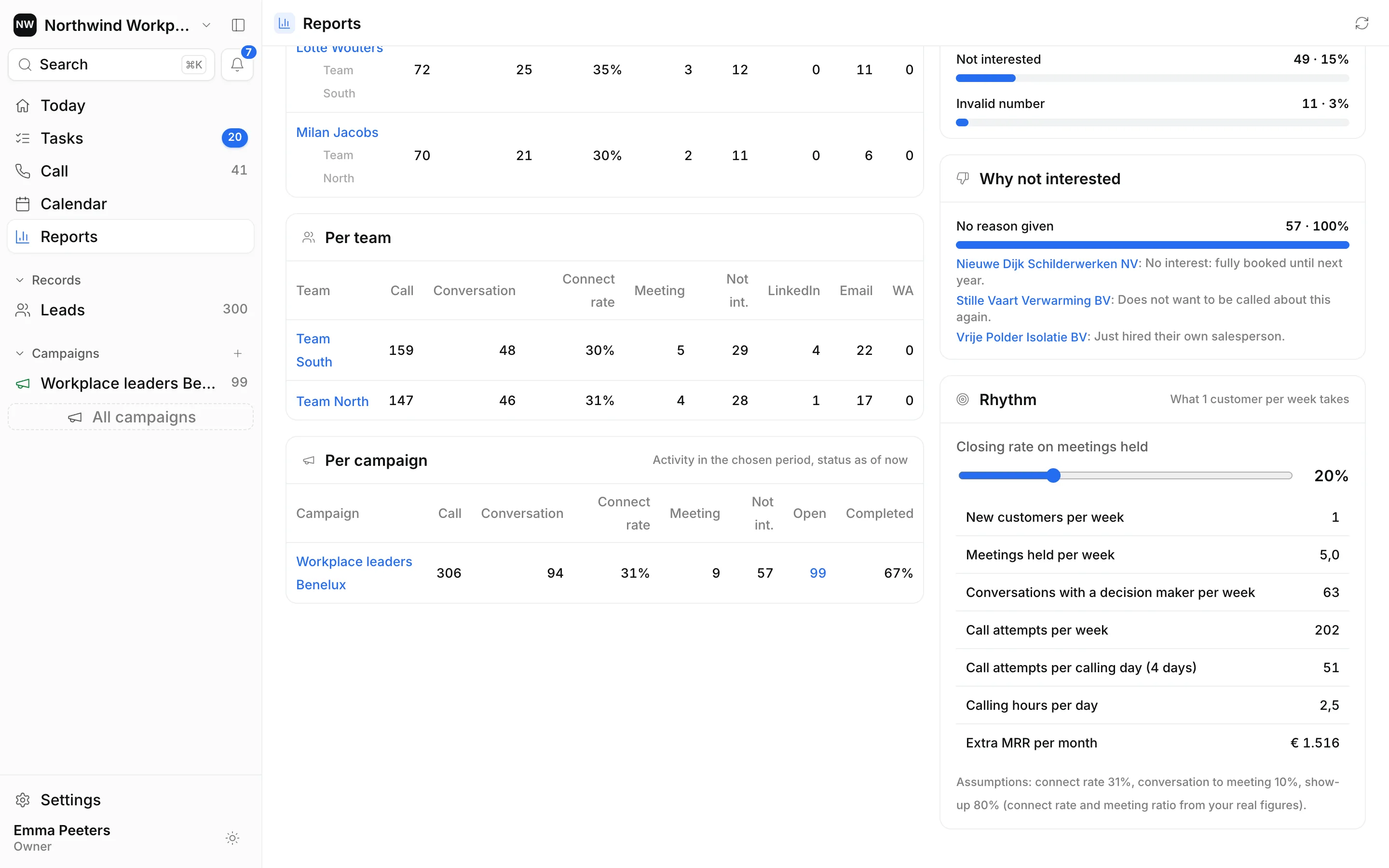
What one new customer takes
Based on your own rates, Ringlane calculates how many calls per week and per day one new customer per week takes.
In this industry: Fill in your own rates and see how many calls per week one new account per week takes, so you can plan the calling around the periods when buyers review suppliers.
Real screens from the Ringlane app with demo data. No affiliation with the companies shown.
What it can bring you: efficiency, money and more
For a printer or packaging producer, the measurable steps are the meeting and the sample. What you can track is how many calls lead to a conversation, how many conversations to a meeting or sample request, and how many of those to a first order.
Example with assumed numbers: one caller, one month, and an assumed value of 30,000 euros a year for one new print or packaging account. These are not benchmarks; replace them with your own figures.
| Step | Assumption | Result |
|---|---|---|
| Call attempts | 35 per day, 20 working days | 700 |
| Conversations | 15% of attempts | 105 |
| Meetings or sample requests | 15% of conversations | 16 |
| New accounts | 1 in 5 meetings | 3 |
| Value per year | 3 x 30,000 euros (assumed) | 90,000 euros |
Efficiency is something you can measure too. Time how long it takes today to note an outcome and plan the next step. If one key and an automatically planned follow-up save two minutes per attempt, 700 attempts save about 23 hours a month. Check that against your own week rather than taking it on trust.
The bigger gain is often in the follow-up. A buyer who asked for samples and heard nothing for three weeks is a buyer who stays with the old supplier. Read how to follow up sales leads, or try it yourself in the interactive demo.
Frequently asked questions
Does cold calling work for printers and packaging companies?
Who buys print and packaging at a company?
What is the EU Packaging and Packaging Waste Regulation?
How many printing companies are there in Belgium?
Does Ringlane calculate quotes or manage samples?
Sources
- Febelgra: First Impression June 2025, Sectorcijfers 2024 part 1 (RSZ data)
- Eurostat: Enterprises by detailed NACE Rev.2 activity (sbs_ovw_act), NACE 18.1, 17.21 and 22.22, 2023
- Eurostat: Enterprises by size class and NACE Rev.2 activity (sbs_sc_ovw), NACE 18, 2023
- European Circular Economy Stakeholder Platform: The EU Packaging and Packaging Waste Regulation, when will it come into effect
- Eurostat: Packaging waste by waste management operations (env_waspac), 2023
All industries
- Accounting firms
- Business events and venues
- Business finance
- Commercial cleaning
- Commercial real estate
- Commercial solar and energy
- Consultancy
- Corporate catering
- Corporate training
- Fleet, leasing and EV charging
- HR and payroll services
- HVAC and building services
- Industrial manufacturing
- Insurance brokers
- IT services and MSPs
- Logistics and transport
- Marketing agencies
- Office furniture and workplace
- Recruitment and staffing
- SaaS and software
- Security services
- Telecom and connectivity
- Wholesale and distribution
- Workwear and PPE