Win new client companies with calls timed to their hiring needs
For recruitment, search and staffing agencies in Belgium and the Netherlands: who to call at an employer, which signals make the call relevant, and how consultants keep business development going next to their candidates.
Recruitment and staffing agencies live on two markets at once: candidates and client companies. Most consultants spend their days on the first and call the second when time allows, which is rarely. The agencies that grow treat business development as fixed work, call employers about one concrete role, and follow up until the vacancy, the peak or the contract renewal comes.
The market: big volumes, many agencies, slower demand
Belgium has a large, organised staffing market. According to Federgon's key figures for 2025, temporary agency work had 7.14 billion euro turnover, up 2.8%, with 218 million hours worked by 740,216 unique temporary workers. Temporary work accounted for 2.64% of salaried employment. Federgon's recruitment, search and selection members had 215.1 million euro turnover, 4.0% less than a year earlier, and interim management fell 12.0%. Federgon has 242 member companies in temporary work and 303 in recruitment, search and selection.
The Dutch market is under pressure. According to the ABU annual figures for 2025, hours worked through agencies fell 5% while turnover stayed flat. Administrative staffing was hit hardest, with 17% fewer hours; industrial staffing lost 1% of hours but grew turnover 4%; technical staffing lost 10% of hours. The CBS business register counted 4,065 temporary employment agencies and 11,705 recruitment and placement businesses on 1 October 2026 (provisional figures).
For business development this means: employers have many agencies to choose from, fewer hours to fill in several segments, and rising expectations. A consultant who calls with a sharp question about one role stands out from the agency that sends a general mail.
Who you call and what you ask
Call the person who feels the empty role and the person who chooses suppliers:
- Owner or operations manager at smaller employers.
- HR manager or talent acquisition lead at mid-sized and larger companies.
- Line manager: a plant manager, warehouse manager or head of finance who needs the people.
- Purchasing: involved when agencies are put on a preferred supplier list or a framework agreement.
Signals that make a call relevant:
- Vacancies that stay open on the employer's site or job boards for weeks.
- Seasonal peaks, for example in logistics before the holidays or in retail in December.
- A new site, a new shift or a contract the employer just won.
- New rules. In the Netherlands, the Wtta takes effect on 1 January 2027. According to AWVN, agencies register for the transitional arrangement between 1 November 2026 and 1 January 2027, and from 1 January 2028 clients that use agencies without admission can be penalised. Employers will review who they work with.
Discovery questions that work with employers:
- Which role is hardest to fill for you right now, and how long has it been open?
- Which agencies do you work with today, and what would you change about that?
- When are your peak periods, and how far ahead do you plan them?
- Who decides which agencies are on your supplier list, and when is it reviewed?
- If I send one profile for that role this week, who should receive it?
Most of these calls meet the same objections. See how to handle sales objections.
What slows a calling team down in this sector
- Candidate work eats the day. Interviews, references and placements always feel more urgent than client calls, so business development slips week after week.
- Agency fatigue. HR managers get many calls from agencies and recognise a generic pitch within seconds.
- Preferred supplier lists and frameworks. Larger employers only review their agencies at fixed moments. Missing that moment means waiting a year.
- Timing. "No vacancies now" is often true today and false in three months. Without a planned call back, the lead is lost.
- Shared markets. In agencies with several branches, consultants call the same employers without knowing it.
The agencies that keep business development going usually agree on three things. Every consultant has a fixed patch, so nobody calls the same employer twice. Every call ends with a planned next step, even if it is a call back in three months when the peak season starts. And the team looks at the same numbers every week: how many employers were reached, how many intakes were booked, and why employers said no. That turns acquisition from something that happens when there is time into a routine that survives a busy week of candidate work.
How Ringlane works for recruitment and staffing agencies
Real screens from the app, with what each feature does in this industry.
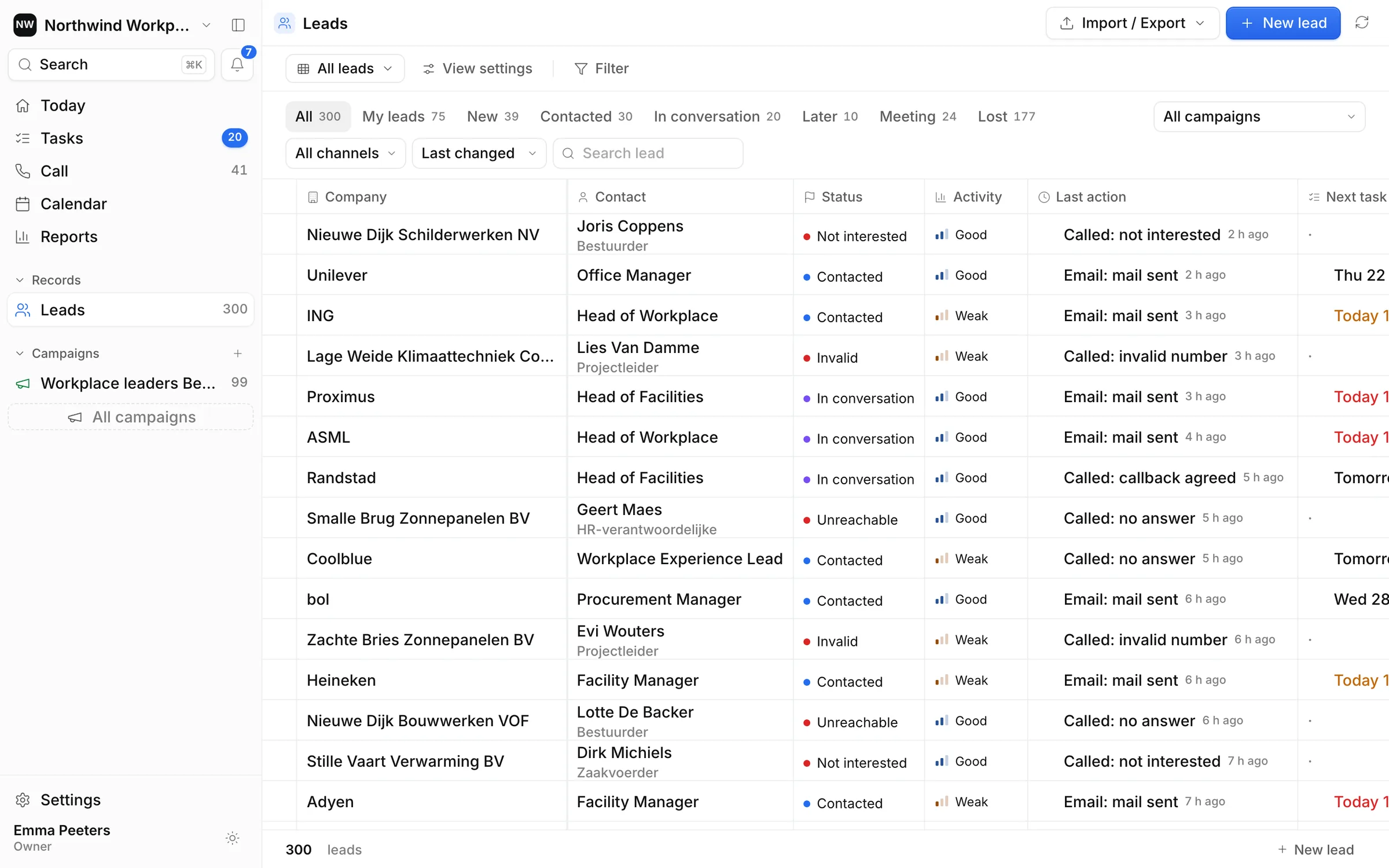
Your lists, in one place
Import Excel, CSV or a Bizzy export into a campaign. Every lead shows its status, last action and next task.
In this industry: Import a list of employers per sector and region, for example logistics companies around Antwerp or installers in Brabant, into one campaign per consultant's patch, so each consultant works their own employers.
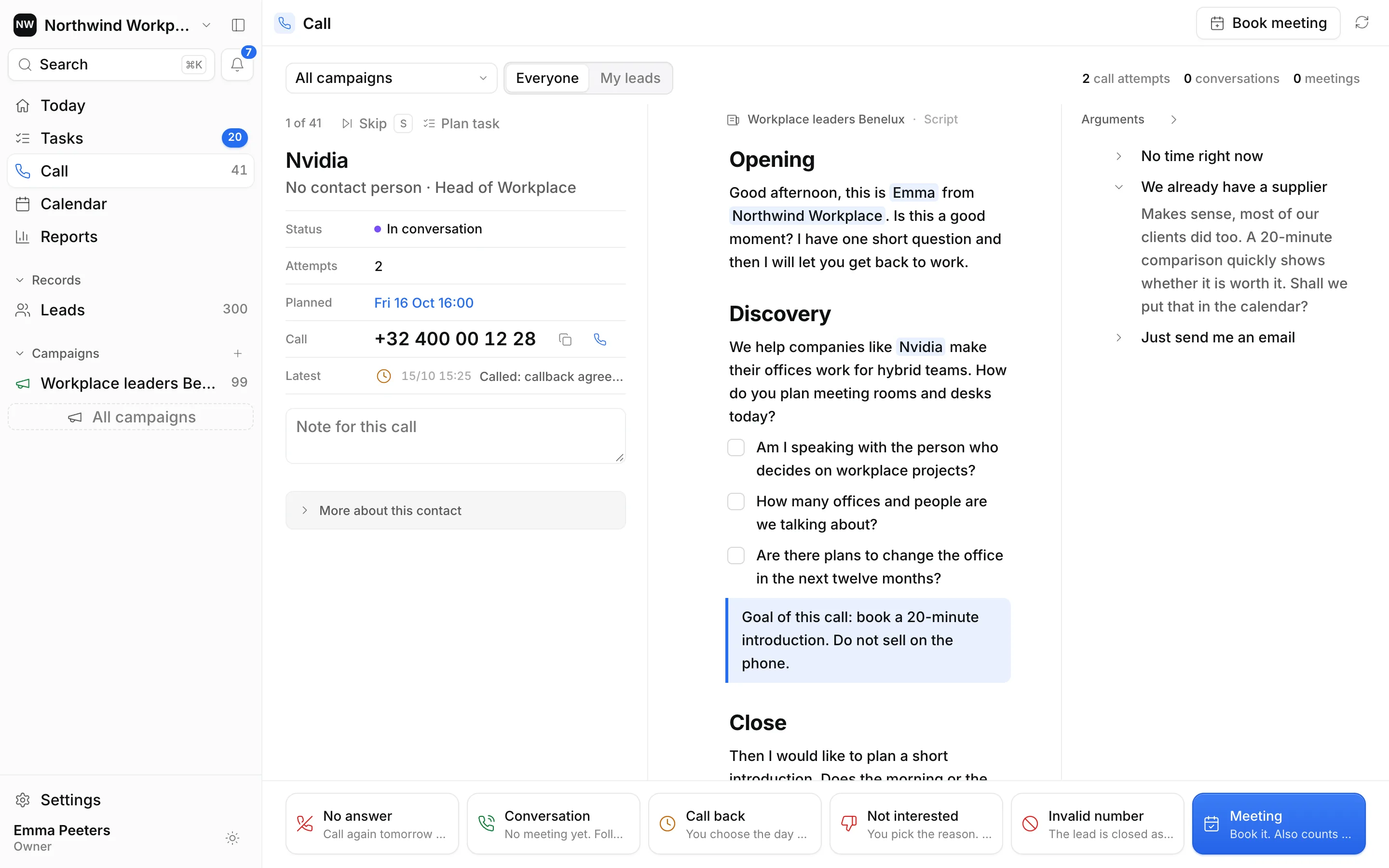
One screen for the call
The lead on the left, the script in the middle with the company name and your own name filled in. Click the number to call from your own phone.
In this industry: Put the questions about open roles, current agencies, preferred supplier lists and peak periods in the script, so every consultant qualifies an employer the same way.
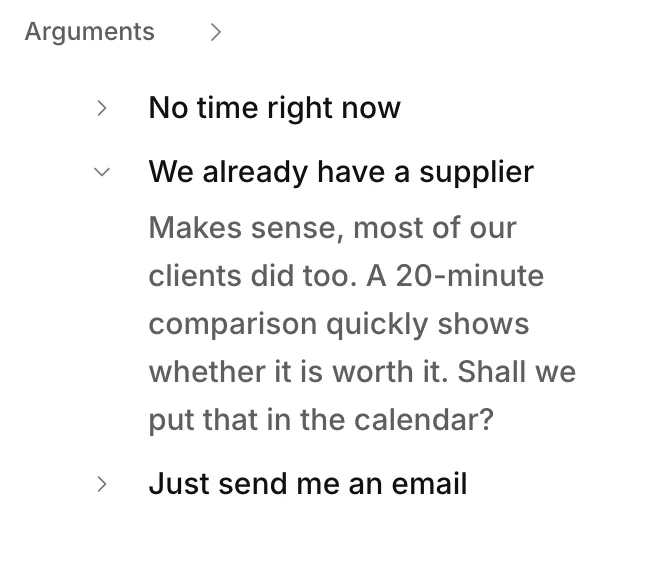
The answer to every objection
Common objections sit in a panel next to the script, so the right answer is one click away.
In this industry: Keep answers to "we already work with three agencies", "we recruit ourselves" and "your fees are too high" next to the script, each one steering toward a single hard-to-fill role.
One key per call, the next step planned
N (not reached) plans a new attempt the next working day, G (conversation) a follow-up call in three days, T (call back) the moment you pick. A records a meeting; X (not interested, with a reason) and O (invalid number) close the lead.
In this industry: HR managers and plant managers are often in interviews or on the floor. N plans the next attempt for the next working day; T lets you call back at the slot they name.

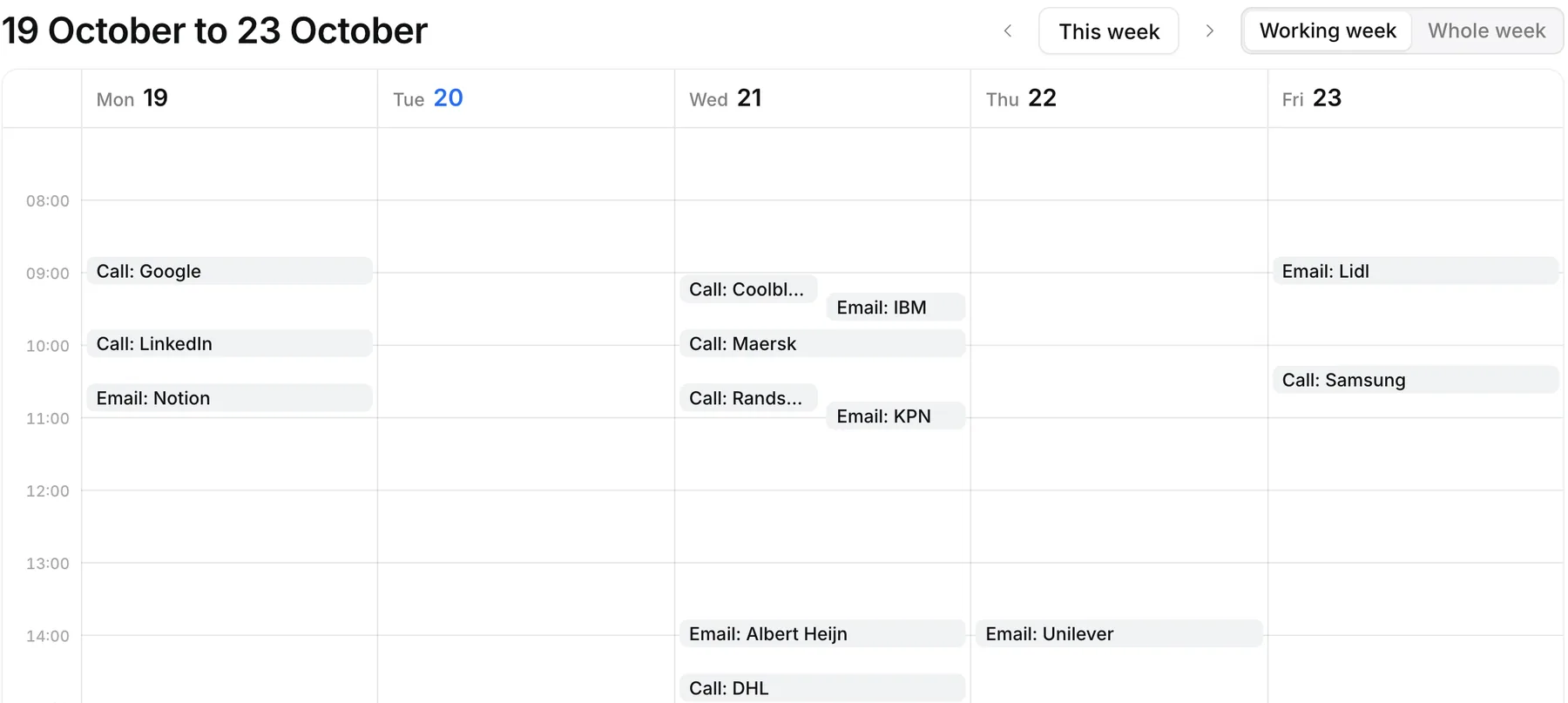
Follow-up on every channel
Calls and emails land in your week. You write emails in Ringlane and send them from your own Gmail; LinkedIn and WhatsApp you send yourself and log by hand. The Today view puts overdue call-backs first.
In this industry: After a call, send a short note on the role you discussed or an anonymous candidate profile from your own Gmail and see the thread with that lead, so a colleague knows what was offered.
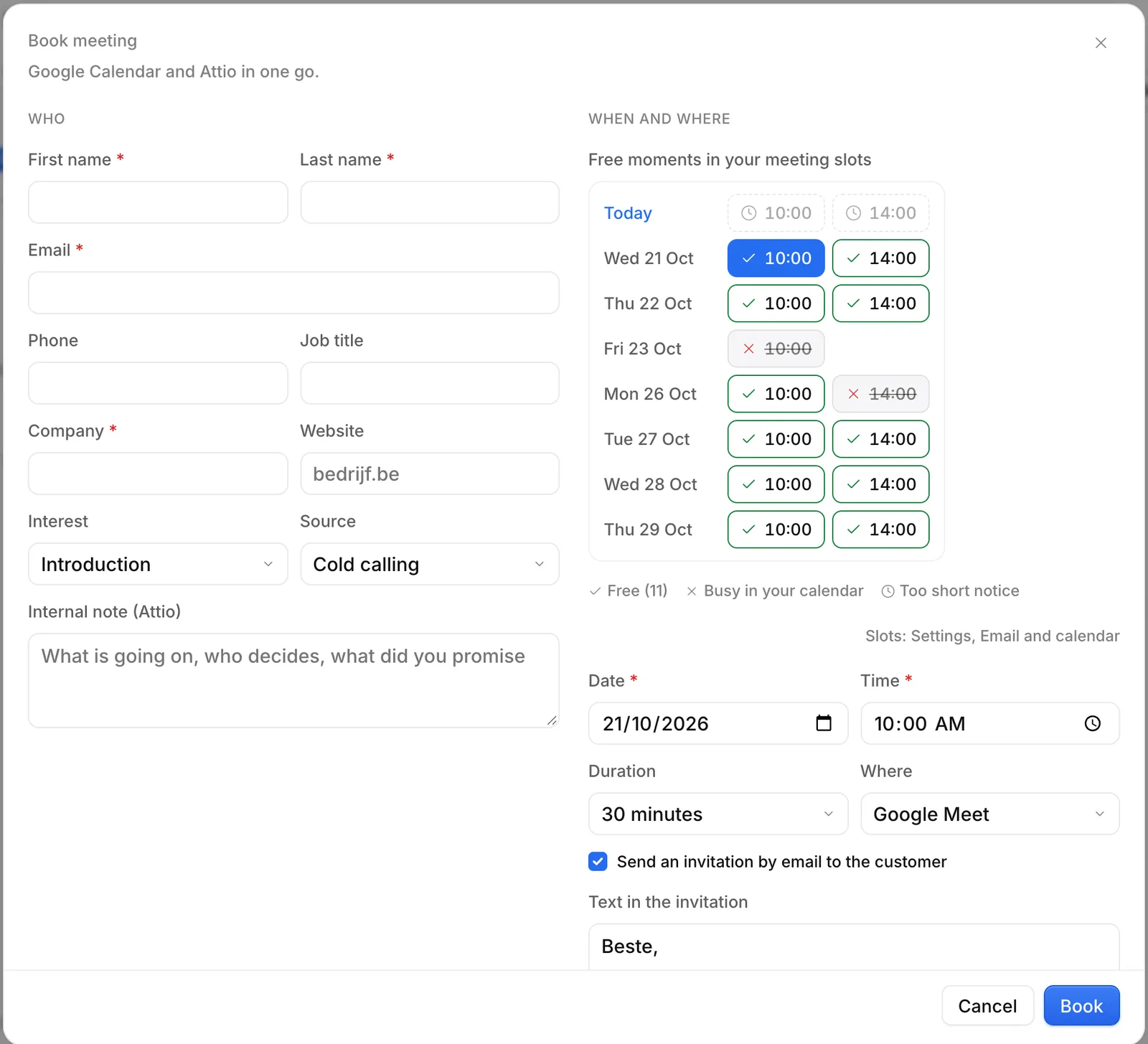
Book while they are on the line
Ringlane shows your free moments in Google Calendar, adds a Google Meet link and sends the invitation. Booked meetings go to Attio.
In this industry: When an employer agrees to an intake about a vacancy, book it in Google Calendar with a Meet link while they are on the line; the meeting goes to Attio.
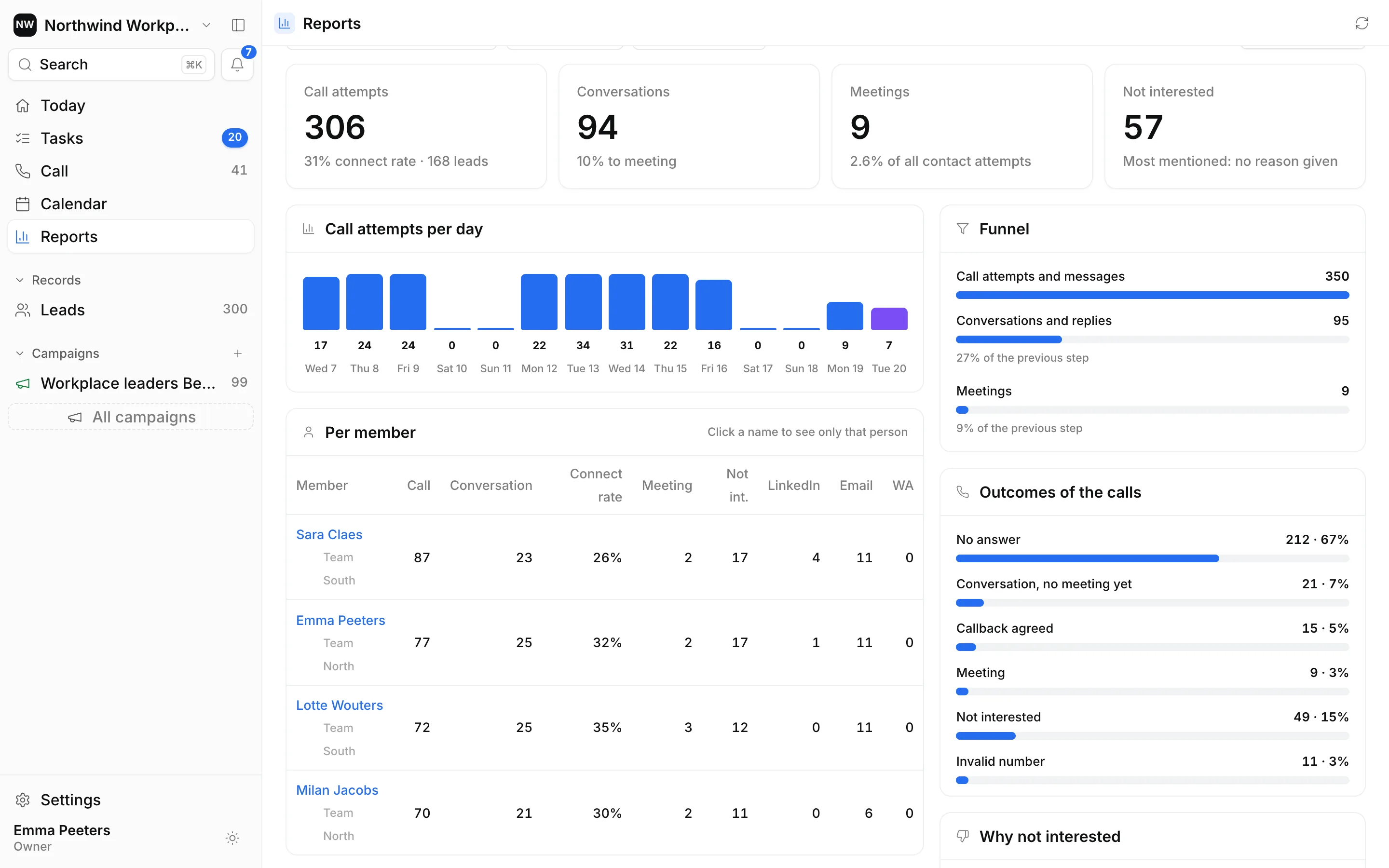
Your numbers, per caller and campaign
Call attempts, connect rate, conversations, meetings, the funnel and the reasons for "not interested", per person, team and campaign.
In this industry: Compare meetings per consultant and per sector campaign, and read the reasons for not interested to see whether "no vacancies now" or "fixed supplier list" is the real block.
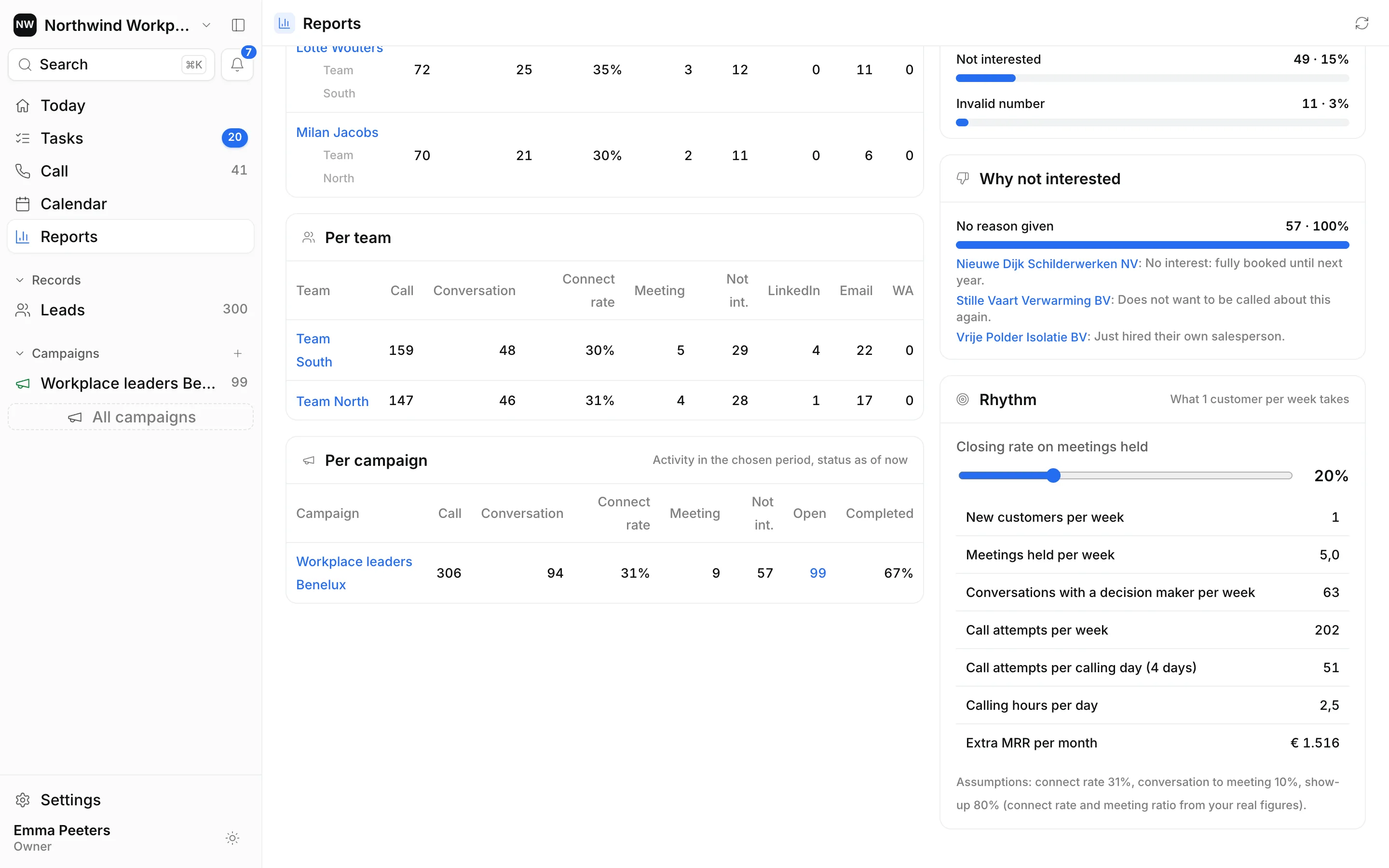
What one new customer takes
Based on your own rates, Ringlane calculates how many calls per week and per day one new customer per week takes.
In this industry: Fill in your own rates and see how many calls per week one new client company per week takes, so business development gets a fixed place next to candidate work.
Real screens from the Ringlane app with demo data. No affiliation with the companies shown.
What it can bring you: efficiency, money and more
A new client company can bring placements or temporary hours for years. The table below is an example with assumed numbers, not a forecast. Replace every figure with your own.
| Example with assumed numbers: one consultant, one month | Value |
|---|---|
| Call attempts (two one-hour blocks a day) | 400 |
| Conversations with a decision maker (assumed 30%) | 120 |
| Intakes about a vacancy (assumed 8% of conversations, rounded) | 10 |
| New client companies (assumed 20% of intakes) | 2 |
| Value of one client in the first year (assumed two permanent placements at 12,000 euro fee each) | 24,000 euro |
In this example, two new client companies a month are worth 48,000 euro in fees in their first year, before any repeat business. Your own fees and conversion rates decide the real figure, so measure them.
Efficiency matters even more in an agency, because every minute of admin comes out of candidate time. Measure for a week how long consultants spend after a client call on notes and on remembering when to call back. Logging the outcome with one key and seeing the next call planned keeps business development inside a fixed block. See how call blocks protect focus and how to follow up leads.
Want to see the calling screen first? Try the demo.
Frequently asked questions
Does cold calling still work for recruitment agencies?
Who should a recruiter call at an employer?
How large is the staffing market in Belgium?
What changes for Dutch staffing agencies with the Wtta?
How do consultants find time for business development?
Sources
All industries
- Accounting firms
- Business events and venues
- Business finance
- Commercial cleaning
- Commercial real estate
- Commercial solar and energy
- Consultancy
- Corporate catering
- Corporate training
- Fleet, leasing and EV charging
- HR and payroll services
- HVAC and building services
- Industrial manufacturing
- Insurance brokers
- IT services and MSPs
- Logistics and transport
- Marketing agencies
- Office furniture and workplace
- Printing and packaging
- SaaS and software
- Security services
- Telecom and connectivity
- Wholesale and distribution
- Workwear and PPE