Win managed service contracts with calls you plan and follow up
For IT service providers and MSPs in Belgium and the Netherlands: who to call at an SME, which moments make the call relevant, and how to keep every conversation moving until the contract ends.
Most small and mid-sized companies already have someone who looks after their IT. That makes selling IT services a switching sale: you are rarely the first, you have to be the better next one. The companies that win are not the ones that call the most, but the ones that call at the right moment and follow up until the contract with the current partner ends.
The market: many providers, a buyer who switches rarely
Belgium and the Netherlands have a crowded IT services market. In Belgium, the ICT sector had 71.7 billion euro turnover and about 130,000 jobs in 2024, according to Agoria figures reported by Computable. Turnover grew only 1.9% that year, the lowest in ten years, and the sector lost about 1,750 jobs. Statbel counted 67,022 VAT-registered enterprises in information and communication at the end of December 2025, a section that also includes publishing, media and telecom.
In the Netherlands, CBS counts more than 106,000 ICT companies in 2025, with most growth coming from ICT service providers. The CBS business register shows 95,160 businesses in IT services on 1 October 2026 (provisional figures), of which 82,155 are one-person companies and only 3,110 have ten or more people. For an MSP that means two things: plenty of competition for every SME, and a lot of freelancers and small partners that your prospects may already rely on.
Decisions are made by few people. At an SME with 10 to 50 employees, the owner usually signs and an office manager or a technically minded employee runs IT on the side. Above that size, an IT manager and a finance director join in. Contracts usually run for a fixed term, so timing matters more than pressure.
Who you call and what you ask
Call the person who feels the pain and the person who signs. In practice:
- Owner or managing director: decides on the partner and the budget.
- Office manager or operations manager: handles tickets, onboarding of new staff and the daily irritation.
- IT manager at companies with their own IT staff: looks for capacity, security tooling or a second line.
- Finance director: joins when costs per workstation are compared.
Moments that make a call relevant:
- Regulation. Belgium adopted its NIS2 law on 26 April 2024. The Dutch Cyberbeveiligingswet took effect on 15 August 2026 for more than 8,000 organisations, with board responsibility for cyber risk. Smaller suppliers to those organisations often get security questionnaires from their customers.
- Old hardware and software. Windows 10 support ended on 14 October 2025. Companies that still run it have a concrete reason to talk.
- Growth or a move: new hires, a second site, a new office.
- A contract end date with the current partner. Write it down. It is the most valuable fact you can learn.
Discovery questions that work in this sector:
- Who looks after your IT today, and until when does that agreement run?
- When did you last test whether you can restore a backup?
- Have customers or insurers asked you security questions in the past year?
- What happens on the day a new employee starts: how long until they can work?
- If you could change one thing about your IT tomorrow, what would it be?
For more on structuring these questions, see how to write a cold calling script.
What slows a calling team down in this sector
- "We already have someone." Nearly every prospect has a partner, a freelancer or a handy employee. The answer is not to argue, but to ask until when and to plan the next call around that date.
- Long gaps between conversation and decision. A prospect who is interested in March may only switch when the contract ends next year. Without a planned follow-up, that lead is gone.
- Technical callers, commercial conversations. Many MSPs let engineers call. They know the subject but often skip asking for the meeting.
- Fear-based selling. Ransomware stories make people defensive. Owners respond better to questions about their own situation than to threats.
- Lists that age fast. Small companies change owners, addresses and numbers. Invalid numbers waste call blocks if nobody closes them.
How Ringlane works for IT service providers
Real screens from the app, with what each feature does in this industry.
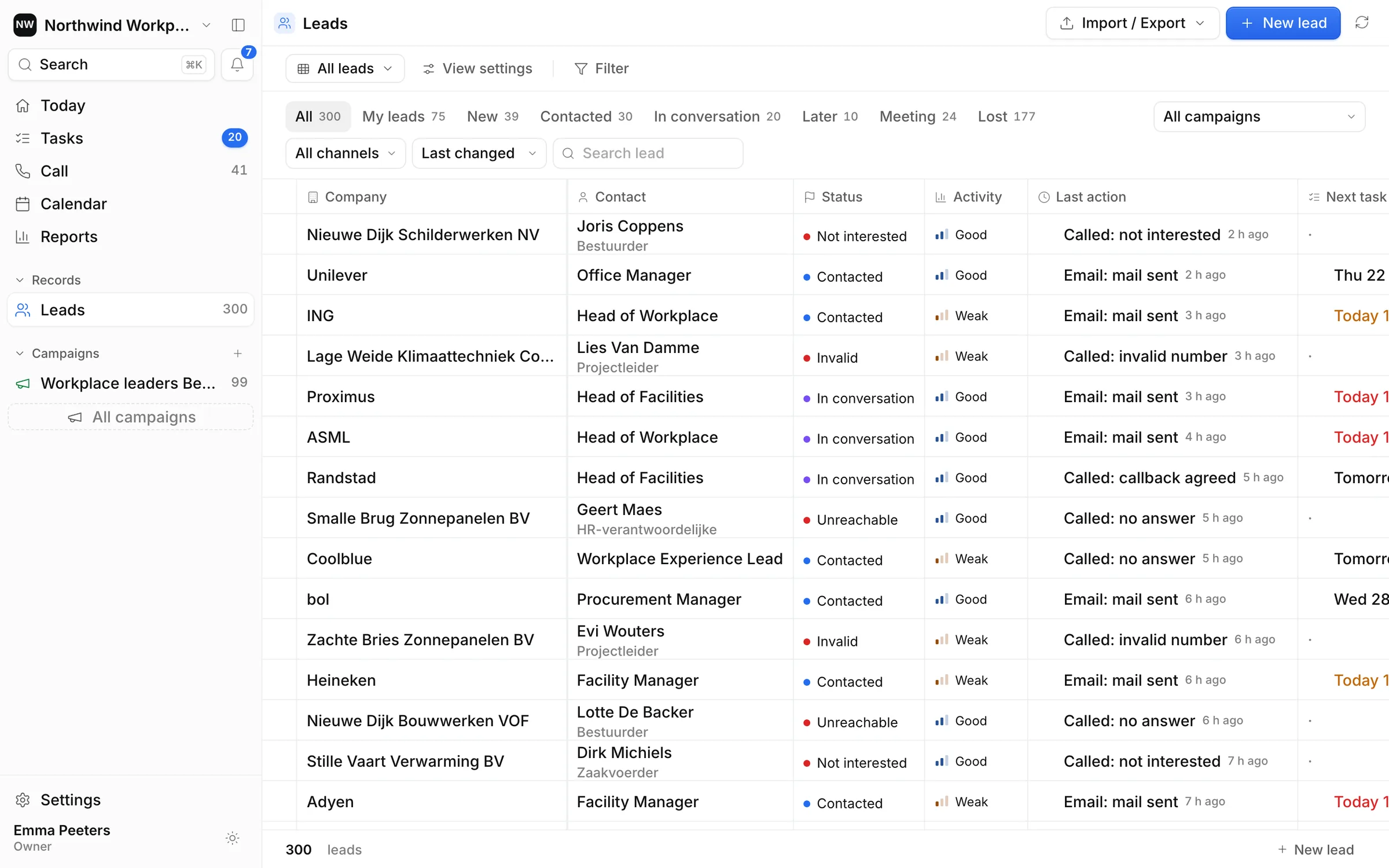
Your lists, in one place
Import Excel, CSV or a Bizzy export into a campaign. Every lead shows its status, last action and next task.
In this industry: Import a Bizzy export of companies with 10 to 100 employees in your region into one campaign per segment, for example accountancy firms or manufacturers, so each caller works one clear list.
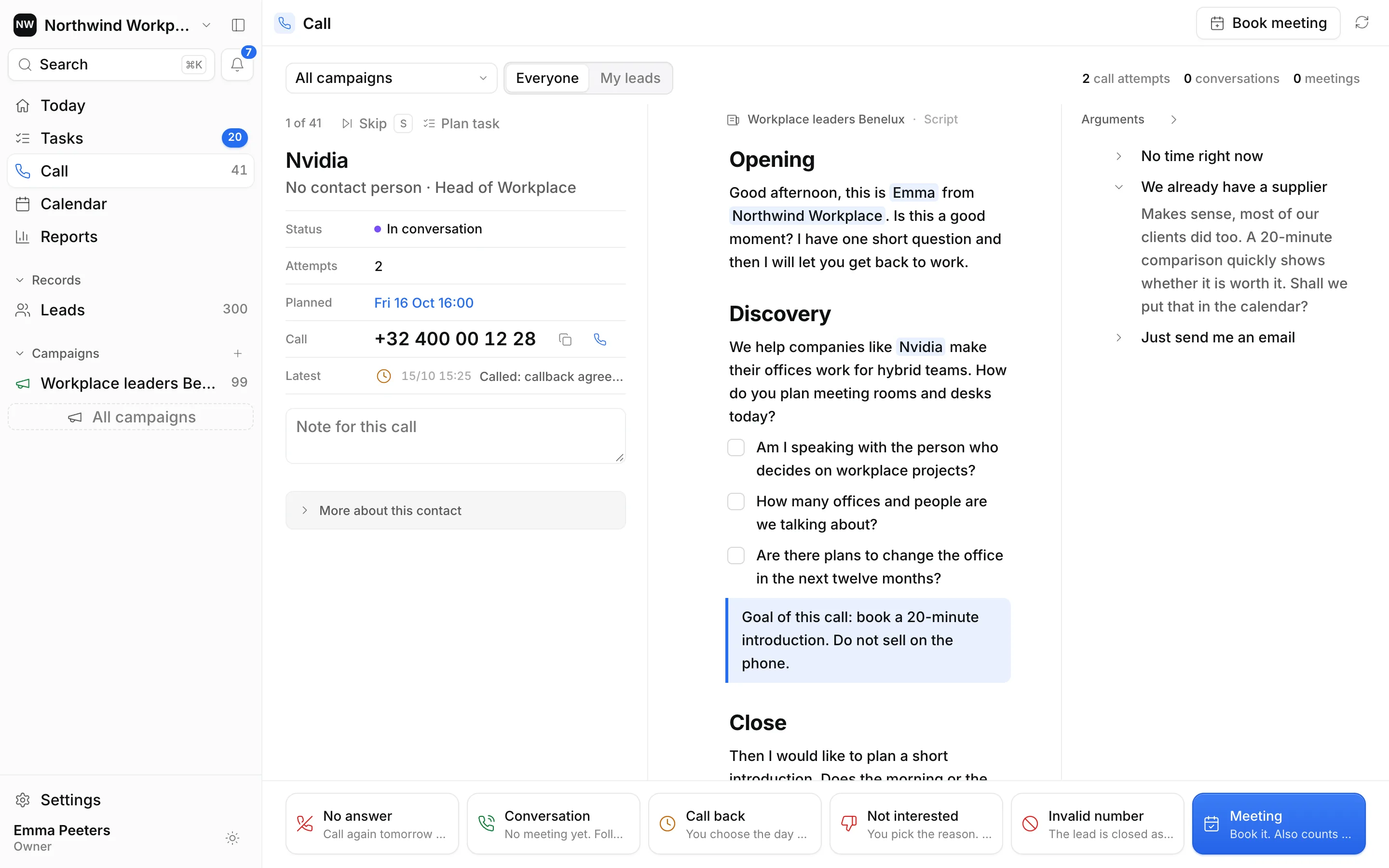
One screen for the call
The lead on the left, the script in the middle with the company name and your own name filled in. Click the number to call from your own phone.
In this industry: Put the questions about the current IT partner, contract end date, number of workstations and backup in the script, so every caller asks them.
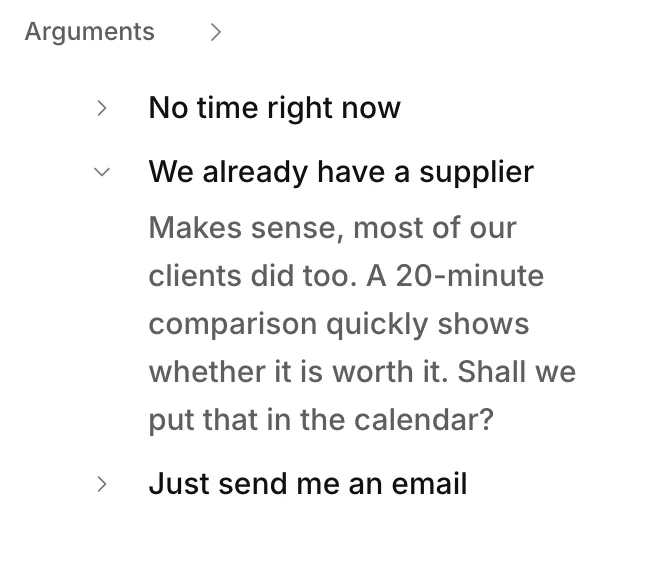
The answer to every objection
Common objections sit in a panel next to the script, so the right answer is one click away.
In this industry: Keep answers to "we already have an IT partner", "my nephew does our IT" and "we are too small for NIS2" next to the script, each ending in a question about the next renewal.
One key per call, the next step planned
N (not reached) plans a new attempt the next working day, G (conversation) a follow-up call in three days, T (call back) the moment you pick. A records a meeting; X (not interested, with a reason) and O (invalid number) close the lead.
In this industry: Office managers and owners are rarely free at the first try. N plans the next attempt for the next working day; T lets you call back at the exact quiet moment they name.

Follow-up on every channel
Calls and emails land in your week. You write emails in Ringlane and send them from your own Gmail; LinkedIn and WhatsApp you send yourself and log by hand. The Today view puts overdue call-backs first.
In this industry: After a conversation, send a short note on backup or the NIS2 scope test from your own Gmail and see it in the history with that lead, so a colleague knows what was promised.
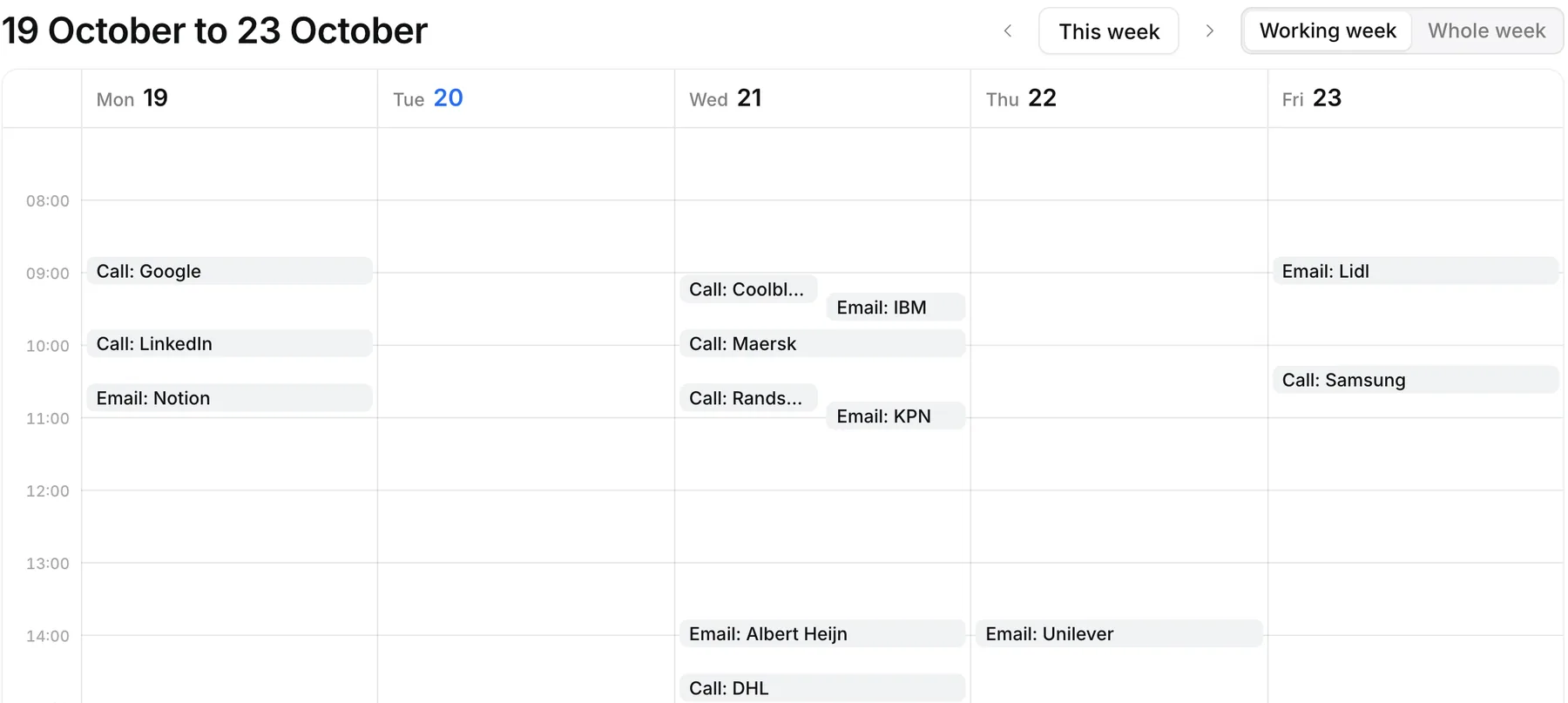
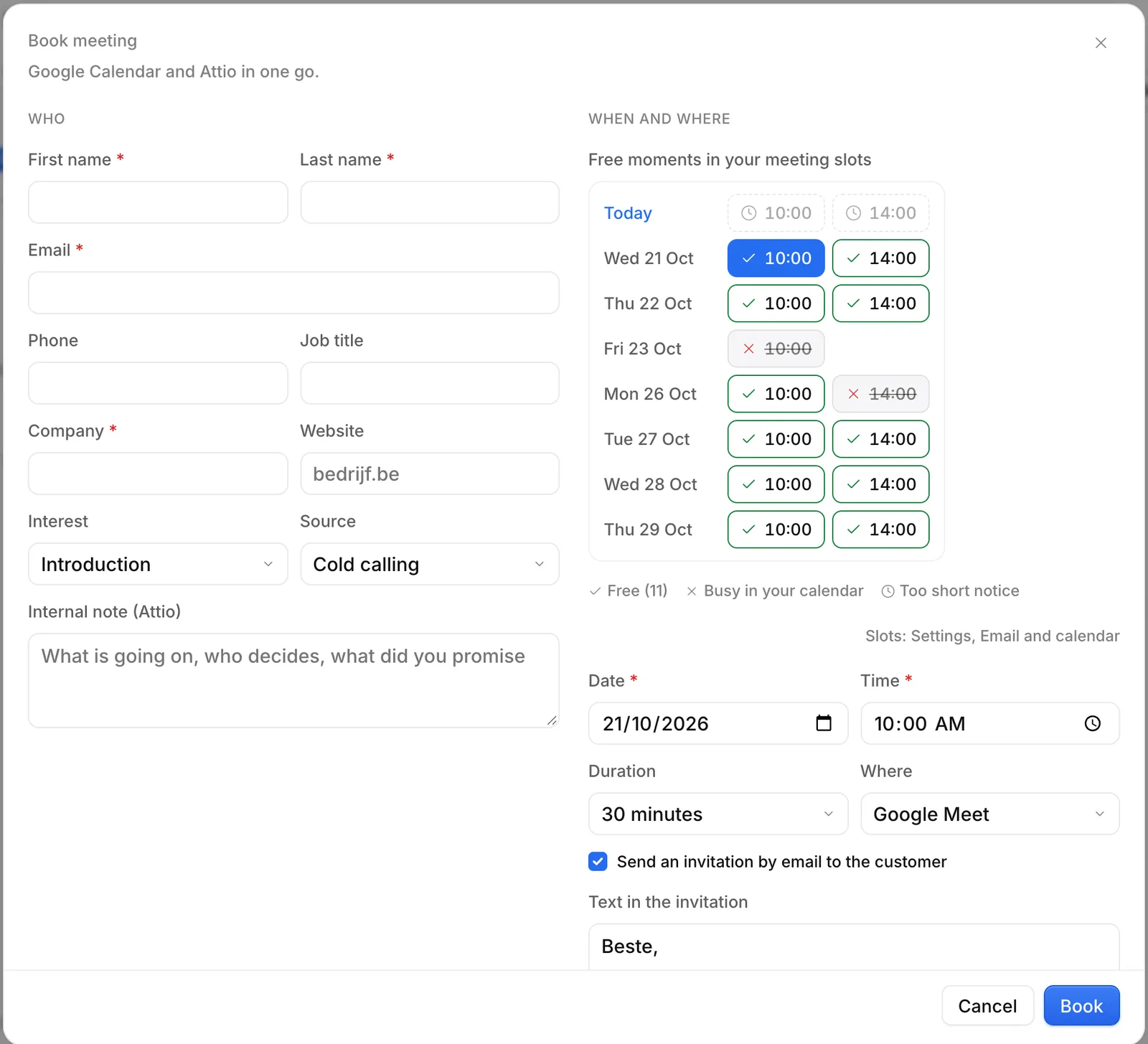
Book while they are on the line
Ringlane shows your free moments in Google Calendar, adds a Google Meet link and sends the invitation. Booked meetings go to Attio.
In this industry: When the owner agrees to an IT scan or an intake, book it in Google Calendar with a Meet link while they are still on the line, and the meeting goes to Attio.
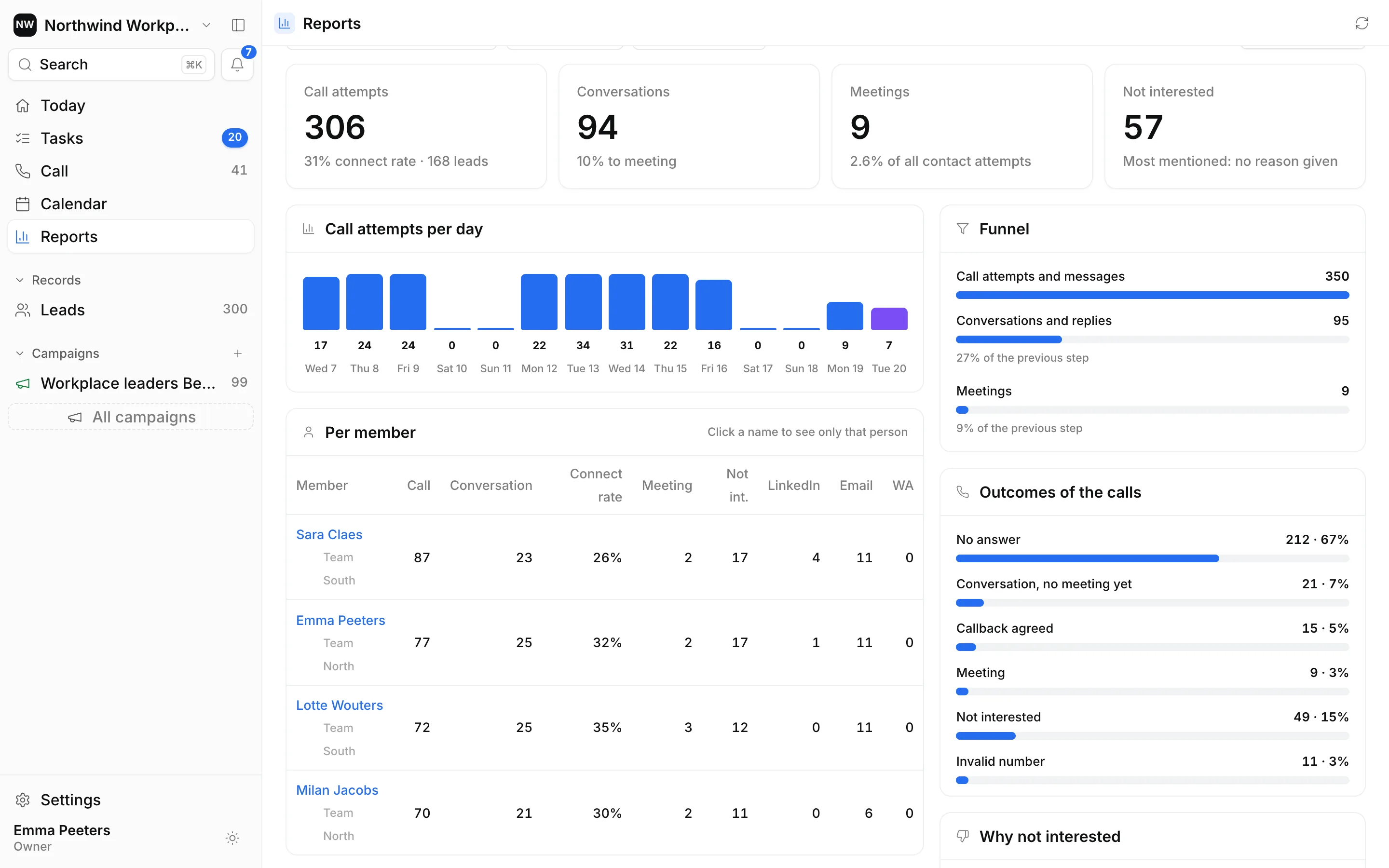
Your numbers, per caller and campaign
Call attempts, connect rate, conversations, meetings, the funnel and the reasons for "not interested", per person, team and campaign.
In this industry: Compare campaigns per segment and read the reasons for not interested. If "contract still running" keeps coming back, ask for the end date and plan a call back with T instead of closing the lead.
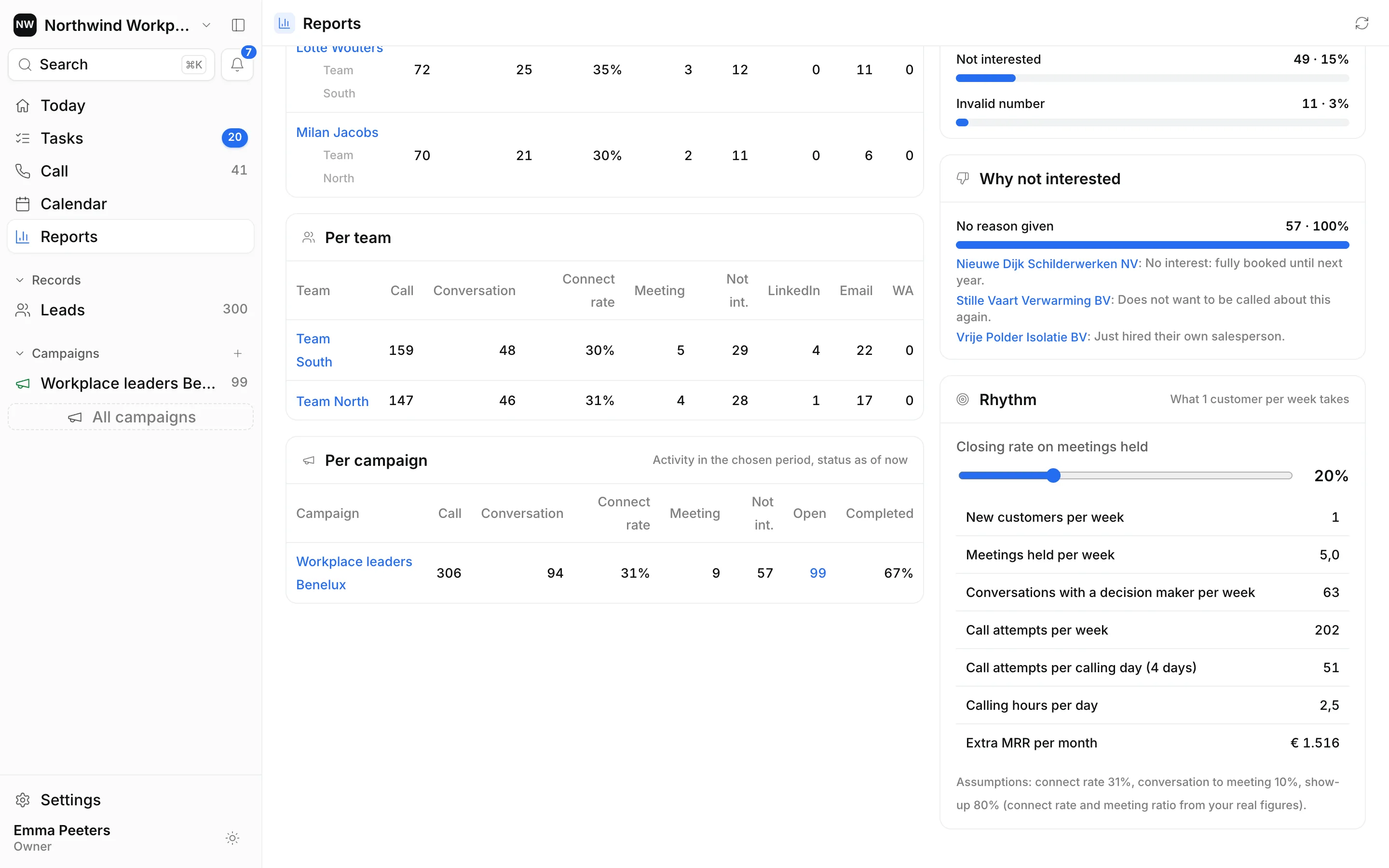
What one new customer takes
Based on your own rates, Ringlane calculates how many calls per week and per day one new customer per week takes.
In this industry: Fill in your own connect and meeting rates and see how many calls per week one new managed service customer per week takes, so a sales manager can plan a realistic target.
Real screens from the Ringlane app with demo data. No affiliation with the companies shown.
What it can bring you: efficiency, money and more
The value of a managed service customer is in the recurring contract, so even a few extra customers a quarter matter. The table below is an example with assumed numbers, not a forecast. Replace every figure with your own.
| Example with assumed numbers: one caller, one month | Value |
|---|---|
| Call attempts | 400 |
| Conversations with a decision maker (assumed 25%) | 100 |
| Meetings or IT scans booked (assumed 10% of conversations) | 10 |
| New customers (assumed 20% of meetings) | 2 |
| Value of one customer (assumed 1,500 euro per month over a 36-month contract) | 54,000 euro |
In this example, two new customers a month are worth 108,000 euro in contract value. Your own numbers will differ, which is exactly why it helps to measure them. Read more in how many calls it takes to win one customer.
Efficiency is the other half. Measure for one week how long your team spends after each call on typing notes, finding the next date and remembering who promised what. Logging an outcome with one key and having the next call already planned removes most of that work. Follow-up also gets done: a lead whose contract ends in nine months is in the calendar instead of in someone's head. See how to follow up leads for a simple cadence.
Want to see the calling screen first? Try the demo.
Frequently asked questions
Does cold calling still work for IT service providers?
Who should an MSP call at a small or mid-sized company?
How large is the IT services market in Belgium and the Netherlands?
Is NIS2 a good reason to call a prospect?
How many calls does it take to win one managed service customer?
Sources
- Computable: Belgische ict-sector krimpt en floreert (Agoria figures for 2024, 29 January 2025)
- Statbel: VAT-registered enterprises by economic activity, monthly, December 2024 to December 2025
- CBS: Digitalisering en kenniseconomie 2025, summary
- CBS StatLine: Bedrijven; bedrijfstak (table 81589NED)
- BIPT: NIS2 registration (Belgian NIS2 law of 26 April 2024)
- Forvis Mazars: Cyberbeveiligingswet treedt op 15 augustus 2026 in werking
- Microsoft: Windows 10 support has ended on October 14, 2025
All industries
- Accounting firms
- Business events and venues
- Business finance
- Commercial cleaning
- Commercial real estate
- Commercial solar and energy
- Consultancy
- Corporate catering
- Corporate training
- Fleet, leasing and EV charging
- HR and payroll services
- HVAC and building services
- Industrial manufacturing
- Insurance brokers
- Logistics and transport
- Marketing agencies
- Office furniture and workplace
- Printing and packaging
- Recruitment and staffing
- SaaS and software
- Security services
- Telecom and connectivity
- Wholesale and distribution
- Workwear and PPE