Reach building owners before their old system or a new rule forces a choice
For HVAC installers and building services companies in Belgium and the Netherlands: who to call, which rules and installation ages make the call relevant, and how to follow up until a maintenance contract or replacement is signed.
Most buildings already have someone who services the heating and cooling. Customers switch when service is poor, when a contract ends, or when a system is old enough that replacement becomes the real question. New rules on energy labels and refrigerants add deadlines. A calling team in HVAC wins by knowing which buildings are at that point and following up until the visit is booked.
The market: busy installers, ageing buildings
According to Eurostat, Belgium had 14,043 enterprises in plumbing, heat and air conditioning installation (NACE 43.22) in 2024, employing 34,092 people with a turnover of about 8.2 billion euro. The Netherlands had 18,752, employing 69,744 people with a turnover of about 14.7 billion euro. CBS counts 7,810 Dutch heating installation businesses (SBI 43222) on 1 October 2026 (provisional figures). Of those, 6,045 are one-person businesses and 380 have 10 or more people. Most of the market is small, so companies with a sales team and maintenance capacity stand out.
Rules drive demand:
- Label C for Dutch offices. Since 1 January 2023, an office needs at least energy label C or may no longer be used as an office. On 1 July 2026, RVO estimated that 72% of office addresses had label C or better, 4% had label D or worse and 24% had no label.
- Energy saving obligation. Dutch locations using from 50,000 kWh of electricity or 25,000 m3 of gas a year must take all measures with a payback of five years or less, according to RVO.
- Flemish renovation obligation. After a sale of a non-residential building, central space heaters older than 15 years must be replaced unless they meet the minimum requirements, and cooling systems older than 15 years that use ozone depleting refrigerants or refrigerants with a GWP of 2,500 or more must be replaced, according to the Flemish government.
- EU F-gas regulation. Regulation (EU) 2024/573 bans placing split systems above 12 kW with refrigerants of GWP 750 or more on the market from 1 January 2029, and with GWP 150 or more from 1 January 2033, unless safety requirements on site demand them. The HFC quota drops to zero from 2050.
Rules as checked in October 2026. This is general information, not legal advice.
Who you call and what you ask
At smaller businesses, call the owner. At larger organisations, the facility manager or technical manager runs maintenance, with purchasing and finance joining for replacements. For rented buildings, the property owner or property manager often decides on installations.
Moments that make a call relevant:
- a maintenance contract that ends within 6 to 12 months
- heating or cooling that is 15 years or older
- an office without label C, or a label project in the building
- a building purchase in Flanders, which starts the renovation obligation
- complaints about comfort, breakdowns or energy bills
Questions that open a real conversation:
- "How old are the heating and cooling installations in the building?"
- "Who maintains them now, and when does that contract end?"
- "Does the building have an energy label, and which one?"
- "Which refrigerant do your air conditioning units use, do you know?"
- "Who decides on a replacement: you, the owner or someone else?"
Make the first visit about the installation, not the sale. An inspection of the plant room or a check of the age and refrigerant of the units gives the facility manager something useful, even if they stay with their current partner for now. It also gives you the facts for the moment the contract ends or a part fails.
For more on building these questions into a call, see how to write a cold calling script.
What slows a calling team down in this sector
- "It still works." Buyers replace when systems fail. Ask the age, and plan a call well before the next heating season.
- Seasonal peaks. Technicians are fully booked in cold and hot spells. Book visits for quieter weeks and say so on the call.
- Owner and user differ. Tenants feel the comfort problem; owners pay for the replacement. Find out who decides early.
- Framework contracts and tenders. Larger organisations and public bodies buy maintenance through multi-year contracts. Know the end date.
- Hard to reach technical managers. They are on site, not at a desk. Call twice at different times rather than leave one voicemail.
How Ringlane works for HVAC and building services companies
Real screens from the app, with what each feature does in this industry.
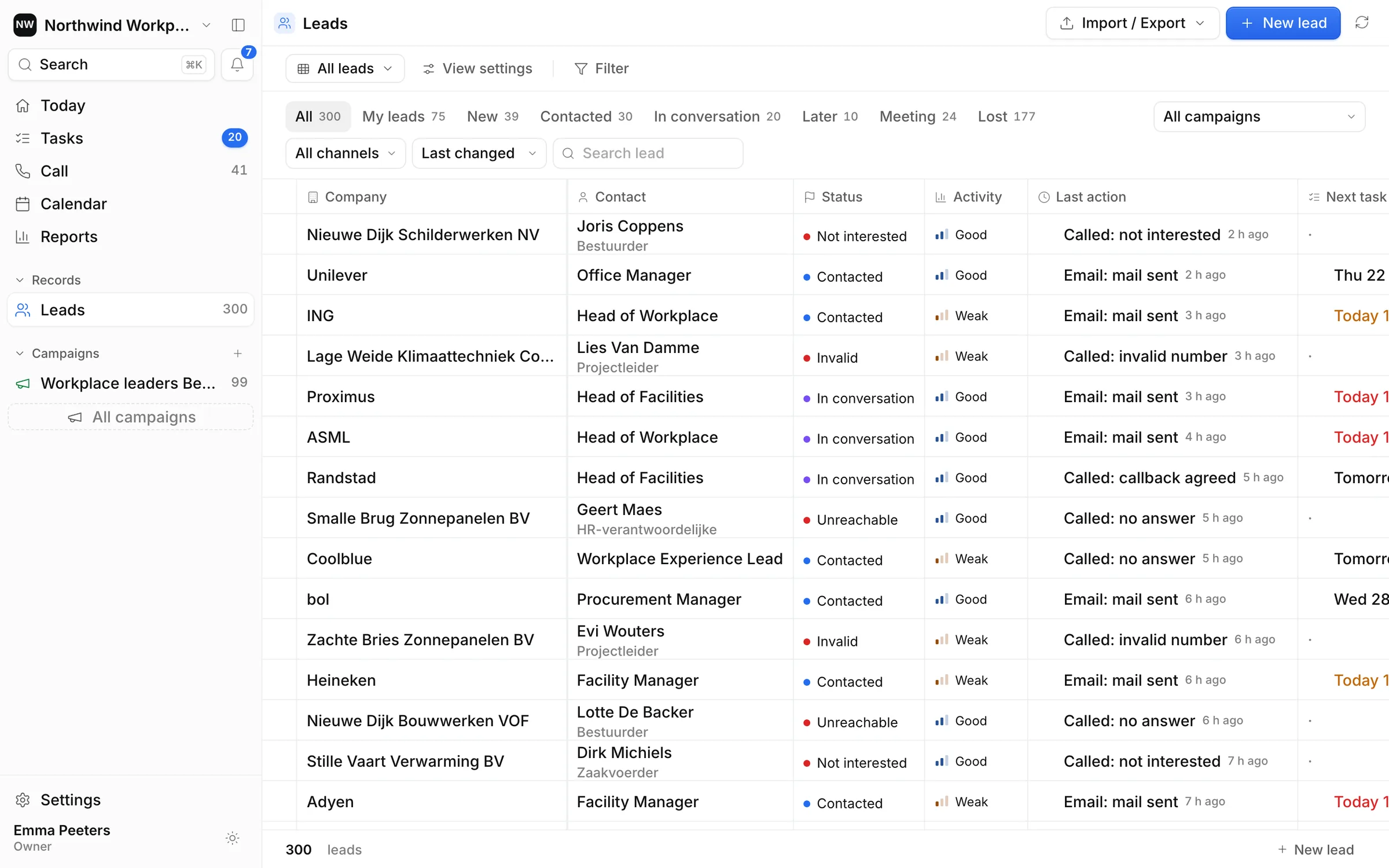
Your lists, in one place
Import Excel, CSV or a Bizzy export into a campaign. Every lead shows its status, last action and next task.
In this industry: Import a Bizzy export of offices, schools, care homes or retailers in your service area into one campaign per building type, so each caller works one clear list.
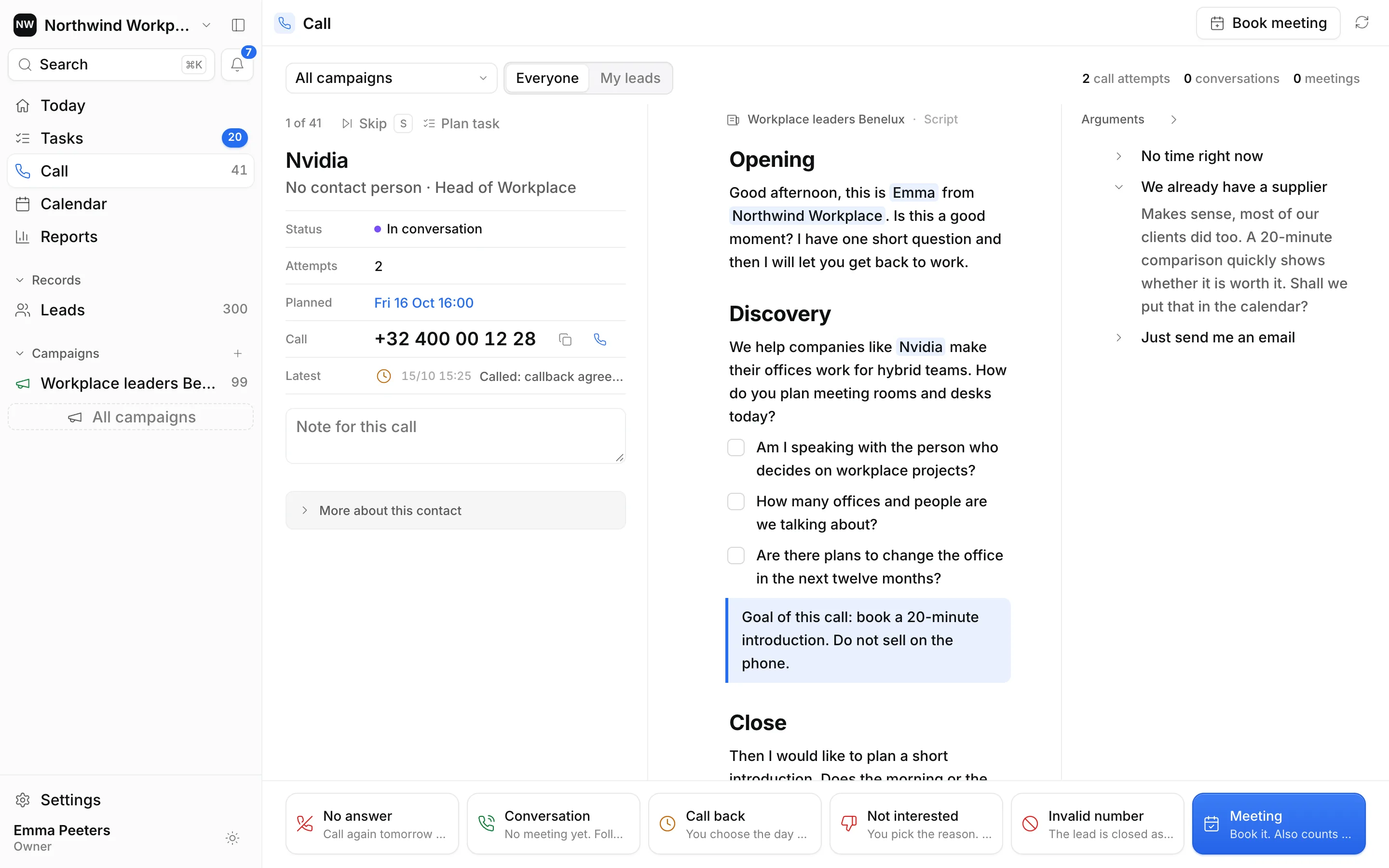
One screen for the call
The lead on the left, the script in the middle with the company name and your own name filled in. Click the number to call from your own phone.
In this industry: Put the questions about the age of the heating and cooling, the current maintenance partner, the energy label and the contract end date in the script, so every caller asks them and nobody forgets one.
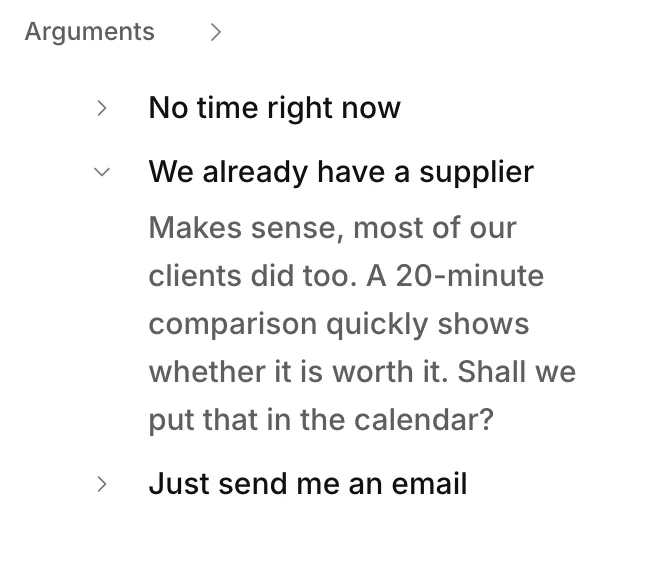
The answer to every objection
Common objections sit in a panel next to the script, so the right answer is one click away.
In this industry: Keep answers to "we have a maintenance contract", "it still works" and "the landlord decides" next to the script, each ending with a question about the next replacement or renewal.
One key per call, the next step planned
N (not reached) plans a new attempt the next working day, G (conversation) a follow-up call in three days, T (call back) the moment you pick. A records a meeting; X (not interested, with a reason) and O (invalid number) close the lead.
In this industry: Technical and facility managers are often in the plant room or on site. N plans the next attempt for the next working day, and T lets you call back at the moment they name.

Follow-up on every channel
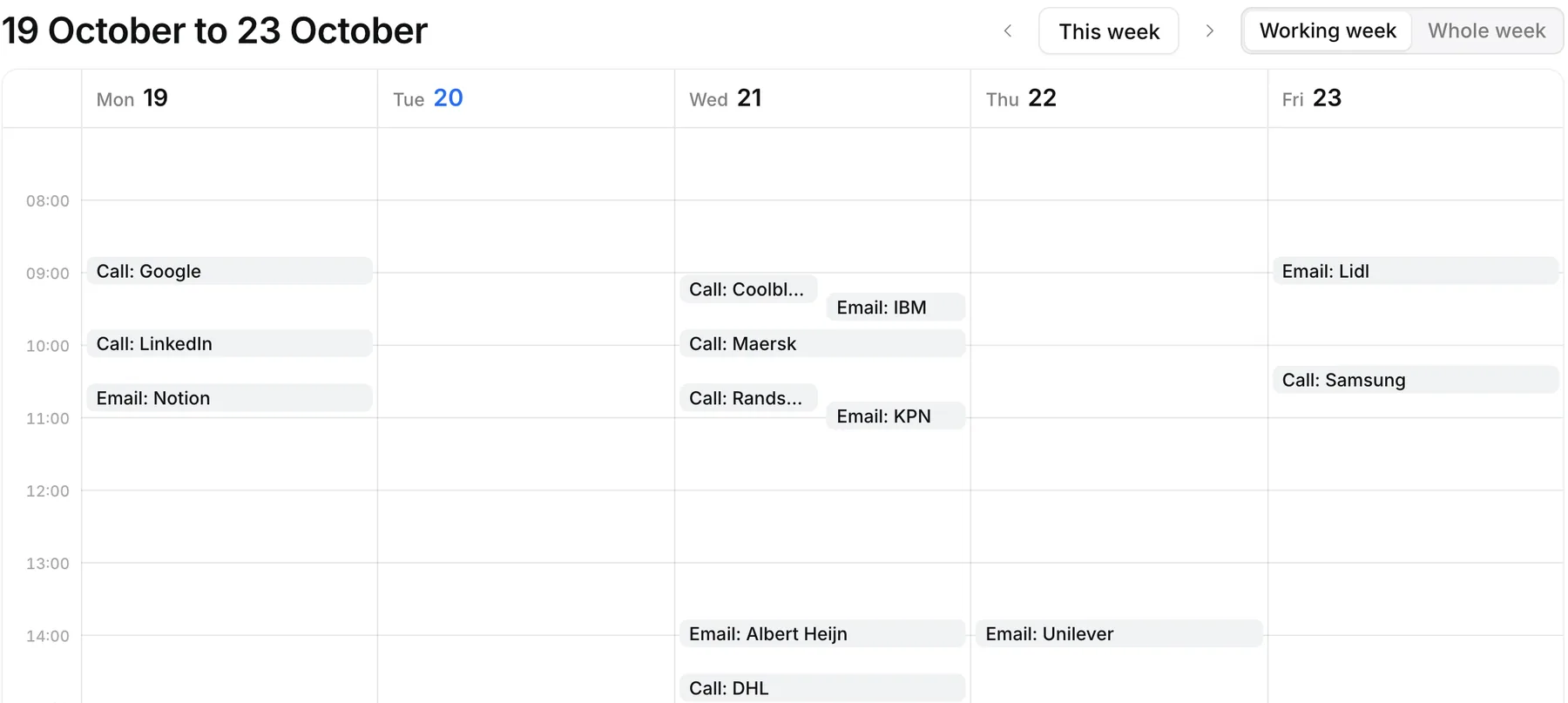
Calls and emails land in your week. You write emails in Ringlane and send them from your own Gmail; LinkedIn and WhatsApp you send yourself and log by hand. The Today view puts overdue call-backs first.
In this industry: After a conversation, send a short note offering an installation check or a label C scan from your own Gmail. The history with that lead shows what you offered.
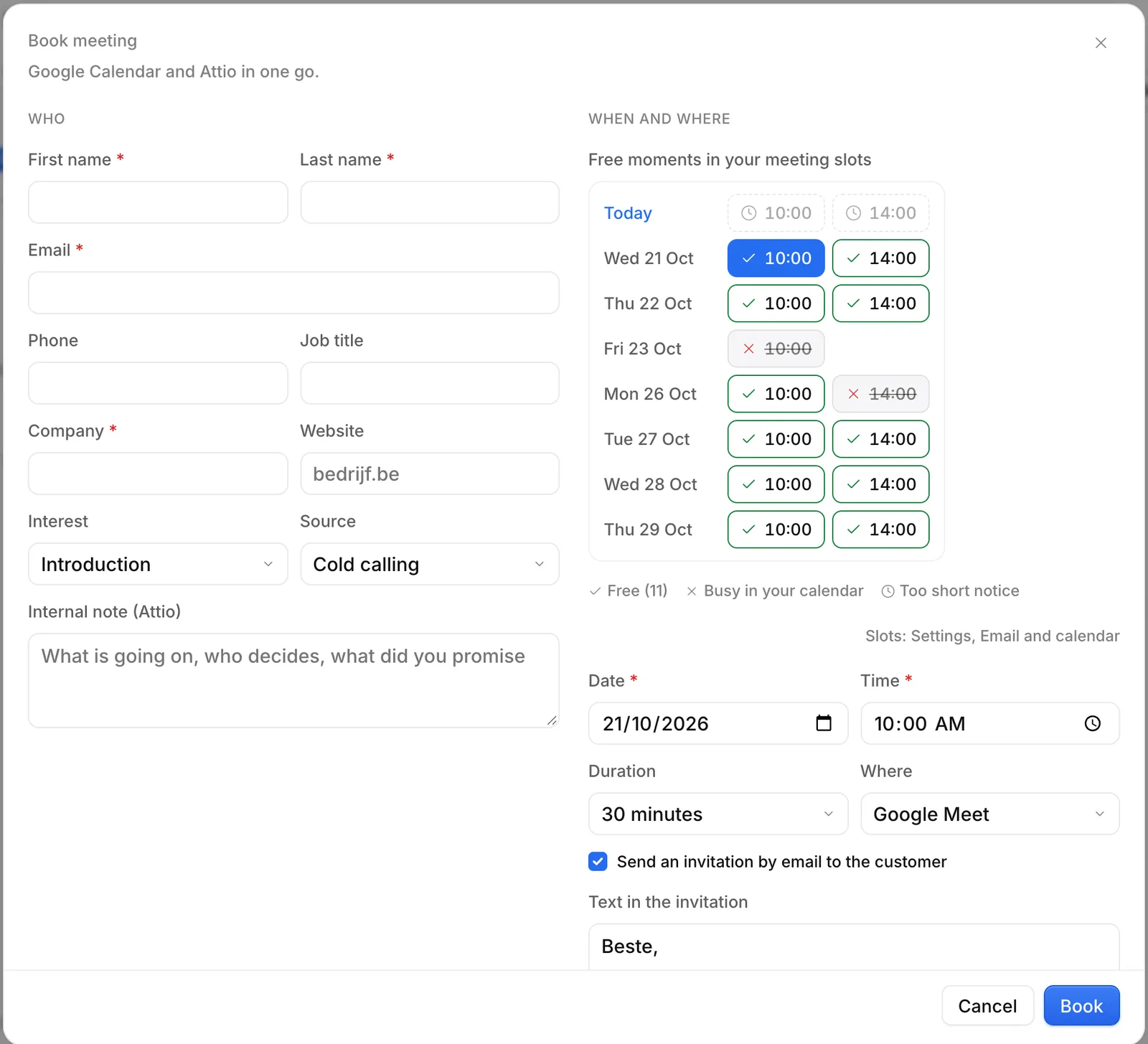
Book while they are on the line
Ringlane shows your free moments in Google Calendar, adds a Google Meet link and sends the invitation. Booked meetings go to Attio.
In this industry: When the facility manager agrees to an inspection or a technical visit, book it in Google Calendar while they are still on the line. The meeting goes to Attio.
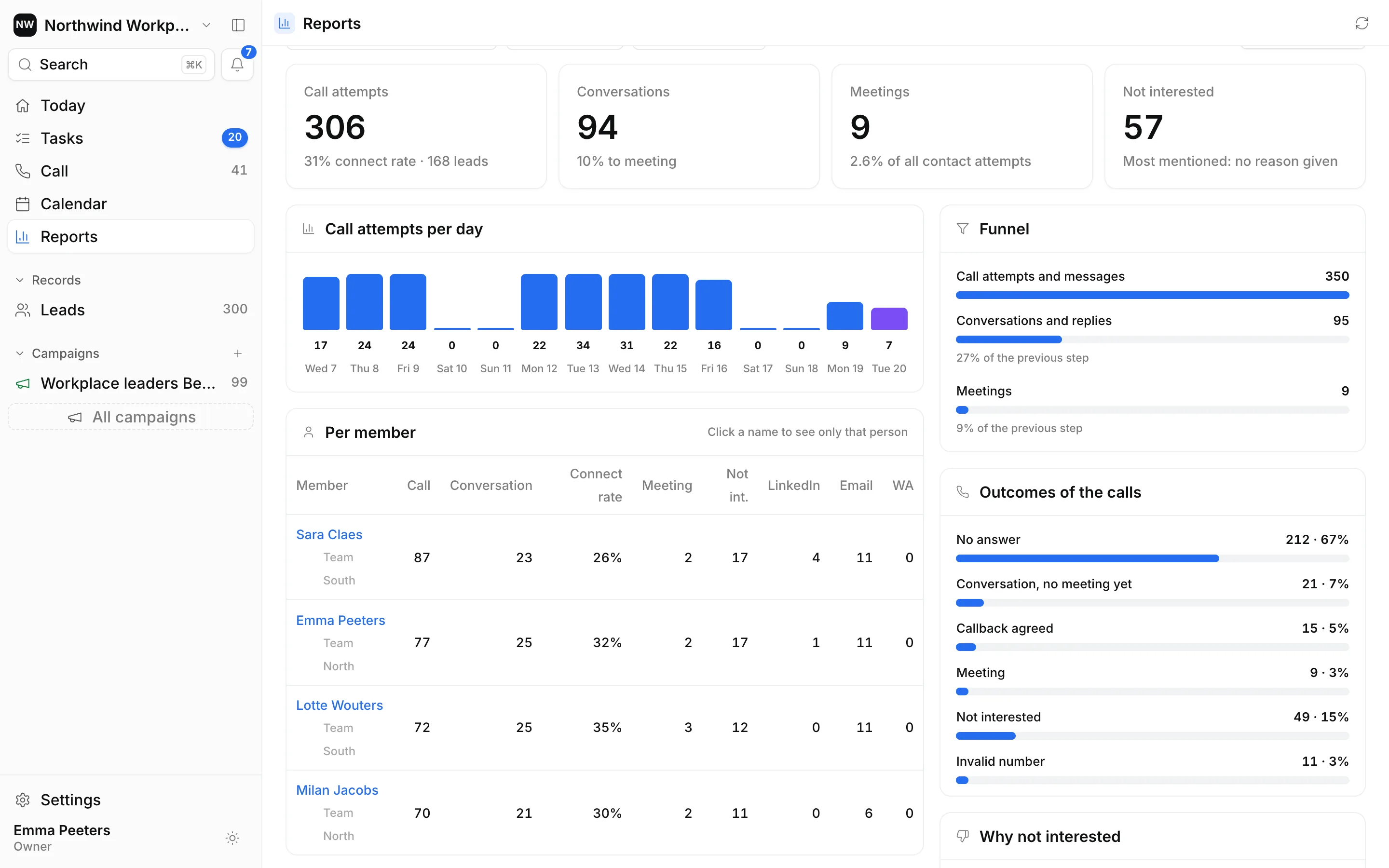
Your numbers, per caller and campaign
Call attempts, connect rate, conversations, meetings, the funnel and the reasons for "not interested", per person, team and campaign.
In this industry: Compare campaigns per building type and read the reasons for not interested. If "maintenance contract until 2027" keeps coming back, plan those leads for the renewal window.
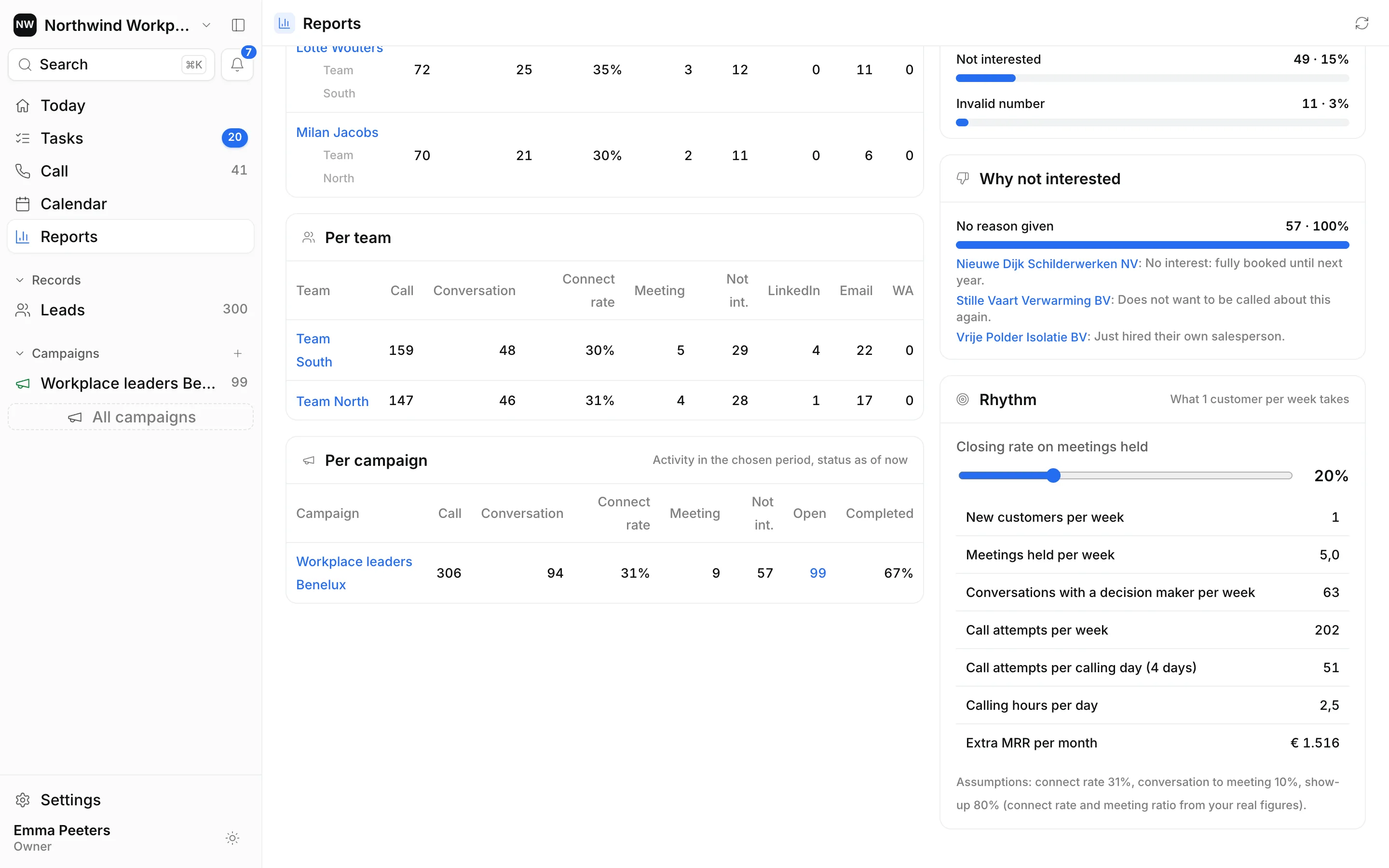
What one new customer takes
Based on your own rates, Ringlane calculates how many calls per week and per day one new customer per week takes.
In this industry: Fill in your own connect and meeting rates and see how many calls per week one new maintenance or replacement customer per week takes, so planning matches your technicians.
Real screens from the Ringlane app with demo data. No affiliation with the companies shown.
What it can bring you: efficiency, money and more
A maintenance contract brings recurring revenue and often leads to the replacement order later. The table below is an example with assumed numbers, not a forecast. Replace every figure with your own.
| Example with assumed numbers: one caller, one month | Value |
|---|---|
| Call attempts | 400 |
| Conversations with a decision maker (assumed 20%) | 80 |
| Inspections or technical visits booked (assumed 10% of conversations) | 8 |
| New customers (assumed 25% of visits) | 2 |
| Value of one customer (assumed 4,000 euro maintenance per year over 3 years) | 12,000 euro |
In this example, two new maintenance customers a month are worth 24,000 euro over three years, before any replacement work. Your numbers will differ, so measure them. See how many calls it takes to win one customer.
Efficiency is the other half. Measure for one week how long your team spends after each call on notes, finding a date for the next call and remembering who asked for an inspection. Logging an outcome with one key and having the next call planned is meant to take much of that away; measure the difference after a few weeks. And follow-up gets done: a lead whose contract ends before next winter is in the calendar. Read how to follow up leads for a simple cadence.
Want to see the calling screen first? Try the demo.
Frequently asked questions
Does cold calling work for HVAC companies?
Who should an HVAC company call?
How large is the HVAC installation market in Belgium and the Netherlands?
Which rules create work for HVAC installers?
How many calls does it take to win one maintenance customer?
Sources
- Eurostat: Enterprises by detailed NACE Rev. 2 activity (sbs_ovw_act), NACE 43.22, Belgium and the Netherlands, 2024
- CBS StatLine: Bedrijven; bedrijfstak (81589NED), SBI 4322 and 43222, status on 1 October 2026 (provisional)
- RVO: Energielabel C kantoren (status on 1 July 2026)
- Flemish government: Renovatieverplichting voor niet-residentiële gebouwen
- EUR-Lex: Regulation (EU) 2024/573 on fluorinated greenhouse gases (7 February 2024)
- RVO: Over de energiebesparingsplicht
All industries
- Accounting firms
- Business events and venues
- Business finance
- Commercial cleaning
- Commercial real estate
- Commercial solar and energy
- Consultancy
- Corporate catering
- Corporate training
- Fleet, leasing and EV charging
- HR and payroll services
- Industrial manufacturing
- Insurance brokers
- IT services and MSPs
- Logistics and transport
- Marketing agencies
- Office furniture and workplace
- Printing and packaging
- Recruitment and staffing
- SaaS and software
- Security services
- Telecom and connectivity
- Wholesale and distribution
- Workwear and PPE