Win mandates and tenants with owners and occupiers you called yourself
For commercial real estate brokers, property managers and developers in Belgium and the Netherlands: who decides on space, when a call lands, and how to keep a conversation alive for the months a move takes.
In commercial real estate, the deal is rarely on the table when you call. A company moves when its lease ends, when it outgrows its space or when its building no longer fits its people or the energy rules. An owner sells or relets when a tenant leaves or a renovation is due. A calling team that finds those moments early, and calls back when promised, is the first broker or landlord the decision maker thinks of.
The market: many owners and brokers, decisions that take months
The sector is large and fragmented. Eurostat business statistics count 15,738 enterprises in Belgium and 20,483 in the Netherlands in 2023 that work in real estate for others, such as brokers and property managers (NACE 68.3). Another 31,977 Belgian and 8,013 Dutch enterprises rent out and operate their own or leased real estate (NACE 68.2), a group that includes residential landlords. For the Netherlands, CBS counted on 1 October 2026 8,295 businesses renting out non-residential real estate, 12,950 real estate brokerages and 10,910 property managers (provisional figures).
Energy rules now drive many decisions. In the Netherlands, offices must have at least energy label C since 1 January 2023; a building that does not comply may no longer be used as an office, with exemptions such as less than 100 square metres of office space. In Flanders, non-residential units transferred since 1 January 2022 must meet energy measures within six years. Large non-residential units of 1,000 square metres or more need an EPC NR since 2025, the other large units since 2026, and every large unit must reach at least label E from 2030. At EU level, the revised Energy Performance of Buildings Directive aims to renovate the worst 16% of non-residential buildings by 2030 and the worst 26% by 2033. This is general information, not legal advice.
For occupiers, the decision is shared. A small company lets the owner choose. A mid-sized company involves the managing director, finance and often HR, because the office is part of how they keep people. Larger companies have a facility or real estate manager and run a selection with several brokers or buildings.
Who you call and what you ask
On the occupier side:
- Managing director or owner: decides on a move at small and mid-sized companies.
- CFO or finance manager: owns the lease, the costs and the timing.
- Facility, workplace or real estate manager: runs the search at larger companies.
On the owner side:
- Private owner or family office: decides on selling, reletting or renovating.
- Asset manager or investor: manages a portfolio and its vacancy and energy risks.
Trigger events that make the call relevant: a lease end or break option in the next one or two years, fast growth or shrinking teams, a merger, a new hybrid work policy, a building that fails the energy rules, a tenant that leaves, and a property that has been empty for months.
Discovery questions that work in this sector:
- When does your current lease end, and is there a break option before that?
- Does your space still fit the number of people and the way you work?
- What energy label does the building have, and what does the owner plan to do about it?
- Who is involved when you decide to stay, renovate or move?
- What would make you start looking six months earlier than planned?
Real estate deals take many touches before a meeting: see how many calls it takes to win a customer.
What slows a calling team down in this sector
- Long cycles. A move or a sale takes many months, sometimes years. A lead that is not ready today is not a lost lead, but it needs a call back at the right moment.
- Hard-to-reach decision makers. Owners and managing directors are protected by assistants and full agendas.
- Existing broker relationships. Many owners and occupiers already know a broker. The question is whether that broker is working for them right now.
- Market swings. Interest rates and the economy change how fast owners sell and occupiers move, so the same list can be cold one year and warm the next.
- Thin lists. Data on lease ends and owners is rarely complete. Every conversation is a chance to learn what the list is missing.
How Ringlane works for commercial real estate firms
Real screens from the app, with what each feature does in this industry.
Your lists, in one place
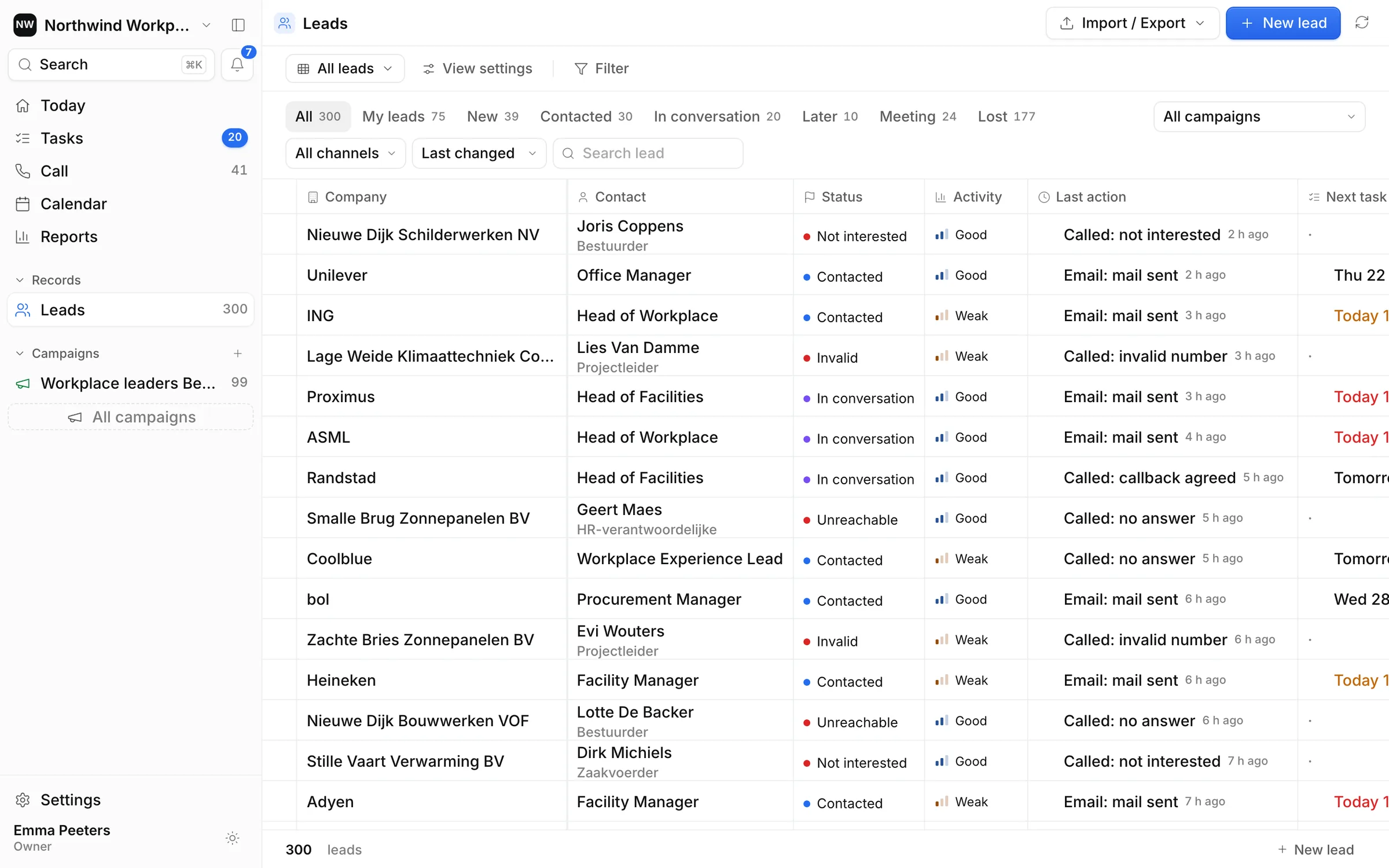
Import Excel, CSV or a Bizzy export into a campaign. Every lead shows its status, last action and next task.
In this industry: Import a Bizzy export of companies by region and size into one campaign for occupiers, and a list of owners of offices or warehouses into another, so each caller works one clear story.
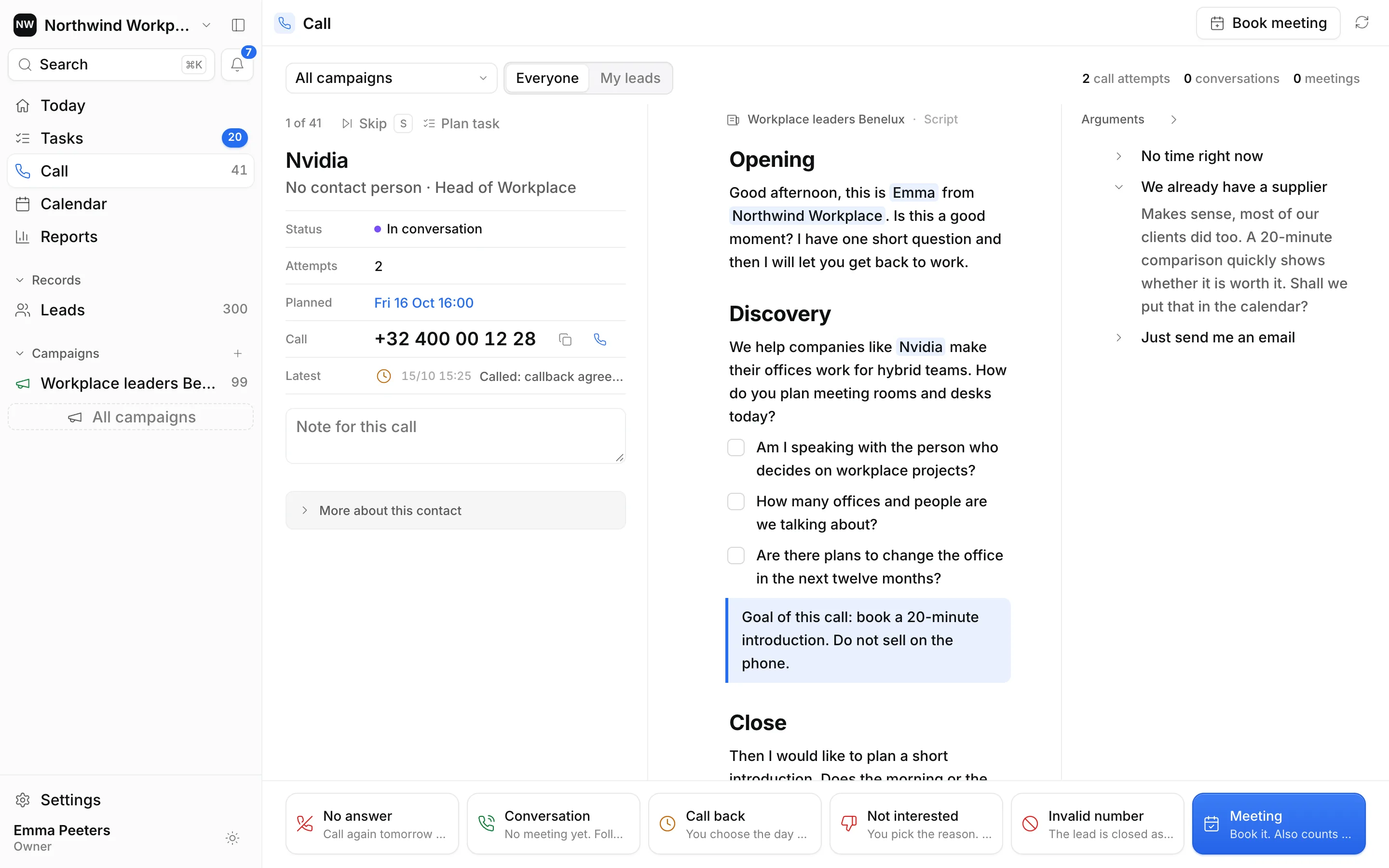
One screen for the call
The lead on the left, the script in the middle with the company name and your own name filled in. Click the number to call from your own phone.
In this industry: Put the questions about the lease end date, the number of square metres, growth plans and the energy label in the script, so every caller asks them in every call.
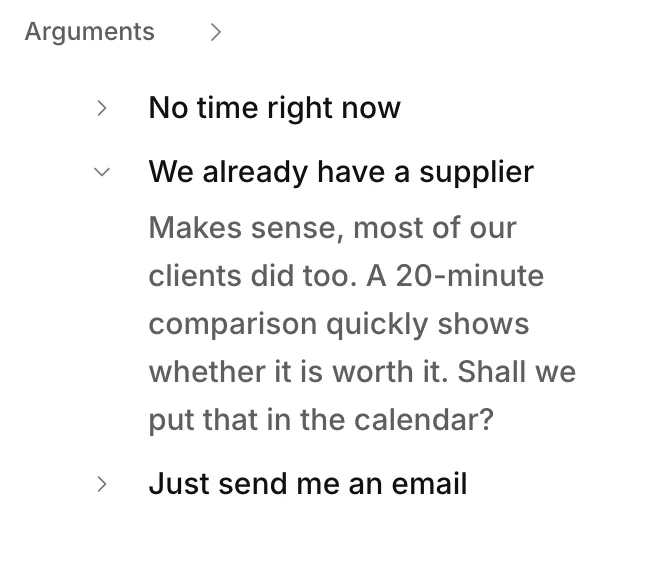
The answer to every objection
Common objections sit in a panel next to the script, so the right answer is one click away.
In this industry: Keep the answers to "our lease runs for years" and "we already work with a broker" next to the script, so a caller can ask about break options or about the energy rules instead of hanging up.
One key per call, the next step planned
N (not reached) plans a new attempt the next working day, G (conversation) a follow-up call in three days, T (call back) the moment you pick. A records a meeting; X (not interested, with a reason) and O (invalid number) close the lead.
In this industry: Owners and managing directors are hard to reach. N plans the next attempt for the next working day, and T lets you call back exactly in the month they name, even if that is far away.

Follow-up on every channel
Calls and emails land in your week. You write emails in Ringlane and send them from your own Gmail; LinkedIn and WhatsApp you send yourself and log by hand. The Today view puts overdue call-backs first.
In this industry: After a conversation, send a short market note or a few matching properties from your own Gmail and see it next to the call history, so a colleague knows what the owner or occupier already received.
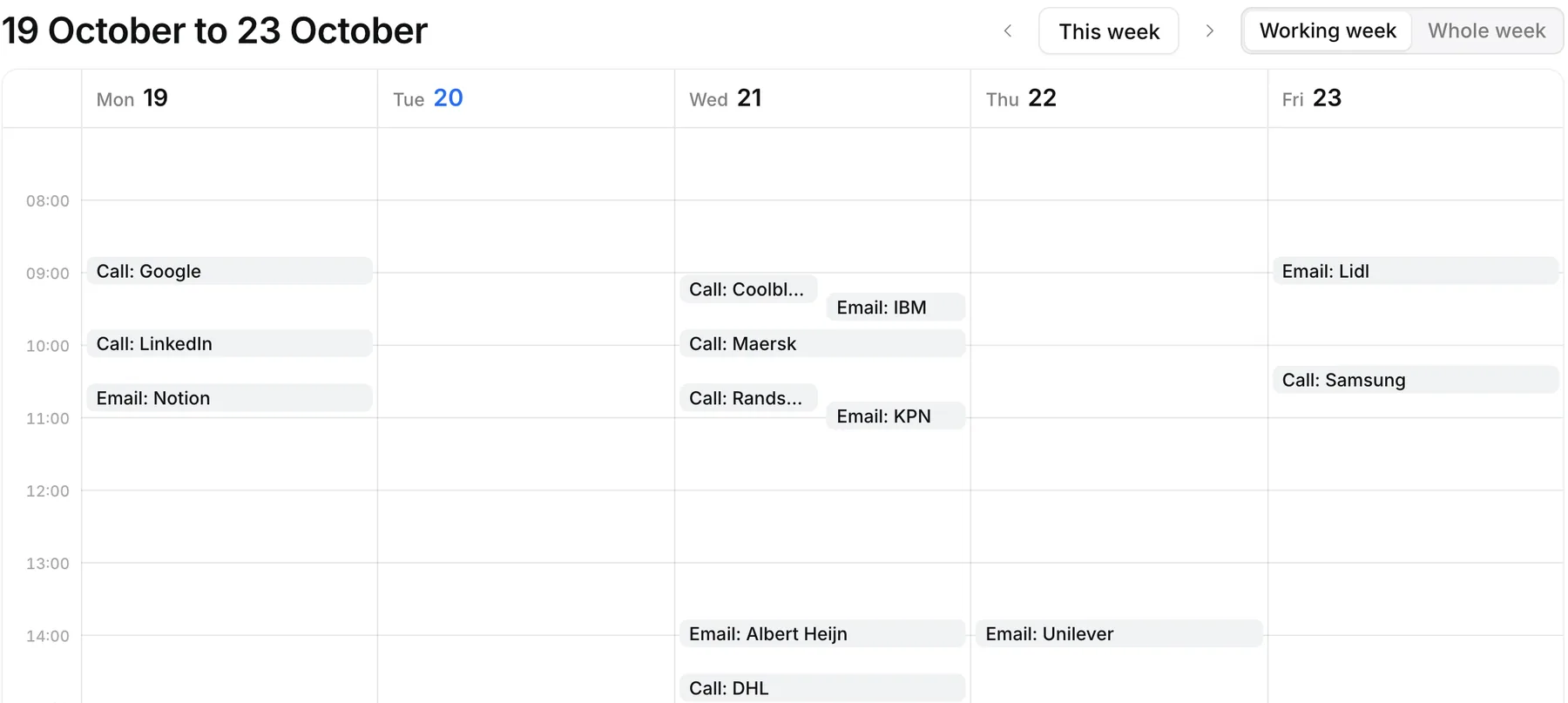
Book while they are on the line
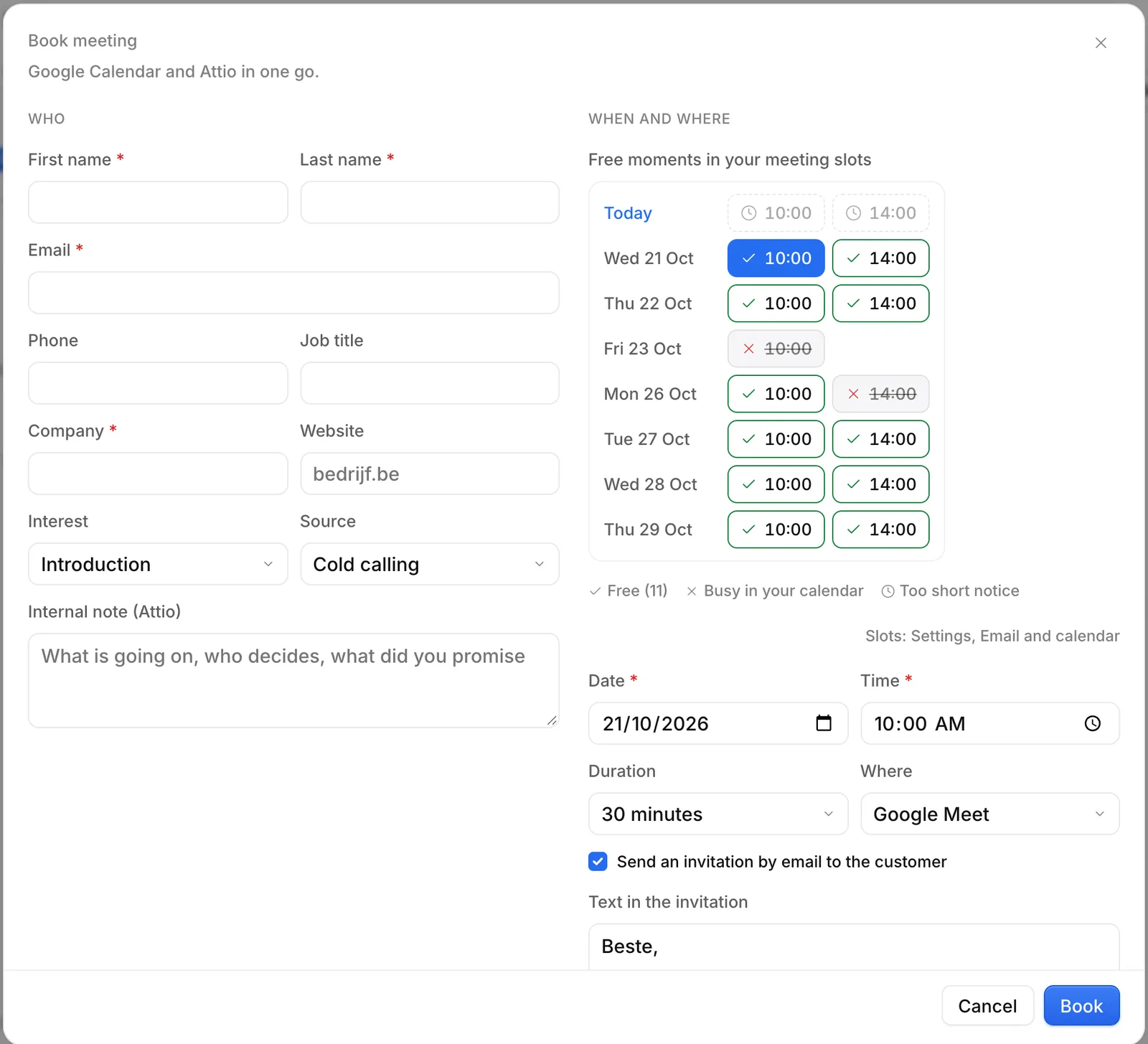
Ringlane shows your free moments in Google Calendar, adds a Google Meet link and sends the invitation. Booked meetings go to Attio.
In this industry: When an owner or occupier agrees to a meeting or a viewing, book it in a free slot in Google Calendar and send the invitation while they are still on the line, then hand it to Attio.
Your numbers, per caller and campaign
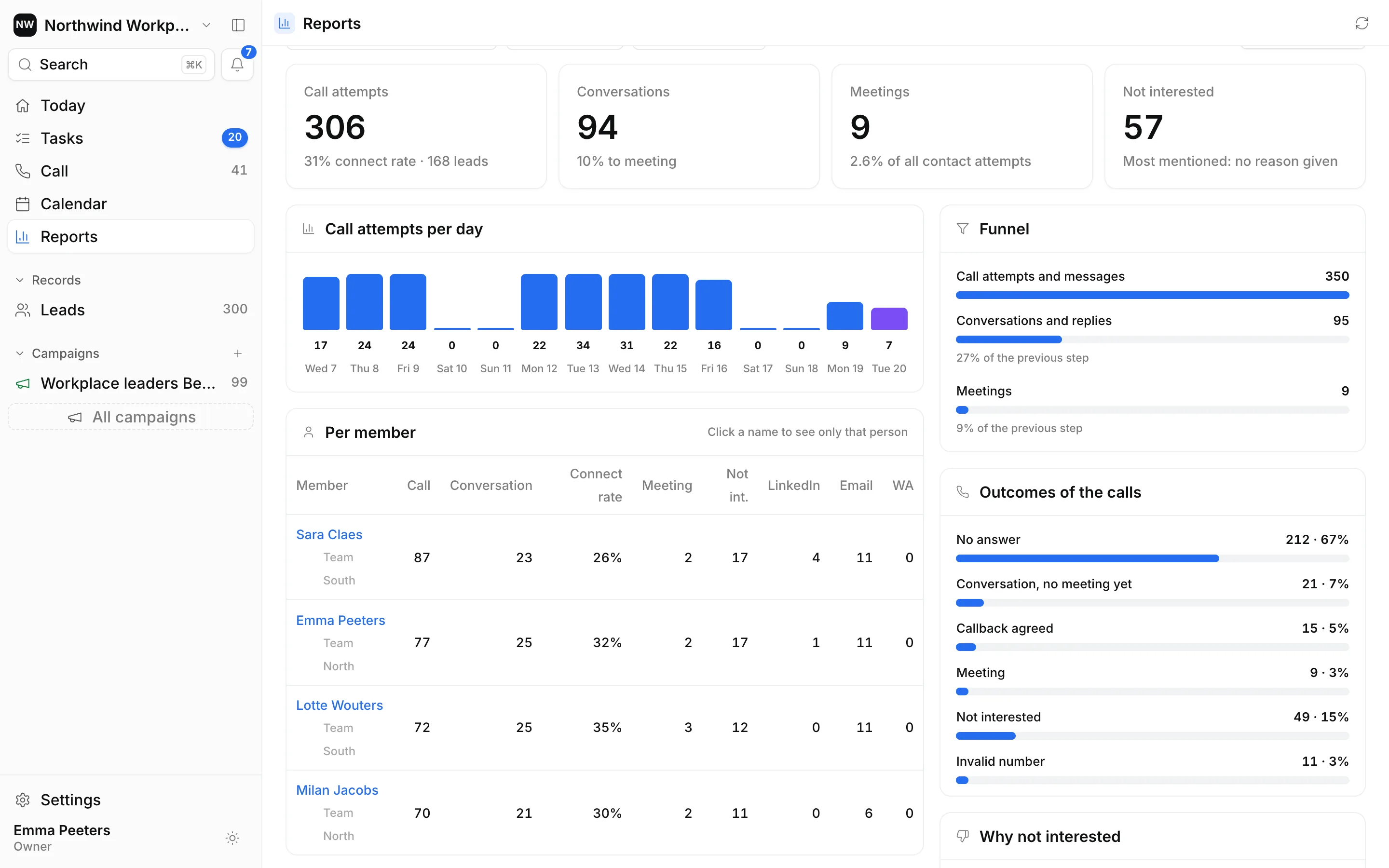
Call attempts, connect rate, conversations, meetings, the funnel and the reasons for "not interested", per person, team and campaign.
In this industry: Compare campaigns for owners and occupiers, offices and warehouses, and read the reasons for not interested, to see whether timing, an existing broker or the market blocks you most.
What one new customer takes
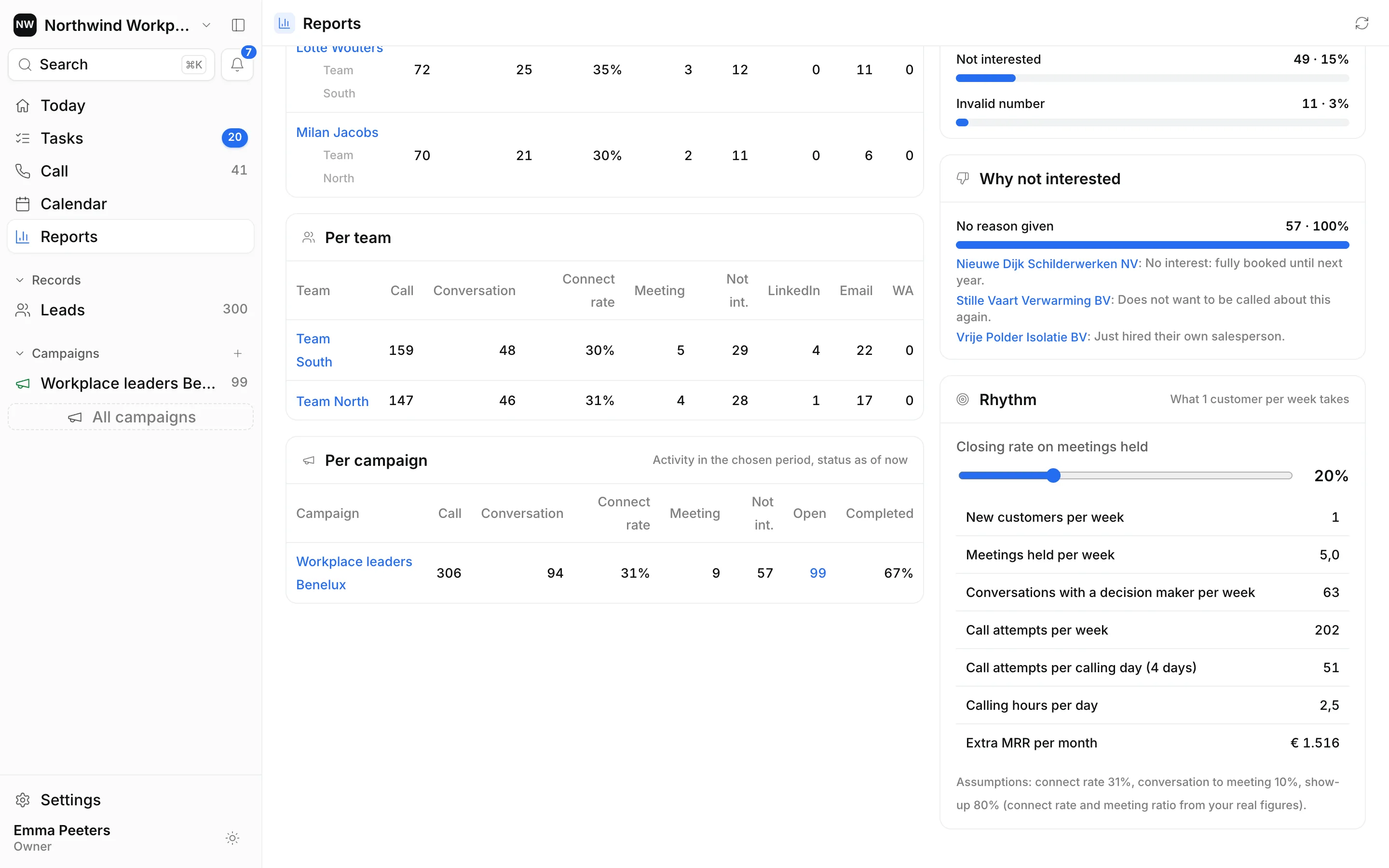
Based on your own rates, Ringlane calculates how many calls per week and per day one new customer per week takes.
In this industry: Fill in your own rates and see how many calls per week one new mandate or client per week takes, a useful number in a business where each deal takes months.
Real screens from the Ringlane app with demo data. No affiliation with the companies shown.
What it can bring you: efficiency, money and more
For a broker or property firm, the measurable step is the first meeting or viewing. What you can track is how many calls lead to a conversation, how many conversations to a meeting, and how many meetings to a mandate or a lease.
Example with assumed numbers: one caller, one month, and an assumed fee of 20,000 euros for one letting or sale mandate. These are not benchmarks; replace them with your own figures.
| Step | Assumption | Result |
|---|---|---|
| Call attempts | 25 per day, 20 working days | 500 |
| Conversations | 18% of attempts | 90 |
| Meetings or viewings | 12% of conversations | 11 |
| Mandates or leases | 1 in 5 meetings | 2 |
| Value | 2 x 20,000 euros (assumed) | 40,000 euros |
Efficiency is something you can measure too. Time how long it takes today to note an outcome and plan the next step. If one key and an automatically planned follow-up save two minutes per attempt, 500 attempts save about 17 hours a month. Check that against your own week rather than taking it on trust.
In a business with long cycles, the leading numbers matter most: conversations and meetings this month predict mandates next year. Read leading and lagging sales indicators and how to follow up sales leads, or try it yourself in the interactive demo.
Frequently asked questions
Does cold calling work in commercial real estate?
Who should a commercial real estate broker call?
Which energy rules apply to offices in the Netherlands and Flanders?
When is the best moment to call an occupier?
Does Ringlane include property data or owner lists?
Sources
- Eurostat: Enterprises by detailed NACE Rev.2 activity (sbs_ovw_act), NACE 68.2 and 68.3, 2023
- CBS StatLine: Bedrijven; bedrijfstak (81589NED), SBI 68204, 6831 and 6832, 4th quarter 2026, provisional
- RVO: Energielabel C kantoren
- Vlaanderen.be: Renovatieverplichting voor niet-residentiële gebouwen
- European Commission: Energy Performance of Buildings Directive (EU) 2024/1275
All industries
- Accounting firms
- Business events and venues
- Business finance
- Commercial cleaning
- Commercial solar and energy
- Consultancy
- Corporate catering
- Corporate training
- Fleet, leasing and EV charging
- HR and payroll services
- HVAC and building services
- Industrial manufacturing
- Insurance brokers
- IT services and MSPs
- Logistics and transport
- Marketing agencies
- Office furniture and workplace
- Printing and packaging
- Recruitment and staffing
- SaaS and software
- Security services
- Telecom and connectivity
- Wholesale and distribution
- Workwear and PPE