Talk to business owners about financing before they need it urgently
For business lenders, lease and factoring companies and finance advisers in Belgium and the Netherlands: who decides on financing, which moments make a call relevant, and how to follow up carefully in a regulated field.
Business owners rarely wake up wanting a loan. They want a new machine, a second van, a bigger warehouse or breathing room while customers pay late. Financing follows the plan. A calling team that asks about plans, writes down when the current loans and lease contracts end, and calls back at that moment is useful. One that pitches rates is not.
The market: steady demand, high success rates, a crowded field
In Belgium, Febelfin reports that outstanding business loans reached a record 202 billion euro at the end of December 2025, 3.0% more than a year earlier. In the fourth quarter of 2025, the number of loan applications rose 2.7% and the number of loans granted 3.3% compared with a year before. The rejection rate stayed at the 2024 level. The potential clients are many and mostly small: Statbel counted 206,517 enterprises with employees in industry, construction and services in 2023, of which 35,139 had 10 or more.
In the Netherlands, the CBS Financieringsmonitor 2025, covering July 2024 to July 2025, found that 15% of SMEs in the business economy needed new external financing. Of the companies that explored their options or already knew them, 67% actually applied, and 93% of applicants got the amount fully or partly. Counted over all companies with a need, the success rate was 55%, the highest since the monitor began. At almost four in ten, a financial adviser was involved in the application. The CBS business register counts 72,340 businesses with 10 or more working persons on 1 October 2026 (provisional).
Banks, lease companies, factoring firms, alternative lenders and advisers all compete for the same owners. That makes timing and trust more important than the offer.
Who you call and what you ask
- Owner or managing director: decides on investments and on who to borrow from.
- CFO or finance manager: at larger companies, compares offers and handles the file.
- External accountant: often the first person an owner asks, and a partner worth knowing.
Moments that make a call relevant:
- Investment plans: machines, vehicles, a building, energy measures or an acquisition.
- Loans or lease contracts nearing their end: the natural moment to compare.
- Growth or late payments: both put pressure on working capital.
- A succession or a management buy-out.
- Year-end figures: many owners only discuss financing once the annual accounts are ready.
Discovery questions that work in this sector:
- Which investments are you planning in the next twelve months?
- How are your current machines and vehicles financed, and when do those contracts end?
- How long do your customers take to pay on average?
- Who do you usually discuss financing with: your bank, your accountant, someone else?
- What would you need to see before you compare an alternative?
Owners make these decisions in steps and with several advisers. Read how B2B buyers buy to plan your calls around those steps.
What slows a calling team down in this sector
- Loyalty to the house bank. Many owners have banked with the same institution for years. A first call rarely changes that; a well-timed second or third one might.
- Trust. Owners are wary of unknown callers about money. Clear introductions, no pressure and written follow-up matter.
- Long decision times. Financing waits for quotes, figures and the accountant. Without planned follow-up, the moment passes.
- Rules on what you may say. Depending on the product, information duties and marketing rules apply. Callers need checked wording.
- Timing around figures. Before the annual accounts are ready, many owners postpone.
How Ringlane works for business finance providers
Real screens from the app, with what each feature does in this industry.
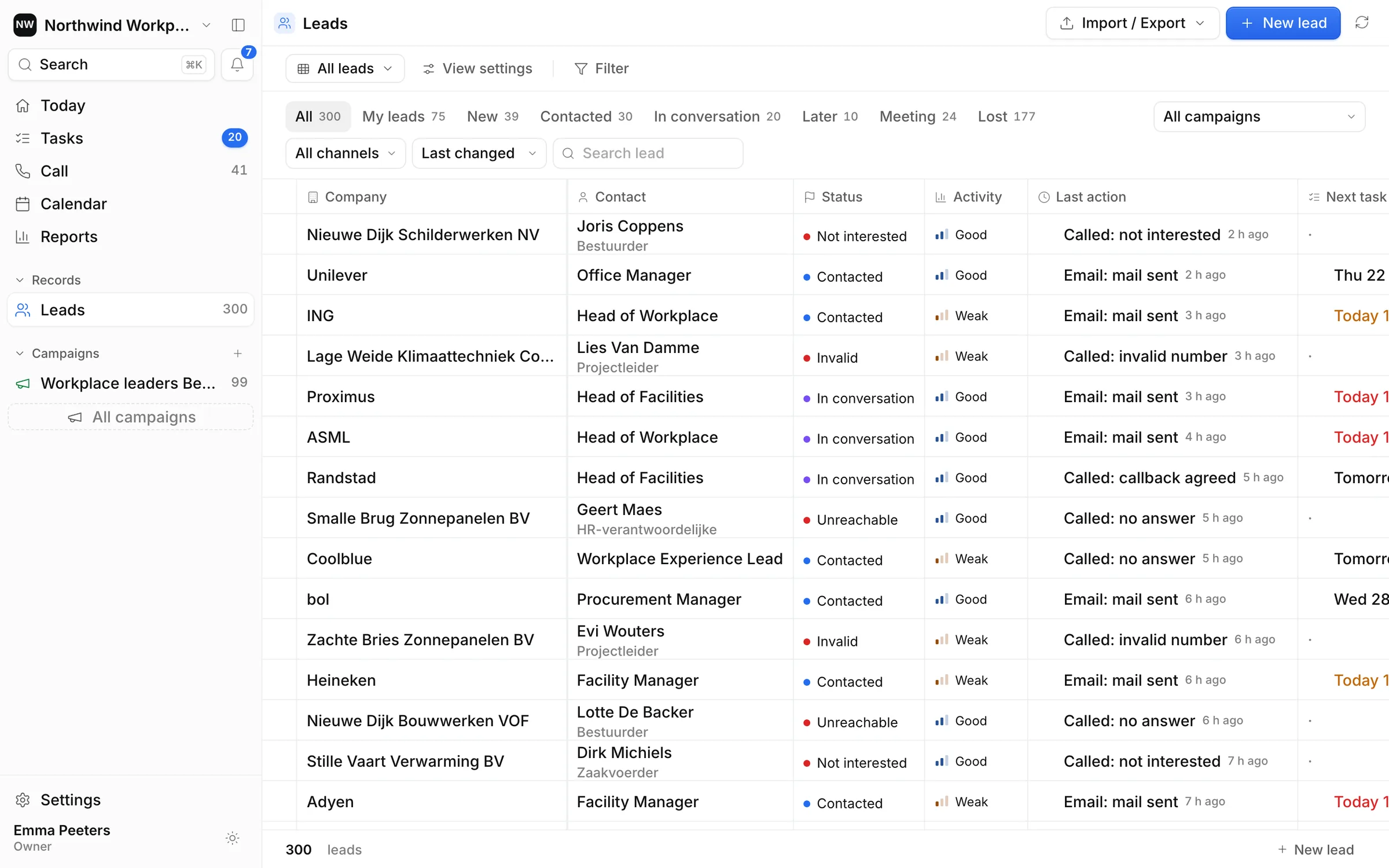
Your lists, in one place
Import Excel, CSV or a Bizzy export into a campaign. Every lead shows its status, last action and next task.
In this industry: Import a Bizzy export into campaigns by sector and size, for example manufacturers and transport companies with 10 to 100 employees, because investment needs and questions differ per sector.
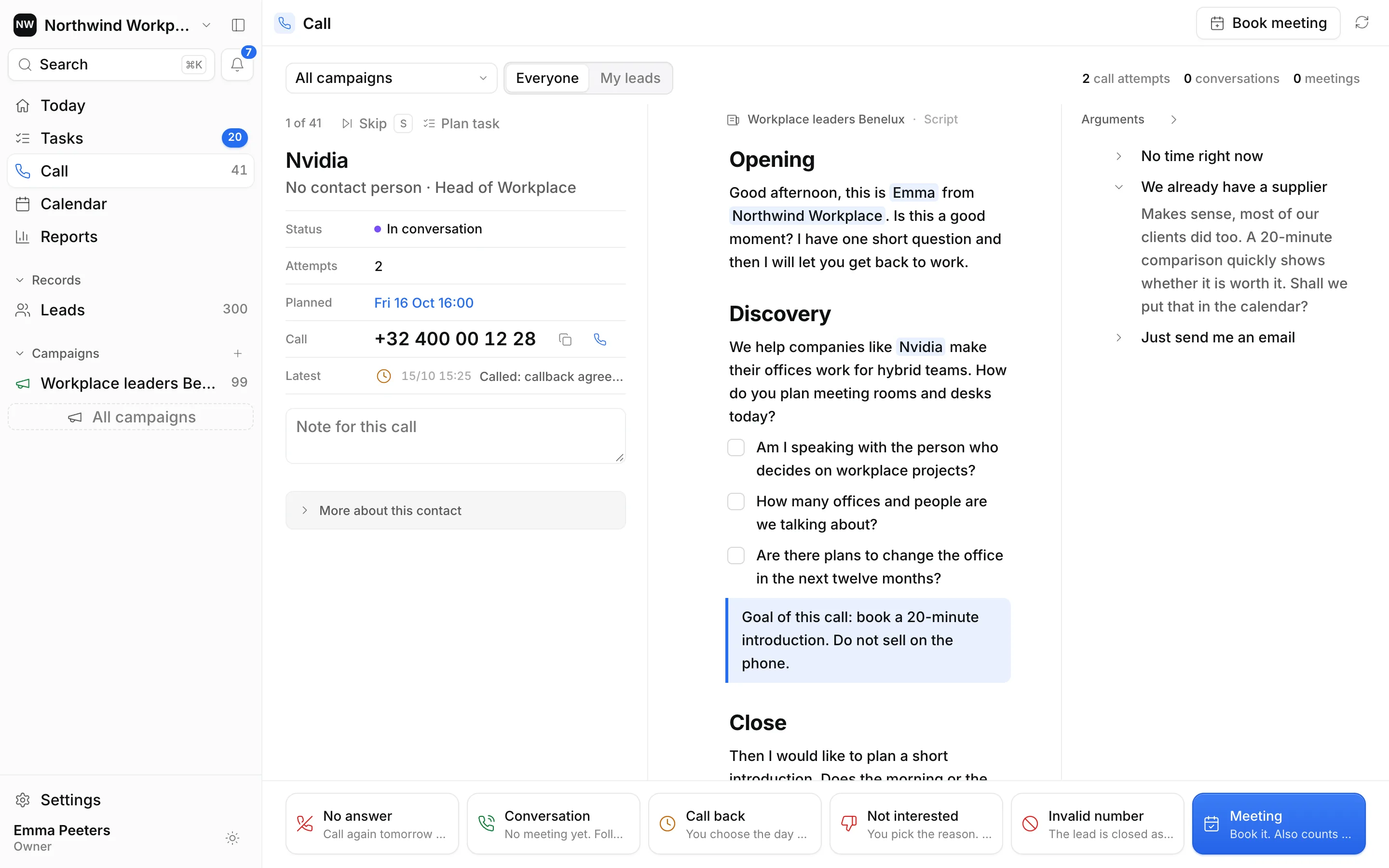
One screen for the call
The lead on the left, the script in the middle with the company name and your own name filled in. Click the number to call from your own phone.
In this industry: Put the questions about planned investments, current financing, end dates of loans and lease contracts and payment terms in the script, so every caller asks them.
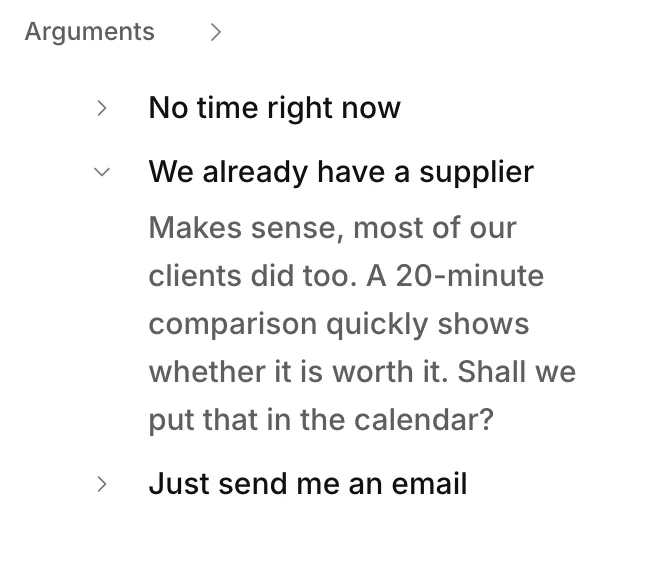
The answer to every objection
Common objections sit in a panel next to the script, so the right answer is one click away.
In this industry: Keep factual answers ready to "we only work with our bank", "we have no plans right now" and "what does it cost", each ending in a question about when the next investment decision is due, never in a promise about rates or approval.
One key per call, the next step planned
N (not reached) plans a new attempt the next working day, G (conversation) a follow-up call in three days, T (call back) the moment you pick. A records a meeting; X (not interested, with a reason) and O (invalid number) close the lead.
In this industry: Owners and finance managers are often unavailable. N plans the next attempt for the next working day; T lets you call back at the moment they choose, for example after the year-end figures are in.

Follow-up on every channel
Calls and emails land in your week. You write emails in Ringlane and send them from your own Gmail; LinkedIn and WhatsApp you send yourself and log by hand. The Today view puts overdue call-backs first.
In this industry: After a conversation, send the information you promised from your own Gmail and see it in the lead history, so a colleague knows exactly what was said and sent before the next call.
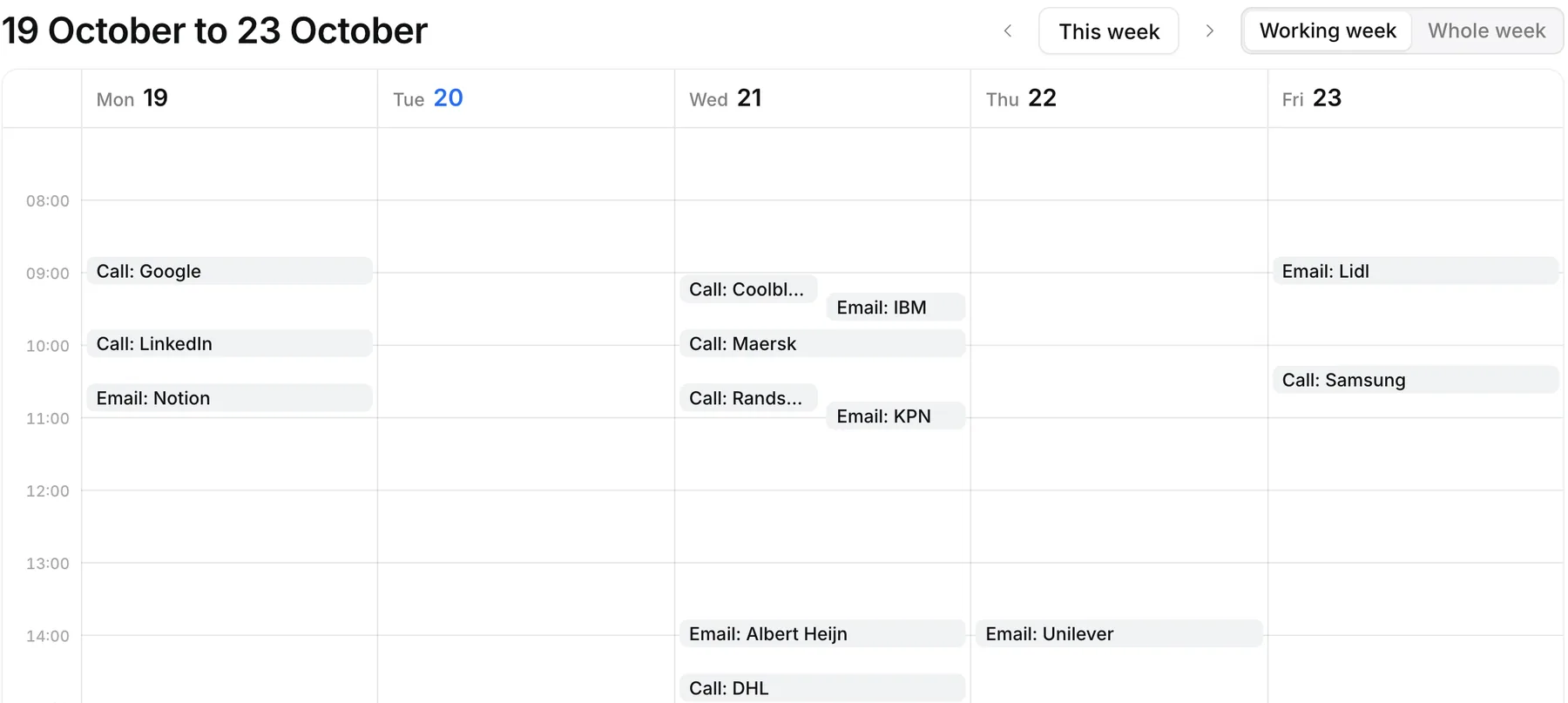
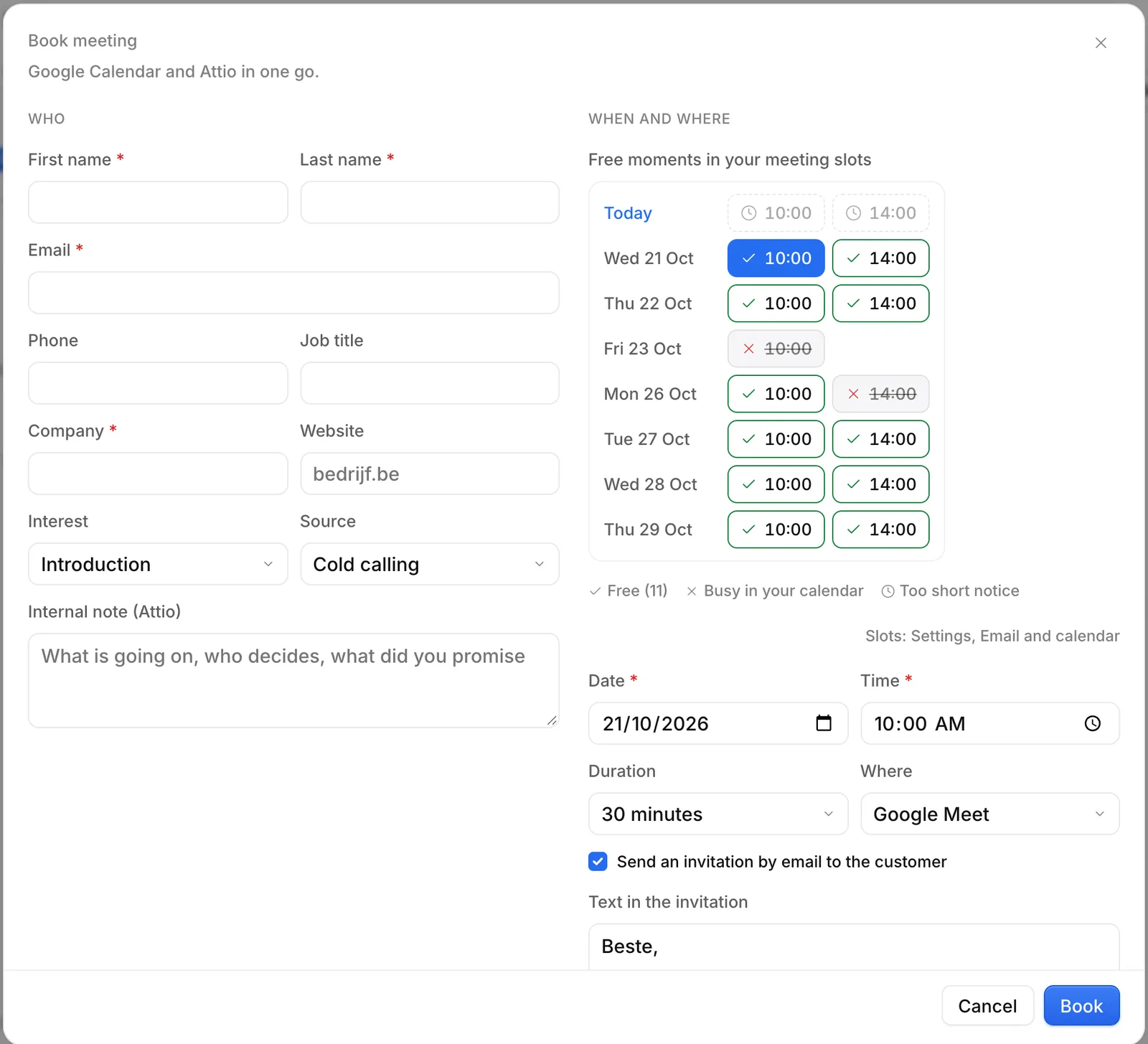
Book while they are on the line
Ringlane shows your free moments in Google Calendar, adds a Google Meet link and sends the invitation. Booked meetings go to Attio.
In this industry: When an owner agrees to a financing conversation, book it in Google Calendar with a Meet link during the call, and suggest the owner brings their accountant; the meeting goes to Attio.
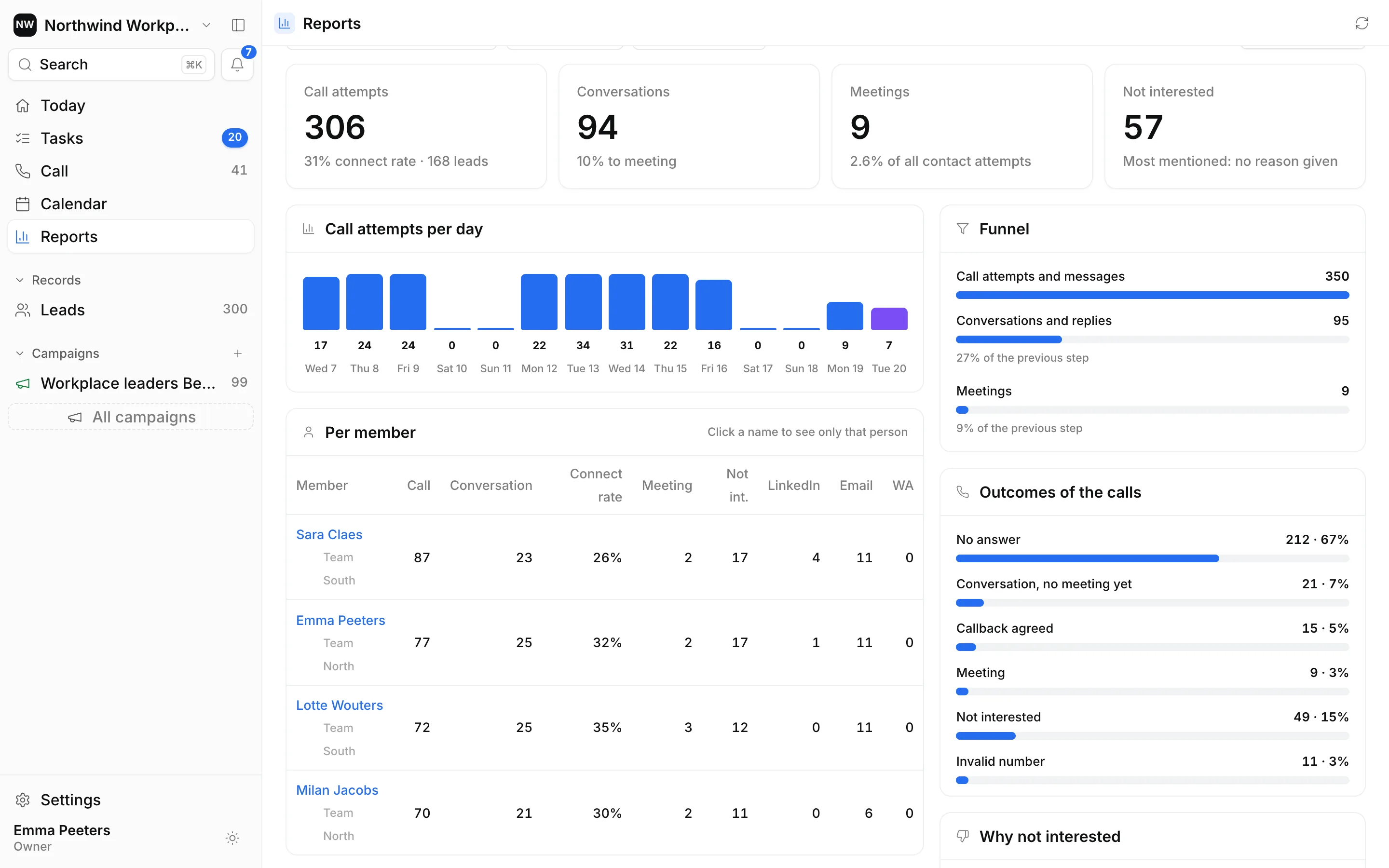
Your numbers, per caller and campaign
Call attempts, connect rate, conversations, meetings, the funnel and the reasons for "not interested", per person, team and campaign.
In this industry: Compare campaigns per sector and read the reasons for not interested. If "we just refinanced" comes back often, plan those leads for when the new contract nears its end.
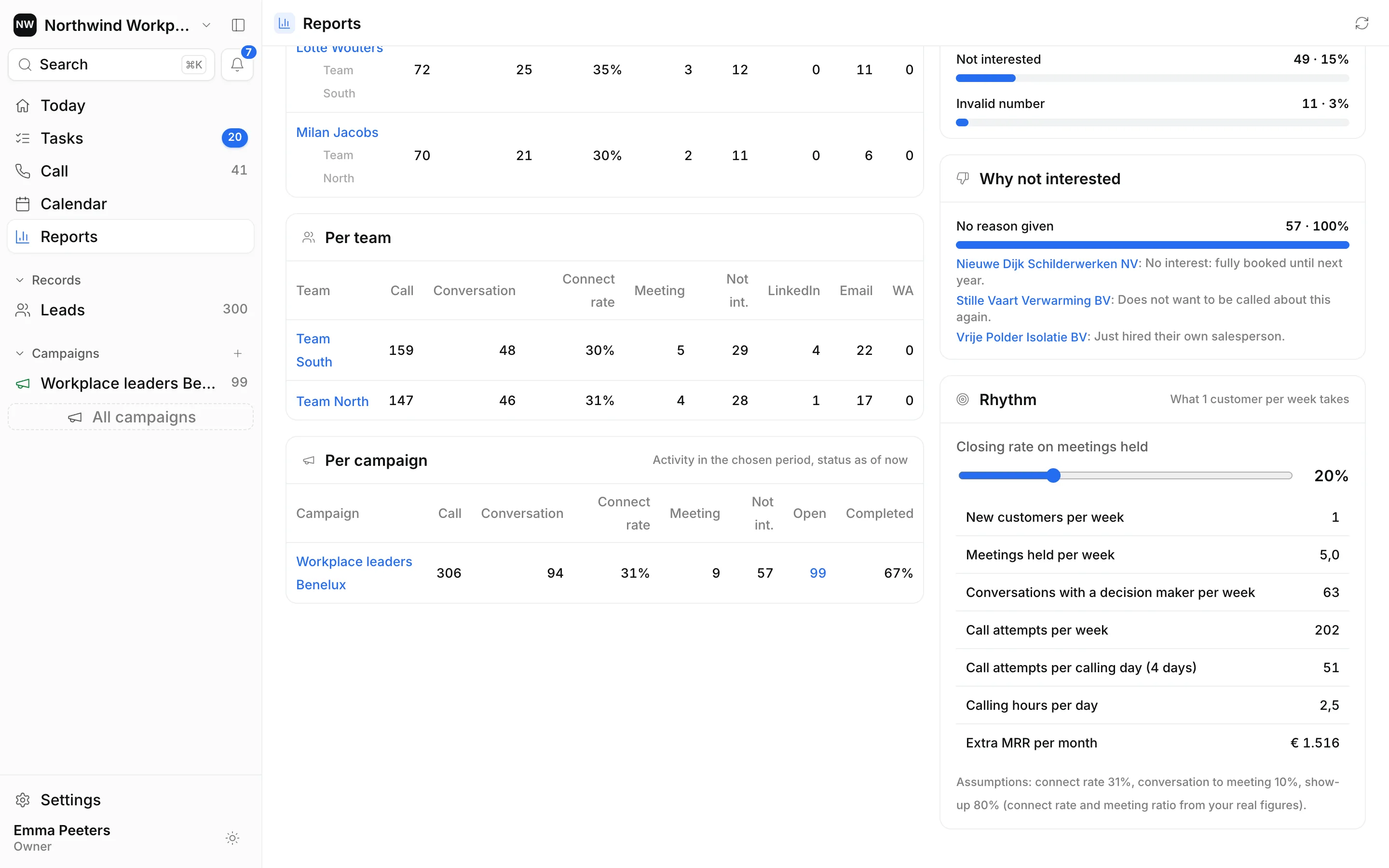
What one new customer takes
Based on your own rates, Ringlane calculates how many calls per week and per day one new customer per week takes.
In this industry: Enter your own connect and meeting rates and see how many calls per week one new financing client per week takes, so targets stay realistic in a field with long decision times.
Real screens from the Ringlane app with demo data. No affiliation with the companies shown.
What it can bring you: efficiency, money and more
One financing client often returns for the next investment, so each new relationship has value beyond the first deal. The table below is an example with assumed numbers, not a forecast. Replace every figure with your own.
| Example with assumed numbers: one caller, one month | Value |
|---|---|
| Call attempts | 400 |
| Conversations with a decision maker (assumed 25%) | 100 |
| Financing conversations booked (assumed 8% of conversations) | 8 |
| New clients (assumed 25% of meetings) | 2 |
| Value of one client (assumed 5,000 euro margin or fee on the first deal) | 5,000 euro |
In this example, two new clients a month are worth 10,000 euro on their first deal, before any repeat business. Your own numbers will differ, which is exactly why it helps to measure them.
Efficiency is the other half. Measure for one week how long your team spends after each call on notes, contract end dates and remembering what was promised. Logging the outcome with one key, with the next call already planned, removes most of that. It also leaves a clear record of what was said and sent, which helps in a regulated field. Read how to follow up leads for a cadence that respects the owner's pace.
Want to see the calling screen first? Try the demo.
Rules to know
This section is general information, not legal advice. Which rules apply depends on what you offer and where.
- Belgium, lending to small enterprises. The law of 21 December 2013 on SME financing applies to credit agreements with SMEs. According to a 2014 summary by Lexgo, lenders must, among other things, tell a company the main elements behind a refusal, and for credits up to 1 million euro an early repayment fee may not exceed six months of interest. The law may have been amended since; check the current text.
- The Netherlands, business lending. In its 2021 study of non-bank small business financing, the AFM wrote that, unlike consumer credit, it had no mandate to supervise business lending. Rules may have changed since; check the current position.
- Investments, insurance and consumer credit are regulated more strictly in both countries, under financial supervisors such as the FSMA in Belgium and the AFM in the Netherlands. Keep calls about those products within the rules for your licence.
- Calling itself. B2B calls must also respect privacy and calling rules. See the rules for cold calling in Belgium and the Netherlands.
In every case: do not promise approval, rates or results on a call, and give balanced information. Ask your compliance officer or lawyer to check your script.
Frequently asked questions
Who decides on financing at a small or mid-sized company?
How many SMEs look for external financing?
Are there special rules for lending to small businesses in Belgium?
Can I promise a rate or an approval on a first call?
How many calls does it take to win one financing client?
Sources
- Febelfin: Outstanding corporate lending reaches a new record at the end of 2025 (3 March 2026)
- CBS: Financieringsmonitor 2025, summary
- Lexgo: Het krediet aan kmo's is voortaan gedeeltelijk gereglementeerd (law of 21 December 2013)
- AFM: Verkenning non-bancaire kleinzakelijke financiering (April 2021)
- Statbel: Demography of enterprises with employees, by NACE and size class, 2023 (Bestat)
- CBS StatLine: Bedrijven; bedrijfsgrootte en rechtsvorm (table 81589NED)
All industries
- Accounting firms
- Business events and venues
- Commercial cleaning
- Commercial real estate
- Commercial solar and energy
- Consultancy
- Corporate catering
- Corporate training
- Fleet, leasing and EV charging
- HR and payroll services
- HVAC and building services
- Industrial manufacturing
- Insurance brokers
- IT services and MSPs
- Logistics and transport
- Marketing agencies
- Office furniture and workplace
- Printing and packaging
- Recruitment and staffing
- SaaS and software
- Security services
- Telecom and connectivity
- Wholesale and distribution
- Workwear and PPE