Win new business clients with calls at the moments owners need help
For accounting, tax and bookkeeping firms in Belgium and the Netherlands: who to call, which moments make an owner open to a new accountant, and how to follow up without it eating into billable hours.
Business owners rarely change accountants. When they do, it is usually because something changed: the company grew, a new rule landed, the accountant retired or simply stopped answering. Accounting firms that grow on purpose find those moments by calling, and then follow up patiently, because the switch often only happens at the next financial year.
The market: many firms, loyal clients, new rules
The profession is large in both countries. In the Netherlands, the professional body NBA had 22,590 members on 31 December 2025, of whom 9,664 were public accountants: 5,464 registeraccountants and 4,200 accountants-administratieconsulenten. The CBS business register counted 37,270 businesses in accountancy and administration on 1 October 2026 (provisional figures), of which 30,740 are one-person companies and only 770 have ten or more people. In Belgium, the ITAA represents more than 15,000 professionals and trainees.
On the client side, Belgium alone has a large base of VAT-liable companies. VRT NWS reported in early December 2025 that only about 515,000 of roughly 1,178,000 VAT-liable companies, or 43%, had registered for Peppol e-invoicing, citing the federal finance ministry. Statbel's monthly figures show that the largest groups of VAT-registered enterprises are in professional services, trade and construction.
Decisions are personal. At a small company the owner picks the accountant, often on trust and a referral. At mid-sized companies a finance manager weighs in on service, software and price. Switching costs effort, so prospects need a reason and a moment.
Who you call and what you ask
- Owner or managing director of a small company: chooses the accountant personally.
- Finance manager or CFO at mid-sized companies: cares about reporting, software and response times.
- Founders of new companies: choose an accountant before or shortly after incorporation.
Moments that make a call relevant:
- New rules. Since 1 January 2026, Belgian VAT-liable companies must send structured B2B e-invoices via Peppol, as VRT NWS explained. Owners who struggle with the setup want help.
- Growth: first employees, a second entity, a move from sole trader to a company.
- A new company in your region.
- The run-up to year end, when owners think about whether they want the same service next year.
- A retiring accountant or a firm that was taken over and changed its service.
Discovery questions that work with owners:
- How quickly does your accountant answer when you have a question?
- Which software do you use for invoicing and bookkeeping, and is e-invoicing running smoothly?
- Do you get figures during the year, or only at year end?
- What would make you consider a different accountant?
- When does your financial year end, and when would a change be easiest for you?
Owners are busiest during the day, so timing your calls matters. See the best time to cold call.
What slows a calling team down in this sector
- Loyalty. "We have had the same accountant for 15 years" is the most common answer. It is a reason to plan a later call, not to give up.
- Busy seasons. Tax deadlines and year-end work push acquisition aside for weeks. Leads that were warm in autumn are cold in spring.
- Billable hours come first. Partners and staff call between client work, so outcomes are often not written down.
- Switching friction. Owners fear the paperwork. A clear, simple onboarding story helps more than a lower price.
- Professional ethics. Rules of the profession ask for restraint. Calls need a helpful reason and no pressure. Check your professional body's guidance and our overview of cold calling rules in Belgium and the Netherlands. This is general information, not legal advice.
A practical answer to most of these obstacles is to split the work by season and by target group. Run one campaign for starters and one for established companies, because the questions and the timing differ. Call established companies in the quiet months after the tax deadlines, ask for the end of their financial year, and plan the next call for a few months before it. Call starters continuously, because a new company needs an accountant right away. Keep the first call short: one question about how things are going today, one offer of a short review, and a clear next step. Owners who say no now often say yes when something changes, so a reason for not interested is worth more than a closed lead without a note.
How Ringlane works for accounting firms
Real screens from the app, with what each feature does in this industry.
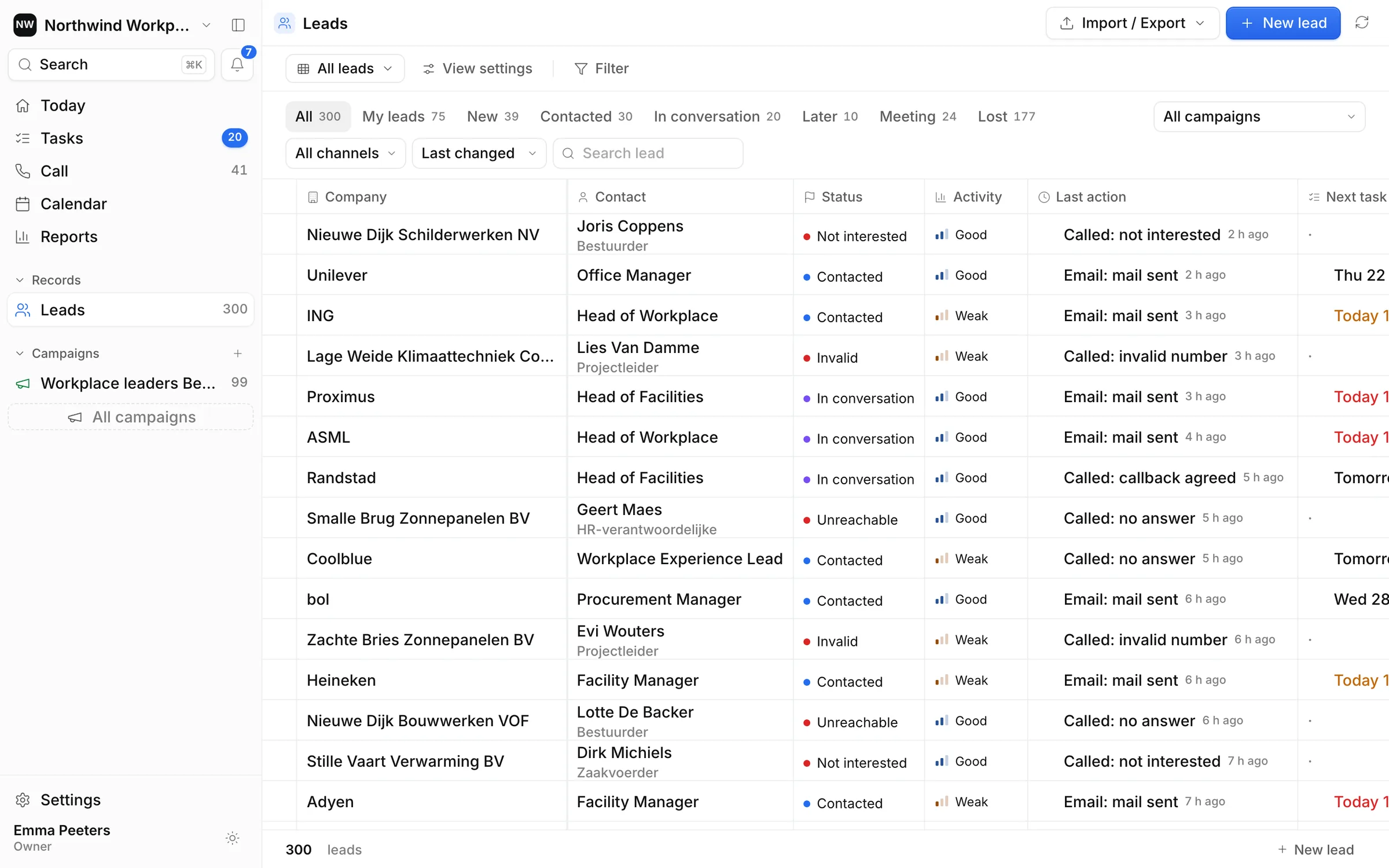
Your lists, in one place
Import Excel, CSV or a Bizzy export into a campaign. Every lead shows its status, last action and next task.
In this industry: Import a Bizzy export of companies by legal form, size and region, for example recently founded BVs within 20 kilometres, into one campaign per target group, so partners and staff work the same list.
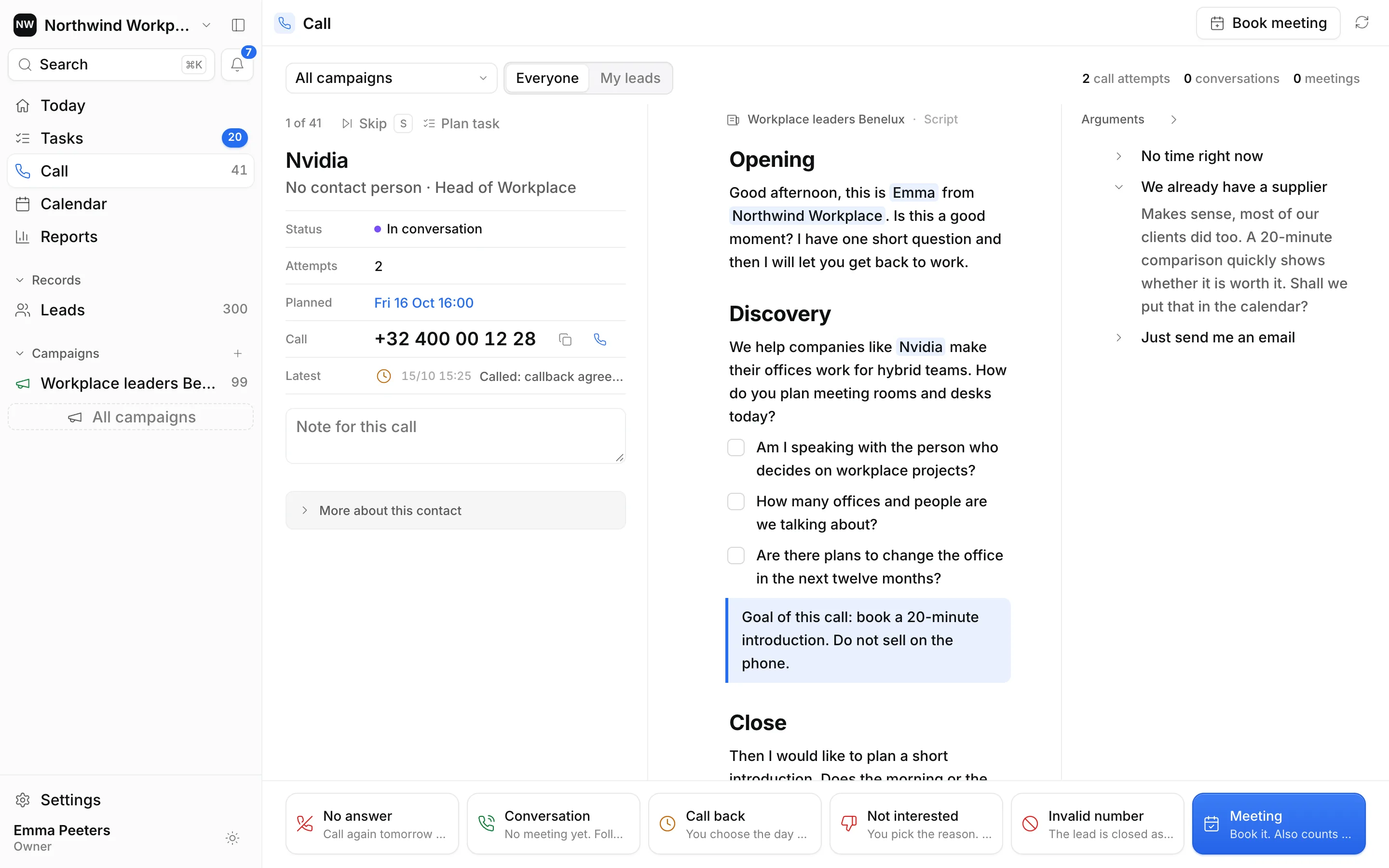
One screen for the call
The lead on the left, the script in the middle with the company name and your own name filled in. Click the number to call from your own phone.
In this industry: Put the questions about current accountant, bookkeeping software, e-invoicing status and year-end timing in the script, so every caller asks the same things.
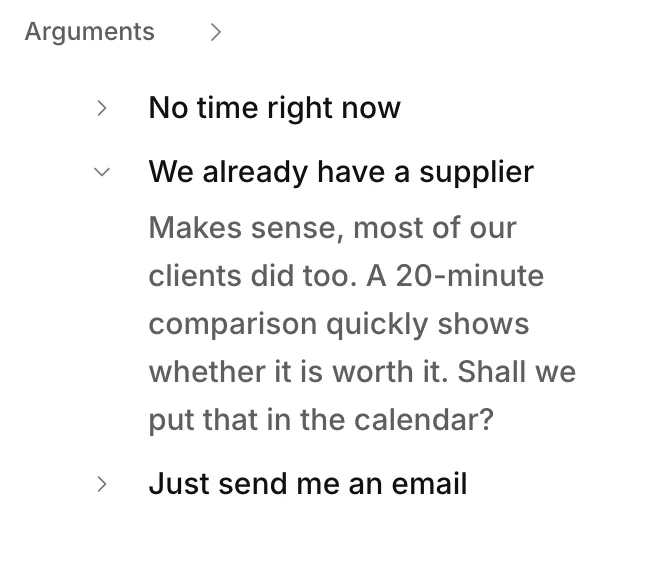
The answer to every objection
Common objections sit in a panel next to the script, so the right answer is one click away.
In this industry: Keep answers to "we are happy with our accountant", "switching is too much work" and "you will be more expensive" next to the script, each one ending in an offer of a short, free review.
One key per call, the next step planned
N (not reached) plans a new attempt the next working day, G (conversation) a follow-up call in three days, T (call back) the moment you pick. A records a meeting; X (not interested, with a reason) and O (invalid number) close the lead.
In this industry: Owners are often on site or with customers during the day. N plans the next attempt for the next working day; T lets you call back early in the morning or after six if that is when they pick up.

Follow-up on every channel
Calls and emails land in your week. You write emails in Ringlane and send them from your own Gmail; LinkedIn and WhatsApp you send yourself and log by hand. The Today view puts overdue call-backs first.
In this industry: After a call, send a short note on e-invoicing or the documents you need for a review from your own Gmail and see the thread with that lead, so a colleague can pick it up.
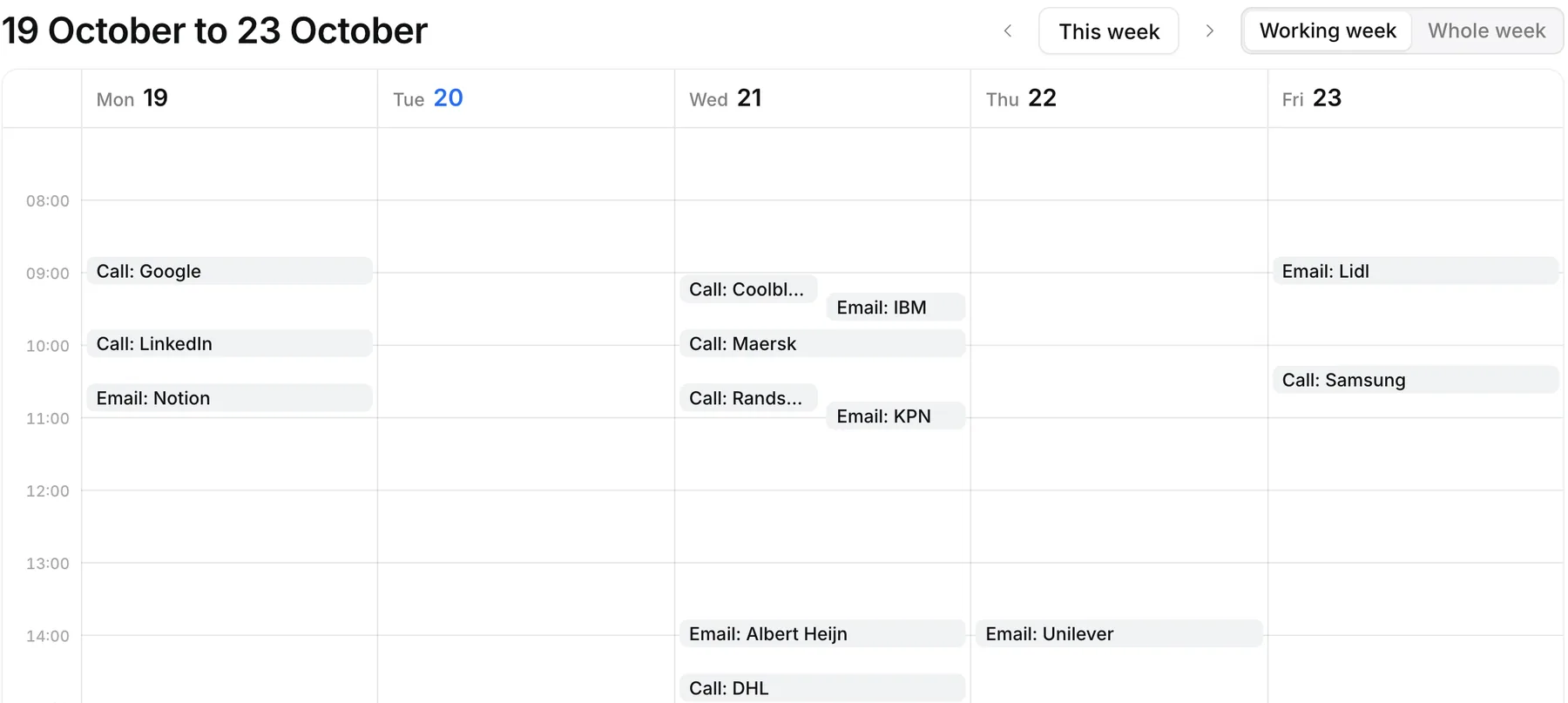
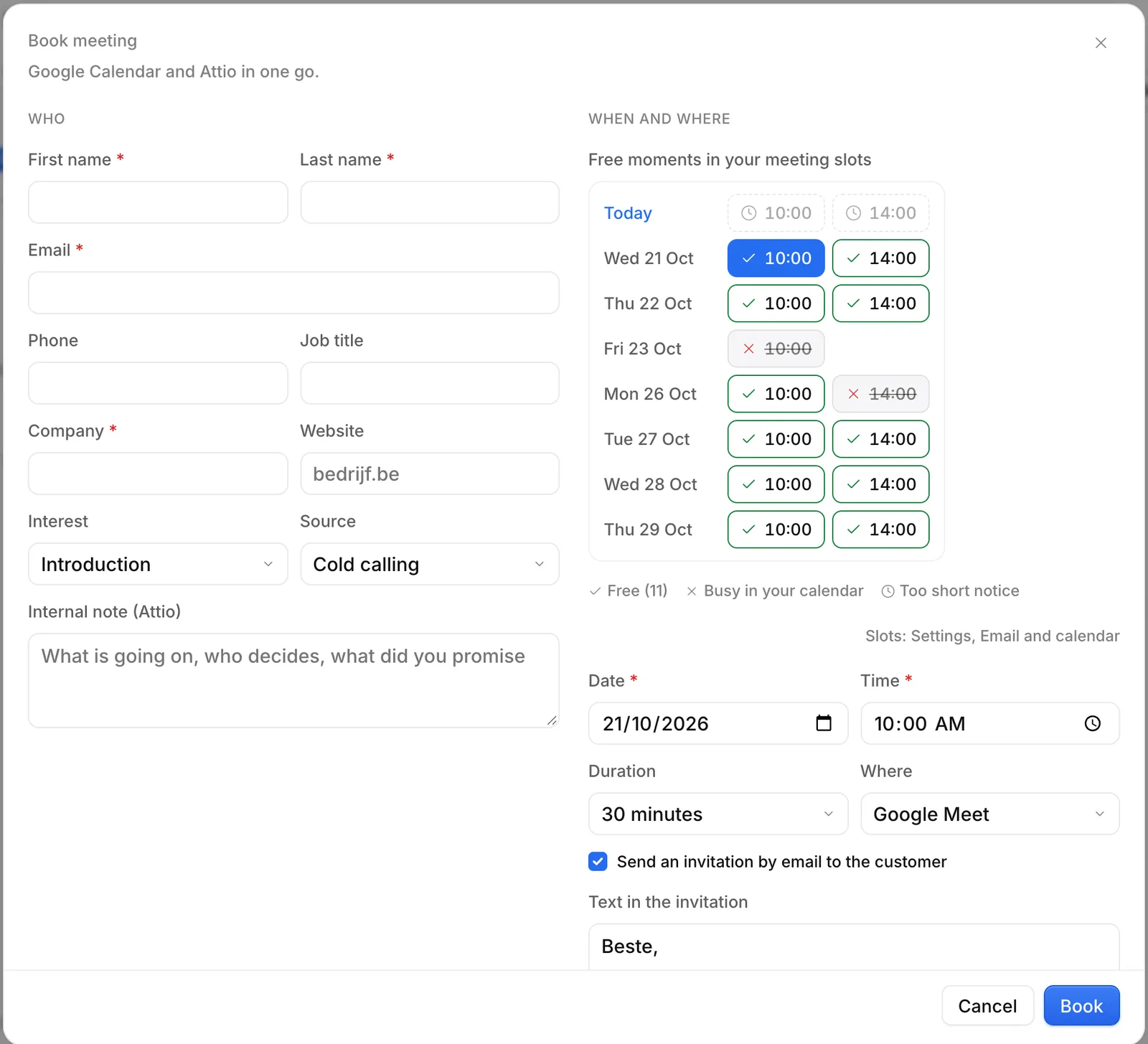
Book while they are on the line
Ringlane shows your free moments in Google Calendar, adds a Google Meet link and sends the invitation. Booked meetings go to Attio.
In this industry: When an owner agrees to an introductory meeting, book it in Google Calendar with a Meet link while they are on the line; the meeting goes to Attio.
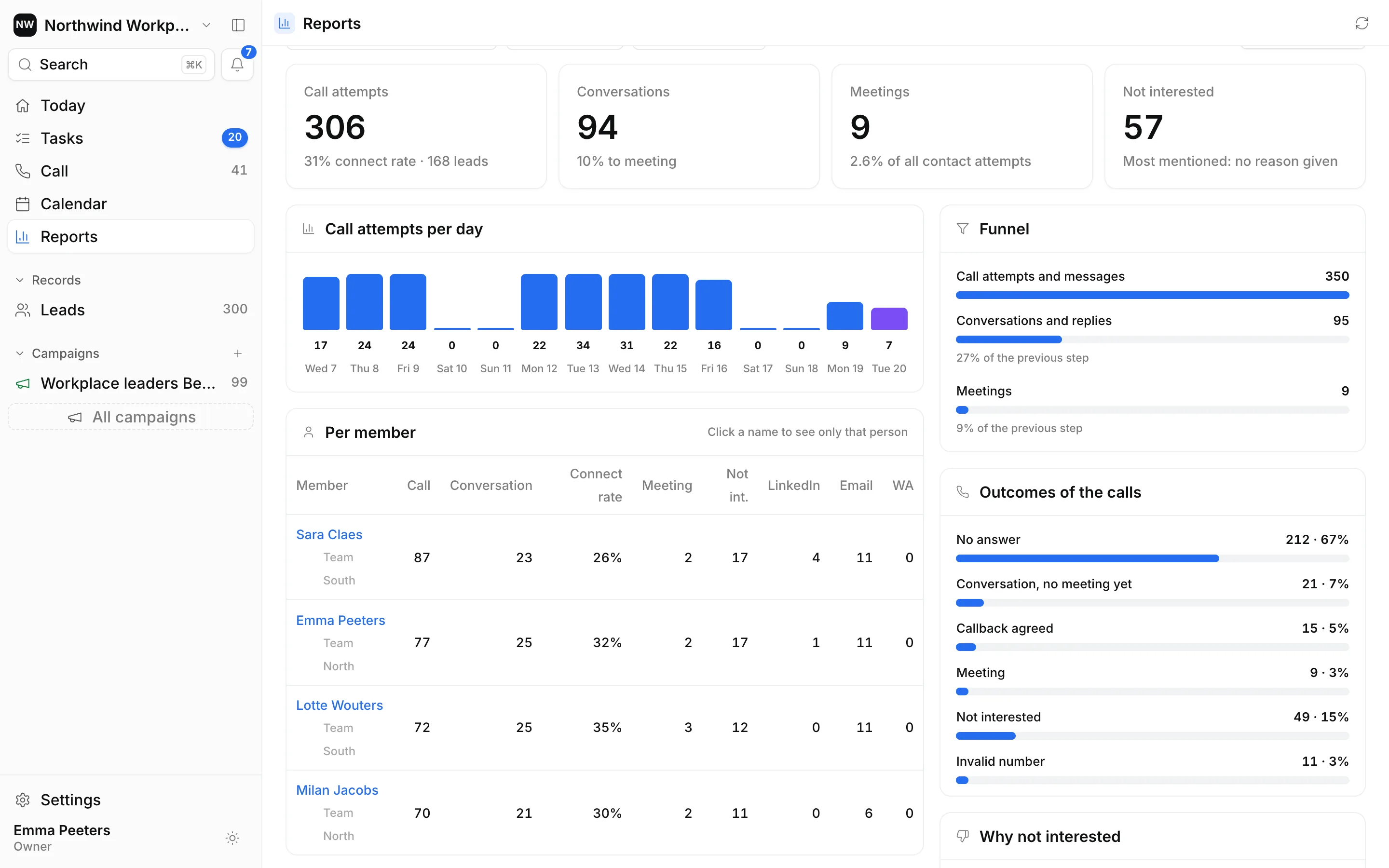
Your numbers, per caller and campaign
Call attempts, connect rate, conversations, meetings, the funnel and the reasons for "not interested", per person, team and campaign.
In this industry: Compare campaigns per target group, for example starters versus established companies, and read the reasons for not interested to see whether price or loyalty is the real obstacle.
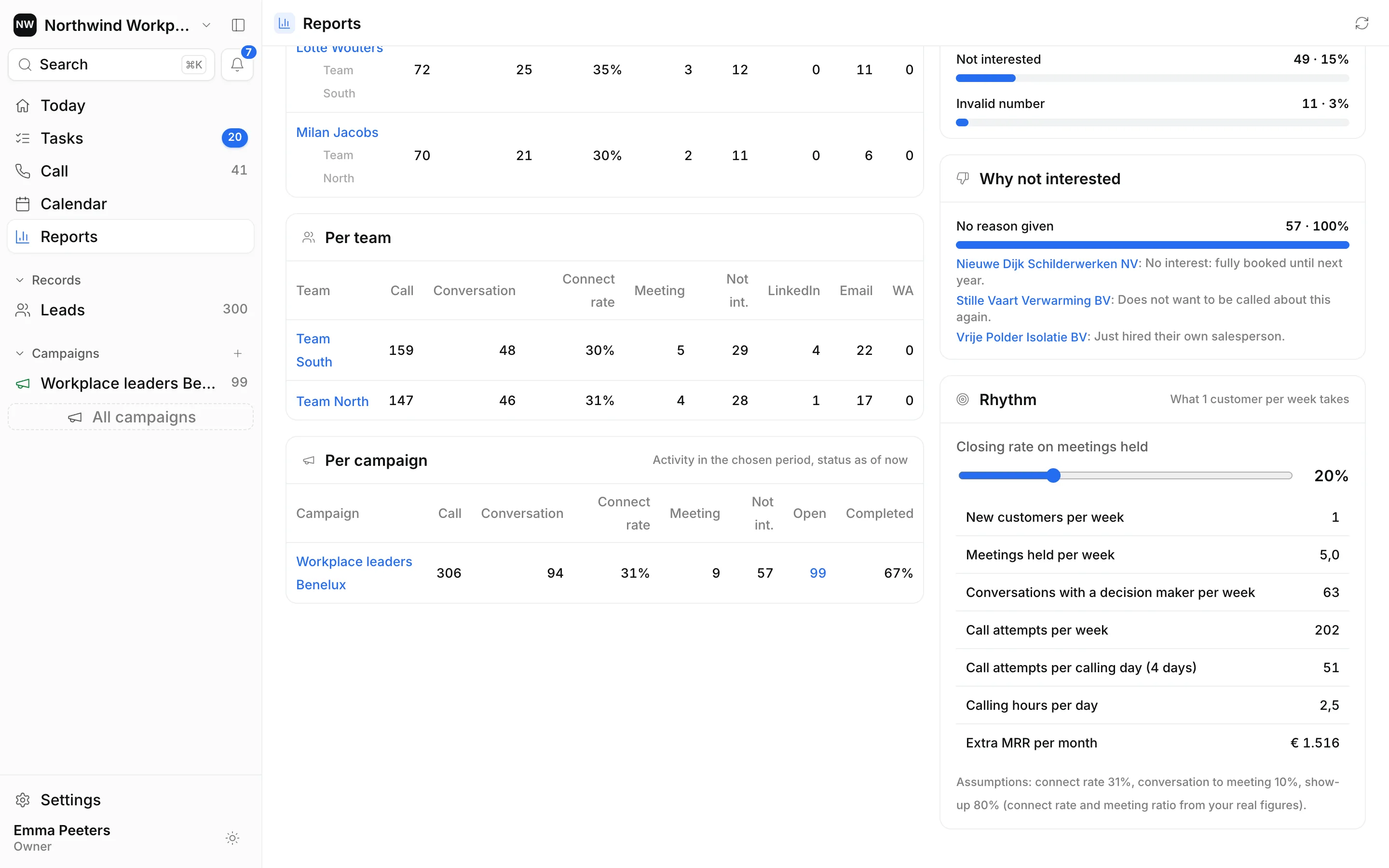
What one new customer takes
Based on your own rates, Ringlane calculates how many calls per week and per day one new customer per week takes.
In this industry: Fill in your own rates and see how many calls per week one new client per week takes, so a partner can decide how many hours acquisition really needs outside the busy season.
Real screens from the Ringlane app with demo data. No affiliation with the companies shown.
What it can bring you: efficiency, money and more
A new business client often stays for years, so the value is in the recurring fee. The table below is an example with assumed numbers, not a forecast. Replace every figure with your own.
| Example with assumed numbers: one person calling, one month | Value |
|---|---|
| Call attempts (outside the busy season) | 300 |
| Conversations with the owner (assumed 30%) | 90 |
| Introductory meetings booked (assumed 10% of conversations) | 9 |
| New clients (assumed 33% of meetings) | 3 |
| Value of one client (assumed 4,000 euro annual fee over five years) | 20,000 euro |
In this example, three new clients a month represent 60,000 euro in fees over five years. Your own fees and retention decide the real figure, so measure them.
Efficiency is where an accounting firm feels it first. Measure for a week how much time goes to notes after calls and to remembering who to call back after the busy season. Logging the outcome with one key and seeing the next call already planned keeps acquisition from eating billable hours. See sales time versus admin and how to handle objections such as "we are happy with our accountant".
Want to see the calling screen first? Try the demo.
Frequently asked questions
Can accounting firms use cold calling to find new clients?
Who should an accounting firm call?
How many accountants are there in Belgium and the Netherlands?
Is e-invoicing a reason to contact Belgian companies?
When is the best time to call business owners?
Sources
- Accountant.nl (NBA): Ledenaantallen NBA, 31 December 2025
- Forum for the Future: Emmanuel Degrève elected president of the ITAA (2026)
- CBS StatLine: Bedrijven; bedrijfstak (table 81589NED)
- VRT NWS: Peppol e-invoicing obligation from 1 January (4 December 2025)
- Statbel: VAT-registered enterprises by economic activity, monthly, December 2024 to December 2025
All industries
- Business events and venues
- Business finance
- Commercial cleaning
- Commercial real estate
- Commercial solar and energy
- Consultancy
- Corporate catering
- Corporate training
- Fleet, leasing and EV charging
- HR and payroll services
- HVAC and building services
- Industrial manufacturing
- Insurance brokers
- IT services and MSPs
- Logistics and transport
- Marketing agencies
- Office furniture and workplace
- Printing and packaging
- Recruitment and staffing
- SaaS and software
- Security services
- Telecom and connectivity
- Wholesale and distribution
- Workwear and PPE