Win catering contracts by calling before the next office decision
For contract caterers, office lunch services and event caterers in Belgium and the Netherlands: who decides on food at work, which moments make a call relevant, and how to keep long contract cycles moving.
Food at work is bought by people who have a building to run. A facility manager thinks about occupancy, the kitchen, the contract with the current caterer and complaints at the coffee machine. Calls from caterers that talk about menus first get a polite no. Calls that ask how many people are on site, and when the contract ends, start a real conversation.
The market: fewer people on site, but every office still eats
The buyers are employers with enough people in one place. In Belgium, Statbel counted 35,139 enterprises with 10 or more employees in industry, construction and services in 2023. In the Netherlands, the CBS business register counts 72,340 businesses with 10 or more working persons on 1 October 2026 (provisional), and 8,625 with 100 or more.
The supply side is concentrated. The same CBS register counts 1,140 businesses in canteens and contract catering, but only 45 have 10 or more working persons. Smaller caterers, lunch delivery services and event caterers compete for the companies that the large contract caterers do not serve.
Hybrid work changed the demand. According to Eurostat, 52.3% of employed people aged 15 to 64 in the Netherlands worked from home sometimes or usually in 2025, and 37.1% in Belgium. That makes daily volumes harder to predict and puts flexible formats on the table.
In Belgium, meal vouchers are part of the same budget discussion. Since 1 January 2026, a meal voucher can be worth up to 10 euro, with a maximum employer share of 8.91 euro. According to Lexgo, the increase is not automatic and needs a company agreement or a contract annex. This is general information, not legal advice.
Who you call and what you ask
- Facility manager or office manager: runs the building, the kitchen and the current catering contract.
- HR manager: involved when food supports wellbeing, recruitment or the return to the office.
- Procurement or finance director: joins for larger contracts and tenders.
- Property manager: decides in shared buildings and business parks.
Moments that make a call relevant:
- The end of a catering contract, or a tender for the next period.
- An office move or renovation: a new kitchen, a new restaurant or no restaurant at all.
- A new office policy: fixed office days often create clear peak days.
- A change in benefits, such as a new meal voucher arrangement in Belgium.
- Growth: a second site or a large group of new hires.
Discovery questions that work in this sector:
- How many people are on site on a busy day, and on a quiet day?
- Who provides lunch today, and until when does that agreement run?
- Which days does your team come to the office most?
- What do employees say about the food today?
- What kitchen facilities does the building have?
Start with people and days, not with food. The answers tell you which format fits: a staffed restaurant, a lunch service on peak days or catering for meetings and events. They also tell you who else you need to speak to before anyone can say yes.
What slows a calling team down in this sector
- Tenders and long contracts. Larger companies tender catering for several years at a time. You call to be invited next time, which means planning a call years ahead.
- Uncertain volumes. "Nobody is here on Fridays" is a real objection. Without an answer about flexible volumes, the call ends.
- Busy gatekeepers. Facility managers are rarely at their desk. Repeated attempts at the right hour matter.
- Several decision makers. Facility, HR, finance and sometimes the property manager each have a say. Notes on who said what keep the next call short.
- Holiday periods. Summer and year end are slow for decisions and for occupancy. Plan call blocks around them.
One more pattern: the prospect who says "call me after the move" or "after the summer" means it more often than you think. Those leads need a call back on that exact moment, with the notes from the first conversation at hand.
For answers that keep the conversation going, see how to handle sales objections.
How Ringlane works for corporate caterers
Real screens from the app, with what each feature does in this industry.
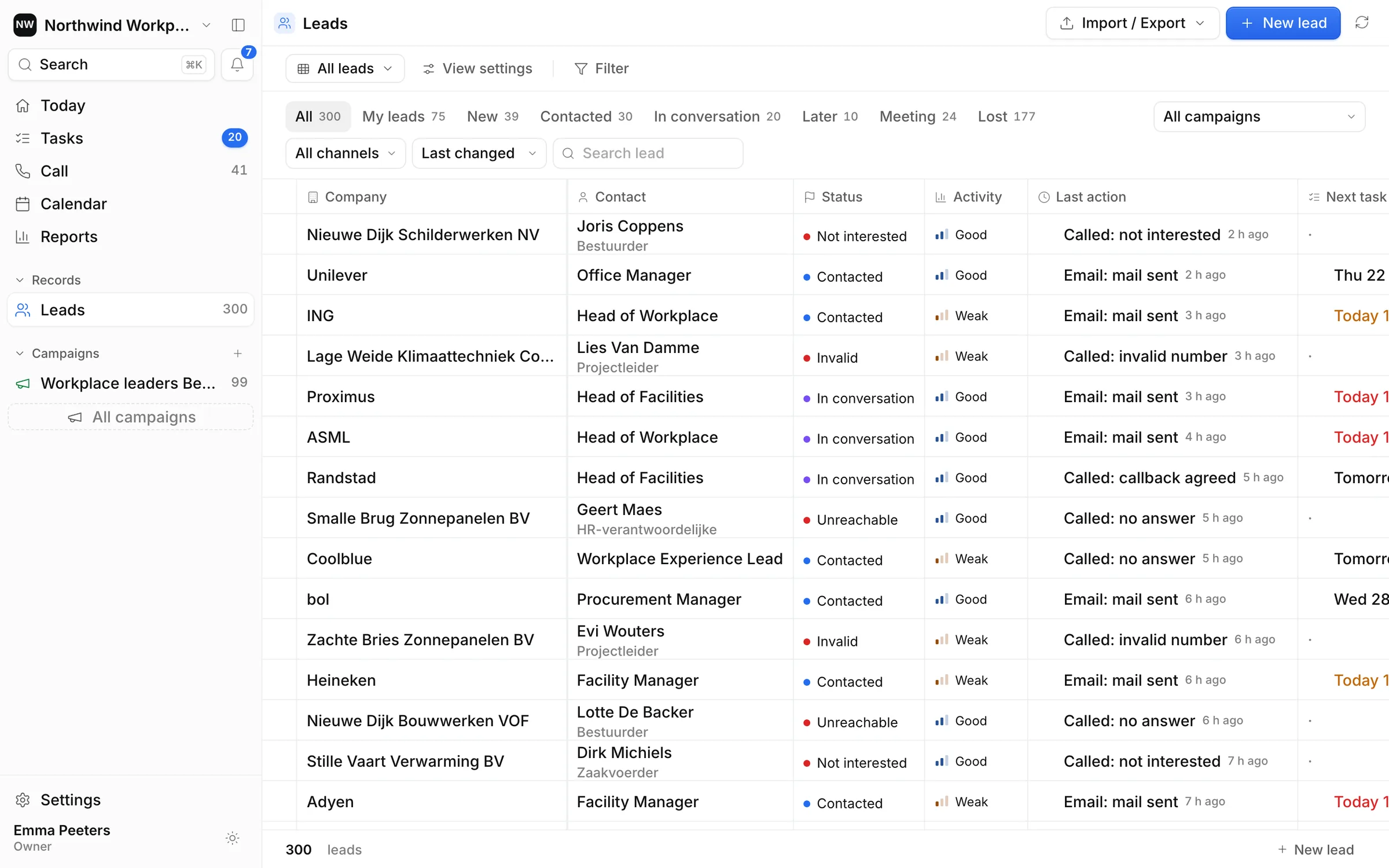
Your lists, in one place
Import Excel, CSV or a Bizzy export into a campaign. Every lead shows its status, last action and next task.
In this industry: Import a Bizzy export of companies with 50 or more employees in your delivery area into one campaign, and a separate one for business parks or multi-tenant buildings, so each caller knows which kind of site they call.
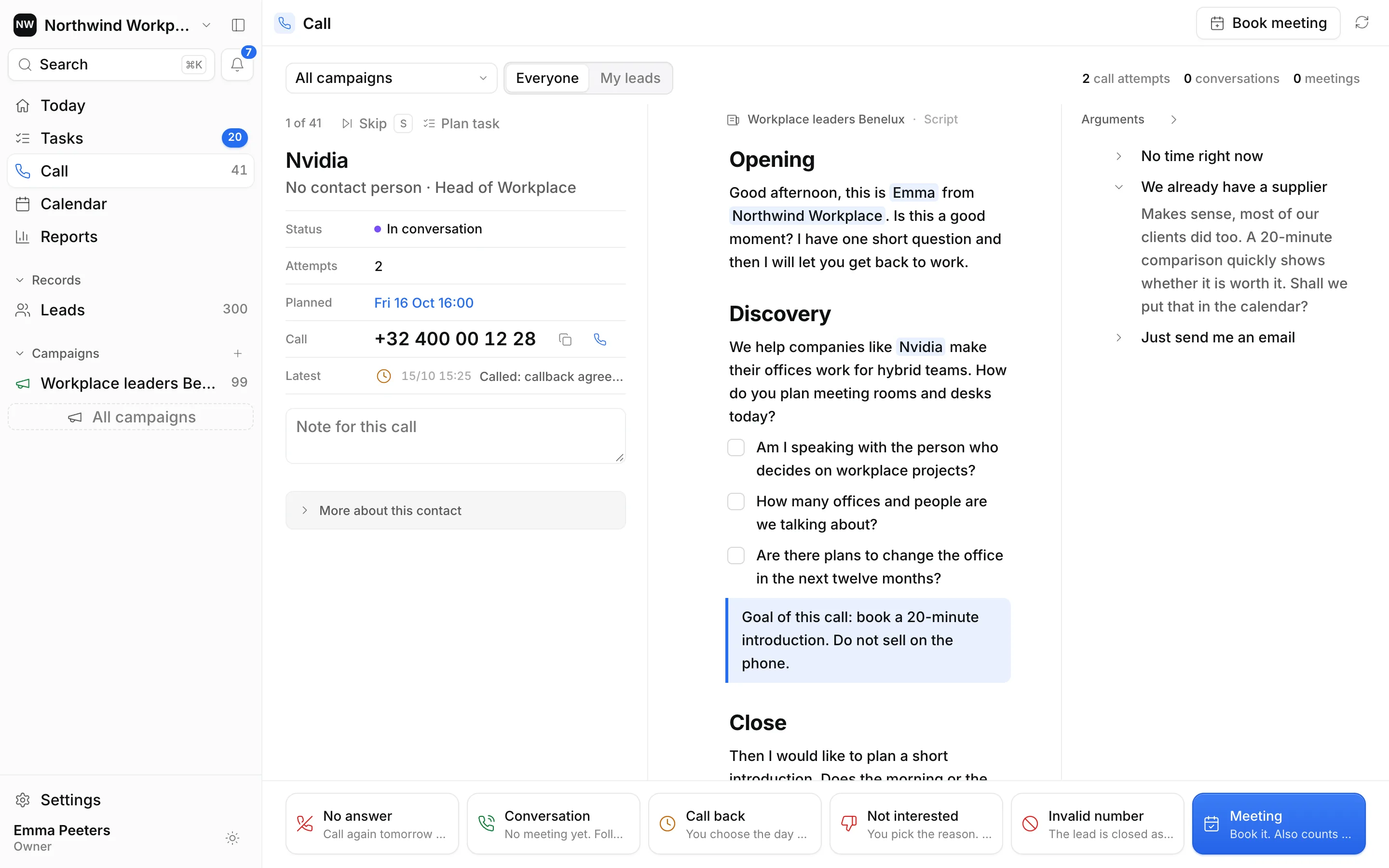
One screen for the call
The lead on the left, the script in the middle with the company name and your own name filled in. Click the number to call from your own phone.
In this industry: Put the questions about the number of people on site per day, the current caterer, the contract end and the kitchen facilities in the script, so every caller asks them.
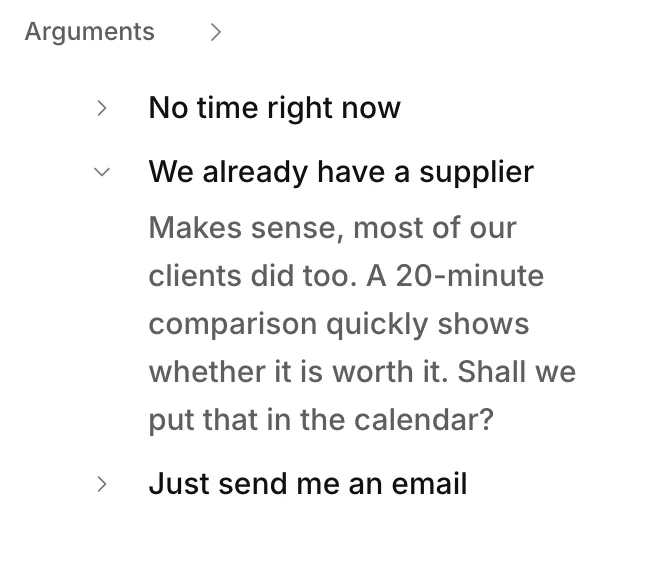
The answer to every objection
Common objections sit in a panel next to the script, so the right answer is one click away.
In this industry: Keep answers ready to "nobody is in the office anymore", "we have a caterer" and "our staff get meal vouchers", each ending in a question about how many people eat on site on a busy day.
One key per call, the next step planned
N (not reached) plans a new attempt the next working day, G (conversation) a follow-up call in three days, T (call back) the moment you pick. A records a meeting; X (not interested, with a reason) and O (invalid number) close the lead.
In this industry: Facility managers walk the building all day. N plans the next attempt for the next working day; T lets you call back at the quiet hour they name.

Follow-up on every channel
Calls and emails land in your week. You write emails in Ringlane and send them from your own Gmail; LinkedIn and WhatsApp you send yourself and log by hand. The Today view puts overdue call-backs first.
In this industry: After a conversation, send your menu example or tasting proposal from your own Gmail and see it in the lead history, so a colleague can pick up the next call without asking.
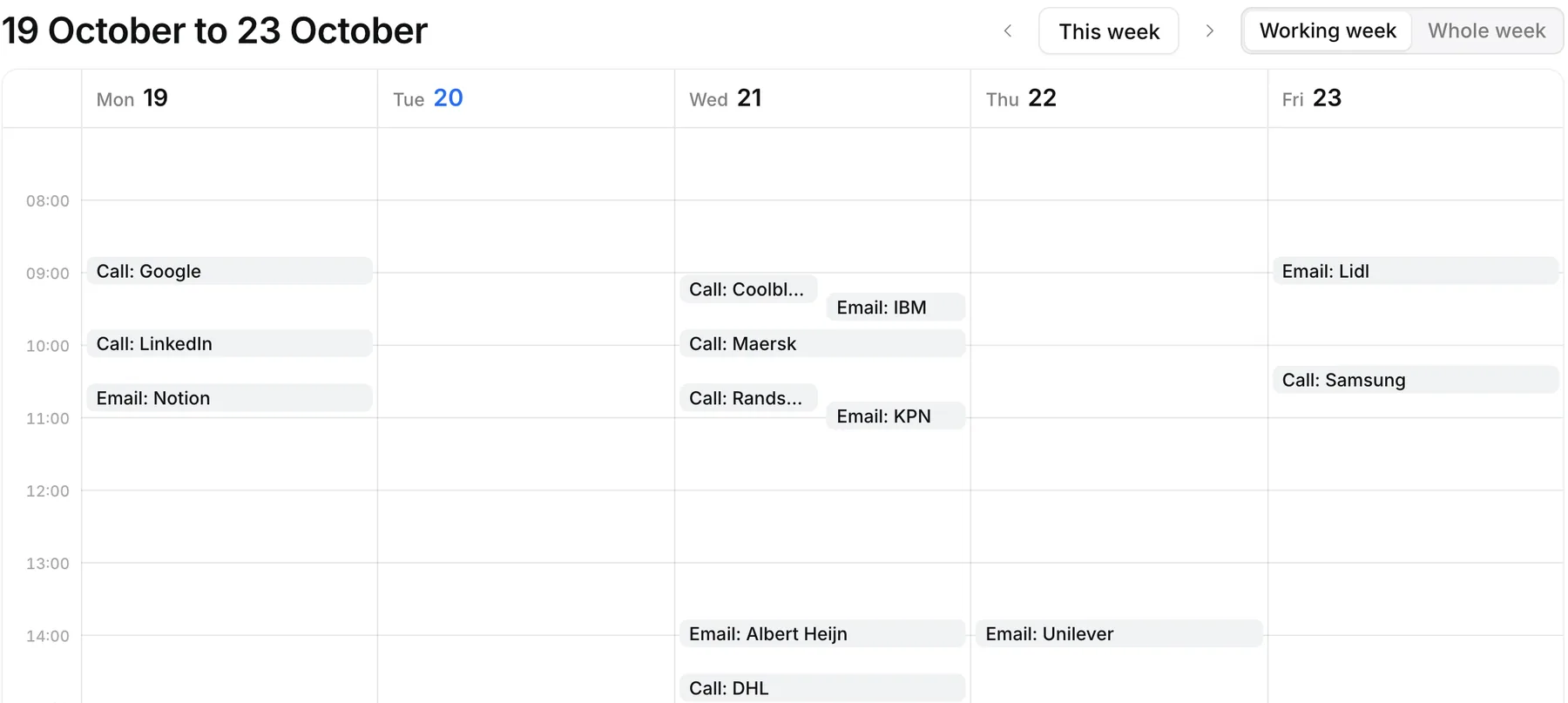
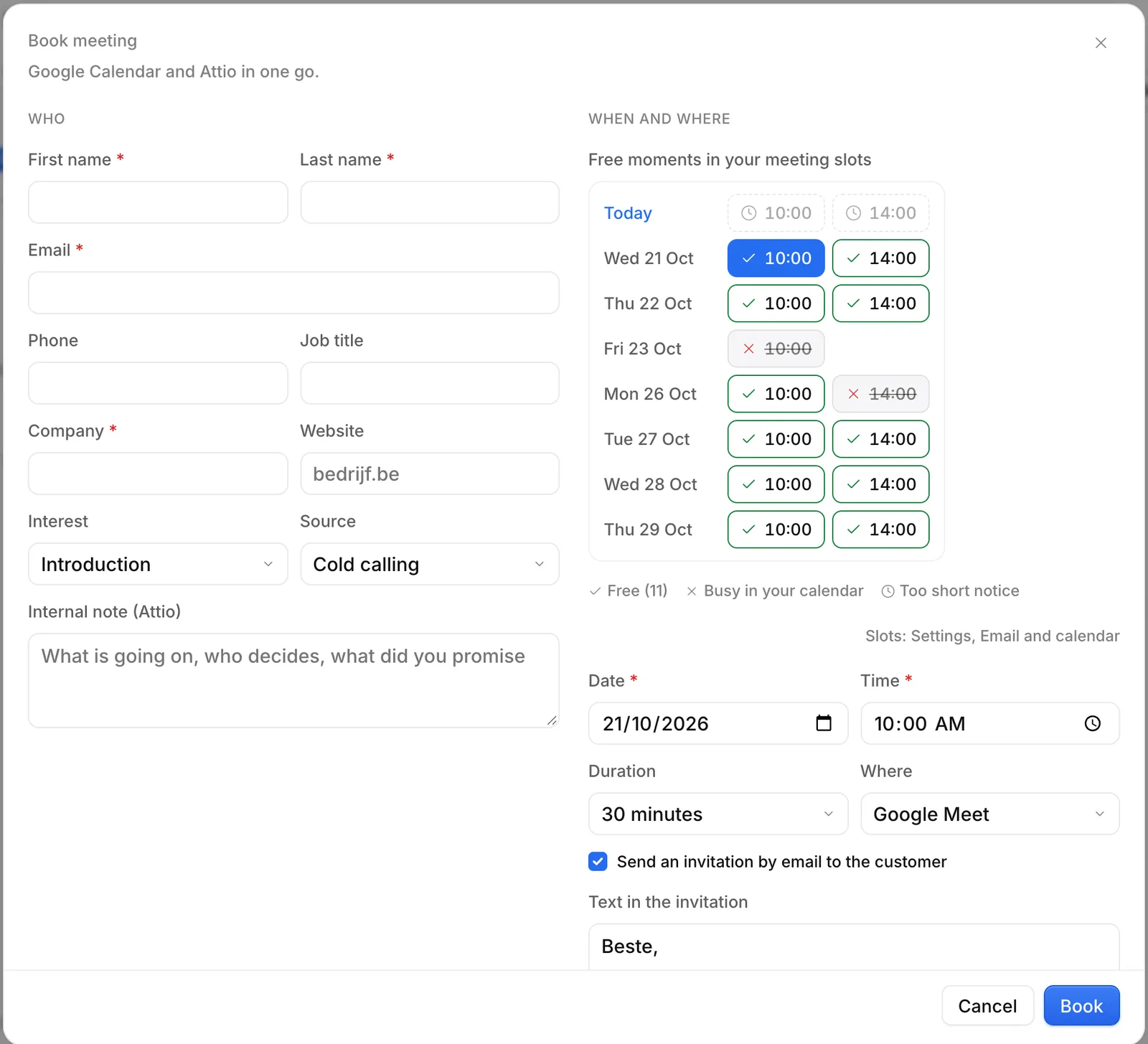
Book while they are on the line
Ringlane shows your free moments in Google Calendar, adds a Google Meet link and sends the invitation. Booked meetings go to Attio.
In this industry: When a facility or HR manager agrees to a tasting or a site visit, book it in Google Calendar with a Meet link while they are on the line; the meeting goes to Attio.
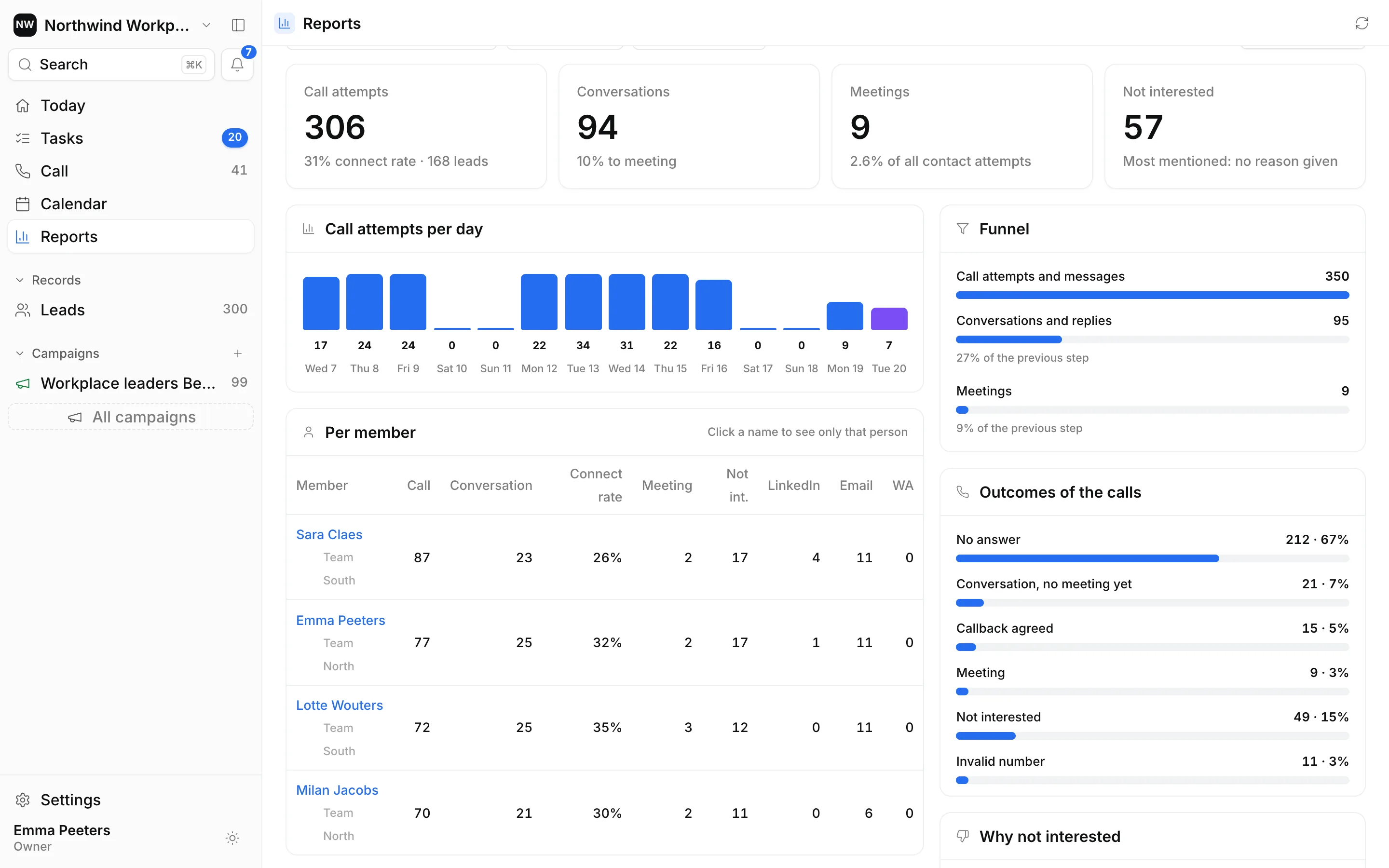
Your numbers, per caller and campaign
Call attempts, connect rate, conversations, meetings, the funnel and the reasons for "not interested", per person, team and campaign.
In this industry: Compare the office campaign with the business park campaign and read the reasons for not interested. If "contract until 2028" comes back often, log that answer next time as a call back (T) before the contract ends, not as not interested.
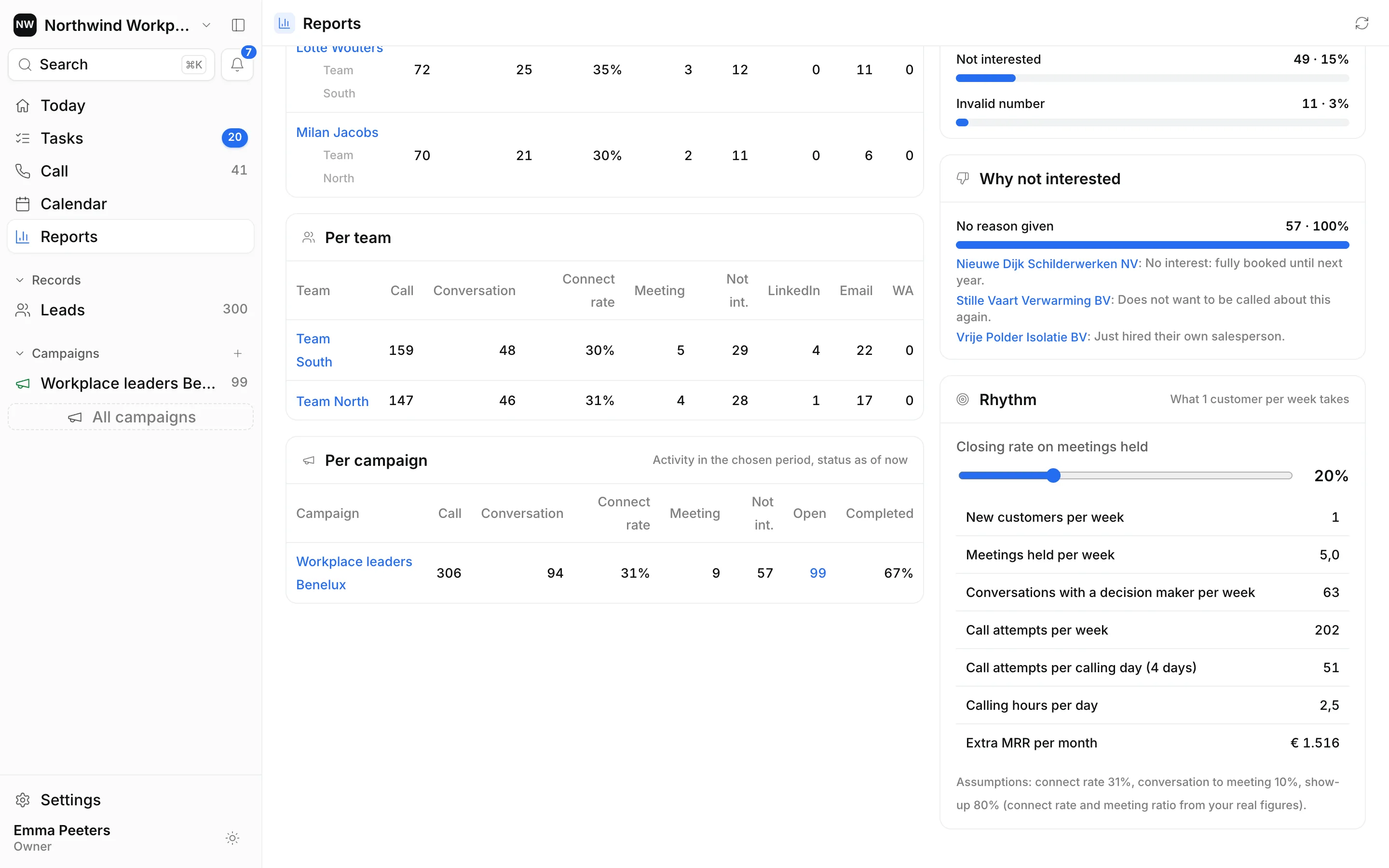
What one new customer takes
Based on your own rates, Ringlane calculates how many calls per week and per day one new customer per week takes.
In this industry: Enter your own connect and meeting rates and see how many calls per week one new catering client per week takes, so the team can plan around holiday periods.
Real screens from the Ringlane app with demo data. No affiliation with the companies shown.
What it can bring you: efficiency, money and more
A catering contract brings revenue every working day, so one extra client can matter for a whole year. The table below is an example with assumed numbers, not a forecast. Replace every figure with your own.
| Example with assumed numbers: one caller, one month | Value |
|---|---|
| Call attempts | 400 |
| Conversations with a decision maker (assumed 25%) | 100 |
| Tastings or site visits booked (assumed 6% of conversations) | 6 |
| New clients (assumed 1 in 6 meetings) | 1 |
| Value of one client (assumed 60,000 euro revenue per year on a 3 year contract) | 180,000 euro |
In this example, one new client a month is worth 180,000 euro in revenue over the contract. Your own numbers will differ, which is why it helps to measure them. See how many calls it takes to win one customer.
Efficiency is the other half. Measure for one week how long your team spends after each call on notes, contract dates and remembering when a tender opens. Logging the outcome with one key, with the next call already planned, removes most of that. A lead whose contract ends in eighteen months is then in the calendar, not forgotten. Read how to follow up leads for a simple cadence.
Want to see the calling screen first? Try the demo.
Frequently asked questions
Who decides on catering at a company?
Does hybrid work make corporate catering harder to sell?
Do Belgian meal vouchers compete with company catering?
How concentrated is contract catering in the Netherlands?
How many calls does it take to win one catering client?
Sources
- Eurostat: Employed persons working from home as a percentage of total employment (lfsa_ehomp), 2025
- Statbel: Demography of enterprises with employees, by NACE and size class, 2023 (Bestat)
- CBS StatLine: Bedrijven; bedrijfsgrootte en rechtsvorm (table 81589NED)
- Lexgo: Maaltijdcheques, de maximale waarde stijgt naar 10 EUR vanaf 1 januari 2026
All industries
- Accounting firms
- Business events and venues
- Business finance
- Commercial cleaning
- Commercial real estate
- Commercial solar and energy
- Consultancy
- Corporate training
- Fleet, leasing and EV charging
- HR and payroll services
- HVAC and building services
- Industrial manufacturing
- Insurance brokers
- IT services and MSPs
- Logistics and transport
- Marketing agencies
- Office furniture and workplace
- Printing and packaging
- Recruitment and staffing
- SaaS and software
- Security services
- Telecom and connectivity
- Wholesale and distribution
- Workwear and PPE