Win guarding and alarm contracts with sites you called yourself
For guarding companies and alarm, camera and access control installers in Belgium and the Netherlands: who buys security, when a call lands, and how to follow up until the contract is signed.
Almost every company with a building, a warehouse or a shop thinks about security, and most already have something in place: a guarding contract, an alarm system, cameras or a monitoring centre. New business for a security company is therefore mostly about switching and adding, and that happens at clear moments: a contract that ends, an incident, a new site. A calling team that knows those moments can be on the shortlist before the tender is written.
The market: a licensed sector with very different players
In Belgium, private security is tightly regulated. The annual report of the FPS Home Affairs under the law of 2 October 2017 counts 153 licensed guarding companies in 2022, next to 148 internal guarding services, 922 alarm installers and 1,462 camera installers. People working in the sector need an identification card: 27,125 valid cards were held by staff of guarding companies in 2022. With 153 licensed guarding companies, buyers usually know the main names, so being specific about their site is how you stand out.
The Netherlands looks different. On 1 October 2026, CBS counted 11,690 businesses in private security (SBI 8010, provisional figures), of which 10,705 were one-person businesses and 240 had 10 or more people working, plus 775 businesses in security through alarm systems (SBI 8020). The KVK counts, on its own basis, 7,273 security businesses on 1 January 2022 and 13,389 on 1 January 2026, after a peak of 15,004 in 2025, and says the drop may be linked to stricter enforcement of the Wet DBA. Every security organisation needs a Wpbr licence from Justis, valid for at most five years, and separate permission for its managers and staff. This is general information, not legal advice.
Decisions follow the size of the client. A shop owner or a small manufacturer picks an alarm installer on trust, speed and price. Larger companies, logistics sites and retail chains compare providers, write a specification, involve purchasing and often sign multi-year contracts. Public buyers work through formal tenders.
Who you call and what you ask
The people who decide on security:
- Facility manager: owns guarding, access and technical security at offices, sites and campuses.
- Prevention adviser or HSE manager: involved when safety, evacuation and risk analysis come up.
- Site, warehouse or operations manager: feels every incident and every false alarm.
- Purchasing manager: runs the tender and compares the price per hour or per site.
- Owner: at smaller companies and shops, the one who decides.
Trigger events that make the call relevant: a security contract that ends in the coming months, a break-in or incident in the area, a new warehouse, shop or office, longer opening hours or night shifts, a demand from the insurer, an event on site, and a provider that failed to show up or changed its staff too often.
Discovery questions that work in this sector:
- How is the site secured today: guarding, patrols, alarm, cameras or a mix?
- When does the current contract end, and how will you choose for the next period?
- What incidents or false alarms did you have in the last year, and what did they cost?
- Who else is involved: purchasing, the prevention adviser, the insurer?
- What would you change first if you could start over?
Security buyers rarely decide alone: see how B2B buyers buy.
What slows a calling team down in this sector
- The incumbent provider. "We already have a security company" is the most common answer. The real question is when that contract is reviewed.
- Tenders and multi-year contracts. Larger clients buy security in rounds. Between rounds, the door is mostly closed, so the follow-up has to be planned months ahead.
- Price per hour. Guarding is easy to compare on the hourly rate. A good conversation is about reliability, response time and the cost of an incident.
- People on the move. Facility and site managers walk the site all day. You need several attempts and a call back at the moment they name.
- Trust. Buyers want proof of licences, screening and references before they let a new provider on site.
To prepare for the objections you will hear, read how to handle sales objections.
How Ringlane works for security companies
Real screens from the app, with what each feature does in this industry.
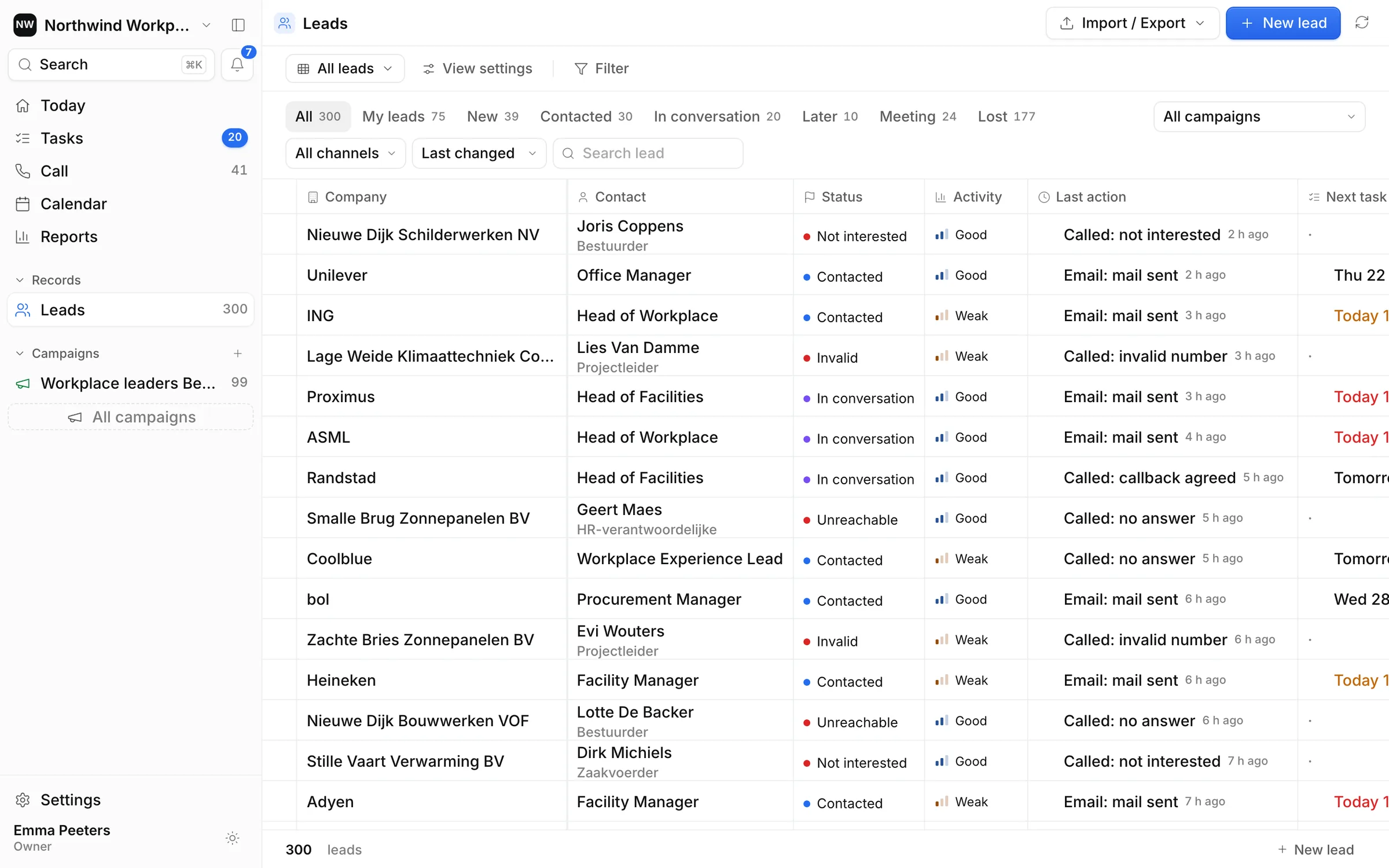
Your lists, in one place
Import Excel, CSV or a Bizzy export into a campaign. Every lead shows its status, last action and next task.
In this industry: Import a Bizzy export of warehouses, retail sites, offices or industrial companies by region into one campaign per service, such as guarding, mobile patrols or camera systems, so each caller works one clear list.
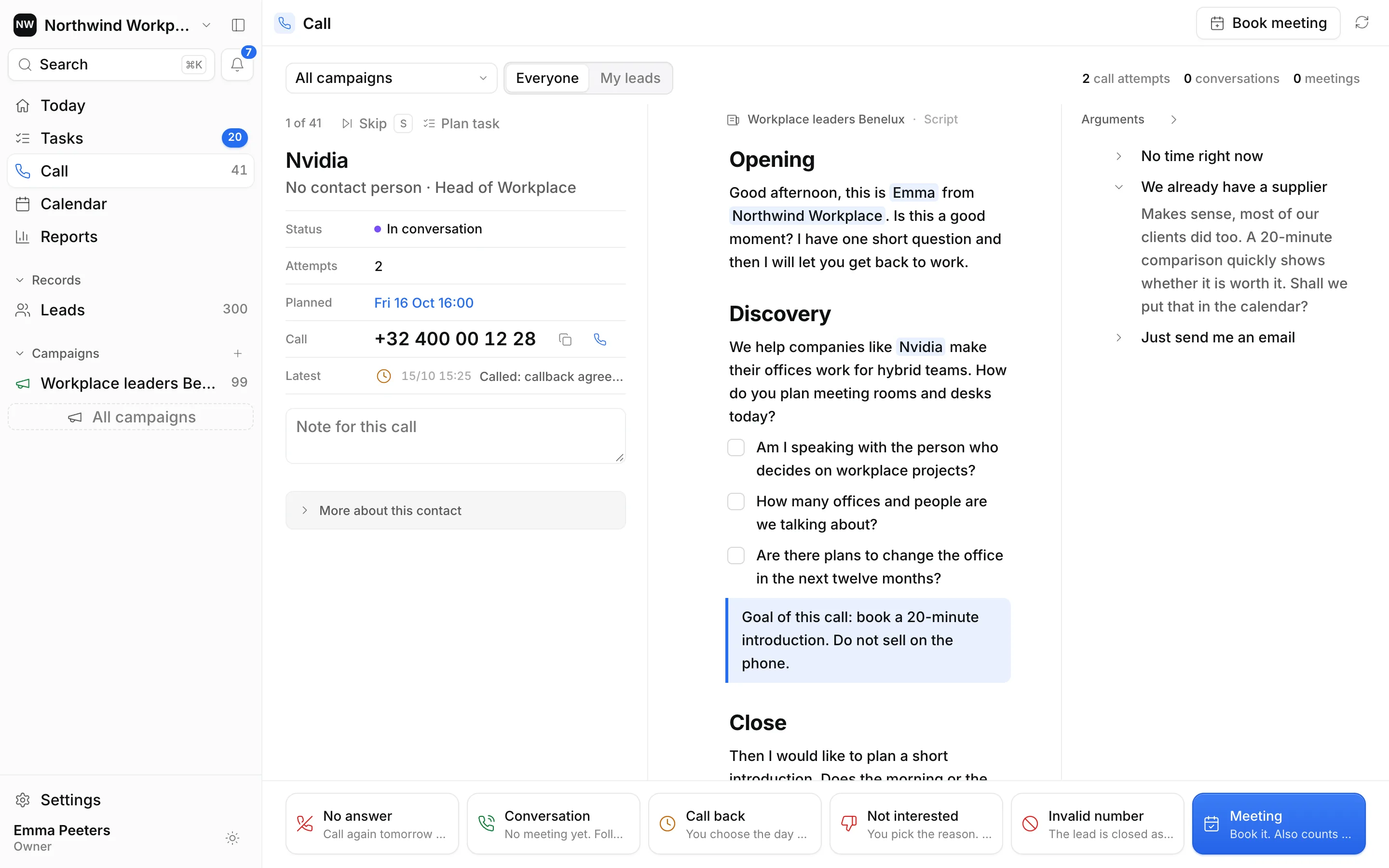
One screen for the call
The lead on the left, the script in the middle with the company name and your own name filled in. Click the number to call from your own phone.
In this industry: Put the questions about the current provider, the contract end date, recent incidents and opening hours in the script, so every caller asks them in every call.
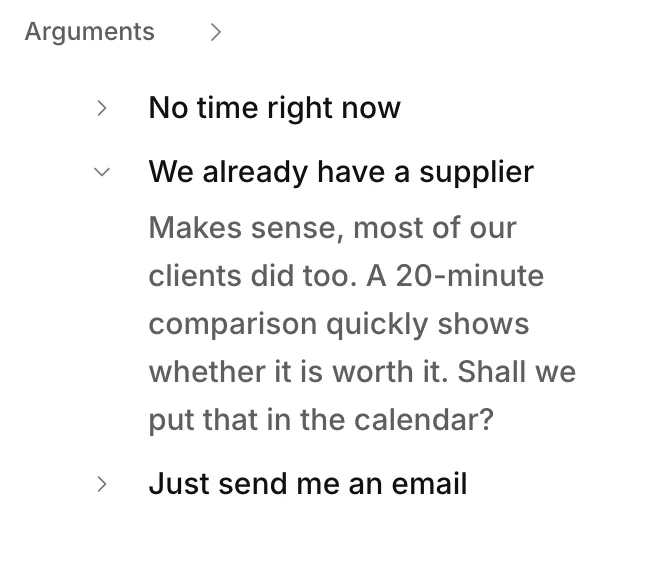
The answer to every objection
Common objections sit in a panel next to the script, so the right answer is one click away.
In this industry: Keep the answers to "we already have a security company" and "it is too expensive" next to the script, so a caller can ask about the contract end date or the cost of the last incident.
One key per call, the next step planned
N (not reached) plans a new attempt the next working day, G (conversation) a follow-up call in three days, T (call back) the moment you pick. A records a meeting; X (not interested, with a reason) and O (invalid number) close the lead.
In this industry: Facility and site managers are often on the floor or on the road. N plans a new attempt for the next working day, and T lets you call back at the moment they name.

Follow-up on every channel
Calls and emails land in your week. You write emails in Ringlane and send them from your own Gmail; LinkedIn and WhatsApp you send yourself and log by hand. The Today view puts overdue call-backs first.
In this industry: After a conversation, send a short note on your licence, references from your own sector or a proposal for a site survey from your own Gmail, and see it next to the call history.
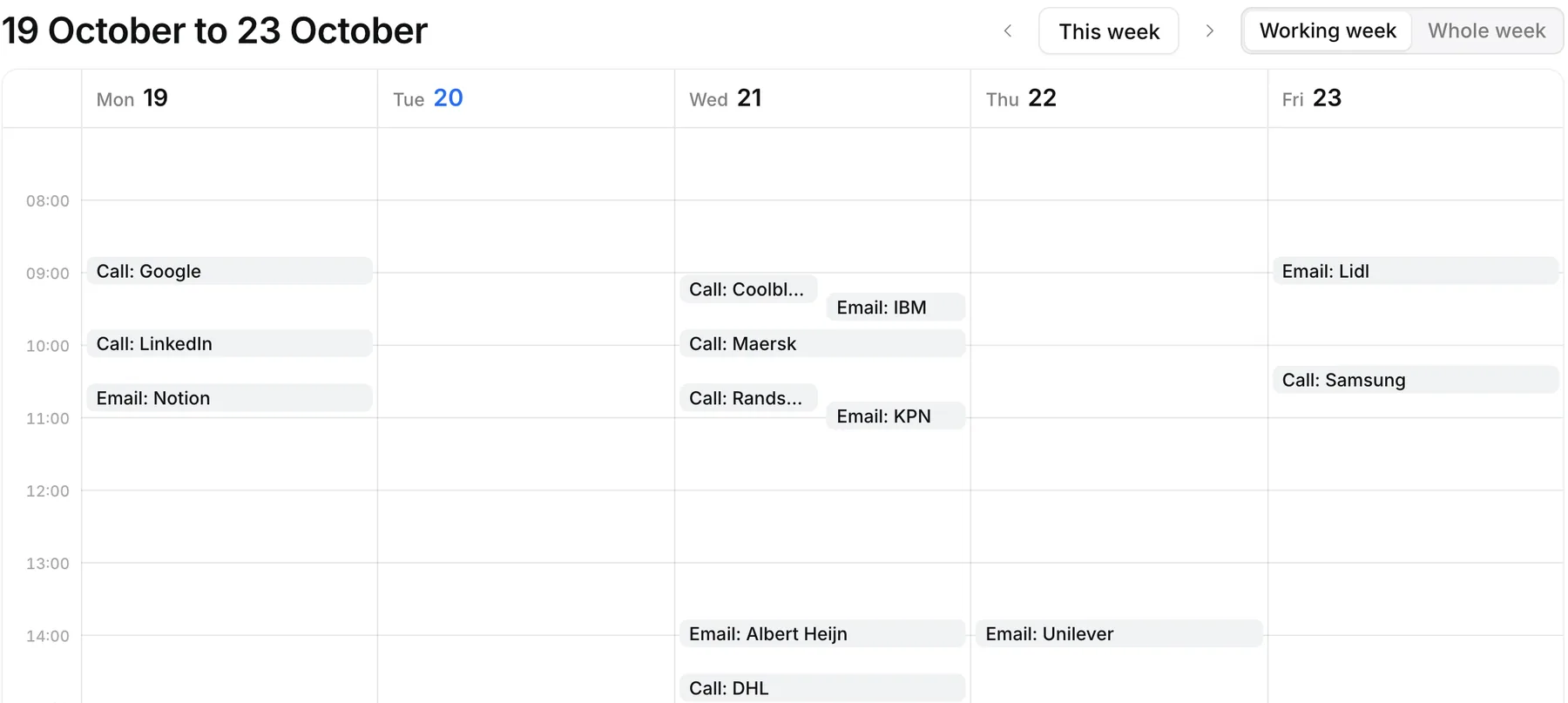
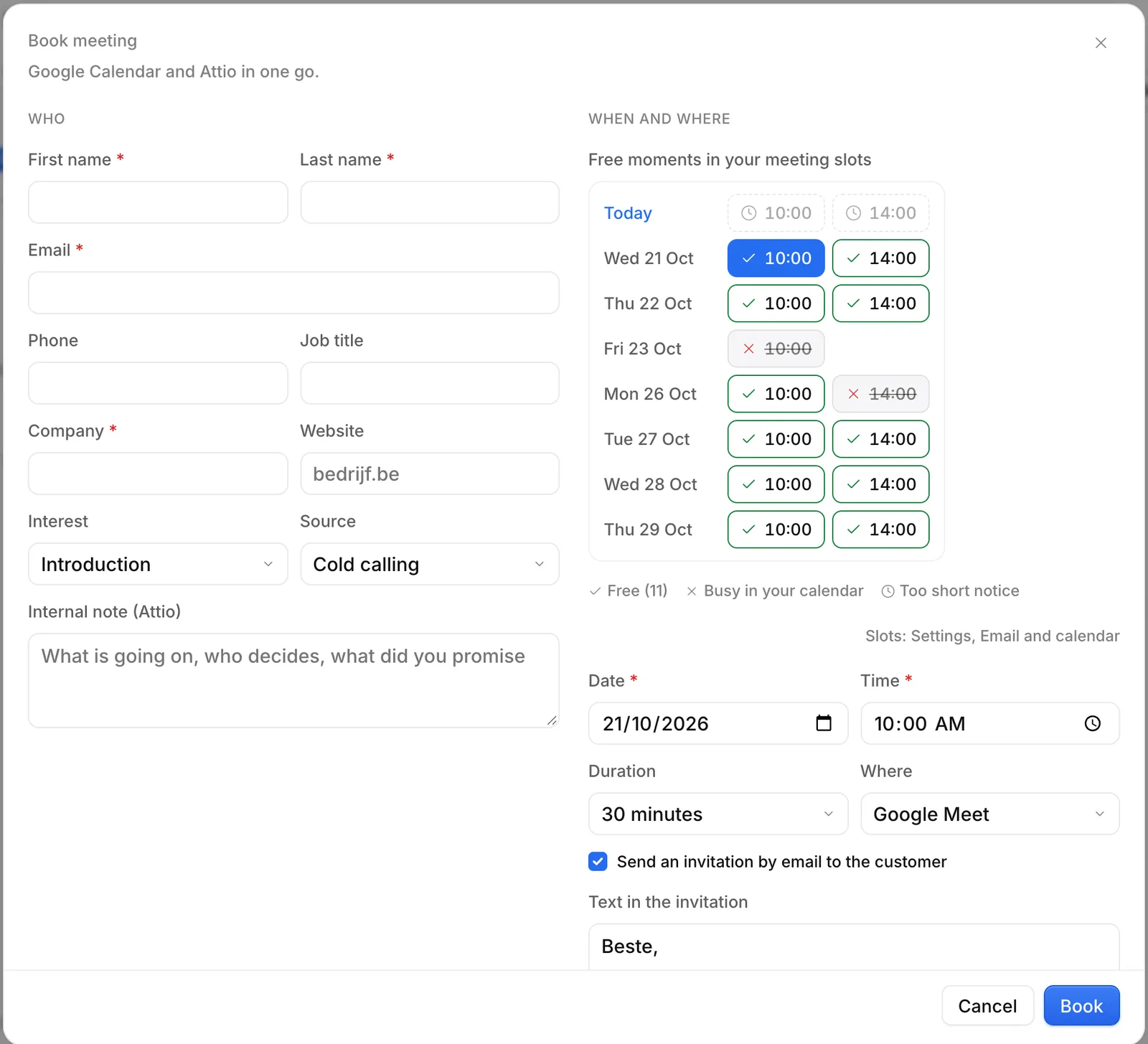
Book while they are on the line
Ringlane shows your free moments in Google Calendar, adds a Google Meet link and sends the invitation. Booked meetings go to Attio.
In this industry: When a facility manager agrees to a site survey or a risk walk, book it in a free slot in Google Calendar and send the invitation while they are still on the line, then hand it to Attio.
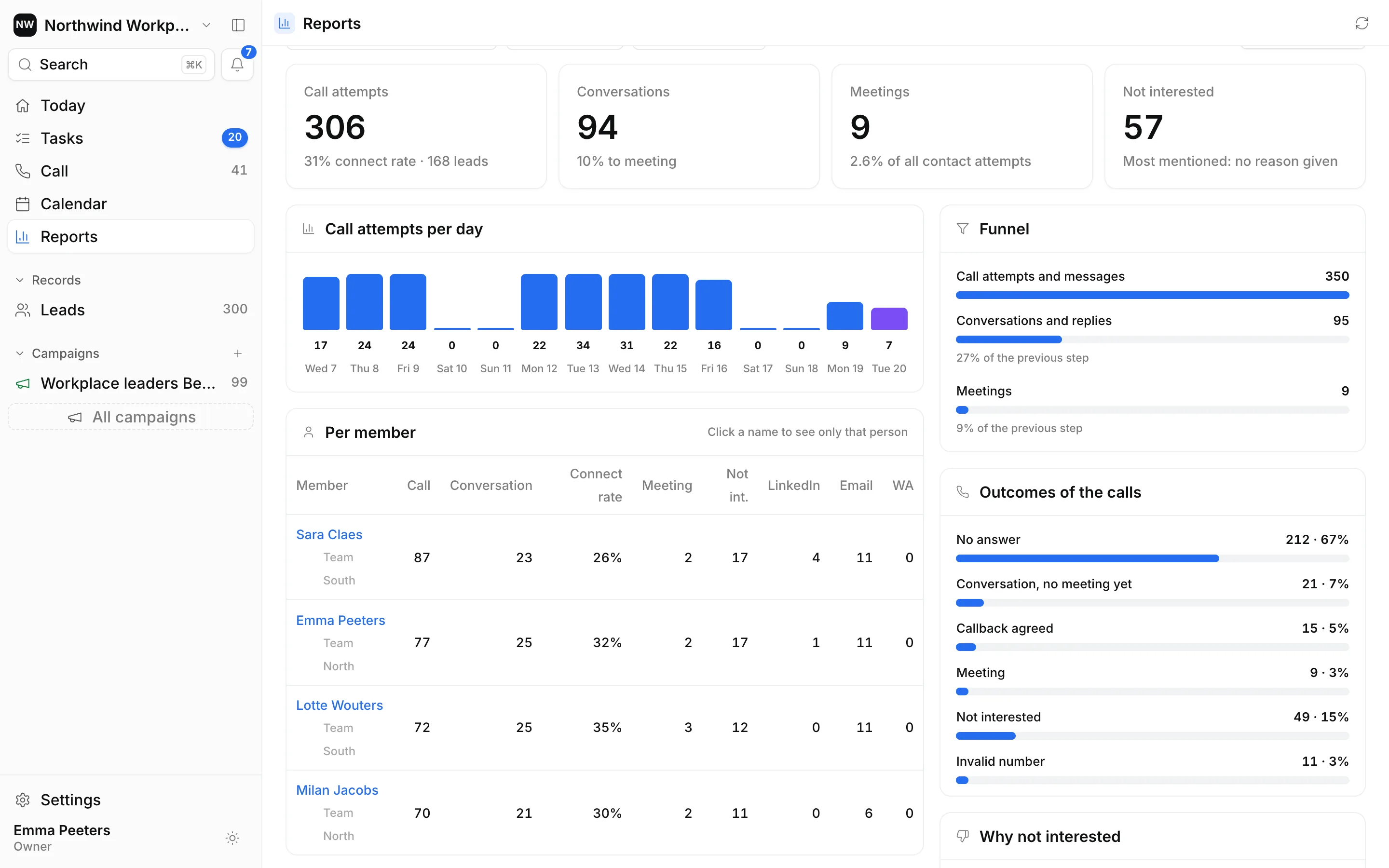
Your numbers, per caller and campaign
Call attempts, connect rate, conversations, meetings, the funnel and the reasons for "not interested", per person, team and campaign.
In this industry: Compare campaigns per service or per type of site and read the reasons for not interested, to see whether an existing contract, price or timing blocks you most.
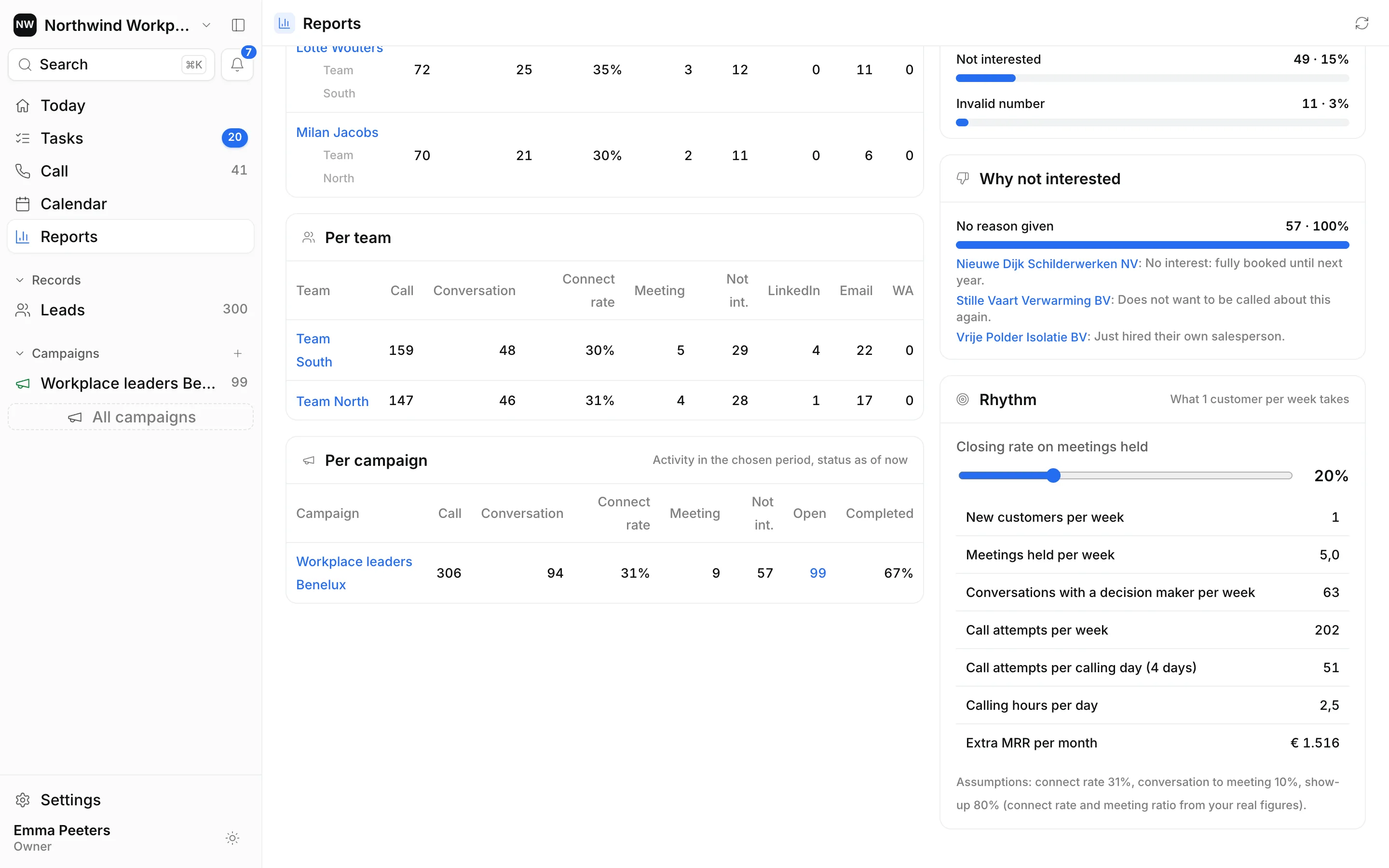
What one new customer takes
Based on your own rates, Ringlane calculates how many calls per week and per day one new customer per week takes.
In this industry: Fill in your own rates and see how many calls per week one new client per week takes, a number a sales manager can plan a team around.
Real screens from the Ringlane app with demo data. No affiliation with the companies shown.
What it can bring you: efficiency, money and more
For a security company, the measurable step is the site survey. What you can track is how many calls lead to a conversation, how many conversations to a survey, and how many surveys to a signed contract.
Example with assumed numbers: one caller, one month, and an assumed value of 25,000 euros a year for one guarding, patrol or monitoring contract. These are not benchmarks; replace them with your own figures.
| Step | Assumption | Result |
|---|---|---|
| Call attempts | 35 per day, 20 working days | 700 |
| Conversations | 14% of attempts | 98 |
| Site surveys | 15% of conversations | 15 |
| Signed contracts | 1 in 5 surveys | 3 |
| Value per year | 3 x 25,000 euros (assumed) | 75,000 euros |
Efficiency is something you can measure too. Time how long it takes today to note an outcome and plan the next step. If one key and an automatically planned follow-up save two minutes per attempt, 700 attempts save about 23 hours a month. Check that against your own week rather than taking it on trust.
The bigger gain is often in the follow-up. A facility manager who said "our contract ends next autumn" is worth a lot if somebody calls in spring. Read how to follow up sales leads, or try it yourself in the interactive demo.
Frequently asked questions
Does cold calling work for security companies?
Who buys security services at a company?
Does a security company need a licence in Belgium and the Netherlands?
When is the best time to call about security?
Does Ringlane check licences or find security leads for me?
Sources
- FPS Home Affairs: annual report under article 270 of the law of 2 October 2017 on private and special security, 2022 (besafe.be)
- CBS StatLine: Bedrijven; bedrijfstak (81589NED), SBI 8010 and 8020, 4th quarter 2026, provisional
- KVK: Starten als beveiliger (number of security businesses, SBI 80.10, per 1 January)
- Ondernemersplein: Vergunning aanvragen voor een particuliere beveiligingsorganisatie of recherchebureau (Wpbr)
All industries
- Accounting firms
- Business events and venues
- Business finance
- Commercial cleaning
- Commercial real estate
- Commercial solar and energy
- Consultancy
- Corporate catering
- Corporate training
- Fleet, leasing and EV charging
- HR and payroll services
- HVAC and building services
- Industrial manufacturing
- Insurance brokers
- IT services and MSPs
- Logistics and transport
- Marketing agencies
- Office furniture and workplace
- Printing and packaging
- Recruitment and staffing
- SaaS and software
- Telecom and connectivity
- Wholesale and distribution
- Workwear and PPE