Call businesses when energy rules and bills give them a reason to act
For commercial solar installers, battery and energy advisers in Belgium and the Netherlands: who to call, which rules make the call relevant, and how to follow a long decision through to a signed quote.
Most business owners know solar panels can pay off. What they do not know is whether it pays off for their building, their connection and their rules, and when they have to act. Commercial solar is a considered purchase with several people involved, so the calling team's job is to find companies with a real reason, get a roof visit, and follow up until the quote is signed.
The market: who buys and why now
Businesses are already the larger part of the market in the Netherlands. According to CBS, installed solar capacity reached 28.6 gigawatt peak at the end of 2024, of which nearly 60% was at businesses, and 70% of the capacity added in 2024 went to businesses. On the supply side, installers usually sit under electrical installation (NACE 43.21), which Eurostat counts at 18,743 enterprises in Belgium and 22,265 in the Netherlands in 2024. Not all of them install solar, but buyers can choose from many.
Rules create the moments to call. In the Netherlands:
- The energy saving obligation applies to locations using from 50,000 kWh of electricity or 25,000 m3 of natural gas a year. They must take all measures with a payback of five years or less, including measures that cut CO2 such as generating renewable energy, and report once every four years.
- Net metering ends. According to the Dutch government, households and small businesses can offset their own solar power until 31 December 2026, and the scheme stops from 1 January 2027. That changes the business case towards own use and storage.
In Flanders:
- Under the Flemish Energy Decree, buildings on a connection point that took more than 1 GWh of electricity in 2021 or 2022 had to have solar panels in service by 1 April 2026. A site that crosses 1 GWh from 2023 onwards gets until 1 January of the fourth year after.
- After a sale, the renovation obligation for non-residential buildings requires large units to reach a minimum 5% share of renewable energy (or label E) within six years.
Dates and thresholds as checked in October 2026. This is general information, not legal advice.
Who you call and what you ask
At smaller companies, call the owner. At larger ones, the managing director and the finance director decide, with the facility or technical manager preparing the case. If the building is rented, the property owner has a say.
Moments that make a call relevant:
- a higher energy bill or a new supply contract
- a reporting duty under the energy saving obligation
- a building purchase, a new hall or a roof renovation
- electric vehicles or heat pumps that raise electricity use
- the end of net metering for a small business on a small connection
Questions that open a real conversation:
- "Do you own the building, and when was the roof last renewed?"
- "How much electricity do you use per year, roughly?"
- "What kind of grid connection do you have, and is there room on it?"
- "Have you reported under the energy saving obligation yet?"
- "Who besides you decides on an investment like this?"
Ask for one document early. A recent energy bill or a yearly consumption overview turns general interest into numbers you can work with, and the request itself shows whether the prospect is serious. If the answer is "not now", ask what would change that, such as a roof renovation, a new supply contract or a budget round, and plan the call for then.
The cost of waiting is often a stronger argument than the gain. See loss aversion in sales.
What slows a calling team down in this sector
- Grid congestion. In parts of the Netherlands there is a queue of large users waiting for transport capacity, according to Netbeheer Nederland. Ask about the connection early.
- Owner and user differ. Tenants want lower bills; landlords pay for the roof. Find out who owns the building in the first call.
- Long decisions. An investment goes past the finance director and sometimes a bank. Without planned follow-up, quotes go quiet.
- Distrust from earlier calls. Many owners have been called about solar before. A specific question about their situation works better than a general offer.
- Changing rules. Dates and thresholds move. Check the current text before you mention them.
How Ringlane works for commercial solar and energy companies
Real screens from the app, with what each feature does in this industry.
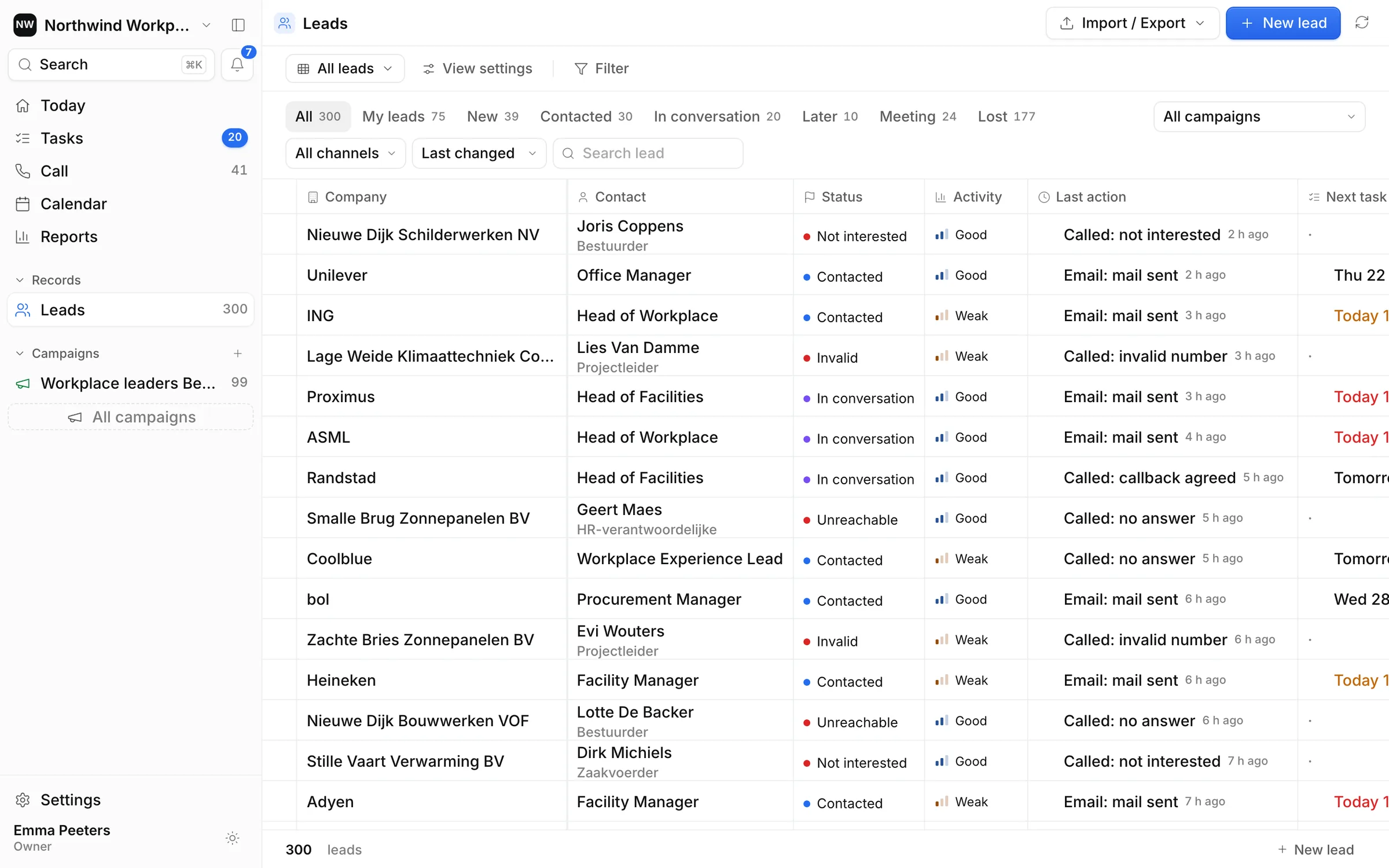
Your lists, in one place
Import Excel, CSV or a Bizzy export into a campaign. Every lead shows its status, last action and next task.
In this industry: Import a Bizzy export of companies with their own buildings, such as manufacturers, warehouses or car dealers, into one campaign per segment or region, so each caller works one clear list.
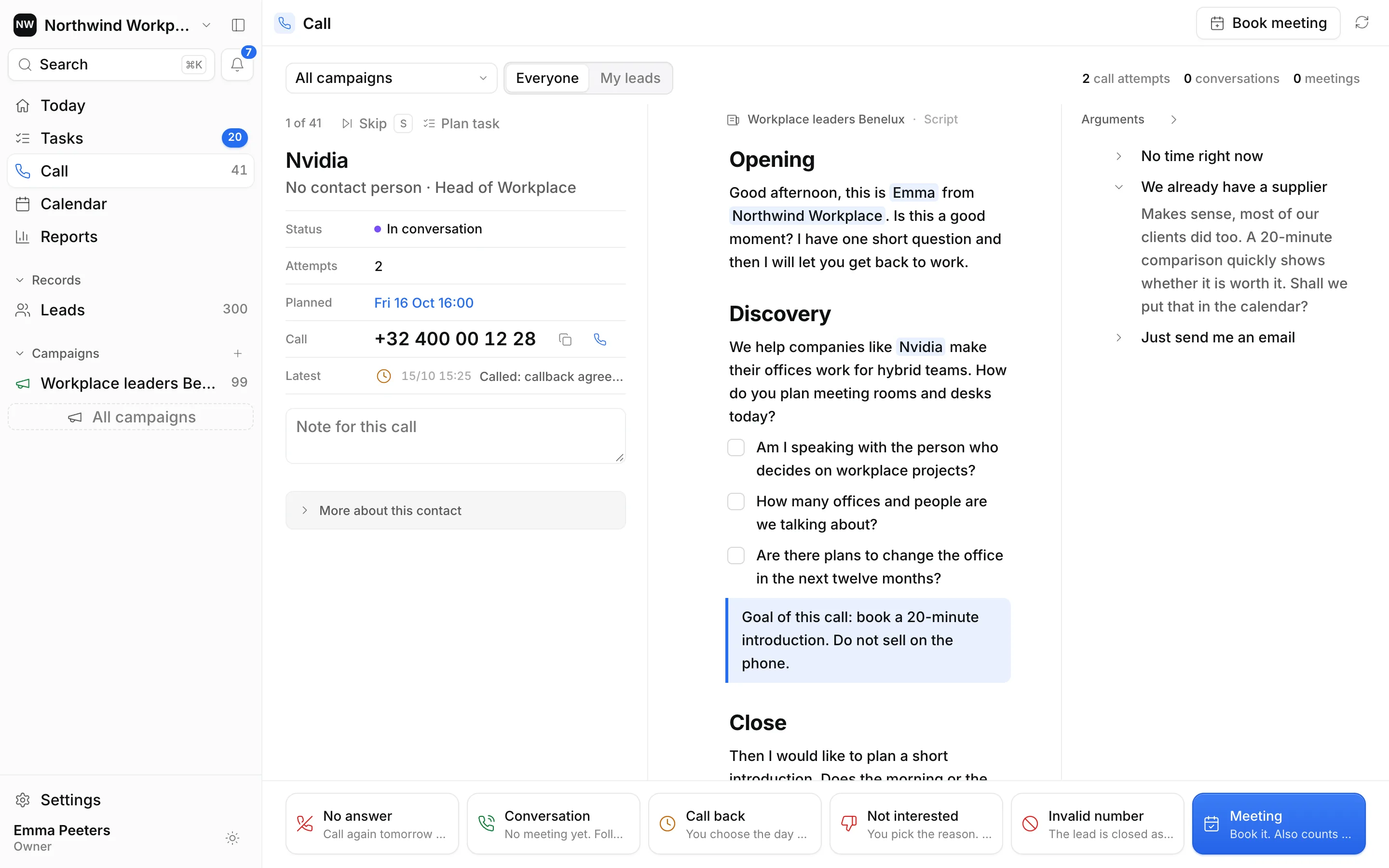
One screen for the call
The lead on the left, the script in the middle with the company name and your own name filled in. Click the number to call from your own phone.
In this industry: Put the questions about roof ownership, annual electricity use, grid connection and the energy saving obligation in the script, so every caller collects the same facts for the technical follow-up.
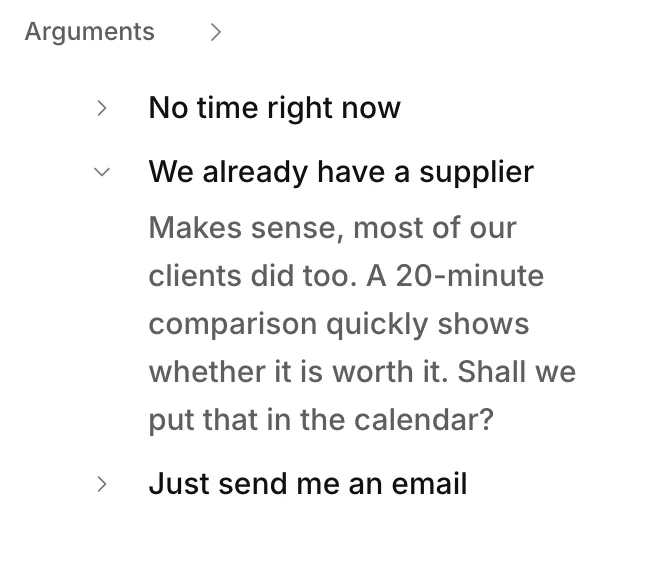
The answer to every objection
Common objections sit in a panel next to the script, so the right answer is one click away.
In this industry: Keep answers to "we rent the building", "the grid is full here" and "payback is too long" next to the script, each ending with a question about the next step.
One key per call, the next step planned
N (not reached) plans a new attempt the next working day, G (conversation) a follow-up call in three days, T (call back) the moment you pick. A records a meeting; X (not interested, with a reason) and O (invalid number) close the lead.
In this industry: Owners and plant managers are often on the shop floor. N plans the next attempt for the next working day, and T lets you call back at the moment they name.

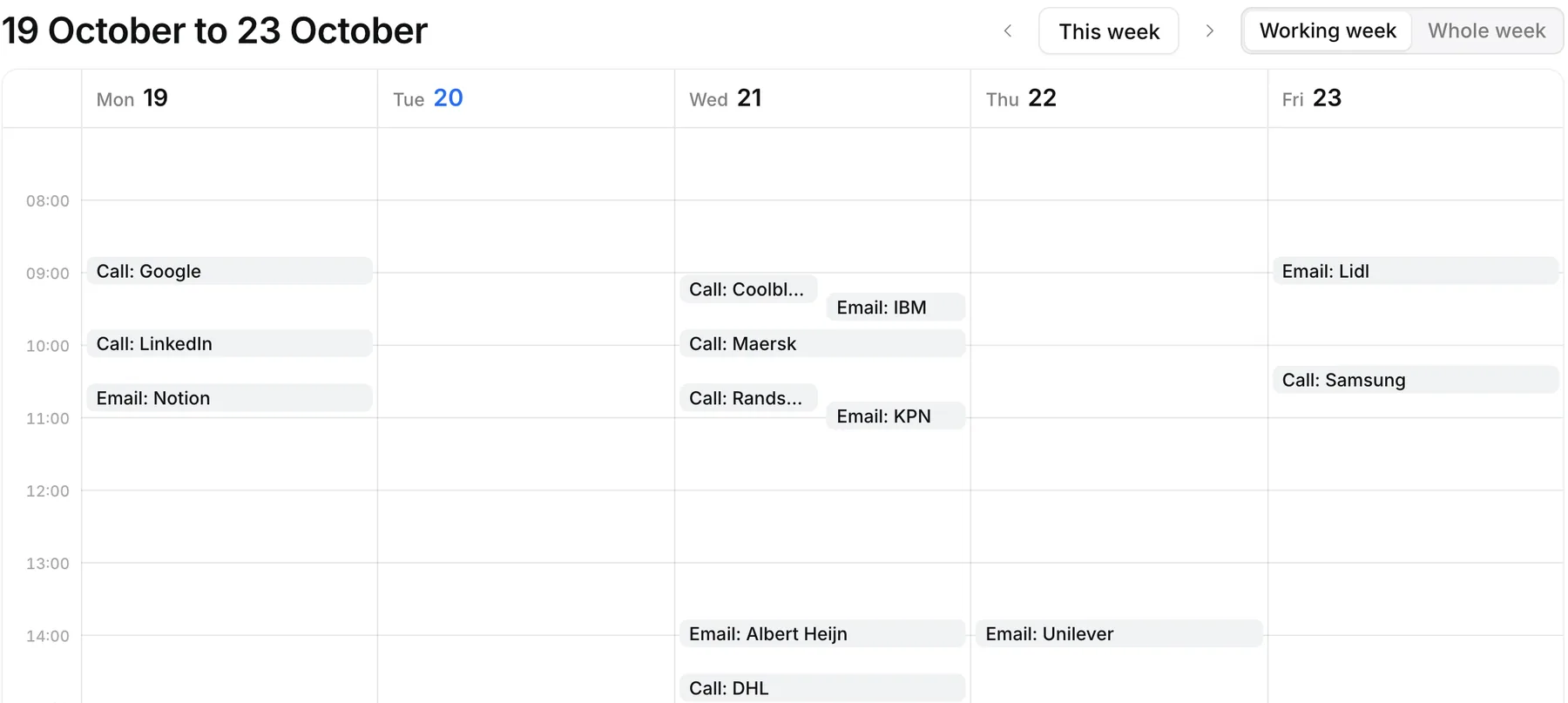
Follow-up on every channel
Calls and emails land in your week. You write emails in Ringlane and send them from your own Gmail; LinkedIn and WhatsApp you send yourself and log by hand. The Today view puts overdue call-backs first.
In this industry: After a conversation, send a short note asking for a recent energy bill or a roof plan from your own Gmail. The history with that lead shows what you asked for.
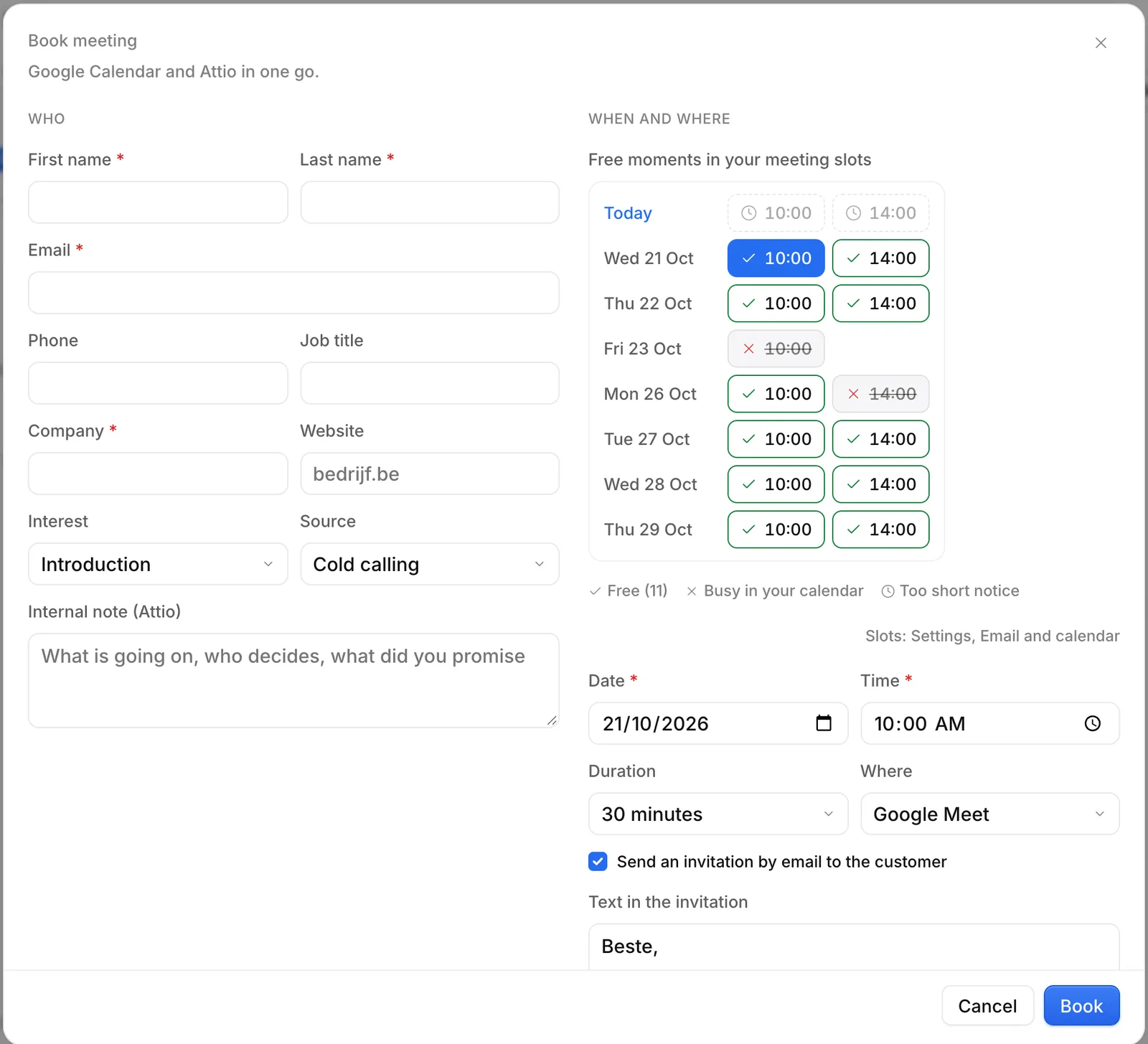
Book while they are on the line
Ringlane shows your free moments in Google Calendar, adds a Google Meet link and sends the invitation. Booked meetings go to Attio.
In this industry: When the owner agrees to a roof visit or an energy scan, book it in Google Calendar while they are still on the line. The meeting goes to Attio.
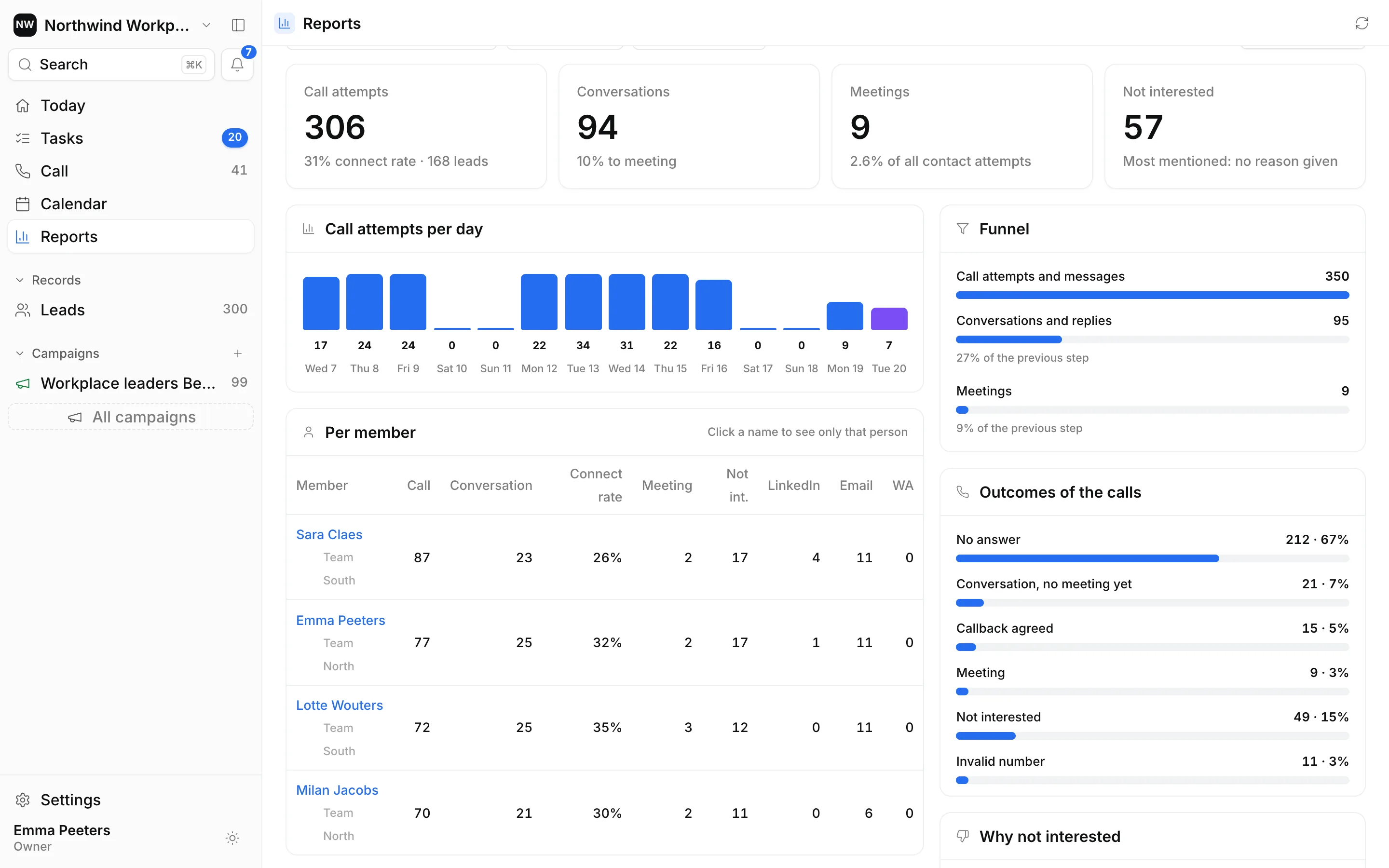
Your numbers, per caller and campaign
Call attempts, connect rate, conversations, meetings, the funnel and the reasons for "not interested", per person, team and campaign.
In this industry: Compare campaigns per segment and read the reasons for not interested. If "grid connection not available" keeps coming back in one region, you know where to focus.
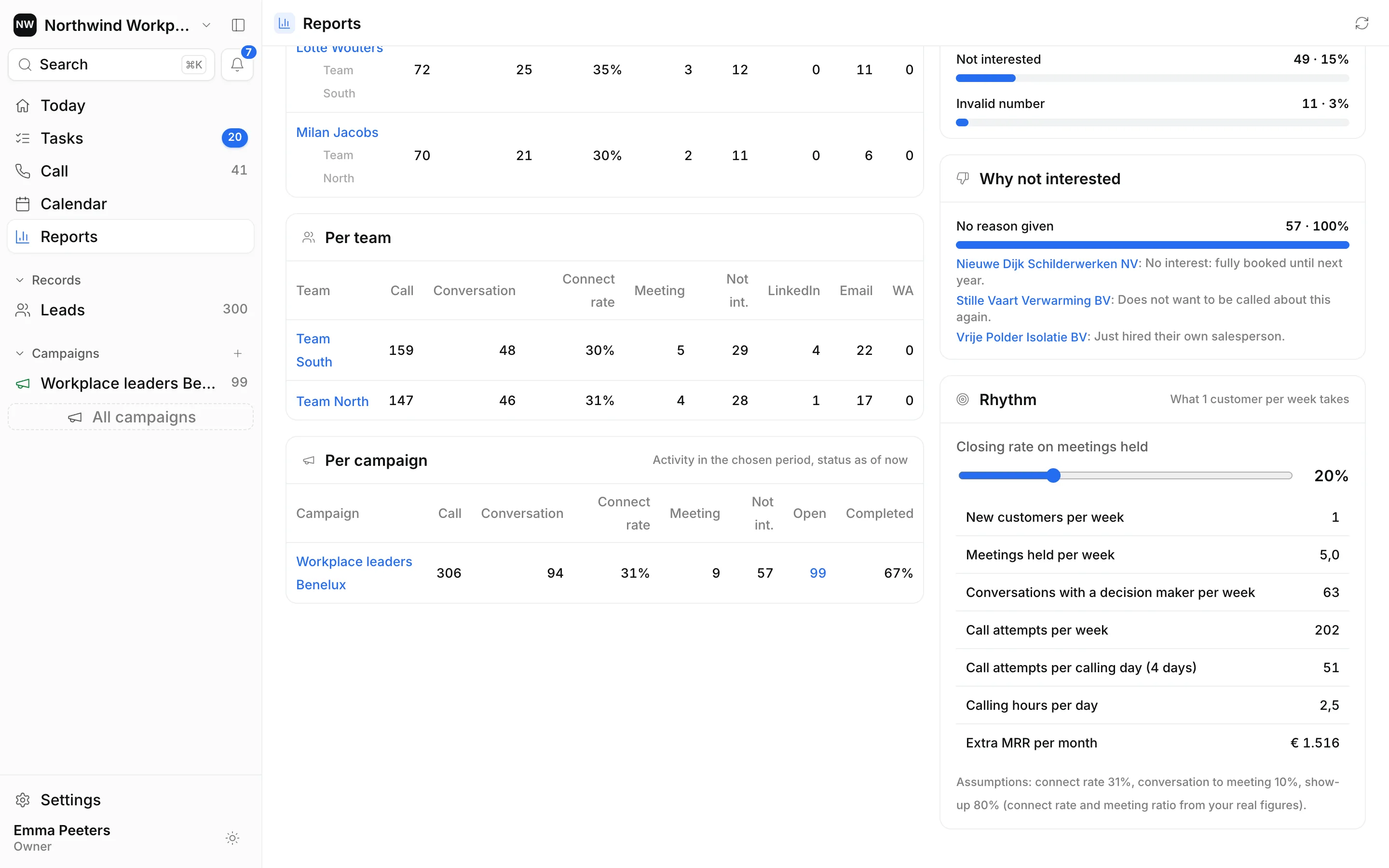
What one new customer takes
Based on your own rates, Ringlane calculates how many calls per week and per day one new customer per week takes.
In this industry: Fill in your own connect and meeting rates and see how many calls per week one new commercial project per week takes, so the planning matches your installation capacity.
Real screens from the Ringlane app with demo data. No affiliation with the companies shown.
What it can bring you: efficiency, money and more
Commercial projects are fewer than residential ones, but each one is much larger. The table below is an example with assumed numbers, not a forecast. Replace every figure with your own.
| Example with assumed numbers: one caller, one month | Value |
|---|---|
| Call attempts | 400 |
| Conversations with a decision maker (assumed 20%) | 80 |
| Roof visits or energy scans booked (assumed 10% of conversations) | 8 |
| Signed projects (assumed 20% of visits) | 1.6 |
| Value of one project (assumed 60,000 euro) | 60,000 euro |
In this example, about one and a half projects a month are worth some 96,000 euro in orders. Your numbers will differ, so measure them. See how many calls it takes to win one customer.
Efficiency is the other half. Measure for one week how long your team spends after each call on notes, finding a date for the next call and remembering who promised to send an energy bill. Logging an outcome with one key and having the next call planned is meant to take much of that away; measure the difference after a few weeks. And follow-up gets done: a lead that wants to decide after the budget round is in the calendar. Read how to follow up leads for a simple cadence.
Want to see the calling screen first? Try the demo.
Frequently asked questions
Does cold calling work for commercial solar companies?
Who decides on solar panels in a business?
Which rules make companies invest in solar in the Netherlands?
Which rule applies to large electricity users in Flanders?
Is grid congestion a reason not to call?
Sources
- CBS: Grootste deel zonnepanelen ligt bij bedrijven (5 August 2025)
- RVO: Over de energiebesparingsplicht
- Rijksoverheid: Salderingsregeling
- Vlaamse Codex: Energiebesluit, chapter VII PV obligation for large users (article 6.7.x)
- Flemish government: Renovatieverplichting voor niet-residentiële gebouwen
- Netbeheer Nederland: Capaciteitskaart
- Eurostat: Enterprises by detailed NACE Rev. 2 activity (sbs_ovw_act), NACE 43.21, 2024
All industries
- Accounting firms
- Business events and venues
- Business finance
- Commercial cleaning
- Commercial real estate
- Consultancy
- Corporate catering
- Corporate training
- Fleet, leasing and EV charging
- HR and payroll services
- HVAC and building services
- Industrial manufacturing
- Insurance brokers
- IT services and MSPs
- Logistics and transport
- Marketing agencies
- Office furniture and workplace
- Printing and packaging
- Recruitment and staffing
- SaaS and software
- Security services
- Telecom and connectivity
- Wholesale and distribution
- Workwear and PPE