Fill your in-company programmes with clients you called yourself
For training companies and independent trainers in Belgium and the Netherlands: who decides on training, when a call is relevant, and how to keep every conversation moving until the budget is set.
Most companies with staff already train them. That makes new business for a training provider a question of timing and relevance: you need to be known by the HR manager before the training plan for next year is set, and you need a reason to call that is about their people, not your catalogue. A calling team that reaches the right person in the right month can win programmes that never go out to tender.
The market: almost every company trains, few have chosen you
Training is widespread in both countries. In the latest European survey on continuing vocational training, Eurostat reports for 2020 that 82.2% of Belgian and 76.8% of Dutch enterprises with 10 or more persons employed provided some form of training, against 67.4% in the EU. External courses, the part a training provider sells, were used by 57.6% of Belgian and 59.7% of Dutch enterprises. That leaves 17.8% in Belgium and 23.2% in the Netherlands that provided no training at all that year.
Size matters. CBS found that 65% of Dutch companies with 10 or more employees offered courses in 2020, down from 76% in 2015. Among small companies with 10 to 50 employees, the share fell from 72% to 59%. Construction (58%) and hospitality (26%) were the lowest. For a calling team, those are the segments where a first conversation is more often about starting than about switching.
The supply side is crowded. On 1 October 2026, CBS counted 27,065 Dutch businesses registered under company training (SBI 85592, provisional figures), of which 24,380 were one-person businesses and only 320 had 10 or more people working. Most buyers hear from many independent trainers. Being clear and specific on the phone is how you stand out.
Rules shape the Belgian market. Under the law of 3 October 2022, the Belgian employment ministry explains, a full-time employee has a right to five training days a year on average since 2024 at employers with 20 or more employees. Employers with 10 to 19 employees must grant at least one day, and those under 10 are excluded. This is general information, not legal advice. In the Netherlands, small and medium companies can apply for the SLIM subsidy, which covers 60% of eligible costs up to 24,999 euros per individual application, in fixed application windows (two in 2026, the second closing on 7 September).
Who you call and what you ask
The people who decide on training:
- HR manager or HR business partner: owns the training plan and the budget at mid-sized companies.
- Learning and development manager: at larger companies, chooses providers and formats.
- Department head or plant manager: feels the skills gap first, often the best first conversation for technical, safety or sales training.
- Owner or managing director: at smaller companies, the one who decides and signs.
Trigger events that make the call relevant: the training plan and budget for next year, a new legal obligation or certification, a reorganisation or new management layer, fast hiring or high turnover, a new system or machine, and a subsidy window that is about to open.
Discovery questions that work in this sector:
- When do you make the training plan for next year, and who is involved?
- How many training days per employee do you plan, and how do you track them?
- Which team or role needs new skills most this year, and why now?
- What do you do in-house, and what do you buy from outside providers?
- What did a past training change in daily work, and how did you see it?
Open questions like these come from the SPIN approach to discovery. Before you call, define which companies fit: read how to write an ideal customer profile.
What slows a calling team down in this sector
- "We do it in-house." Larger companies have an academy or internal trainers. The real question is what they cannot cover themselves.
- Budget cycles. Training budgets are often set once a year. Outside that window, the answer is "not now", so the follow-up must be planned months ahead.
- Busy HR teams. HR managers spend their days in interviews, meetings and payroll deadlines. You need several attempts and a call back at the moment they name.
- Many providers, one catalogue look. Buyers hear from many trainers. A vague pitch sounds like all the others.
- Quiet months. Summer holidays and the end of the year slow decisions down, while the autumn is when plans are made.
How Ringlane works for training providers
Real screens from the app, with what each feature does in this industry.
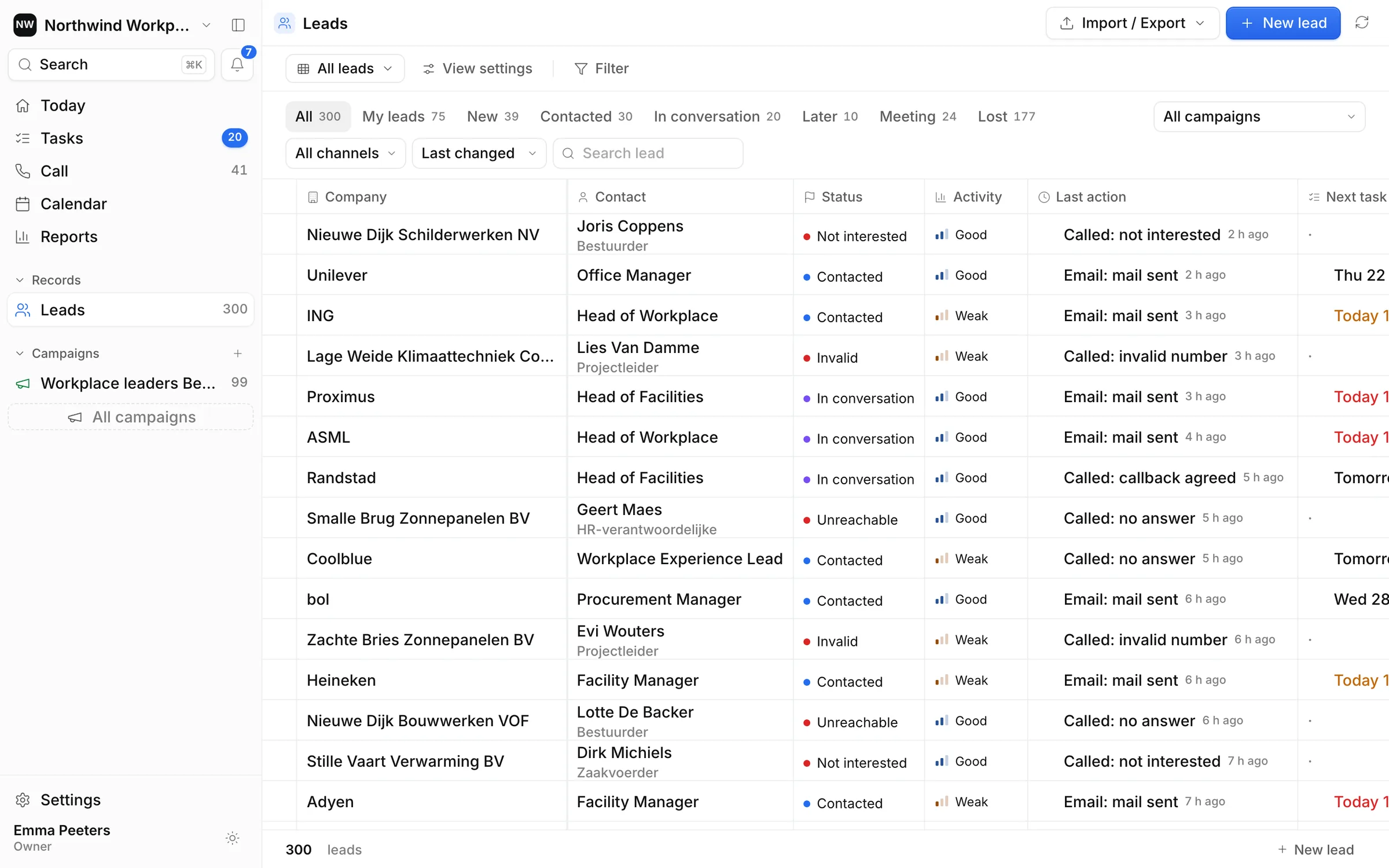
Your lists, in one place
Import Excel, CSV or a Bizzy export into a campaign. Every lead shows its status, last action and next task.
In this industry: Import a Bizzy export of companies with 20 or more employees into one campaign per region or per topic, such as leadership or safety, so a caller sees which HR managers still need a first attempt.
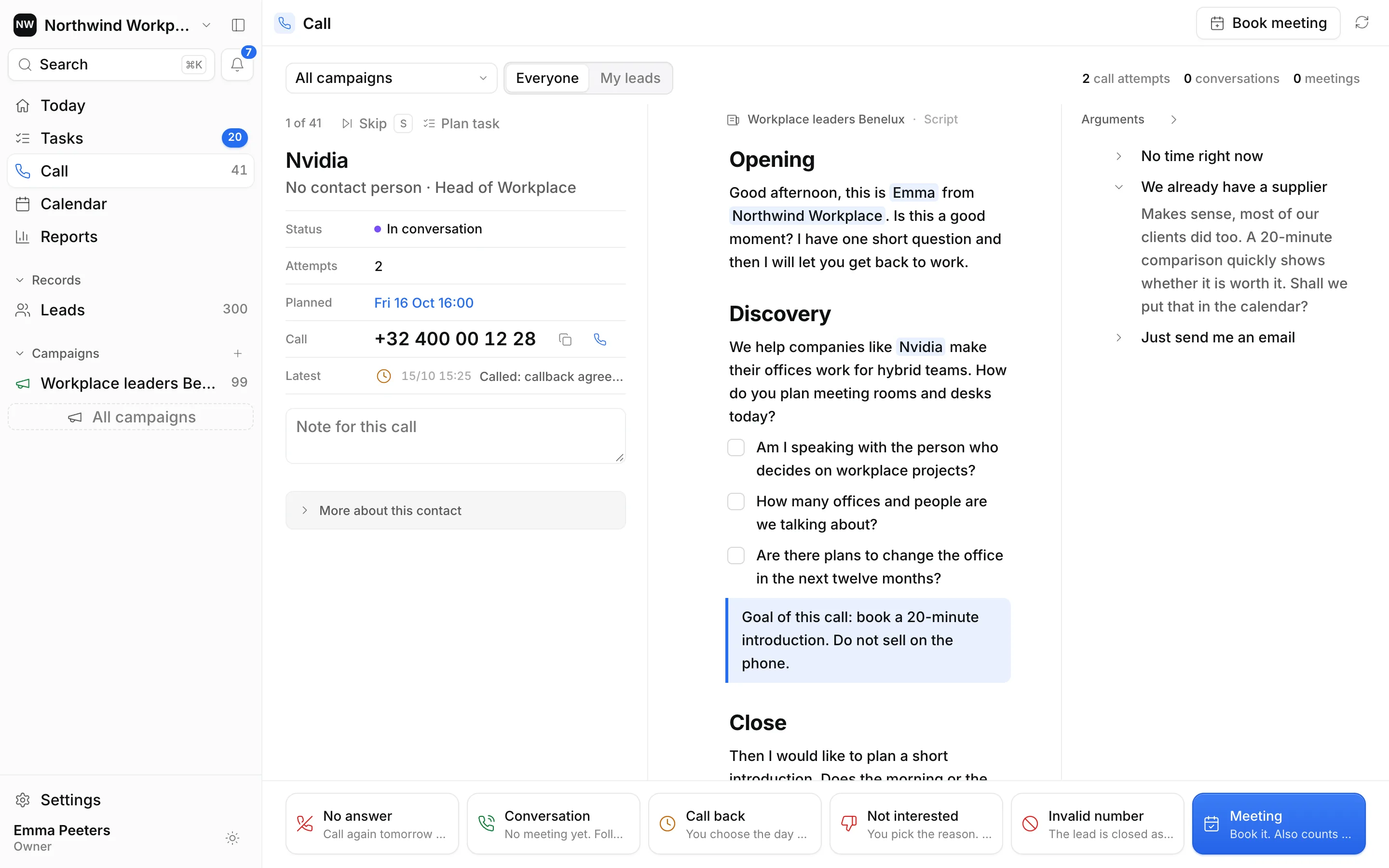
One screen for the call
The lead on the left, the script in the middle with the company name and your own name filled in. Click the number to call from your own phone.
In this industry: Put the questions about the training plan, the number of training days per employee and the budget cycle in the script, so every caller asks them in every call.
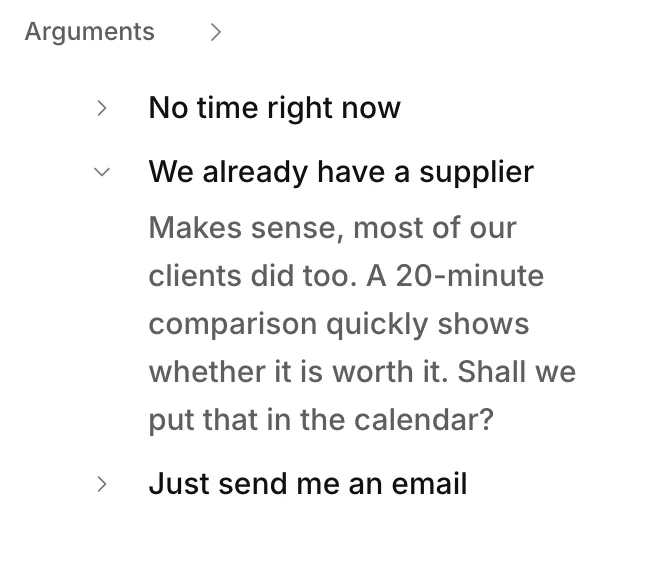
The answer to every objection
Common objections sit in a panel next to the script, so the right answer is one click away.
In this industry: Keep the answers to "we do it in-house" and "our budget is already spent" next to the script, so a caller can steer to the next training plan instead of ending the call.
One key per call, the next step planned
N (not reached) plans a new attempt the next working day, G (conversation) a follow-up call in three days, T (call back) the moment you pick. A records a meeting; X (not interested, with a reason) and O (invalid number) close the lead.
In this industry: HR and L&D managers are often in meetings or interviews. N plans the next attempt for the next working day, and T lets you call back at the moment they name.

Follow-up on every channel
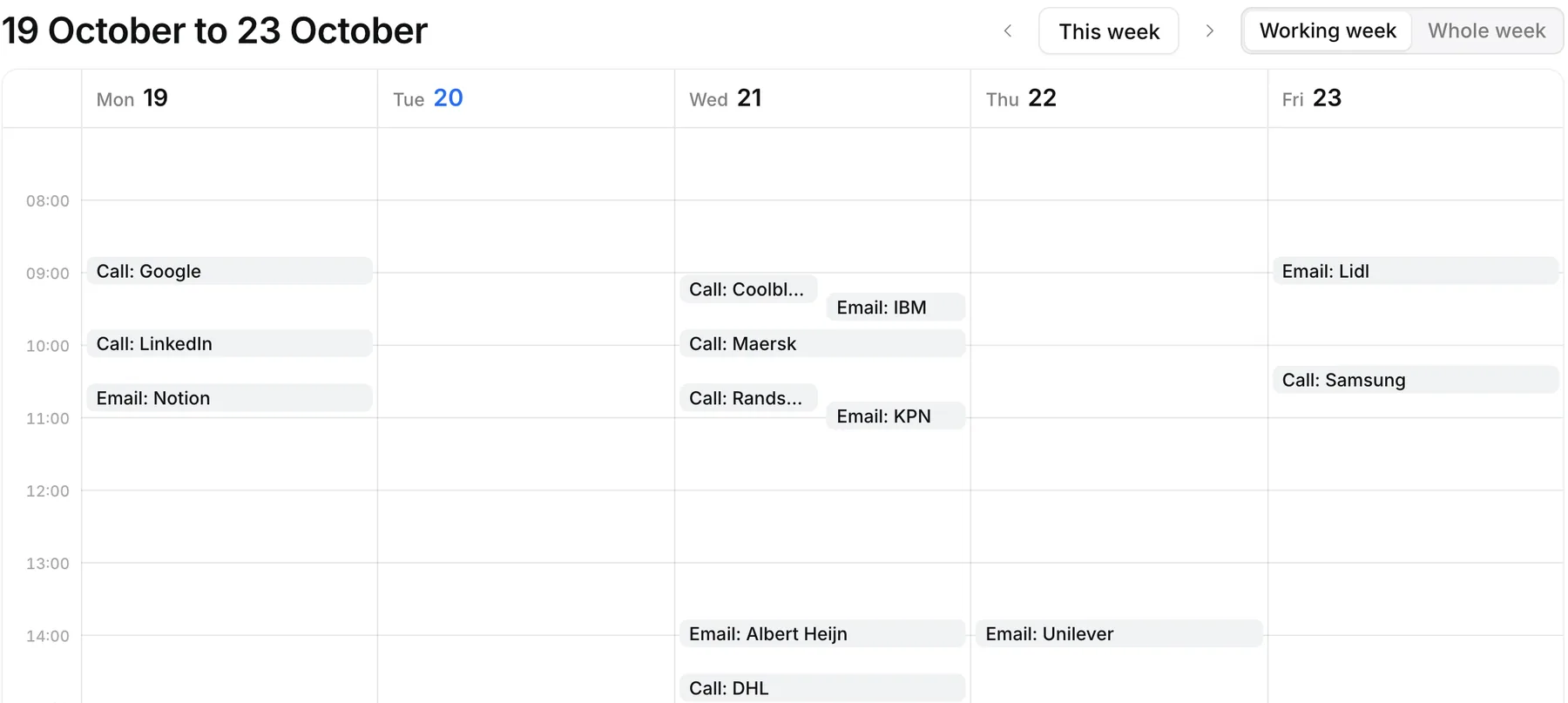
Calls and emails land in your week. You write emails in Ringlane and send them from your own Gmail; LinkedIn and WhatsApp you send yourself and log by hand. The Today view puts overdue call-backs first.
In this industry: After a conversation, send the programme outline or a short proposal from your own Gmail and see it next to the call history, so a colleague knows exactly what was sent.
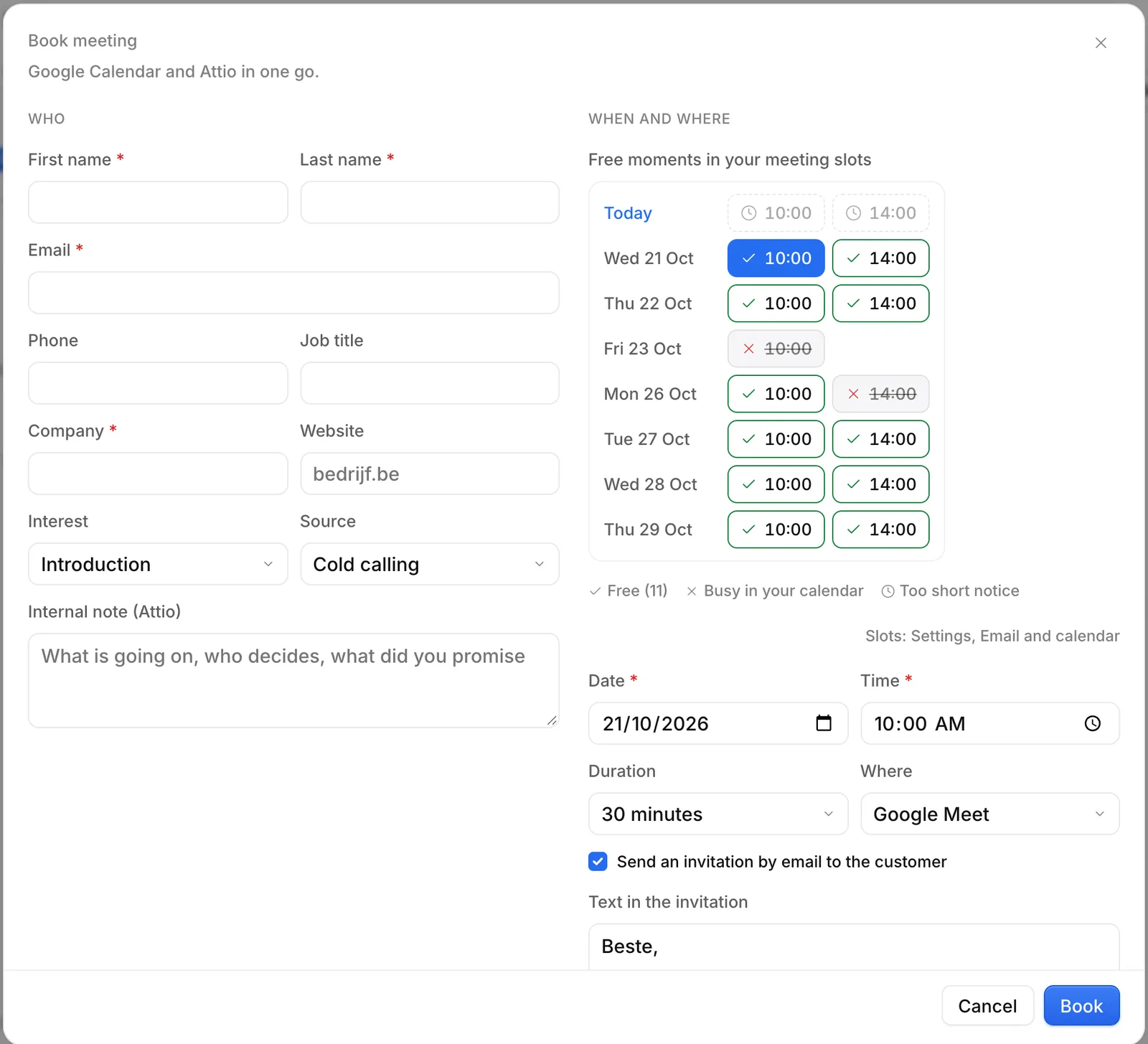
Book while they are on the line
Ringlane shows your free moments in Google Calendar, adds a Google Meet link and sends the invitation. Booked meetings go to Attio.
In this industry: When an HR manager agrees to an intake about next year's training plan, book it in Google Calendar with a Meet link while they are still on the line.
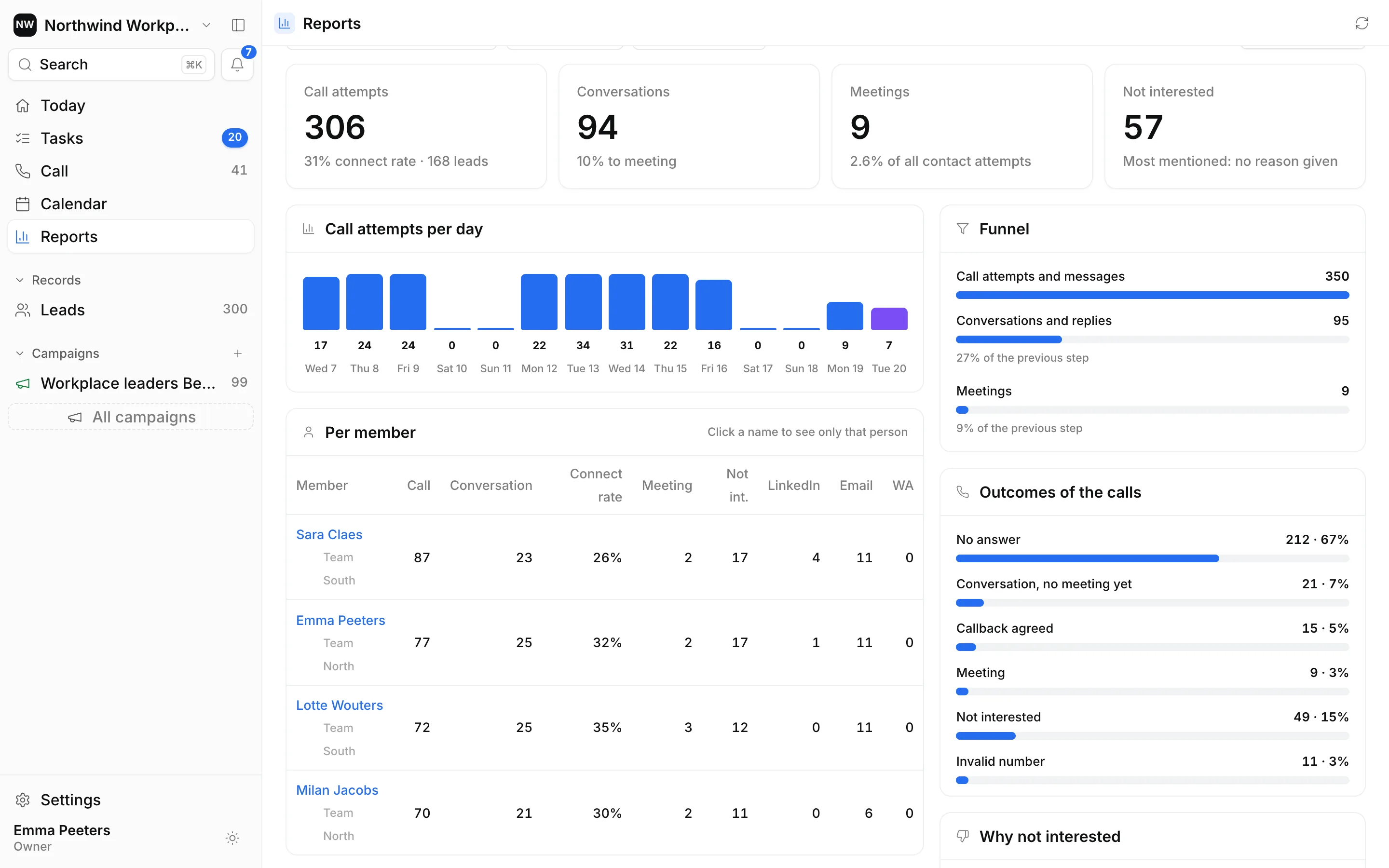
Your numbers, per caller and campaign
Call attempts, connect rate, conversations, meetings, the funnel and the reasons for "not interested", per person, team and campaign.
In this industry: Compare campaigns per topic or per region and read the reasons for not interested, to see whether budget, timing or an internal academy blocks you most.
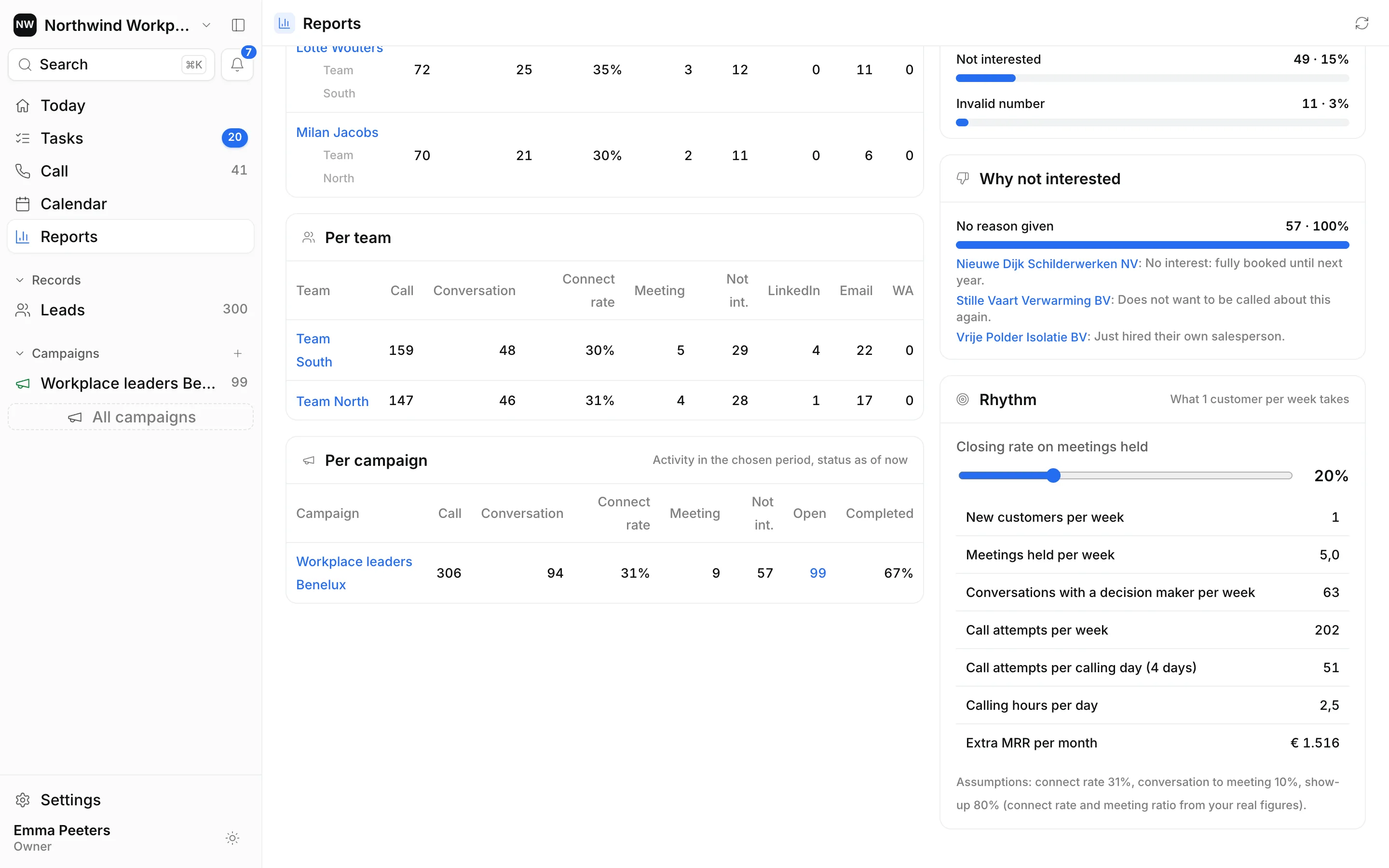
What one new customer takes
Based on your own rates, Ringlane calculates how many calls per week and per day one new customer per week takes.
In this industry: Fill in your own rates and see how many calls per week one new client per week takes, so you can plan calling around the months when training plans are made.
Real screens from the Ringlane app with demo data. No affiliation with the companies shown.
What it can bring you: efficiency, money and more
A calling team in training sales lives on a steady flow of intakes. What you can measure is how many calls lead to a conversation, how many conversations to an intake, and how many intakes to a programme.
Example with assumed numbers: one caller, one month, and an assumed value of 12,000 euros for a first in-company programme. These are not benchmarks; replace them with your own figures.
| Step | Assumption | Result |
|---|---|---|
| Call attempts | 40 per day, 20 working days | 800 |
| Conversations | 15% of attempts | 120 |
| Intakes booked | 20% of conversations | 24 |
| New clients | 1 in 6 intakes | 4 |
| Value | 4 x 12,000 euros (assumed) | 48,000 euros |
Efficiency is something you can measure too. Time how long it takes today to note an outcome and plan the next step in a spreadsheet or CRM. If one key and an automatically planned follow-up save two minutes per attempt, 800 attempts save about 27 hours a month. Check that number against your own week rather than taking it on trust.
The bigger gain is often the follow-up. A training decision can take months, and a lead that was promised a call in September is worth little if nobody calls. Read how to follow up sales leads, or try the flow yourself in the interactive demo.
Frequently asked questions
Does cold calling work for training companies?
Who should a training provider call at a company?
Do Belgian companies have to train their employees?
When is the best time to call about corporate training?
Does Ringlane find training budgets or leads for me?
Sources
- Eurostat: Enterprises providing training by type of training and size class (trng_cvt_01s), CVTS 2020
- CBS: Vooral bij kleine bedrijven minder cursussen in 2020 (December 2022)
- CBS StatLine: Bedrijven; bedrijfstak (81589NED), SBI 85592 Bedrijfsopleiding en -training, 4th quarter 2026, provisional
- FPS Employment (FOD WASO): Individueel opleidingsrecht, information for professionals
- Uitvoering van Beleid SZW: SLIM mkb, individual applications and partnerships 2025 to 2029
All industries
- Accounting firms
- Business events and venues
- Business finance
- Commercial cleaning
- Commercial real estate
- Commercial solar and energy
- Consultancy
- Corporate catering
- Fleet, leasing and EV charging
- HR and payroll services
- HVAC and building services
- Industrial manufacturing
- Insurance brokers
- IT services and MSPs
- Logistics and transport
- Marketing agencies
- Office furniture and workplace
- Printing and packaging
- Recruitment and staffing
- SaaS and software
- Security services
- Telecom and connectivity
- Wholesale and distribution
- Workwear and PPE