Talk to companies before they move, grow or rethink their office
For office furniture dealers, manufacturers and workplace designers in Belgium and the Netherlands: who to call, which moments make an office project likely, and how to stay in touch until it starts.
Companies rarely buy office furniture on impulse. They buy when they move, grow, renovate or change how people work. The supplier that knows about that moment early, and has already had a good conversation, is the one invited to quote. Cold calling in this sector is about finding those moments and keeping the lead warm until the project starts.
The market: who sells and who buys
According to Eurostat, Belgium had 334 manufacturers of office and shop furniture (NACE 31.01) in 2024, employing 1,732 people with a turnover of about 361 million euro. The Netherlands had 5,460, employing 14,586 people with a turnover of about 2.75 billion euro. The same source counts 180 wholesalers of office furniture (NACE 46.65) in Belgium and 873 in the Netherlands. CBS counts 4,660 Dutch businesses in office and shop furniture manufacturing on 1 October 2026 (provisional figures), of which 3,620 are one-person businesses and 230 have 10 or more people. Add dealers, workplace designers and interior builders, and most buyers have several options.
The way people work shapes demand. In 2025, 44.1% of Dutch employed people aged 20 to 64 sometimes worked from home and 12.0% usually did, according to Eurostat. In Belgium, the shares were 24.3% and 13.5%, against an EU average of 14.4% and 8.9%. Hybrid offices need fewer fixed desks and more meeting rooms, focus spaces and flexible furniture, so many companies are reworking floors they already have.
Building rules add renovation moments. In the Netherlands, offices need at least energy label C since 1 January 2023. RVO estimates that on 1 July 2026, 72% of office addresses had label C or better and 24% had no label. In Flanders, the renovation obligation for non-residential buildings applies after a sale, and every large non-residential unit needs at least label E from 1 January 2030. A building that gets renovated often gets a new interior too.
Who you call and what you ask
At companies up to about 50 employees, the owner or the office manager usually decides. At larger companies, the facility manager leads, with HR involved for wellbeing and finance for the budget. During a move, the architect or project manager often writes the specification, so ask who that is.
Moments that make a call relevant:
- a lease that ends within 12 to 24 months, or a planned move
- strong hiring, a merger or a new branch
- a new hybrid working policy
- a renovation or an energy label project in the building
- complaints about noise, lack of meeting rooms or back pain
Questions that open a real conversation:
- "How many people work at this office, and how many are in on a busy day?"
- "When does your lease end, and are you staying?"
- "What do people complain about most in the office?"
- "Who decides on the layout and the furniture, and who else has a say?"
- "What did you buy last, and when?"
Keep the first goal small. A short workplace scan or a showroom visit is easier to agree to than a design proposal, and it shows you how the floor is really used. If there is no project now, ask when the lease ends or when the next growth step is planned, and plan the call for six months before that moment.
For more on asking questions that uncover a need, see SPIN selling questions.
What slows a calling team down in this sector
- Long gaps between purchases. A company that just furnished its office will not buy again soon. Ask when the next change is expected and plan the call.
- The architect decides. In larger projects, the specification is set before suppliers are invited. Calling early, before the design, matters.
- Price comparison with online stores. For a few chairs, buyers compare prices online. Talk about the whole workplace, not single items.
- Tenders. Public bodies and large companies buy through tenders or framework contracts. Know the end date and be known before it is published.
- Busy office managers. Furniture is one of many tasks. Short calls at the moment they choose work better than long pitches.
How Ringlane works for office furniture and workplace suppliers
Real screens from the app, with what each feature does in this industry.
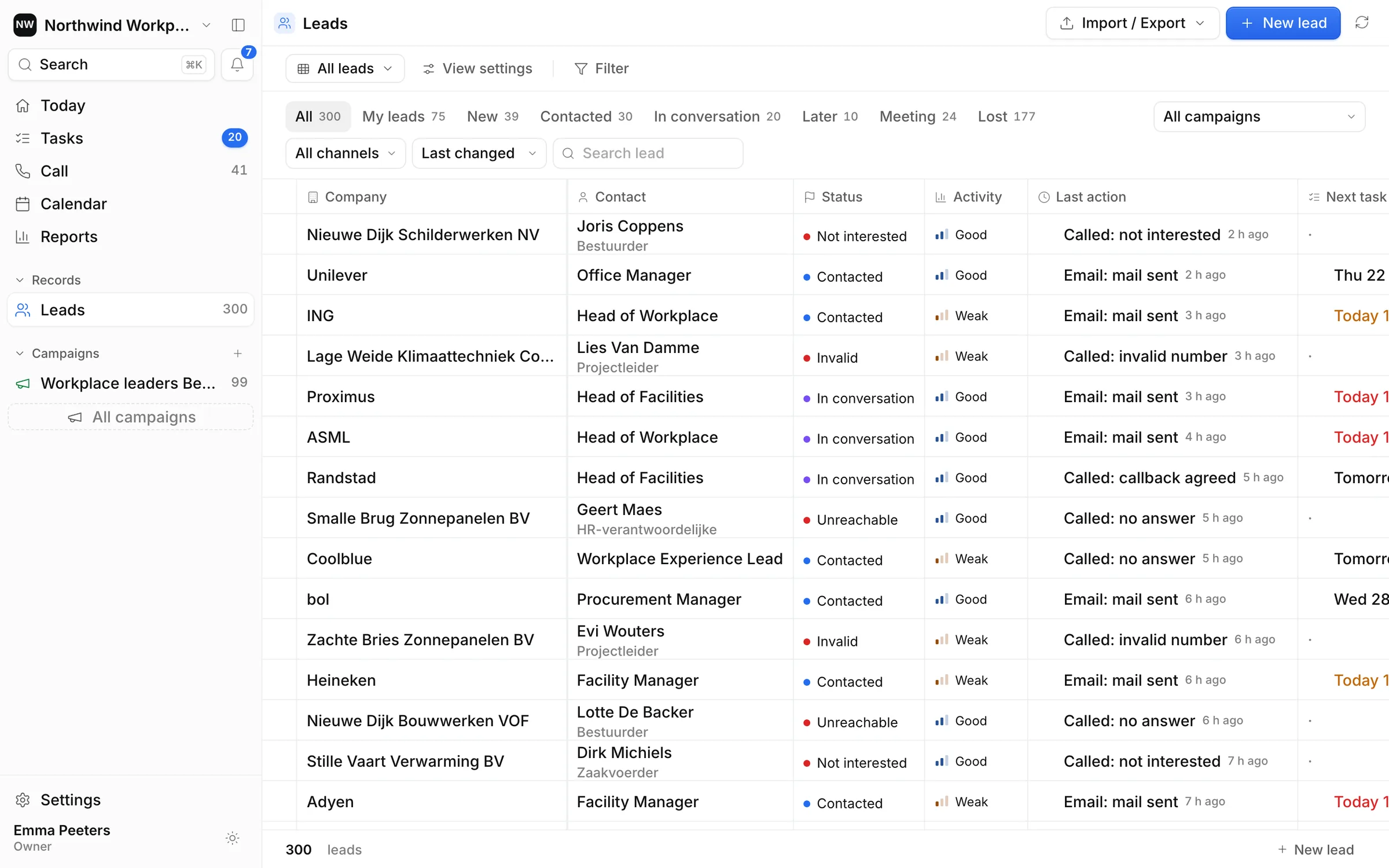
Your lists, in one place
Import Excel, CSV or a Bizzy export into a campaign. Every lead shows its status, last action and next task.
In this industry: Import a Bizzy export of companies with 20 to 250 employees in your region into one campaign per segment, for example law firms or tech companies, so each caller works one clear list.
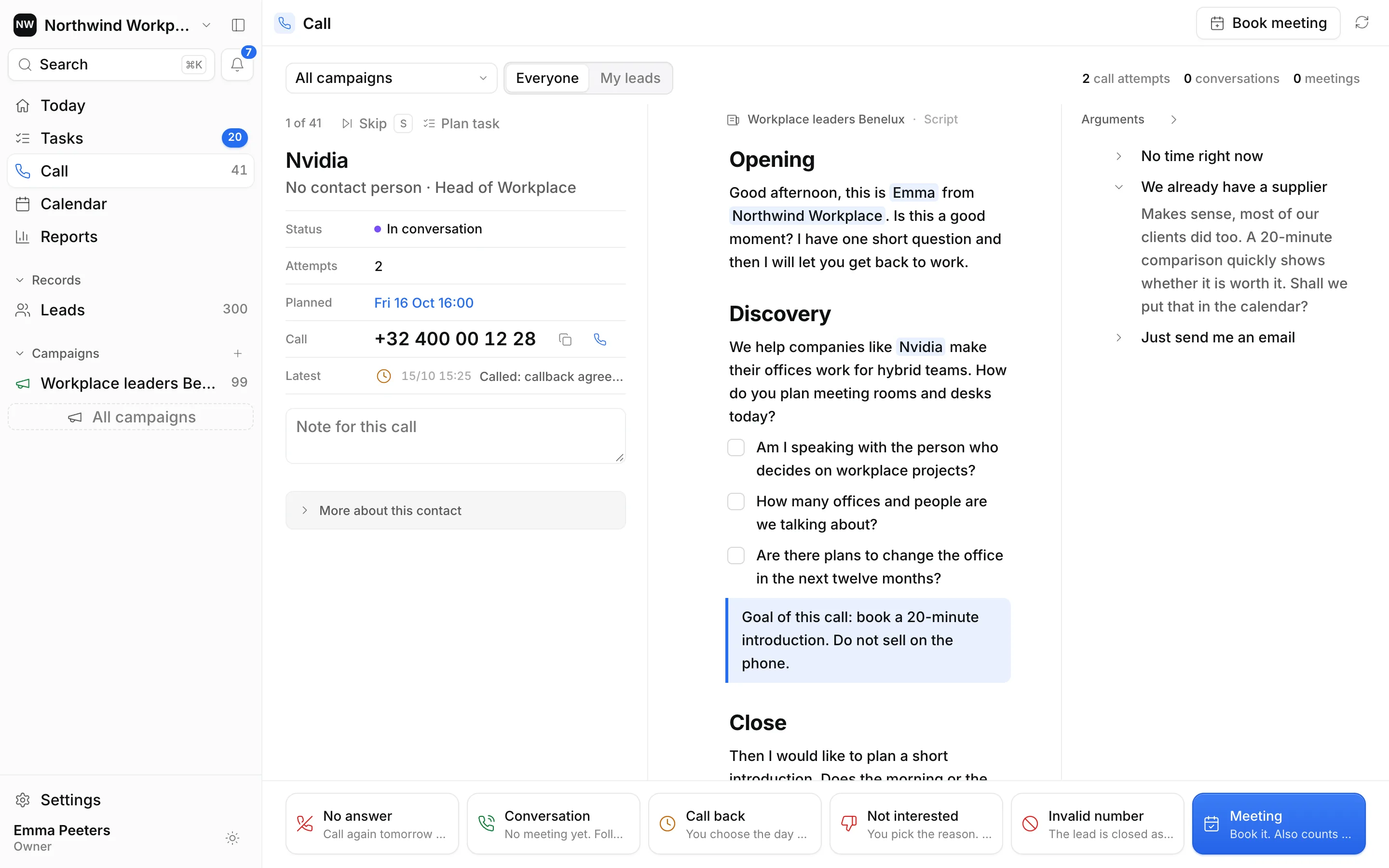
One screen for the call
The lead on the left, the script in the middle with the company name and your own name filled in. Click the number to call from your own phone.
In this industry: Put the questions about headcount, lease end, hybrid policy and the number of desks in the script, so every caller asks them and nobody forgets one.
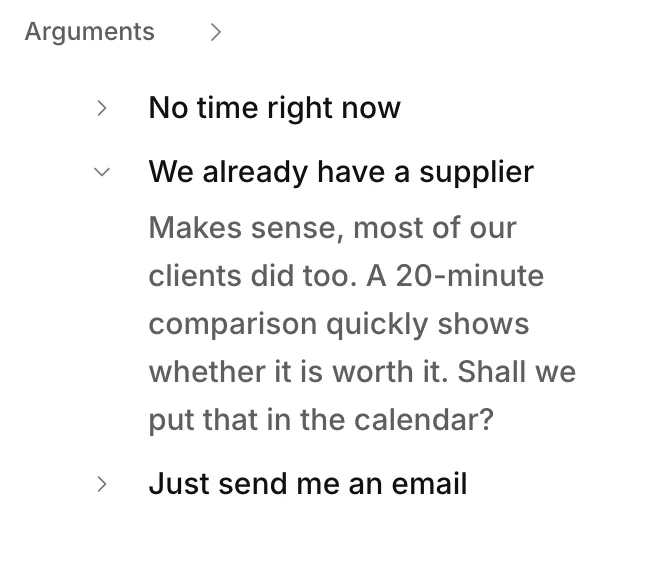
The answer to every objection
Common objections sit in a panel next to the script, so the right answer is one click away.
In this industry: Keep answers to "we just bought chairs", "we are not moving" and "our architect handles that" next to the script, each ending with a question about the next office change.
One key per call, the next step planned
N (not reached) plans a new attempt the next working day, G (conversation) a follow-up call in three days, T (call back) the moment you pick. A records a meeting; X (not interested, with a reason) and O (invalid number) close the lead.
In this industry: Office managers juggle many tasks. N plans the next attempt for the next working day, and T lets you call back at the moment they name, for example after a board meeting.

Follow-up on every channel
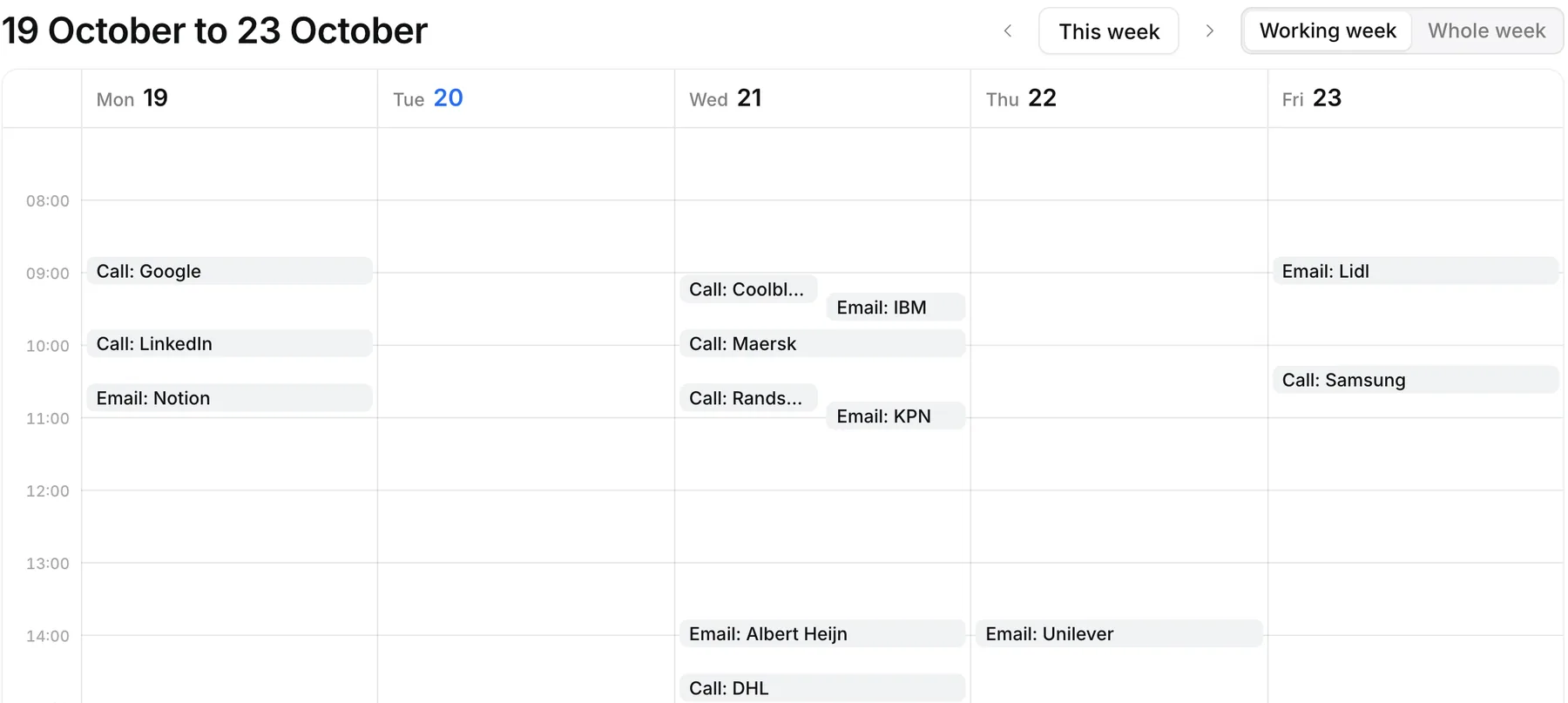
Calls and emails land in your week. You write emails in Ringlane and send them from your own Gmail; LinkedIn and WhatsApp you send yourself and log by hand. The Today view puts overdue call-backs first.
In this industry: After a conversation, send a short note with a showroom invitation or a reference project from your own Gmail. The history with that lead shows what you promised.
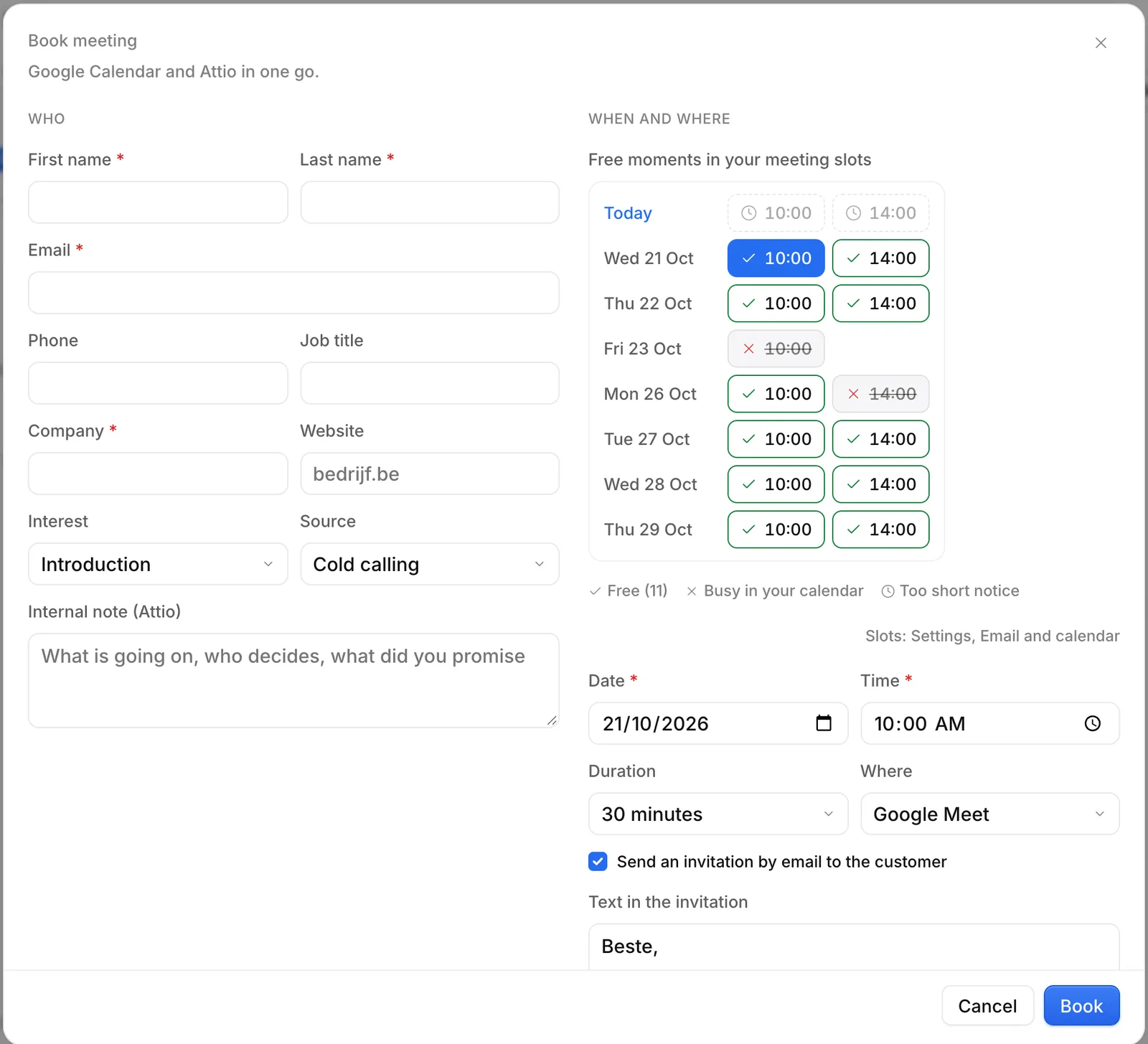
Book while they are on the line
Ringlane shows your free moments in Google Calendar, adds a Google Meet link and sends the invitation. Booked meetings go to Attio.
In this industry: When the facility manager agrees to a workplace scan or a showroom visit, book it in Google Calendar while they are still on the line. The meeting goes to Attio.
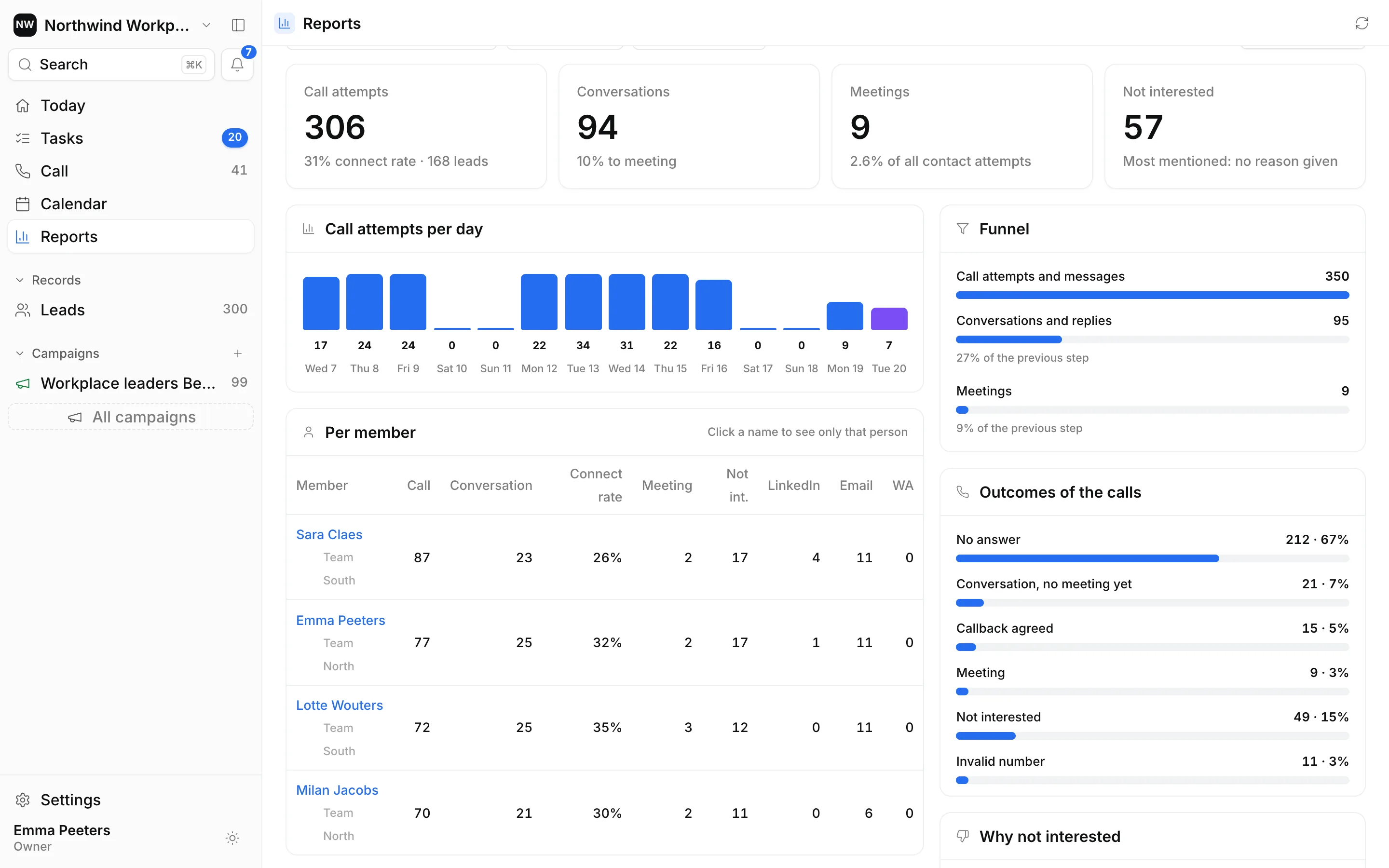
Your numbers, per caller and campaign
Call attempts, connect rate, conversations, meetings, the funnel and the reasons for "not interested", per person, team and campaign.
In this industry: Compare campaigns per company size or segment and read the reasons for not interested. If "lease runs until 2028" keeps coming back, plan those leads for later rather than drop them.
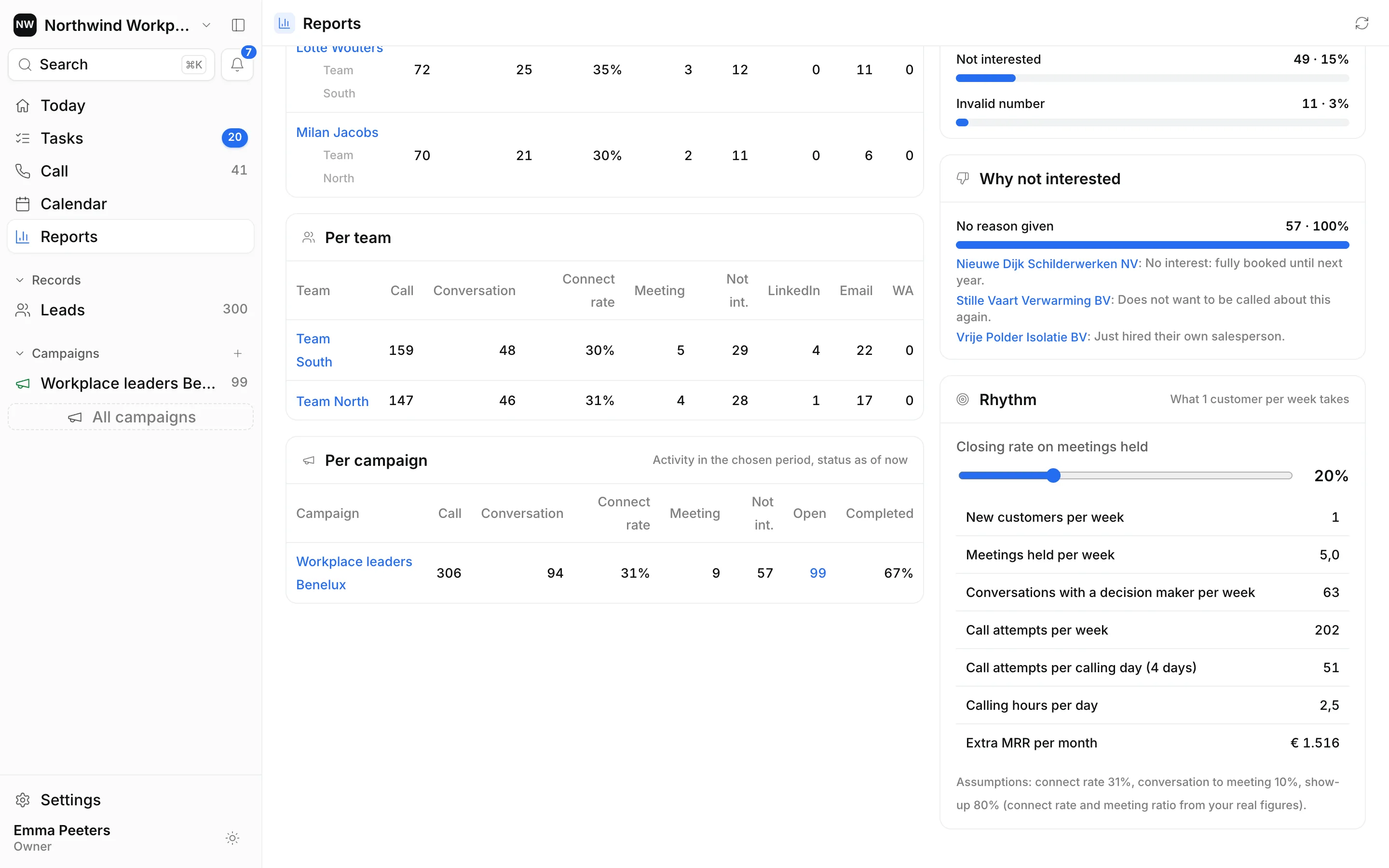
What one new customer takes
Based on your own rates, Ringlane calculates how many calls per week and per day one new customer per week takes.
In this industry: Fill in your own connect and meeting rates and see how many calls per week one new office project per week takes, so a sales manager can set a target that fits.
Real screens from the Ringlane app with demo data. No affiliation with the companies shown.
What it can bring you: efficiency, money and more
Office projects are irregular but large, and a satisfied customer often comes back for the next floor or branch. The table below is an example with assumed numbers, not a forecast. Replace every figure with your own.
| Example with assumed numbers: one caller, one month | Value |
|---|---|
| Call attempts | 400 |
| Conversations with a decision maker (assumed 20%) | 80 |
| Workplace scans or showroom visits booked (assumed 10% of conversations) | 8 |
| New projects (assumed 15% of meetings) | 1.2 |
| Value of one project (assumed 40,000 euro) | 40,000 euro |
In this example, about one new project a month is worth some 48,000 euro in orders. Your numbers will differ, so measure them. See how many calls it takes to win one customer.
Efficiency matters as much. Measure for one week how long your team spends after each call on notes, finding the next date and remembering who asked for a brochure. Logging an outcome with one key and having the next call planned is meant to take much of that away; measure the difference after a few weeks. And the follow-up happens: a lead whose lease ends in 18 months is in the calendar, not forgotten. Read how to follow up leads for a simple cadence.
Want to see the calling screen first? Try the demo.
Frequently asked questions
Does cold calling work for office furniture suppliers?
Who decides on office furniture in a company?
How large is the office furniture market in Belgium and the Netherlands?
Does hybrid working reduce demand for office furniture?
How many calls does it take to win one office project?
Sources
- Eurostat: Enterprises by detailed NACE Rev. 2 activity (sbs_ovw_act), NACE 31.01 and 46.65, Belgium and the Netherlands, 2024
- CBS StatLine: Bedrijven; bedrijfstak (81589NED), SBI 3101 Bedrijfsmeubelindustrie, status on 1 October 2026 (provisional)
- Eurostat: Employed persons working from home (lfsa_ehomp), ages 20 to 64, 2025
- RVO: Energielabel C kantoren (status on 1 July 2026)
- Flemish government: Renovatieverplichting voor niet-residentiële gebouwen
All industries
- Accounting firms
- Business events and venues
- Business finance
- Commercial cleaning
- Commercial real estate
- Commercial solar and energy
- Consultancy
- Corporate catering
- Corporate training
- Fleet, leasing and EV charging
- HR and payroll services
- HVAC and building services
- Industrial manufacturing
- Insurance brokers
- IT services and MSPs
- Logistics and transport
- Marketing agencies
- Printing and packaging
- Recruitment and staffing
- SaaS and software
- Security services
- Telecom and connectivity
- Wholesale and distribution
- Workwear and PPE