Win new payroll clients by calling before the switching window
For payroll providers, social secretariats and HR service firms in Belgium and the Netherlands: who chooses the provider, which changes make employers open to a conversation, and how to stay in touch until they are ready to move.
Almost every employer already has someone who runs payroll: a social secretariat, a payroll provider, the accountant or an in-house administrator. Payroll has to be right every month, so employers do not switch lightly. The providers that grow are the ones that know when a contract can end, call at that moment and stay in touch in between.
The market: every employer is a buyer, few switch at once
In Belgium, Statbel counted 206,517 enterprises with employees in industry, construction and services in 2023. Most are small: 139,212 had 1 to 4 employees, 32,166 had 5 to 9 and 35,139 had 10 or more. Many Belgian employers work with a recognised social secretariat. Such a secretariat is recognised by the Minister of Social Affairs and has the exclusive right to collect social contributions from its affiliated employers. That makes the choice of provider a formal one.
In the Netherlands, the CBS business register lists 2.45 million businesses on 1 October 2026 (provisional), but 2.03 million of them are one-person businesses. Businesses with 10 or more working persons number 72,340, and 8,625 have 100 or more. Those are the employers where payroll, HR administration and reporting become a real workload. The same register counts 285 payrolling businesses, besides payroll software vendors, accountants and administration offices.
New regulation is pushing employers to look at their pay data. Directive (EU) 2023/970 on pay transparency had to be transposed by 7 June 2026. It gives applicants the right to information about the starting pay or its range, and it requires gender pay gap reports: every year from 7 June 2027 for employers with 250 or more workers, every three years from 7 June 2027 for 150 to 249 workers and from 7 June 2031 for 100 to 149 workers.
Who you call and what you ask
- Owner or managing director: decides at smaller employers, often on the advice of the accountant.
- HR manager: owns the employee experience, contracts, onboarding and soon pay transparency.
- Finance director or controller: watches cost per payslip and the link with bookkeeping.
- Payroll administrator: does the monthly work and knows exactly where it hurts.
Moments that make a call relevant:
- Pay transparency. In Belgium, a spring 2026 update by social secretariat Besox noted that transposition was not yet done and that private employers do not yet have to apply the directive while no Belgian law is in force. In the Netherlands, the bill went to parliament in May 2026 with a planned start on 1 January 2027; employers with 150 or more employees would first report by 7 June 2028. Check the current status before you call; this is general information, not legal advice.
- Growth past a threshold. Passing 50 or 100 employees can bring new obligations and often outgrows the current set-up.
- Year end. Many employers prefer to switch on 1 January, so the conversations happen months earlier.
- A merger, a new site or a new collective agreement. Each one makes payroll more complex.
Discovery questions that work in this sector:
- Who runs your payroll today, and until when does that agreement run?
- How many payslips do you process each month, and how many joint committees or collective agreements apply?
- How much time does your team spend on corrections after payroll closes?
- Are you ready to give applicants a pay range and to report on pay gaps?
- If you could change one thing about payroll tomorrow, what would it be?
Questions like these work best in the order of situation, problem, impact and need. See how to ask SPIN questions.
What slows a calling team down in this sector
- Fear of switching. A wrong payslip is the worst possible start. Prospects need to hear how migration works before they agree to a meeting.
- The accountant as gatekeeper. Many small employers follow their accountant's advice, and some accountants run payroll themselves.
- Fixed switching windows. Contracts and notice periods mean a yes today often becomes a start next year. Without planned follow-up, the lead is gone.
- Busy days. Around payroll closing, nobody in HR has time for a call. Calling on the wrong day wastes attempts.
- Regulation that is still moving. Dates for pay transparency differ by country and may change. Callers need checked answers.
How Ringlane works for HR and payroll providers
Real screens from the app, with what each feature does in this industry.
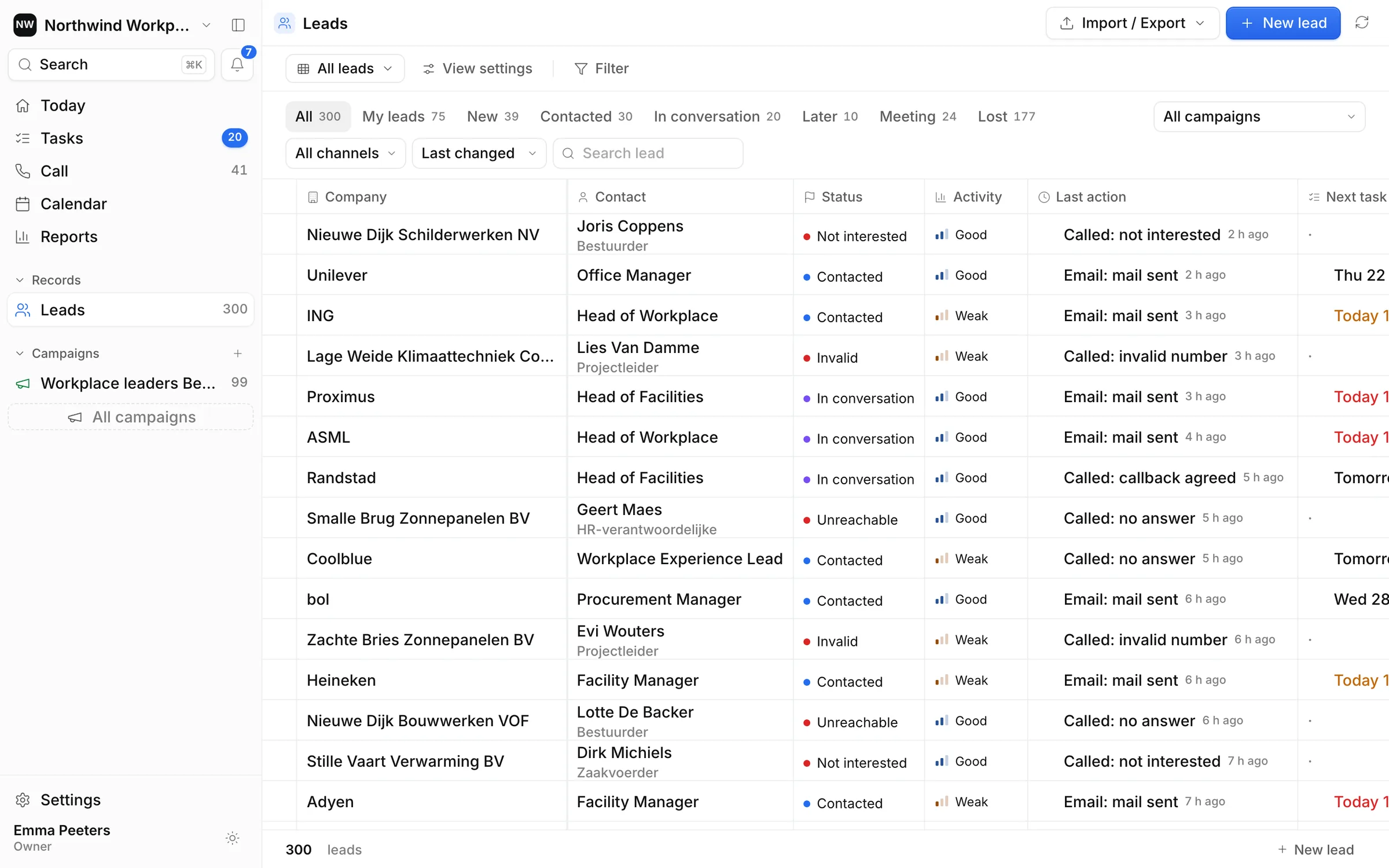
Your lists, in one place
Import Excel, CSV or a Bizzy export into a campaign. Every lead shows its status, last action and next task.
In this industry: Import a Bizzy export of employers by headcount band, for example 10 to 49 and 50 to 249 employees, into separate campaigns, because the questions and the decision makers differ by size.
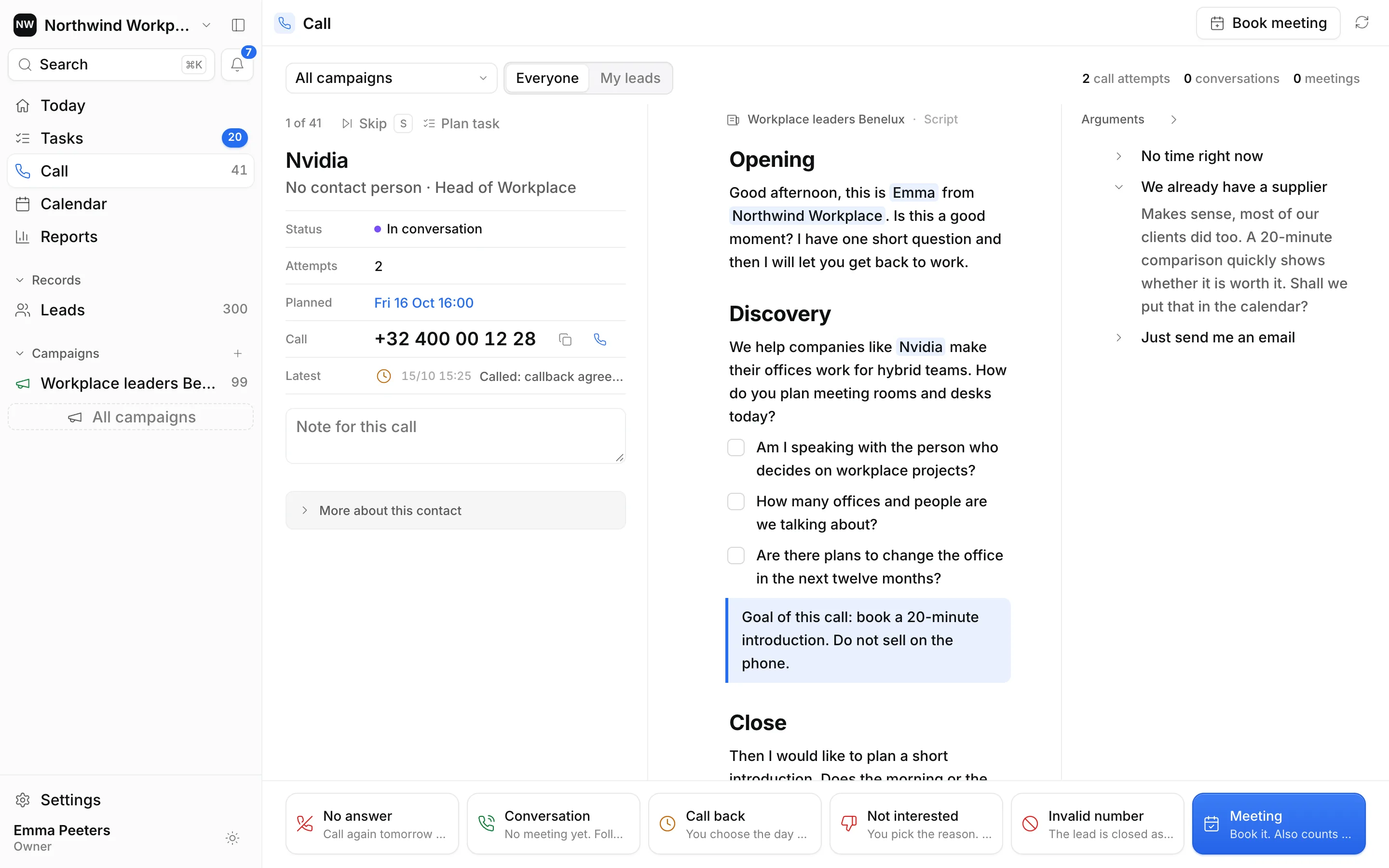
One screen for the call
The lead on the left, the script in the middle with the company name and your own name filled in. Click the number to call from your own phone.
In this industry: Put the questions about the current provider, the number of payslips, the joint committee or collective agreement and the contract end in the script, so every caller asks them.
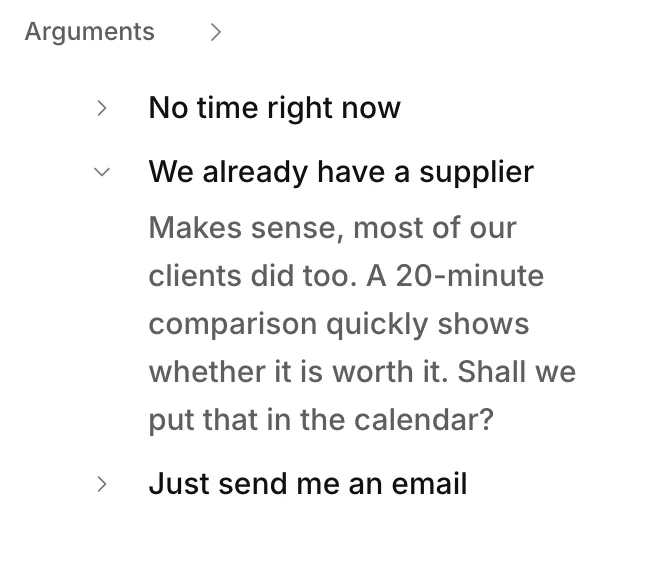
The answer to every objection
Common objections sit in a panel next to the script, so the right answer is one click away.
In this industry: Keep answers ready to "switching payroll is too risky", "our accountant handles it" and "we just renewed", each ending in a question about when the contract can be ended.
One key per call, the next step planned
N (not reached) plans a new attempt the next working day, G (conversation) a follow-up call in three days, T (call back) the moment you pick. A records a meeting; X (not interested, with a reason) and O (invalid number) close the lead.
In this industry: HR managers and owners are busy around payroll closing days. N plans a new attempt the next working day; T lets you call back on the quiet day they name.

Follow-up on every channel
Calls and emails land in your week. You write emails in Ringlane and send them from your own Gmail; LinkedIn and WhatsApp you send yourself and log by hand. The Today view puts overdue call-backs first.
In this industry: After a conversation, send a short note on the pay transparency timeline or your migration plan from your own Gmail, and see it in the lead history before the next call.
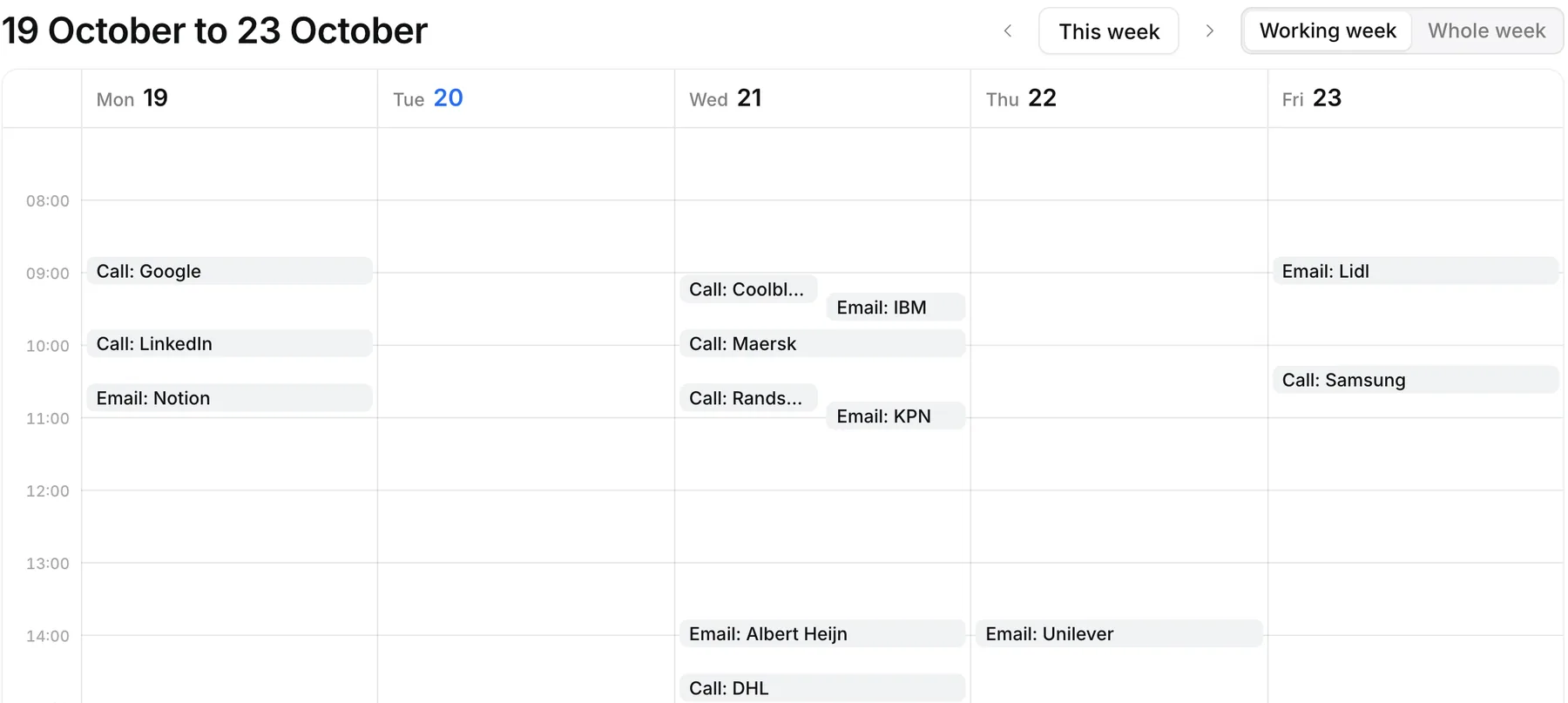
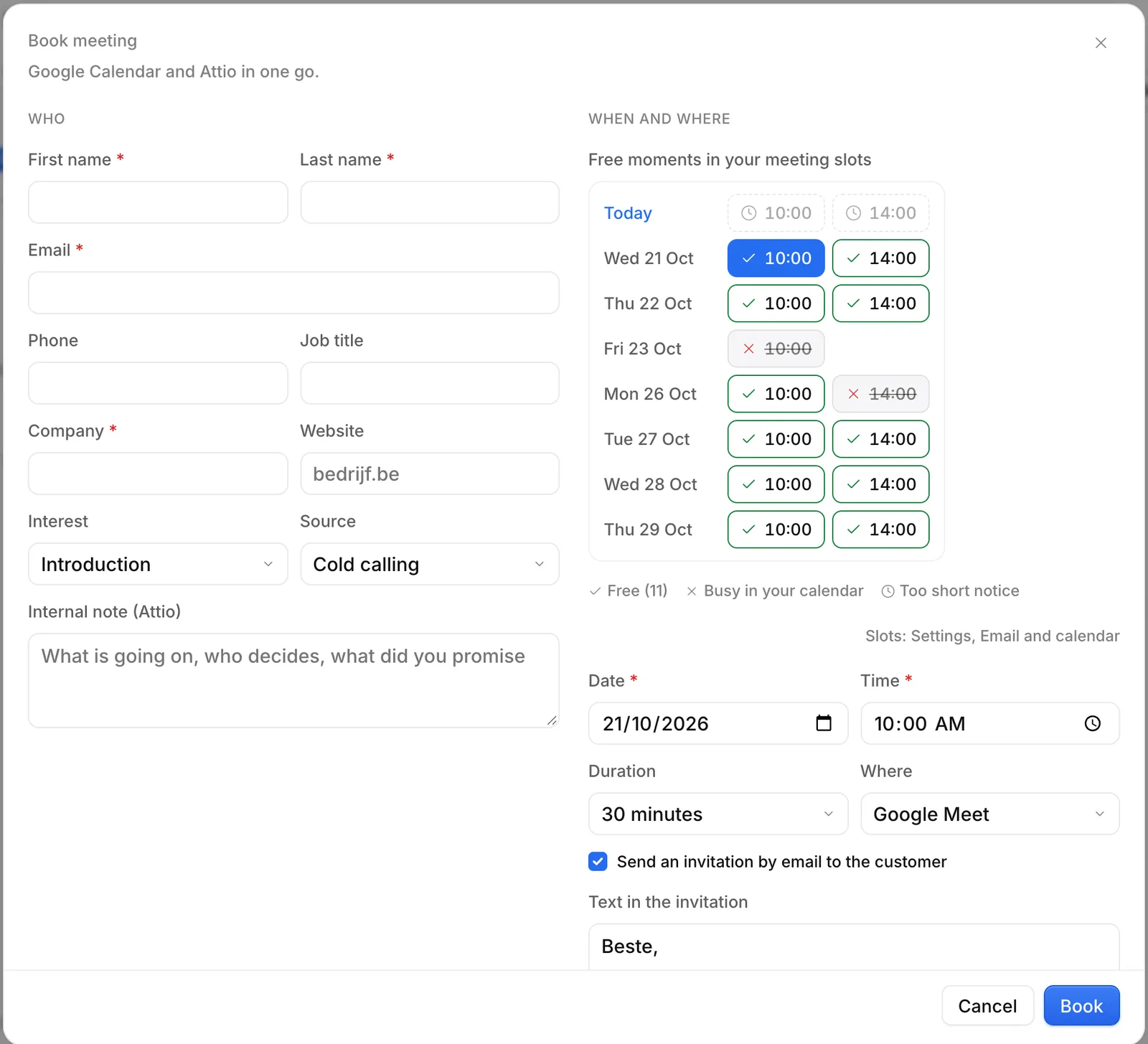
Book while they are on the line
Ringlane shows your free moments in Google Calendar, adds a Google Meet link and sends the invitation. Booked meetings go to Attio.
In this industry: When an HR manager agrees to a demo or a payroll review, book it in Google Calendar with a Meet link while they are on the line; the meeting goes to Attio.
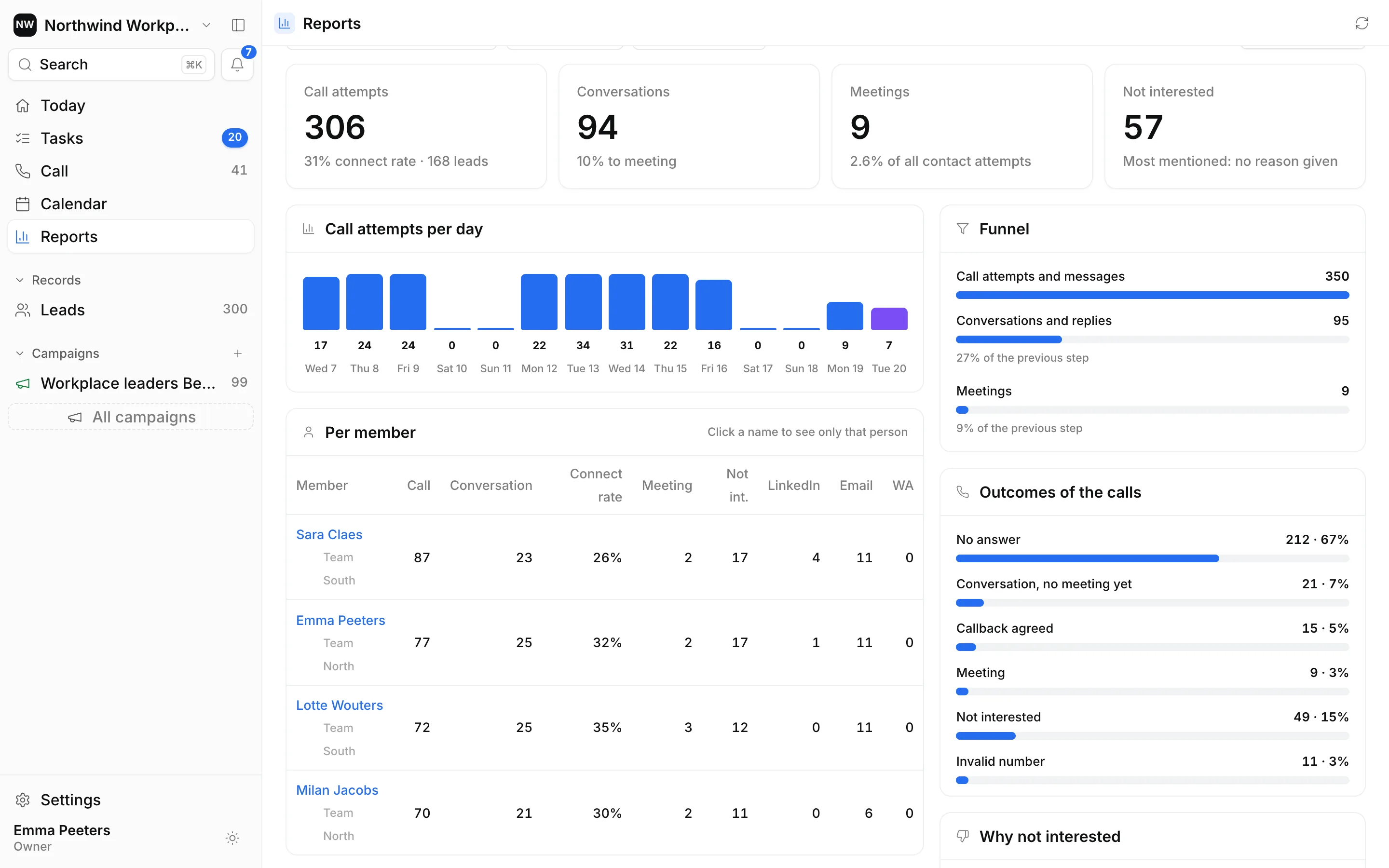
Your numbers, per caller and campaign
Call attempts, connect rate, conversations, meetings, the funnel and the reasons for "not interested", per person, team and campaign.
In this industry: Compare campaigns by company size and read the reasons for not interested. If "contract ends next year" keeps coming back, log that answer next time as a call back (T) a few months before the contract end, not as not interested.
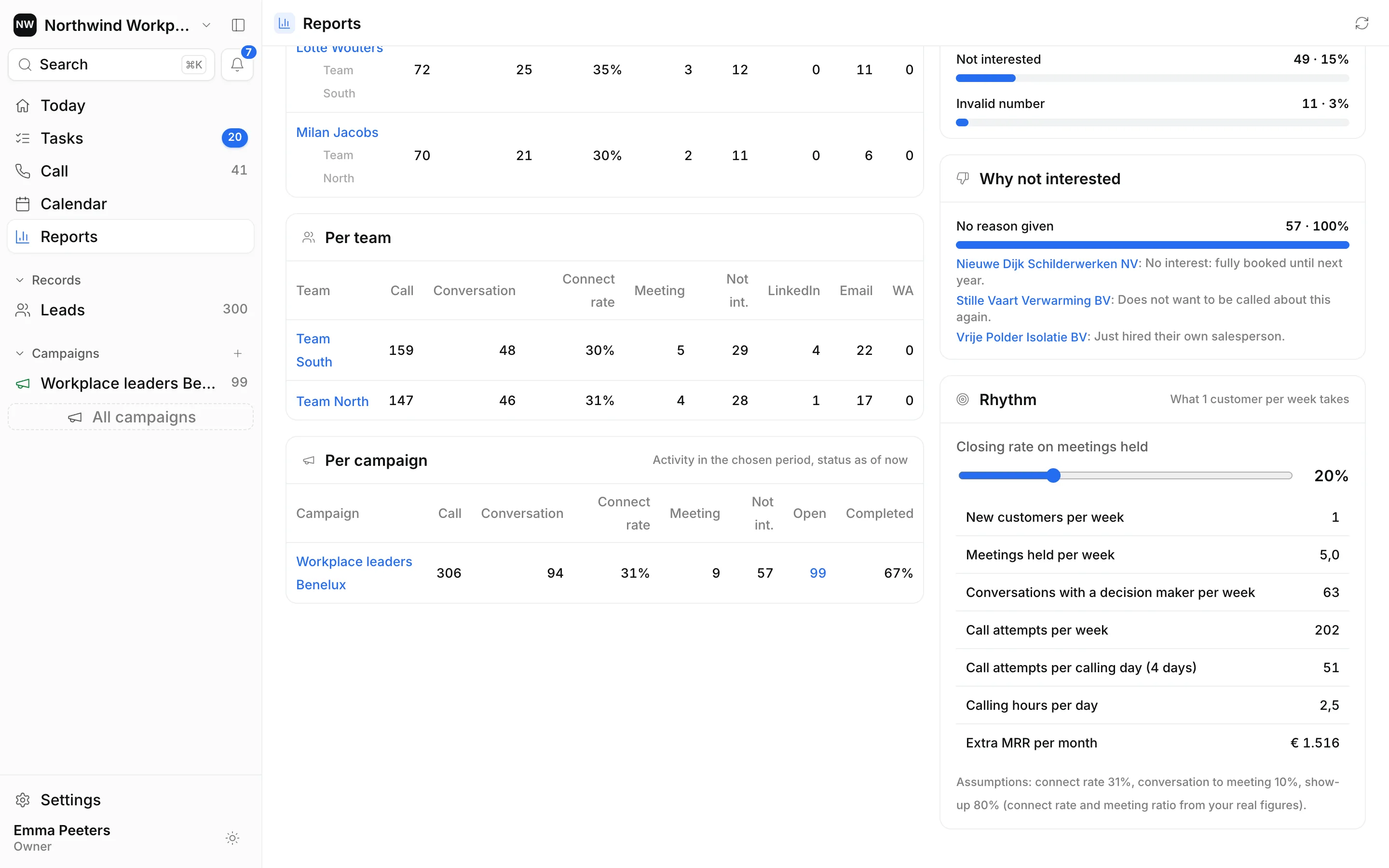
What one new customer takes
Based on your own rates, Ringlane calculates how many calls per week and per day one new customer per week takes.
In this industry: Enter your own connect and meeting rates and see how many calls per week one new payroll client per week takes, so a sales manager can plan the months before 1 January.
Real screens from the Ringlane app with demo data. No affiliation with the companies shown.
What it can bring you: efficiency, money and more
A payroll client is recurring revenue for years, so a few extra clients before each switching window add up. The table below is an example with assumed numbers, not a forecast. Replace every figure with your own.
| Example with assumed numbers: one caller, one month | Value |
|---|---|
| Call attempts | 400 |
| Conversations with a decision maker (assumed 25%) | 100 |
| Demos or payroll reviews booked (assumed 10% of conversations) | 10 |
| New clients (assumed 20% of meetings) | 2 |
| Value of one client (assumed 30 employees at 25 euro per payslip per month, over 3 years) | 27,000 euro |
In this example, two new clients a month are worth 54,000 euro in revenue over three years. Your own numbers will differ, which is exactly why it helps to measure them. See how many calls it takes to win one customer.
Efficiency is the other half. Measure for one week how long your team spends after each call on notes, contract end dates and remembering when to call back. Logging the outcome with one key, with the next call already planned, removes most of that work. A prospect whose contract can end next January is then in the calendar in time. Read how to follow up leads for a cadence that bridges the months until the switch.
Want to see the calling screen first? Try the demo.
Frequently asked questions
Who chooses a payroll provider at a small or mid-sized company?
Is the EU pay transparency directive a reason to call employers?
Which employers will have to report on pay gaps?
How many potential clients are there?
How many calls does it take to win one payroll client?
Sources
- Statbel: Demography of enterprises with employees, by NACE and size class, 2023 (Bestat)
- CBS StatLine: Bedrijven; bedrijfsgrootte en rechtsvorm (table 81589NED)
- EUR-Lex: Directive (EU) 2023/970 on pay transparency
- Forum for the Future (Besox): Loontransparantie, stand van zaken
- HR Praktijk: Wetsvoorstel loontransparantie naar Tweede Kamer, invoering per 1 januari 2027 (21 May 2026)
- Socialsecurity.be: Recognised social secretariats (DmfA instructions)
All industries
- Accounting firms
- Business events and venues
- Business finance
- Commercial cleaning
- Commercial real estate
- Commercial solar and energy
- Consultancy
- Corporate catering
- Corporate training
- Fleet, leasing and EV charging
- HVAC and building services
- Industrial manufacturing
- Insurance brokers
- IT services and MSPs
- Logistics and transport
- Marketing agencies
- Office furniture and workplace
- Printing and packaging
- Recruitment and staffing
- SaaS and software
- Security services
- Telecom and connectivity
- Wholesale and distribution
- Workwear and PPE