Book more demos with calls timed to renewals and real problems
For SaaS and software companies selling to businesses in Belgium and the Netherlands: who to call, which moments open the door, and how SDRs keep every trial and demo moving.
Most companies with ten or more employees in Belgium and the Netherlands already pay for cloud software. A SaaS company rarely sells to an empty spot. It sells against a spreadsheet, a homegrown tool or a competitor with a contract that renews on a fixed date. Calling works when an SDR finds that date, asks about the problem behind it and books a short demo before the moment passes.
The market: buyers who already pay for software
Cloud software is mainstream in both countries. According to Eurostat data for 2025, 61.6% of Belgian and 68.5% of Dutch enterprises with ten or more employees used paid cloud computing services, against 52.7% across the EU. The gap is even larger for business software: paid cloud CRM was used by 29.8% of Belgian and 39.8% of Dutch enterprises, against 14.7% in the EU, and finance or accounting software in the cloud by 45.7% and 53.3%. Eurostat's overview shows that email, office software and file storage are the most common cloud services, so most buyers have been through a software purchase before.
On the supply side the market is crowded. CBS counts more than 106,000 ICT companies in the Netherlands in 2025, and the CBS business register lists 49,085 businesses in software development on 1 October 2026 (provisional figures), most of them one-person companies. In Belgium, the ICT sector had 71.7 billion euro turnover and about 130,000 jobs in 2024, according to Agoria figures reported by Computable.
Two consequences for outbound. First, the buyer compares you with what they have, not with nothing. Second, both markets are small. A Belgian or Dutch ideal customer profile often holds a few thousand companies, not hundreds of thousands, so every lead deserves follow-up rather than one attempt.
Who you call and what you ask
Call the person who lives with the problem and the person who owns the budget. Depending on the product:
- Department head: finance director, HR manager, operations manager, sales manager.
- Owner or managing director at companies with fewer than about 50 employees, where one person decides.
- IT or security: rarely the first contact, but involved in integration, access and data questions.
- The daily user: a team lead who can tell you what really breaks.
Moments that make a call relevant:
- A renewal date of the current tool, often annual. It is the single most useful field to capture.
- A new person in the role. New managers review tools in their first months.
- Growth: a new site, a second country, a team that doubles.
- Regulation. In Belgium, structured e-invoicing via Peppol became mandatory for B2B invoices from 1 January 2026; in December 2025 only about 43% of VAT-liable companies had registered, according to VRT NWS. Rules like this push companies to review finance and admin tools.
Discovery questions that work for software:
- How do you handle this today, and what does it cost you in time each week?
- Which tool do you use now, and when does that contract renew?
- Who else would want to see a demo before you decide?
- What would have to be true for you to switch this year?
- If we spend 20 minutes on a demo, which one question should it answer?
Defining who to call before you dial is half the work. See how to define your ideal customer profile.
What slows a calling team down in this sector
- Locked-in contracts. Many prospects cannot switch before renewal. Without a planned call back at the right month, the opportunity disappears.
- "Send me a deck." A polite way to end the call. The better reply is one question about the problem, then a short demo.
- Many SDRs, little shared memory. When several people call the same market, leads get called twice or not at all.
- Demo no-shows. A demo booked a week out with no clear purpose is easy to skip.
- Bilingual markets. Belgian prospects may prefer Dutch or French, Dutch prospects Dutch. A script in the wrong language costs the first minute.
Most of these problems shrink when an SDR team agrees on one shared list per segment, one script and one rule: every call ends with an outcome and a planned next step.
How Ringlane works for SaaS and software companies
Real screens from the app, with what each feature does in this industry.
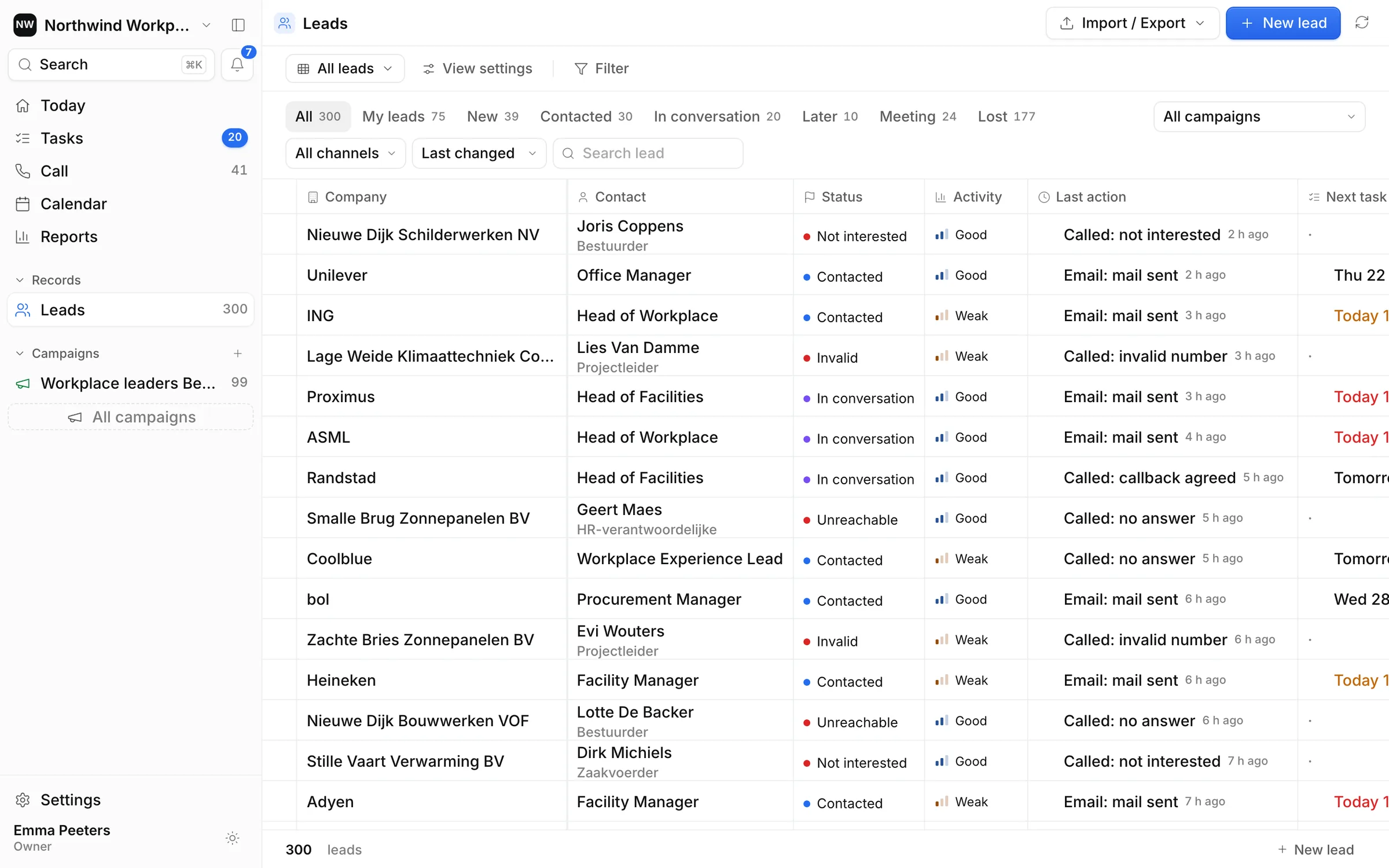
Your lists, in one place
Import Excel, CSV or a Bizzy export into a campaign. Every lead shows its status, last action and next task.
In this industry: Import a list per ideal customer profile, for example finance teams at companies with 50 to 250 employees, into its own campaign, so SDRs compare segments instead of mixing them.
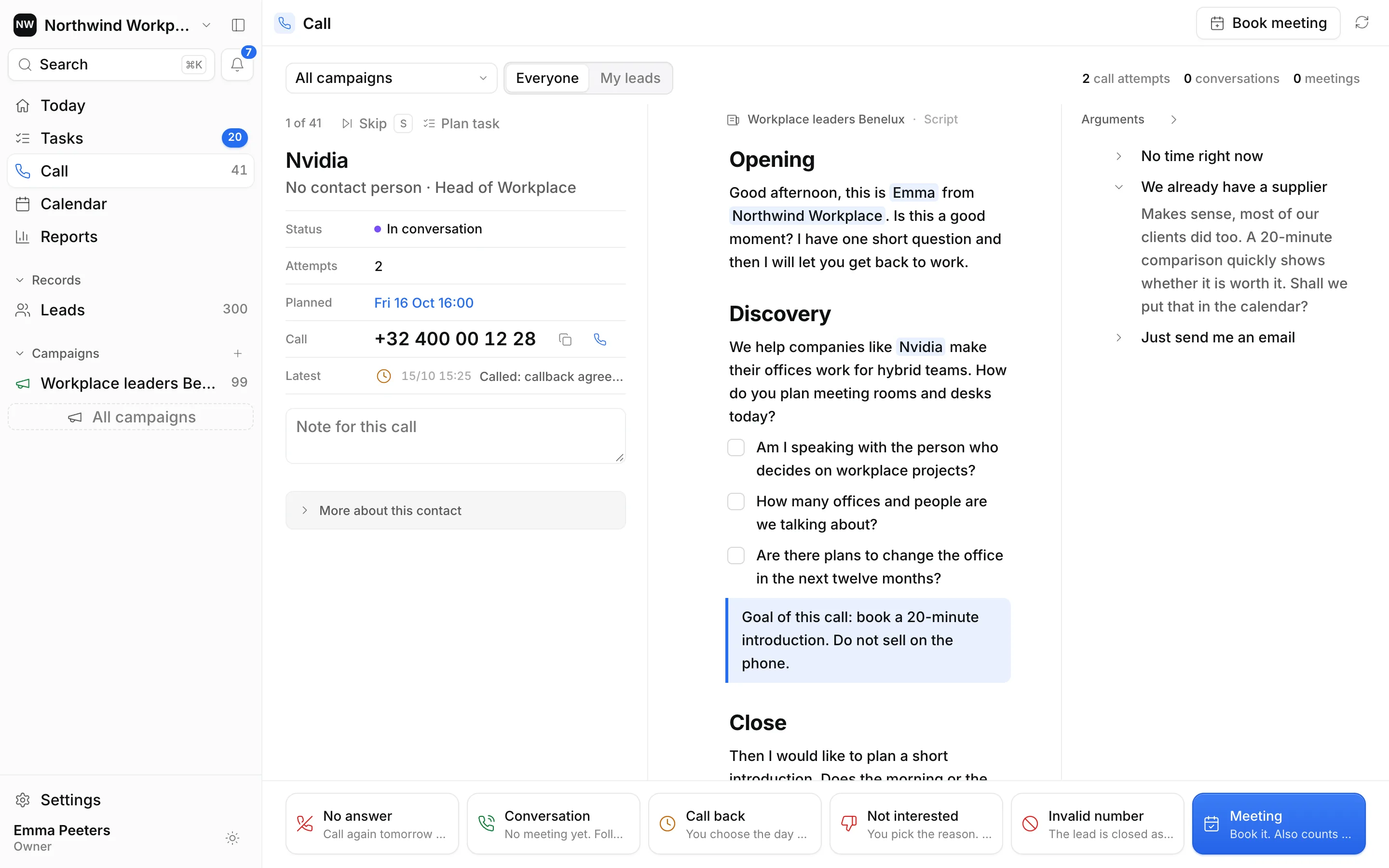
One screen for the call
The lead on the left, the script in the middle with the company name and your own name filled in. Click the number to call from your own phone.
In this industry: Put the questions about current tool, contract renewal date, number of users and who owns the budget in the script, so every SDR qualifies the same way.
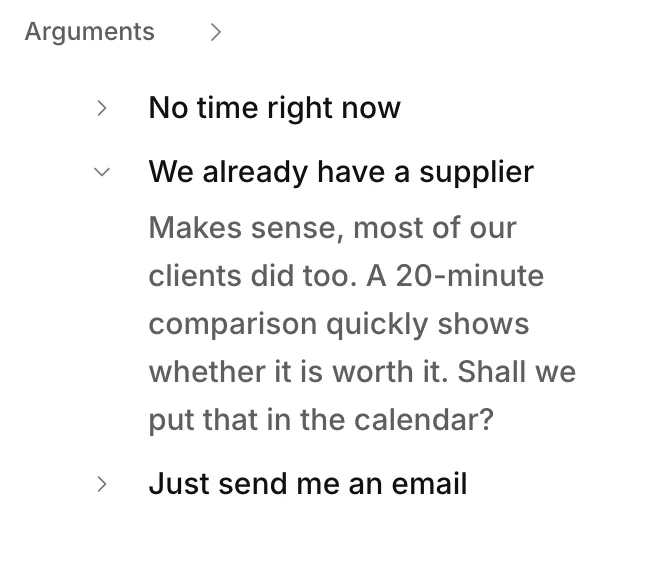
The answer to every objection
Common objections sit in a panel next to the script, so the right answer is one click away.
In this industry: Keep answers to "we just signed with a competitor", "we built it ourselves" and "send me a deck" next to the script, each one steering toward a short demo or a renewal date.
One key per call, the next step planned
N (not reached) plans a new attempt the next working day, G (conversation) a follow-up call in three days, T (call back) the moment you pick. A records a meeting; X (not interested, with a reason) and O (invalid number) close the lead.
In this industry: When a prospect says the contract renews in spring, T plans the call back at that moment; X with the reason "locked in until renewal" closes the lead with a clear note.

Follow-up on every channel
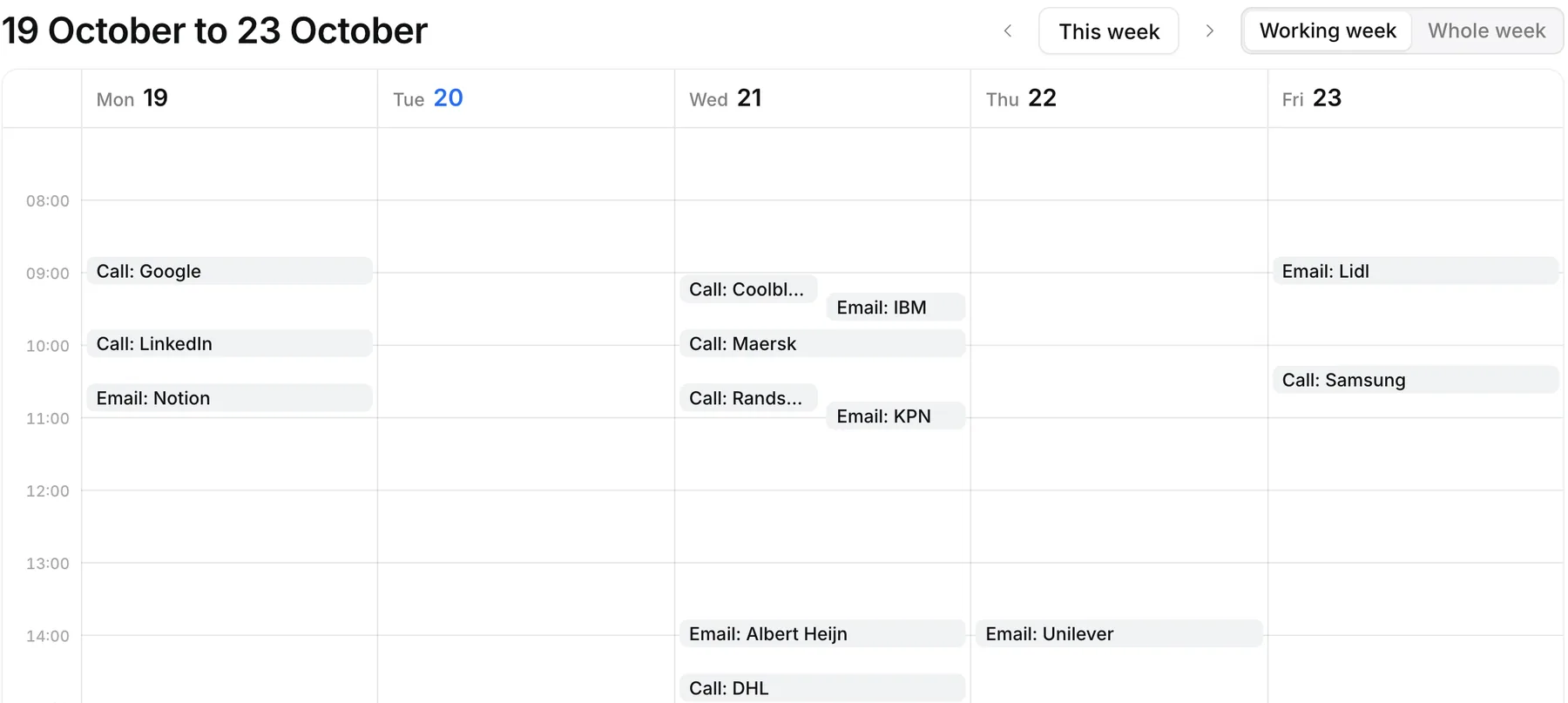
Calls and emails land in your week. You write emails in Ringlane and send them from your own Gmail; LinkedIn and WhatsApp you send yourself and log by hand. The Today view puts overdue call-backs first.
In this industry: After a call, send the one-page summary or the demo link from your own Gmail and see the whole thread with that lead, so the account executive sees what the SDR promised.
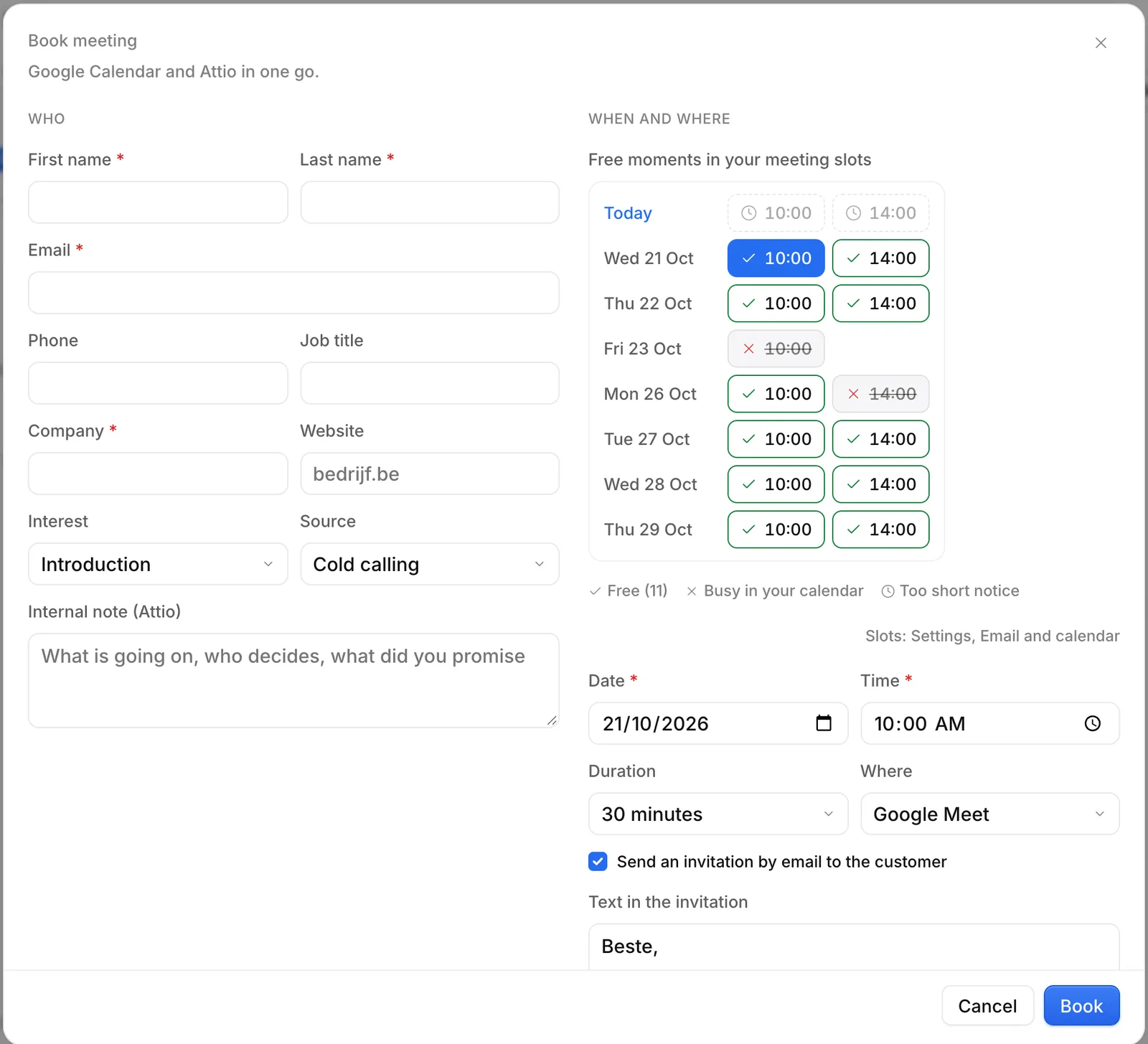
Book while they are on the line
Ringlane shows your free moments in Google Calendar, adds a Google Meet link and sends the invitation. Booked meetings go to Attio.
In this industry: Book the demo in Google Calendar while the prospect is on the line, with the Meet link in the invitation; booked demos go to Attio for the account executive.
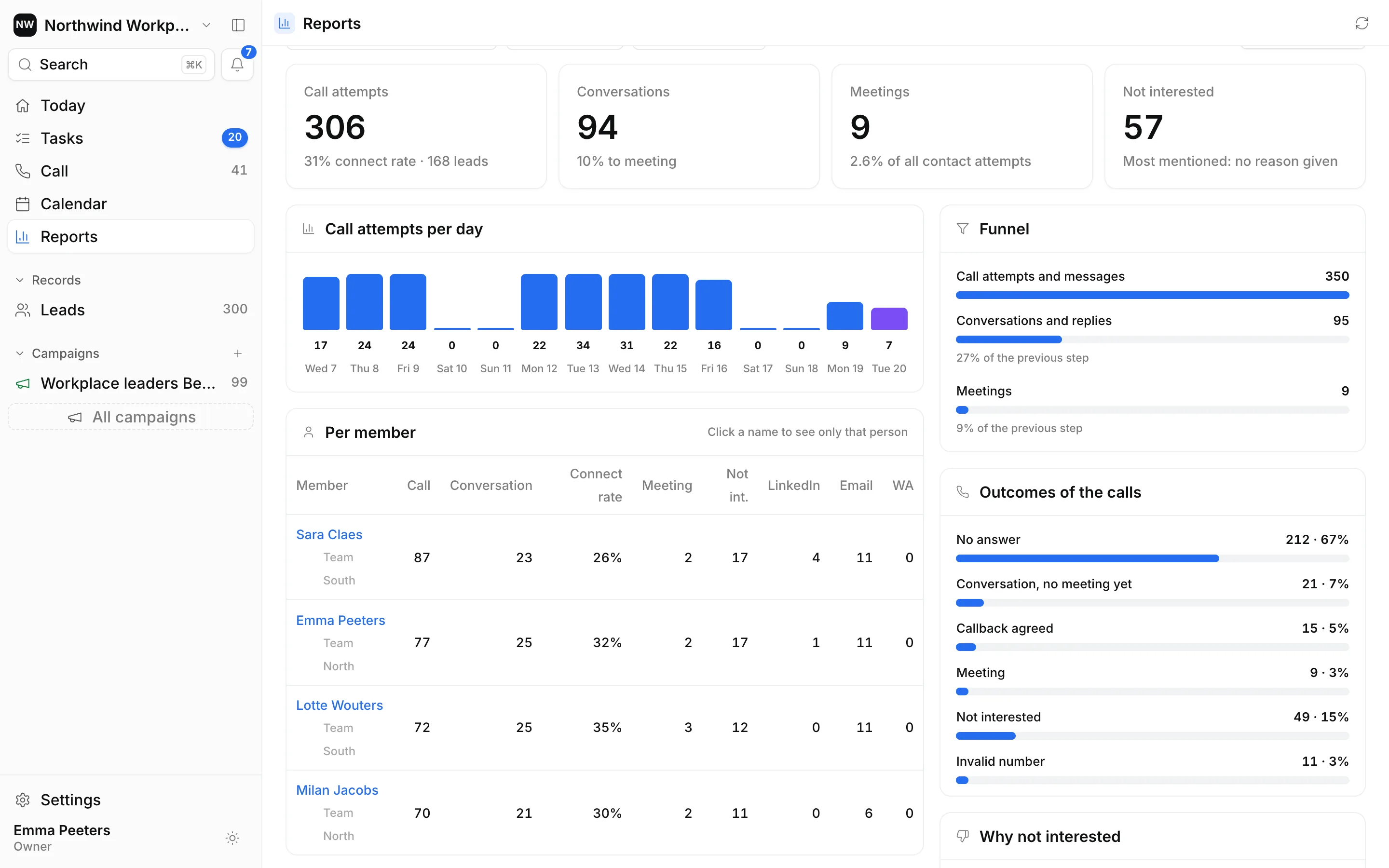
Your numbers, per caller and campaign
Call attempts, connect rate, conversations, meetings, the funnel and the reasons for "not interested", per person, team and campaign.
In this industry: Compare connect rates and demos per SDR and per segment, and read the reasons for not interested to see which profile or which message does not land.
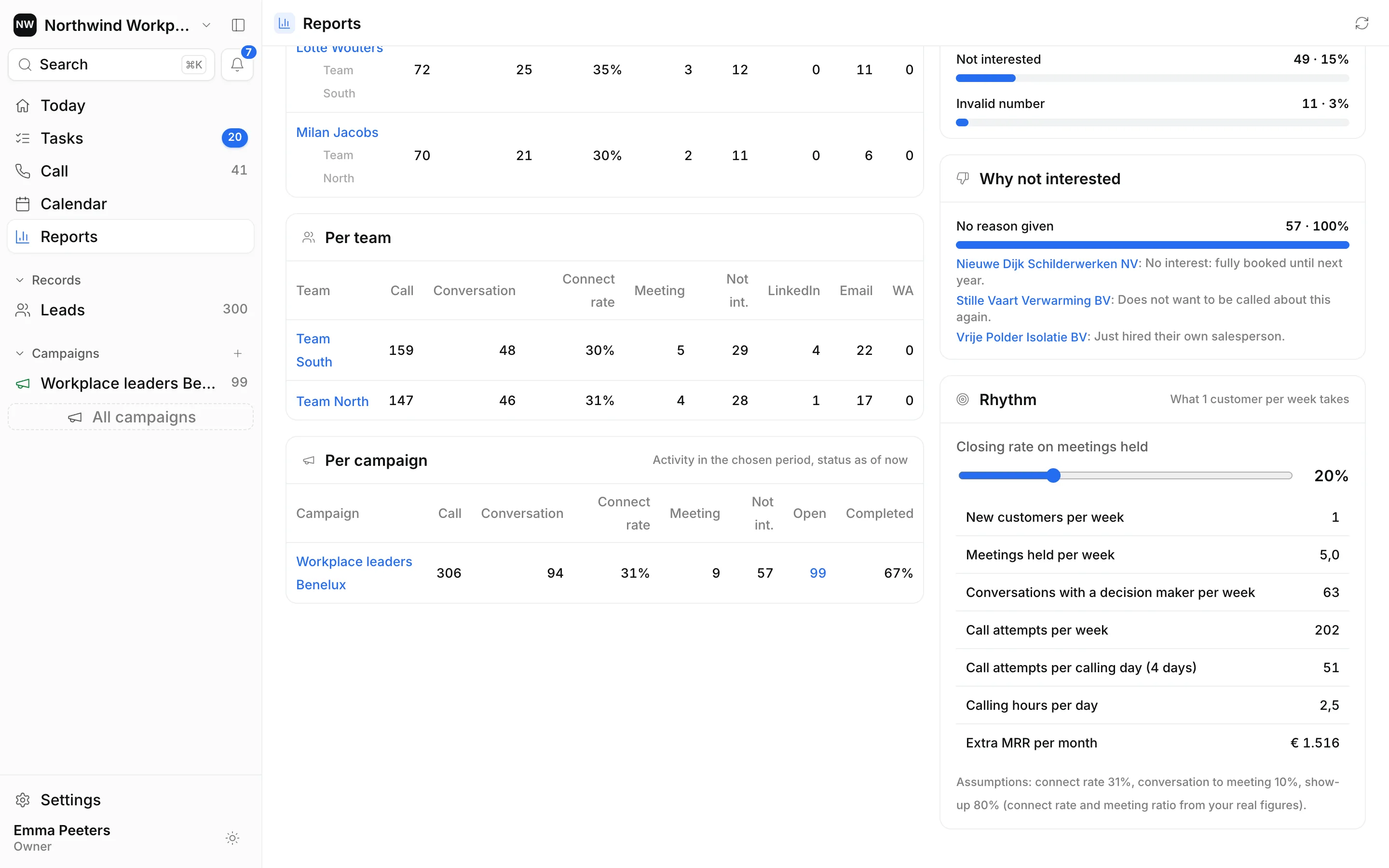
What one new customer takes
Based on your own rates, Ringlane calculates how many calls per week and per day one new customer per week takes.
In this industry: Fill in your own connect, demo and close rates and see how many dials per week one new customer per week takes, a number you can plan SDR capacity on.
Real screens from the Ringlane app with demo data. No affiliation with the companies shown.
What it can bring you: efficiency, money and more
SaaS revenue compounds, so every extra customer won by an SDR team keeps paying. The table below is an example with assumed numbers, not a forecast. Replace every figure with your own funnel.
| Example with assumed numbers: one SDR, one month | Value |
|---|---|
| Call attempts | 600 |
| Conversations with a decision maker (assumed 20%) | 120 |
| Demos booked (assumed 12% of conversations, rounded) | 14 |
| New customers (assumed 20% of demos, rounded) | 3 |
| Value of one customer (assumed 6,000 euro per year over three years) | 18,000 euro |
In this example, one SDR month yields about 54,000 euro in contract value over three years. Your own rates decide whether the real figure is higher or lower, so measure them. The jump from conversation to demo is often where most value is lost: see how to ask for the meeting.
Efficiency is measurable too. Track for a week how long SDRs spend after each call on notes, CRM fields and finding the next date. Logging the outcome with one key and having the next step planned keeps SDRs on the phone. Setting the demo while the prospect is still on the line keeps the gap short and the purpose fresh; see how to reduce meeting no-shows.
Want to see the calling screen first? Try the demo.
Frequently asked questions
Does cold calling work for SaaS in Belgium and the Netherlands?
Who should an SDR call at a prospect?
How many companies in Belgium and the Netherlands already buy cloud software?
What is a good reason to call a software prospect?
How do I reduce no-shows for booked demos?
Sources
- Eurostat: Cloud computing, statistics on the use by enterprises (Statistics Explained)
- Eurostat: Cloud computing services by size class of enterprise (dataset isoc_cicce_use, 2025)
- CBS: Digitalisering en kenniseconomie 2025, summary
- CBS StatLine: Bedrijven; bedrijfstak (table 81589NED)
- Computable: Belgische ict-sector krimpt en floreert (Agoria figures for 2024, 29 January 2025)
- VRT NWS: Peppol e-invoicing obligation from 1 January (4 December 2025)
All industries
- Accounting firms
- Business events and venues
- Business finance
- Commercial cleaning
- Commercial real estate
- Commercial solar and energy
- Consultancy
- Corporate catering
- Corporate training
- Fleet, leasing and EV charging
- HR and payroll services
- HVAC and building services
- Industrial manufacturing
- Insurance brokers
- IT services and MSPs
- Logistics and transport
- Marketing agencies
- Office furniture and workplace
- Printing and packaging
- Recruitment and staffing
- Security services
- Telecom and connectivity
- Wholesale and distribution
- Workwear and PPE