Stop waiting for referrals: book your own new client meetings
For marketing, digital and communication agencies in Belgium and the Netherlands: who to call, which moments make an agency call welcome, and how to follow up without becoming one more agency in the inbox.
Most agencies grow on referrals and on the network of the founder. That works until it stops: a big client leaves, the network is used up, and the pipeline is empty. Agencies sell growth to others but often have no steady new business process of their own. A few fixed hours of calling per week, with planned follow-up, can give an agency a pipeline it controls.
The market: thousands of agencies, most of them very small
Competition is intense. According to Eurostat business statistics for 2023, Belgium had 8,546 enterprises in advertising and market research and the Netherlands 33,462. Most are one-person businesses: 7,321 in Belgium and 27,875 in the Netherlands had zero or one person employed. Only 241 Belgian and 822 Dutch enterprises in this group had 10 or more people. The same Eurostat series counts 19,687 persons employed in Belgium and 65,769 in the Netherlands.
PR and communication agencies fall under a separate activity code, and in the Netherlands their number grew fast. The Dutch chamber of commerce KVK reported 9,526 PR and communication agencies on 1 January 2022, up 142% from 3,934 two years earlier, with 82% of them sole traders.
The budget is there, especially online. An analysis of IAB Europe figures reported by Emerce puts Dutch online advertising spend at €4.761 billion in 2025, up from €2.255 billion in 2019. The catch: prospects are approached by agencies all the time. In a Gartner survey of 632 B2B buyers, 73% said they actively avoid suppliers who send irrelevant outreach. Relevance is the price of entry.
How decisions are made depends on size. At small and mid-sized companies, the owner or commercial director picks the agency, often after one or two conversations. Larger companies have a marketing manager or head of marketing, sometimes run a pitch with several agencies, and involve purchasing for larger retainers.
Who you call and what you ask
- Owner or managing director: at smaller companies, decides on marketing spend and agencies.
- Commercial director or sales manager: cares about leads and revenue, often the easiest door for performance marketing.
- Marketing manager or head of marketing: owns the plan, the budget and the agency relationships.
- Brand, digital or e-commerce lead: at larger companies, the specialist who briefs the agency.
Trigger events: a new marketing manager, a rebrand or name change, a website relaunch, a product launch, a new market or new location, growth funding, a vacancy in the marketing team, and campaigns that disappoint.
Discovery questions that work for agencies:
- What should marketing deliver for you this year: leads, brand, sales in a new market?
- What do you do in-house, and what do you hand to an agency today?
- Which launch or project is coming up in the next six months?
- What would make you look at another agency?
- Who else is involved when you choose an agency?
A first sentence that works
Open with something you noticed about them. For example: "I am calling because I saw you are opening a second location this spring, and I wanted to ask how you plan to fill it with customers." It proves you did your homework and puts their goal first. If the answer is "we already have an agency", ask what that agency does for them and what they would add if they could; many companies use more than one partner. Send one case that matches their situation afterwards, not your full portfolio. A short, relevant follow-up is what separates you from the other agencies in their inbox.
Your first sentence decides whether you get to ask them; see cold call opening lines.
What slows a calling team down in this sector
- Everyone sounds the same. Prospects hear from agencies every week. A call about their situation, not your services, makes the difference.
- "We already have an agency" or "we do it in-house". Common, and often only half true. Prepared answers help; see how to handle sales objections.
- Billable work comes first. In an agency, client work always wins over new business. Fixed call blocks protect the time.
- Pitches and long decisions. Larger clients compare several agencies, which stretches the cycle.
- Marketing managers in meetings. Several attempts per lead are normal; plan the call back at the time they name.
How Ringlane works for marketing agencies
Real screens from the app, with what each feature does in this industry.
Your lists, in one place
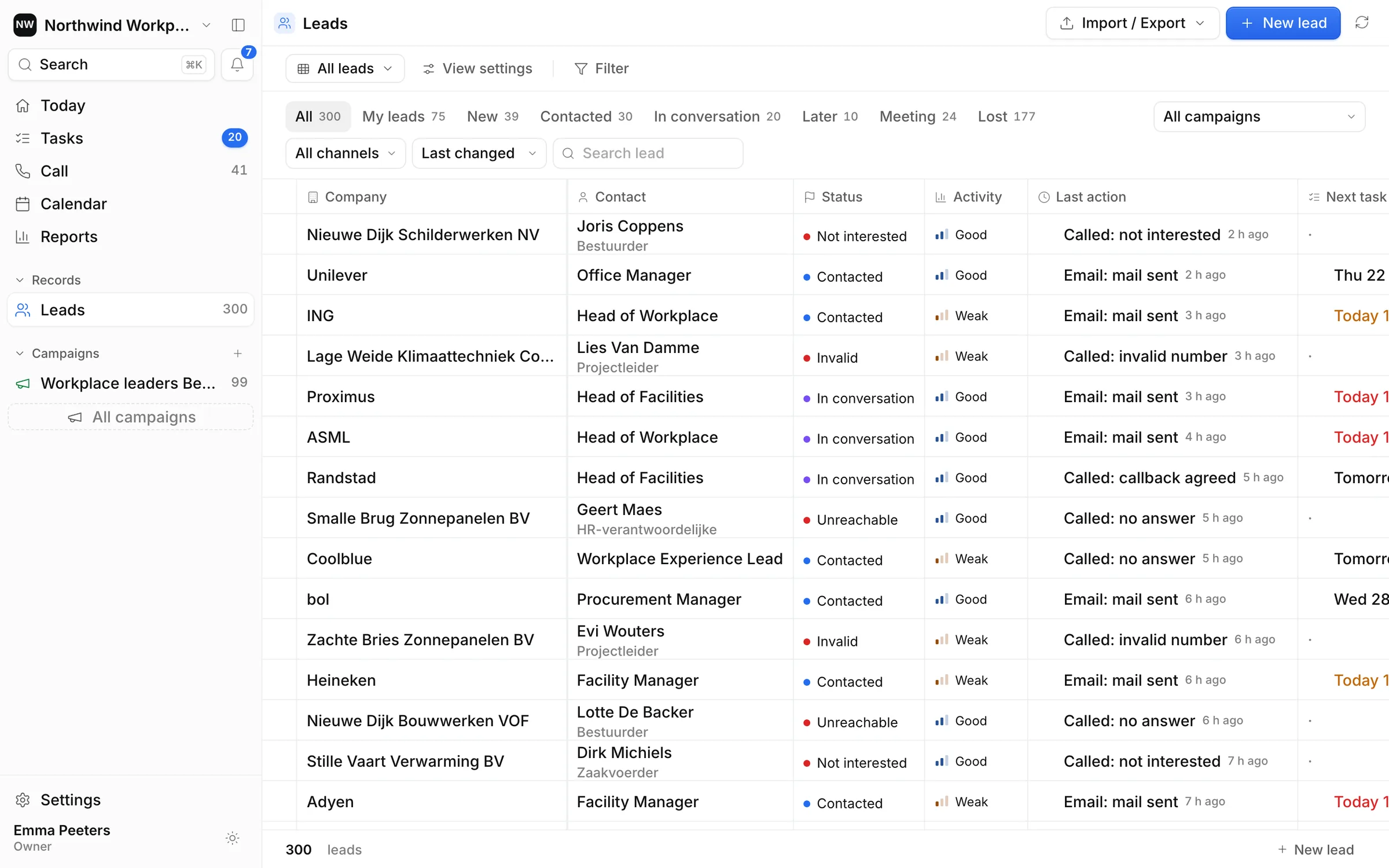
Import Excel, CSV or a Bizzy export into a campaign. Every lead shows its status, last action and next task.
In this industry: Import a Bizzy export of companies in your niche and region into a campaign per service, for example websites or paid ads, so you see which prospects you have not called yet and which are waiting for a follow-up.
One screen for the call
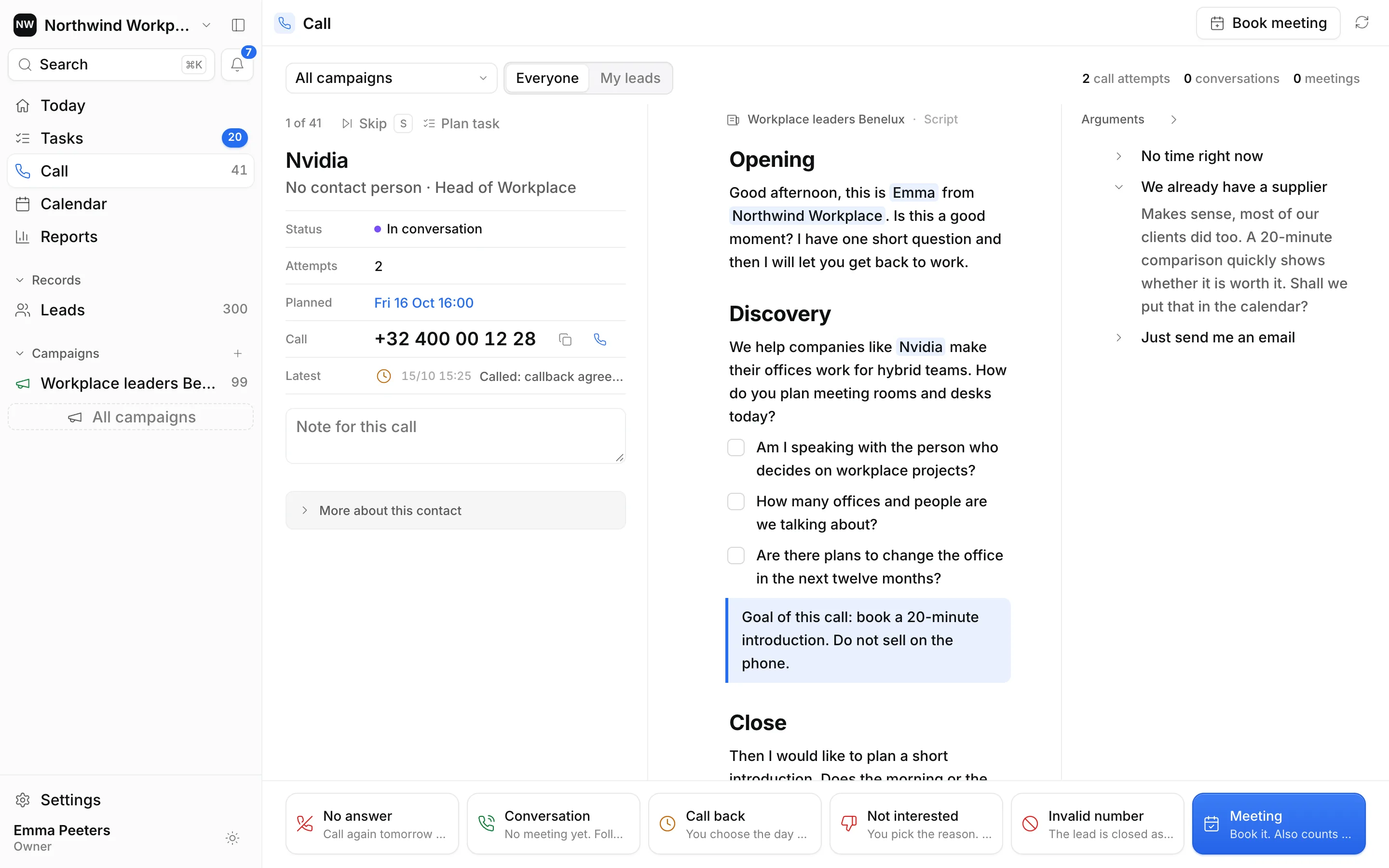
The lead on the left, the script in the middle with the company name and your own name filled in. Click the number to call from your own phone.
In this industry: Put the questions about current agency, in-house team, goals and the next launch in the script, and fill in the company name, so every call sounds prepared and not like a mass pitch.
The answer to every objection
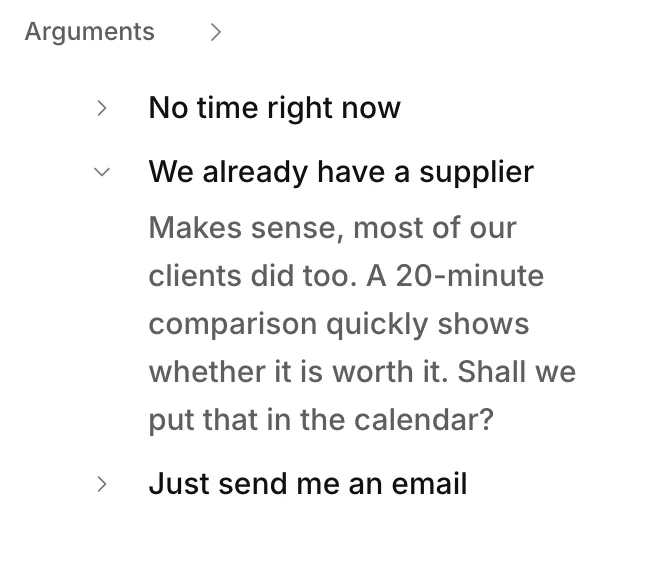
Common objections sit in a panel next to the script, so the right answer is one click away.
In this industry: Keep the answers to "we already have an agency", "we do it in-house" and "send me your cases" next to the script, so a caller can ask a sharper question instead of giving up.
One key per call, the next step planned
N (not reached) plans a new attempt the next working day, G (conversation) a follow-up call in three days, T (call back) the moment you pick. A records a meeting; X (not interested, with a reason) and O (invalid number) close the lead.
In this industry: Marketing managers live in meetings. N plans the next attempt for the next working day, T lets you call back at the time they name, and X with a reason shows why prospects say no.

Follow-up on every channel
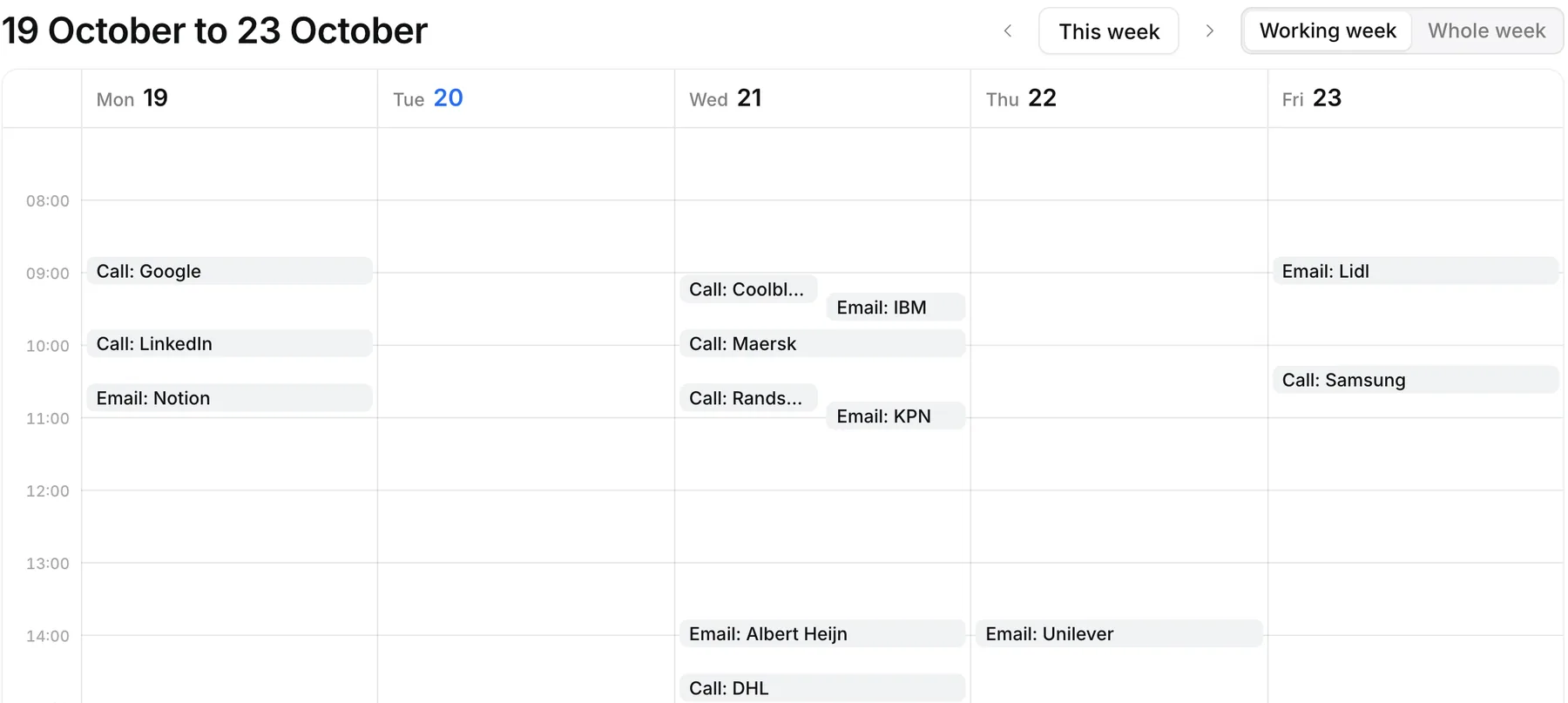
Calls and emails land in your week. You write emails in Ringlane and send them from your own Gmail; LinkedIn and WhatsApp you send yourself and log by hand. The Today view puts overdue call-backs first.
In this industry: After a conversation, send the one case that fits from your own Gmail and see it next to the call history, then follow up by LinkedIn and log that by hand on the lead.
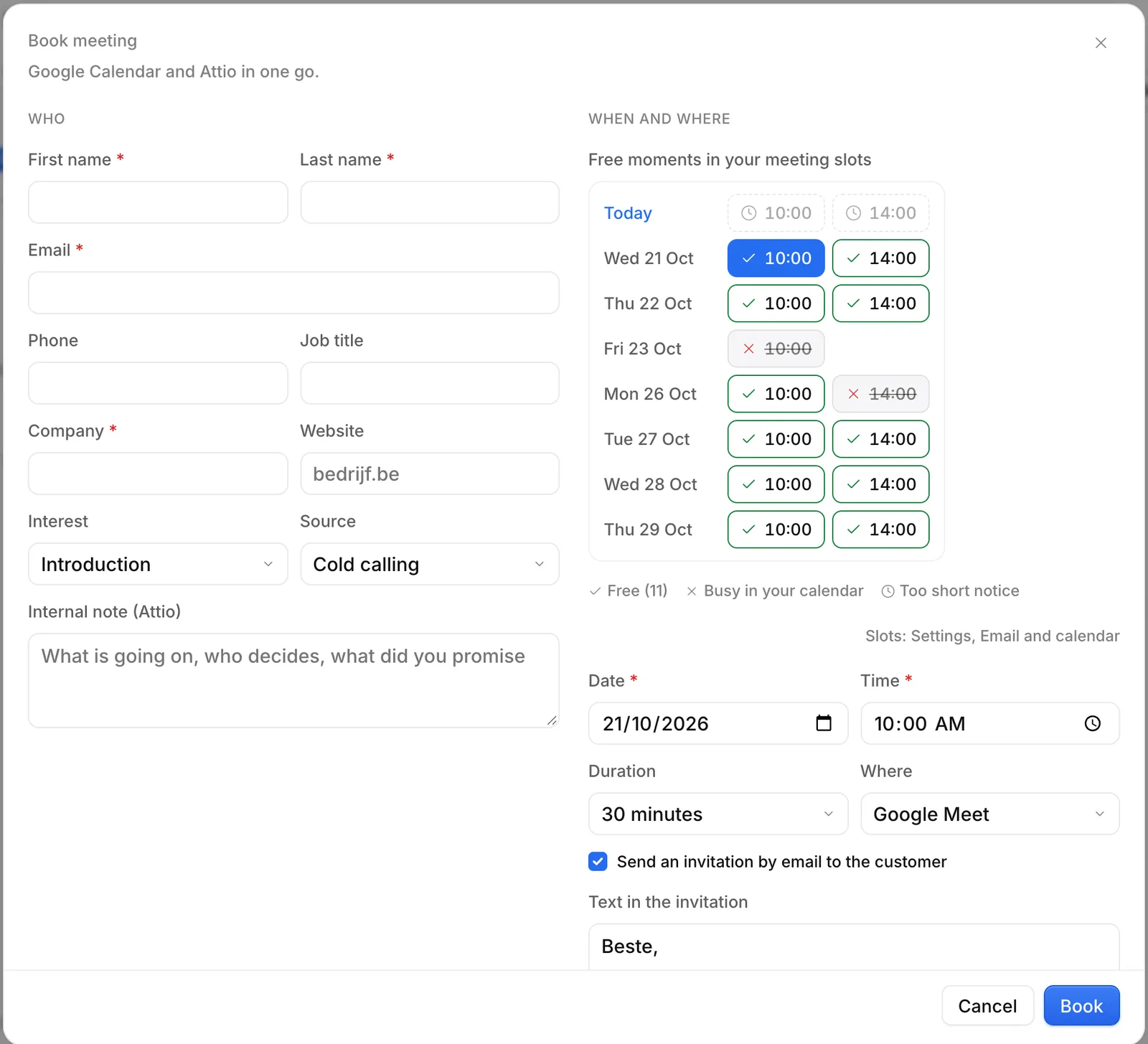
Book while they are on the line
Ringlane shows your free moments in Google Calendar, adds a Google Meet link and sends the invitation. Booked meetings go to Attio.
In this industry: When a marketing manager agrees to a short intro call, pick a free moment in Google Calendar, add a Meet link and send the invitation before you hang up.
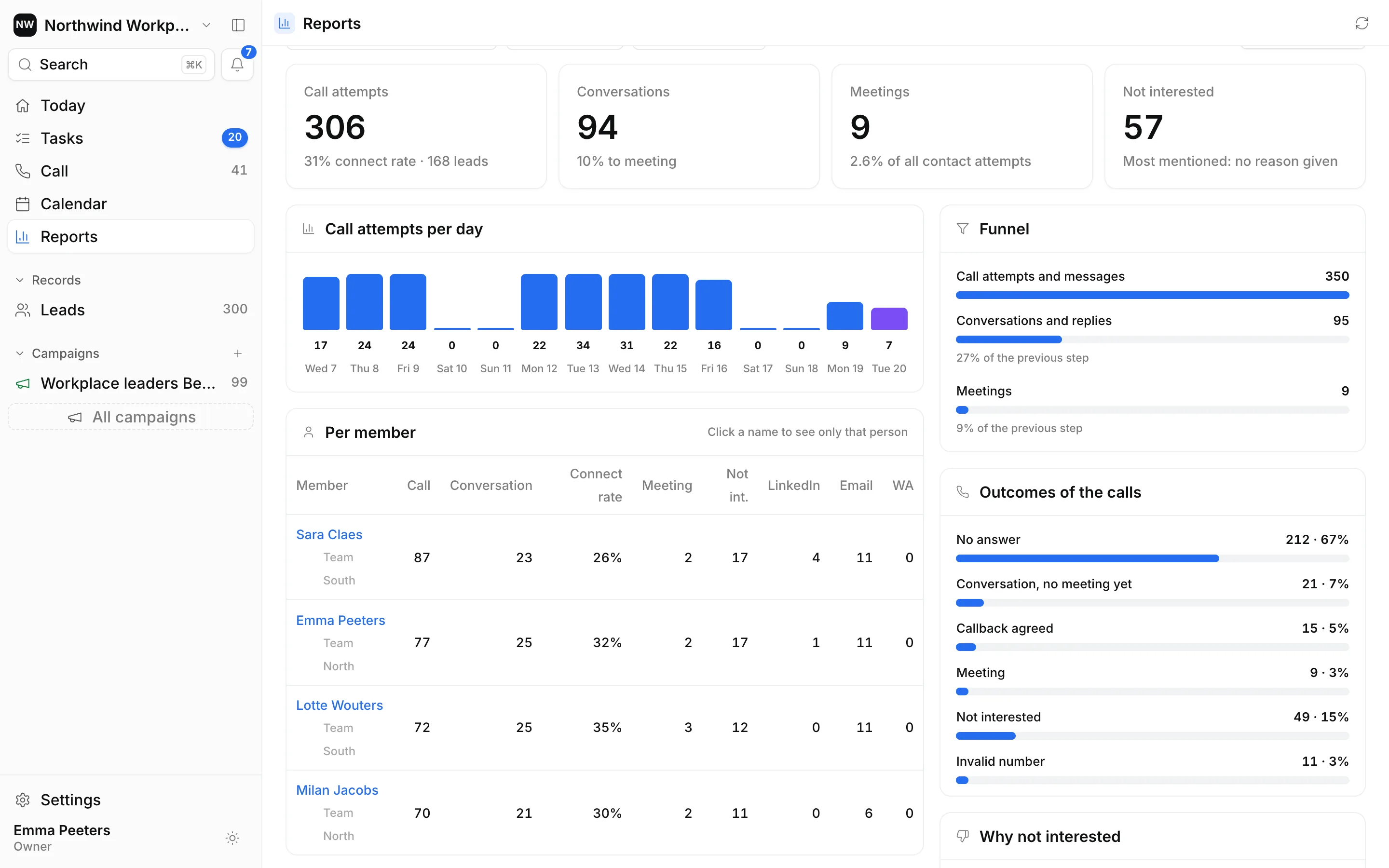
Your numbers, per caller and campaign
Call attempts, connect rate, conversations, meetings, the funnel and the reasons for "not interested", per person, team and campaign.
In this industry: Compare campaigns per service or niche and per caller, and see where the funnel breaks: at reaching people, at the conversation, or at booking the meeting.
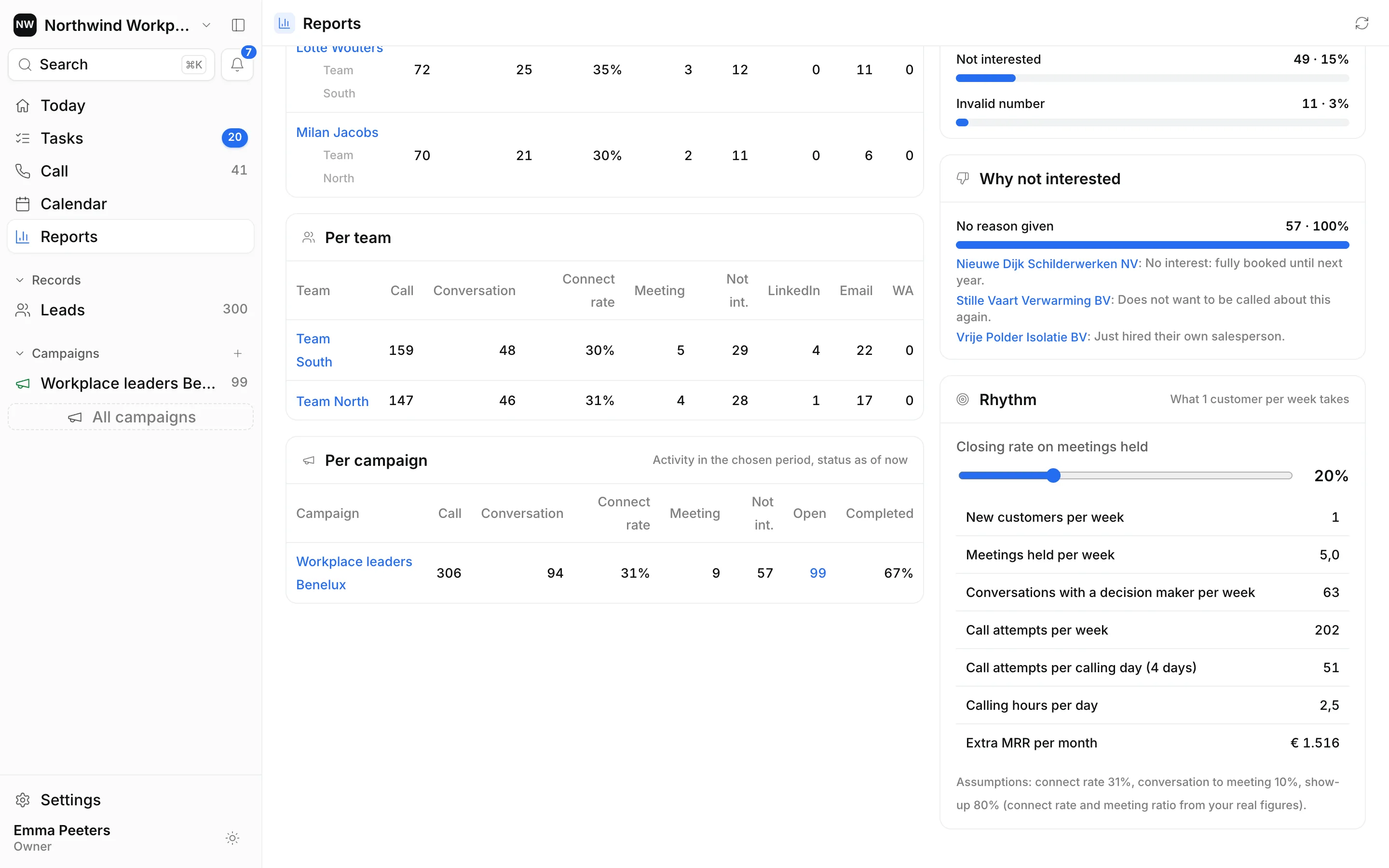
What one new customer takes
Based on your own rates, Ringlane calculates how many calls per week and per day one new customer per week takes.
In this industry: Fill in your own rates and see how many calls per week one new client per week takes, so the agency owner can plan new business hours next to billable work.
Real screens from the Ringlane app with demo data. No affiliation with the companies shown.
What it can bring you: efficiency, money and more
One retainer client can carry an agency for years. The table below is an example with assumed numbers, not a forecast. It assumes the owner or a new business person makes 400 call attempts a month, and a new client pays an assumed retainer of €3,000 per month, €36,000 per year.
| Step (example, assumed rates) | Assumed rate | Per month |
|---|---|---|
| Call attempts | 400 | |
| Conversations with a decision maker | 20% of attempts | 80 |
| Intro meetings | 10% of conversations | 8 |
| New clients | 20% of meetings | 1 to 2 |
| Assumed value per new client | €36,000 per year |
Your rates will differ. What you can measure is which service or niche turns conversations into meetings, and which reasons for not interested keep coming back, so you can sharpen the offer.
The efficiency gain matters most where every hour is billable. When each call ends with one key and the next attempt or follow-up call is planned for you, a calling block is spent calling, not updating spreadsheets. If logging and planning take a minute per call today, 400 calls is close to seven hours a month. Measure your own time before and after, and try the flow in the demo.
Frequently asked questions
Does cold calling work for marketing agencies?
Who should an agency call at a prospect?
How many agencies are there in Belgium and the Netherlands?
When is a good moment to call a prospect?
Does Ringlane send emails or LinkedIn messages for me?
Sources
- Eurostat: Enterprises by size class and NACE Rev.2 activity (sbs_sc_ovw), 2023
- Eurostat: Enterprises by detailed NACE Rev.2 activity and special aggregates (sbs_ovw_act), 2023
- KVK: Aantal public relations (PR) en communicatiebureaus zeer snel toegenomen (5 May 2022)
- Emerce: Uitgaven aan online reclame sinds 2019 meer dan verdubbeld (Citable analysis of IAB Europe AdEx, July 2026)
- MarketScreener: Gartner Sales Survey Finds 61% of B2B Buyers Prefer a Rep-Free Buying Experience (Gartner press release, June 2025)
All industries
- Accounting firms
- Business events and venues
- Business finance
- Commercial cleaning
- Commercial real estate
- Commercial solar and energy
- Consultancy
- Corporate catering
- Corporate training
- Fleet, leasing and EV charging
- HR and payroll services
- HVAC and building services
- Industrial manufacturing
- Insurance brokers
- IT services and MSPs
- Logistics and transport
- Office furniture and workplace
- Printing and packaging
- Recruitment and staffing
- SaaS and software
- Security services
- Telecom and connectivity
- Wholesale and distribution
- Workwear and PPE