Reach fleet decision makers before their next car policy is set
For lease companies, fleet service providers and EV charging installers in Belgium and the Netherlands: who decides on company cars and charging points, which deadlines make a call relevant, and how to keep long cycles moving.
Company cars and charging points are bought on a cycle. Lease contracts run for years, car policies are revised once in a while and charging decisions wait for the building owner, the budget or a deadline. A calling team that knows those dates, and calls back exactly when a contract or a rule comes up, has a real advantage over one that calls whoever is next on the list.
The market: large fleets, going electric, on long contracts
In the Netherlands, the VNA counted a total lease fleet of 1.37 million vehicles at the end of 2025, up just 0.3%. Of those, 873,500 were business leased cars, 241,800 private lease cars and 256,600 vans. The VNA calls 2025 a year of stabilisation after four years of growth. Plug-in cars are now the majority of the business fleet: 43% are fully electric and another 11% are plug-in hybrids. Newly signed business contracts ran 48 months on average.
In Belgium, members of the leasing federation Renta manage more than 540,000 vehicles in long-term rental, according to figures reported in April 2026. Renta members also operate 195,990 fully electric cars, or 51% of all electric cars in Belgium, according to figures published in November 2025. Company fleets are where electrification happens, and that drives demand for charging at offices and at home.
Tax rules set the pace. According to Securex, Belgian zero emission company cars acquired in 2026 are 100% deductible, dropping to 95% for 2027, 90% for 2028, 82.5% for 2029, 75% for 2030 and 67.5% for 2031. In the Netherlands, the taxable benefit for an electric company car first registered in 2026 is 18% on the first 30,000 euro of list price and 22% above that. These rules are summarised as general information, not legal or tax advice; check the current rules for your customers.
Who you call and what you ask
A company car is equipment, a salary component and a building question at the same time. That is why several people are involved:
- Fleet manager or office manager: runs the fleet, contracts and damage, and feels every problem first.
- HR or compensation and benefits manager: owns the car policy, because the car is part of pay.
- CFO or owner: signs, and watches deductibility and total cost.
- Facility manager or building owner: decides on charging points in the car park.
Moments that make a call relevant:
- Deductibility steps in Belgium. Each new year lowers the deduction for zero emission cars acquired that year. Orders planned around year end are a natural topic.
- Charging obligations. In Flanders, existing non-residential buildings with more than 20 parking spaces had to have at least two charging points by 1 January 2025. In the Netherlands, such buildings need at least one charging point, and from 1 January 2027 one per 10 spaces, or ducting for at least half of the spaces.
- Contract end dates. With 48 month contracts, part of every fleet comes up for renewal each year.
- Hiring, a move or a new site. New employees with a car, or a new car park, mean new decisions.
Discovery questions that work in this sector:
- How many cars and vans do you have, and how many are fully electric today?
- When does your next batch of lease contracts end?
- Who writes the car policy, and when was it last changed?
- Where do your drivers charge now: at home, at the office or on the road?
- How many parking spaces does your building have, and who owns the building?
For a structure that keeps these questions short, see how to define your ideal customer profile and pick the fleet sizes worth calling first.
What slows a calling team down in this sector
- Framework contracts. Larger companies have a preferred lessor and sometimes a tender every few years. You call to get on the list for the next round, not to win this week.
- Decisions spread over HR, finance and facilities. The person you reach is rarely the person who signs. Without notes on who is who, the second call starts from scratch.
- Rules that change. Tax and building rules shift every year. Callers need short, checked answers, not guesses.
- Building ownership. Tenants often cannot decide on charging points. You need the owner or the property manager too.
- Long gaps. A fleet manager who is interested in spring may only decide when contracts end next year. A lead without a planned follow-up is lost.
How Ringlane works for fleet, leasing and EV charging companies
Real screens from the app, with what each feature does in this industry.
Your lists, in one place
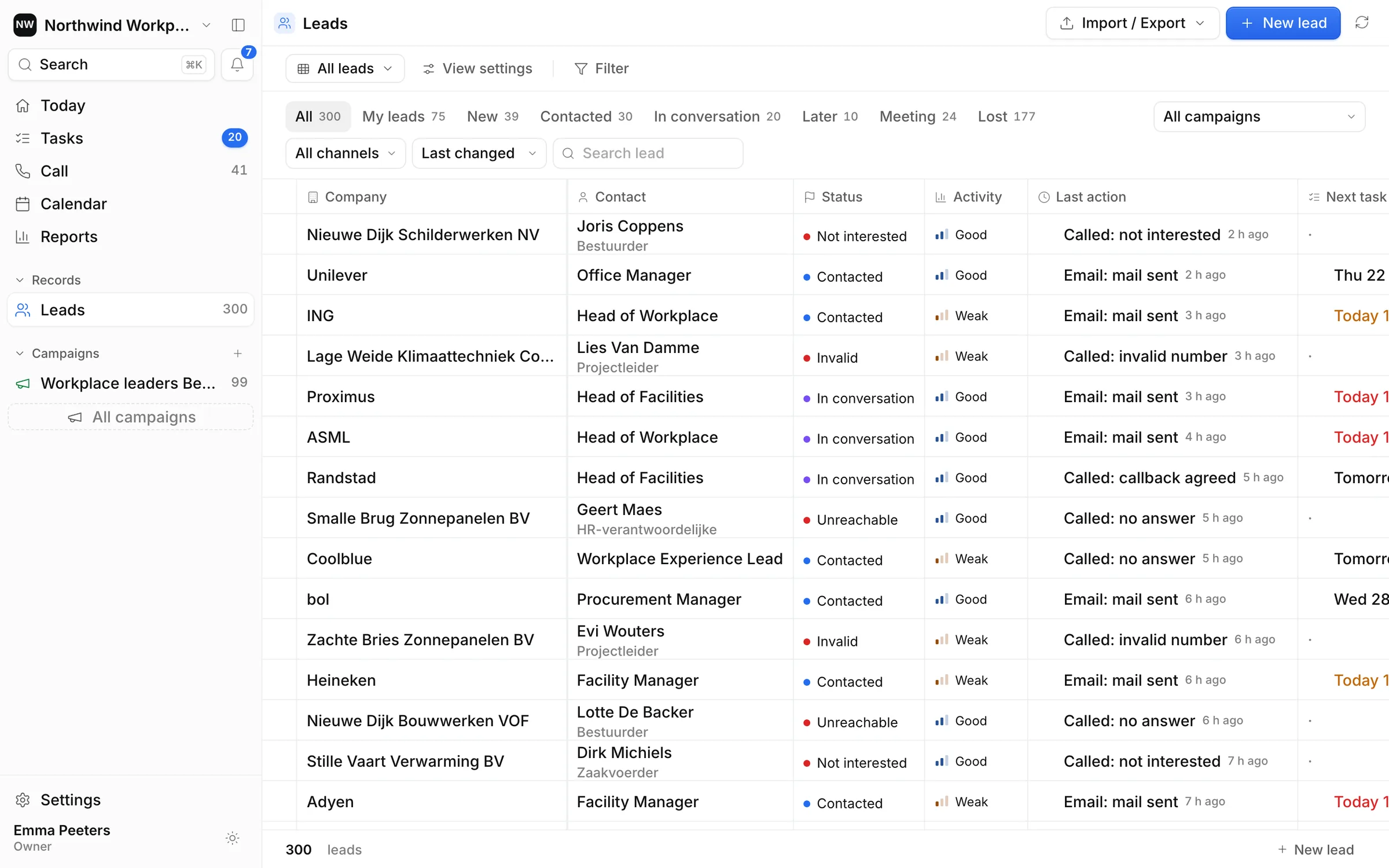
Import Excel, CSV or a Bizzy export into a campaign. Every lead shows its status, last action and next task.
In this industry: Split your Bizzy export into campaigns by size and region, for example companies with 20 to 200 employees, so a caller for charging points and a caller for leasing each work their own list.
One screen for the call
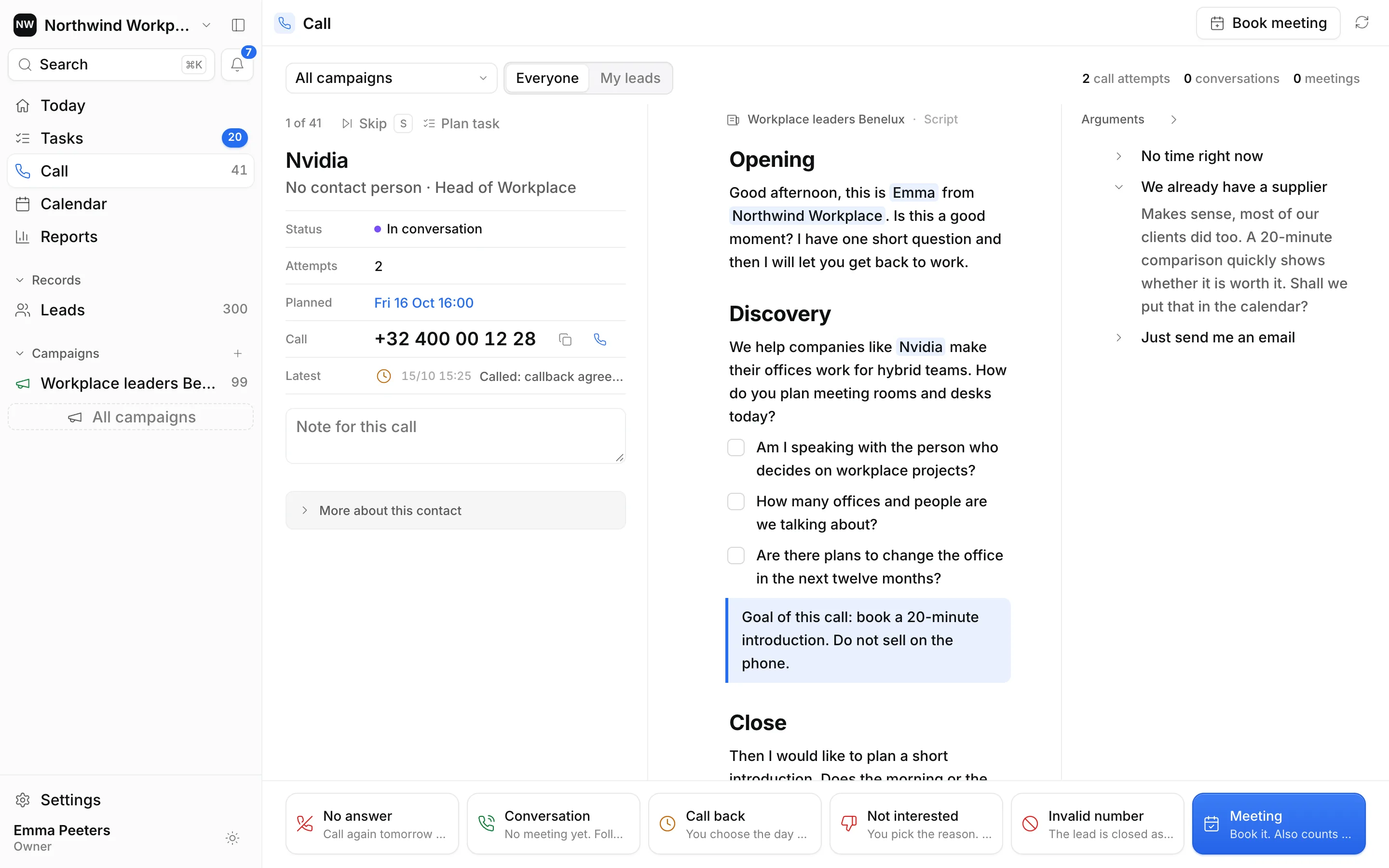
The lead on the left, the script in the middle with the company name and your own name filled in. Click the number to call from your own phone.
In this industry: Put the questions about fleet size, share of electric cars, contract end dates and number of parking spaces in the script, so every caller asks them.
The answer to every objection
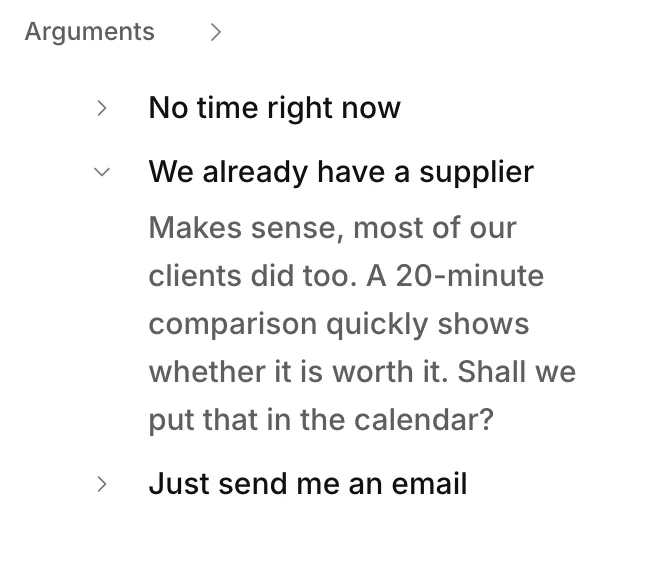
Common objections sit in a panel next to the script, so the right answer is one click away.
In this industry: Keep answers ready to "we are tied to our lessor until 2028", "our building owner decides on charging" and "HR handles the cars", each ending in a question about who decides and when.
One key per call, the next step planned
N (not reached) plans a new attempt the next working day, G (conversation) a follow-up call in three days, T (call back) the moment you pick. A records a meeting; X (not interested, with a reason) and O (invalid number) close the lead.
In this industry: Fleet and facility managers are often in meetings or on the road. N plans a new attempt the next working day; T lets you call back at the time they name.

Follow-up on every channel
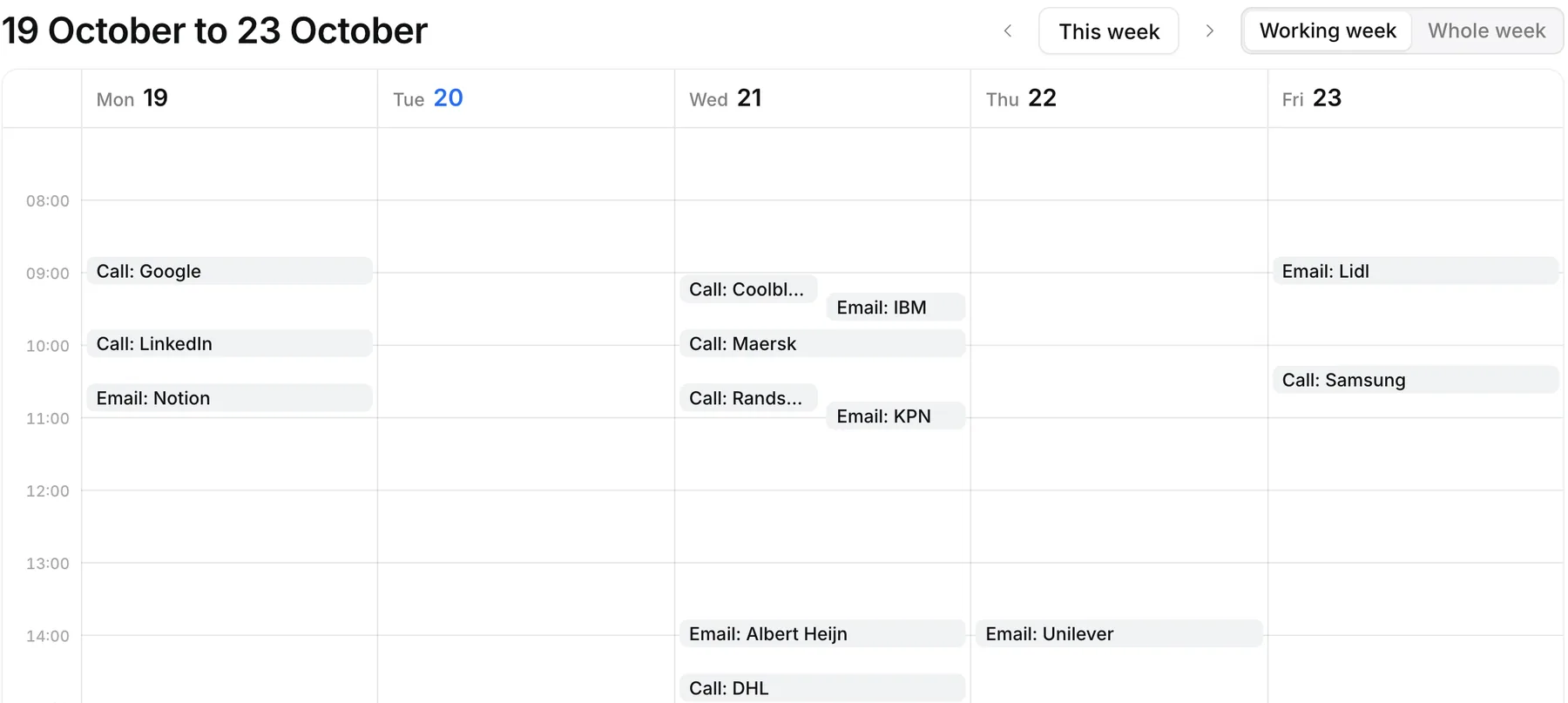
Calls and emails land in your week. You write emails in Ringlane and send them from your own Gmail; LinkedIn and WhatsApp you send yourself and log by hand. The Today view puts overdue call-backs first.
In this industry: After a conversation, send a short note on the 2027 deductibility step or the Dutch charging point rule from your own Gmail, and see it in the lead history so a colleague knows what was sent.
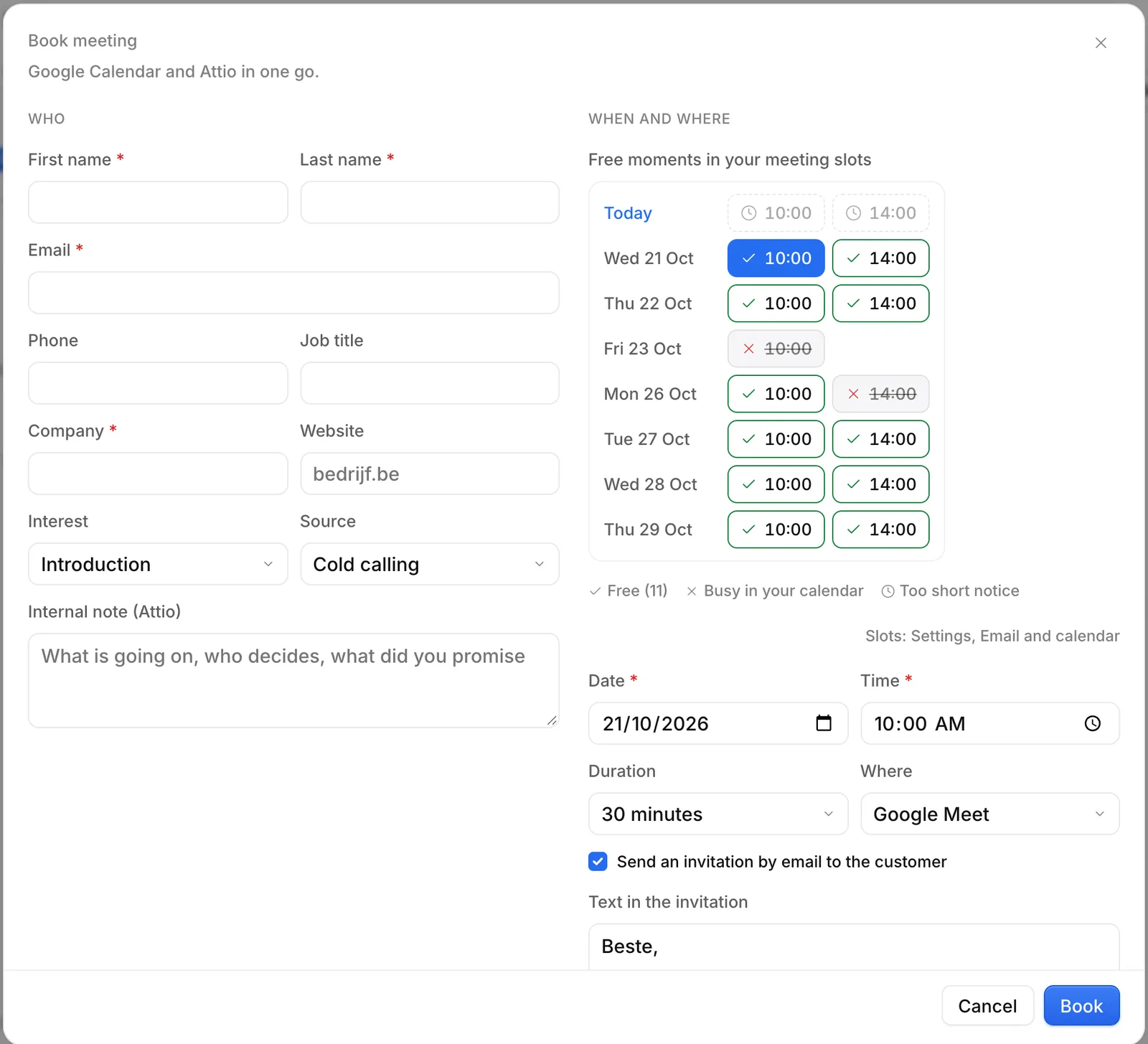
Book while they are on the line
Ringlane shows your free moments in Google Calendar, adds a Google Meet link and sends the invitation. Booked meetings go to Attio.
In this industry: When a fleet manager agrees to a car policy review or a site visit for charging points, book it in Google Calendar with a Meet link during the call; the meeting goes to Attio.
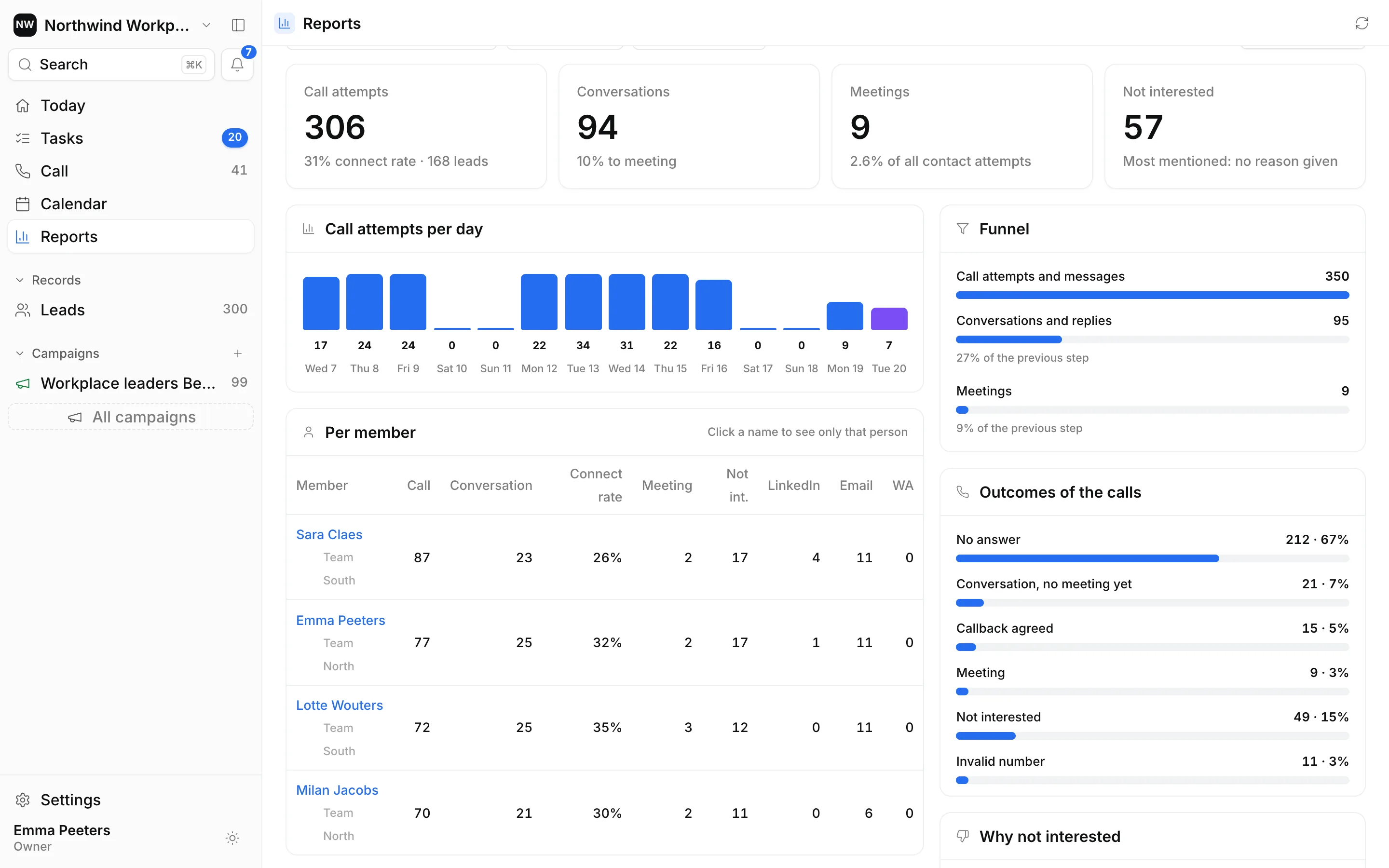
Your numbers, per caller and campaign
Call attempts, connect rate, conversations, meetings, the funnel and the reasons for "not interested", per person, team and campaign.
In this industry: Compare the leasing campaign with the charging campaign and read the reasons for not interested. If "contract runs another two years" dominates, log that answer next time as a call back (T) at the contract end date, not as not interested.
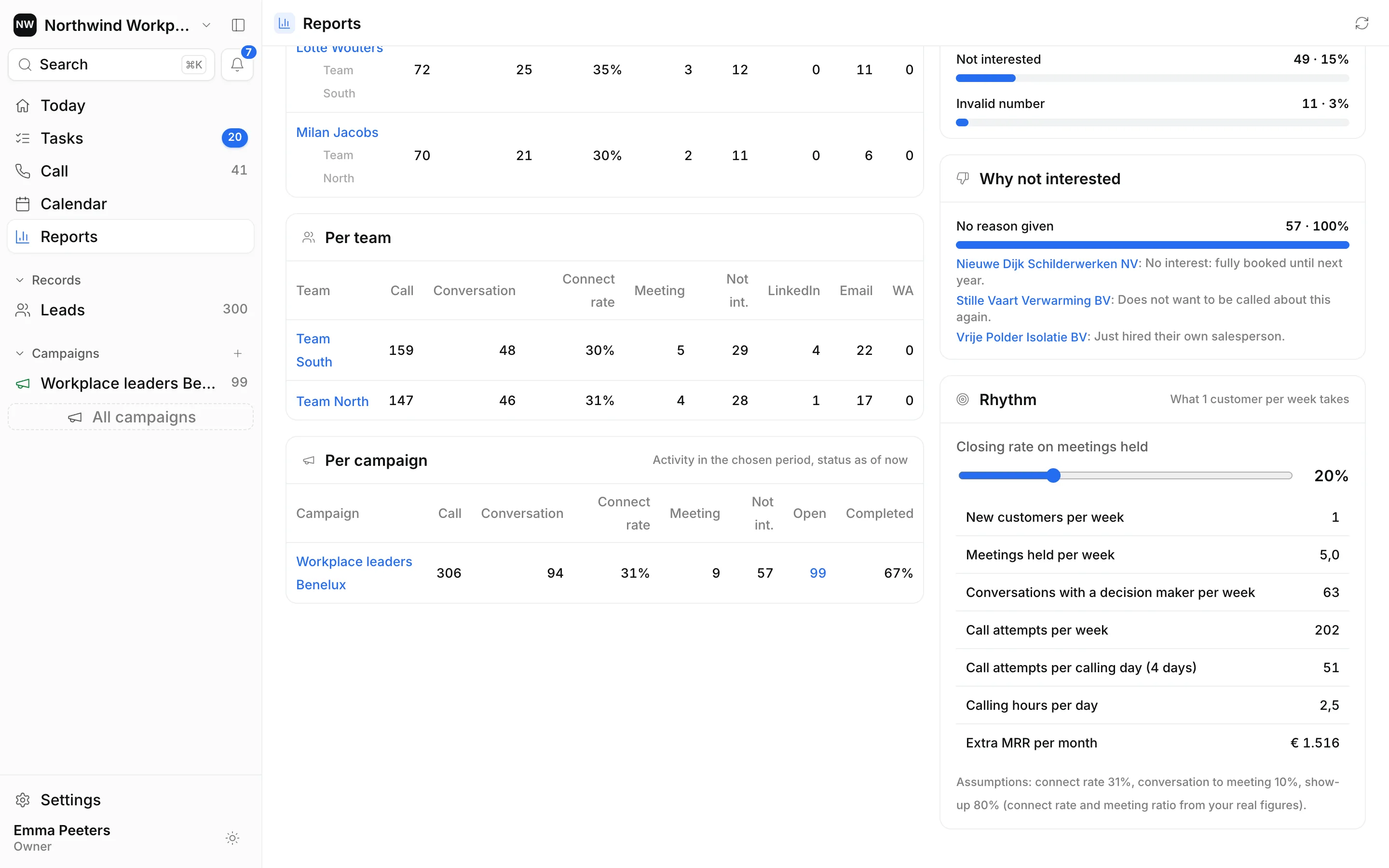
What one new customer takes
Based on your own rates, Ringlane calculates how many calls per week and per day one new customer per week takes.
In this industry: Enter your own connect and meeting rates and see how many calls per week one new fleet or charging customer per week takes, so targets match long buying cycles.
Real screens from the Ringlane app with demo data. No affiliation with the companies shown.
What it can bring you: efficiency, money and more
A fleet or charging customer is usually worth a lot over the contract, so a few extra customers a quarter make a difference. The table below is an example with assumed numbers, not a forecast. Replace every figure with your own.
| Example with assumed numbers: one caller, one month | Value |
|---|---|
| Call attempts | 400 |
| Conversations with a decision maker (assumed 25%) | 100 |
| Meetings or site visits booked (assumed 8% of conversations) | 8 |
| New customers (assumed 25% of meetings) | 2 |
| Value of one customer (assumed gross margin of 15,000 euro over a 48 month contract or one charging project) | 15,000 euro |
In this example, two new customers a month are worth 30,000 euro in gross margin. The 48 months match the VNA average for new business contracts; the margin is an assumption. Your own numbers will differ, which is why it pays to measure them. See how many calls it takes to win one customer.
Efficiency is the other half. Measure for one week how much time your team spends after each call on notes, looking up contract dates and deciding when to call back. Logging the outcome with one key, with the next call already planned, takes most of that away. It also means a lead whose contracts end in ten months is in the calendar, not in someone's memory. Read how to follow up leads for a cadence that fits long cycles.
Want to see the calling screen first? Try the demo.
Frequently asked questions
Who decides on company cars at a mid-sized company?
Is the Belgian deductibility schedule a good reason to call?
Do Dutch office buildings have to install charging points?
How long do lease contracts run in the Netherlands?
How many calls does it take to win a fleet or charging customer?
Sources
- VNA: Autoleasemarkt in cijfers 2025 (April 2026)
- NewMobility: Private lease rises in Belgium, but ownership myth remains (Renta, 16 April 2026)
- NewMobility: Renta, half of Belgium's EVs are company leased (7 November 2025)
- Securex: Fiscale aftrekbaarheid van bedrijfswagens, wat verandert op 1 januari 2026 (4 December 2025)
- MKB Servicedesk: Elektrische auto, bijtelling in 2026
- Vlaanderen.be: Verplichtingen voor laadpunten bij parkings
- Ondernemersplein: Verplichte laadpalen op bedrijfsparkeerplaats
All industries
- Accounting firms
- Business events and venues
- Business finance
- Commercial cleaning
- Commercial real estate
- Commercial solar and energy
- Consultancy
- Corporate catering
- Corporate training
- HR and payroll services
- HVAC and building services
- Industrial manufacturing
- Insurance brokers
- IT services and MSPs
- Logistics and transport
- Marketing agencies
- Office furniture and workplace
- Printing and packaging
- Recruitment and staffing
- SaaS and software
- Security services
- Telecom and connectivity
- Wholesale and distribution
- Workwear and PPE