Talk to businesses when their contract, copper line or office changes
For business telecom resellers, VoIP and connectivity providers in Belgium and the Netherlands: who to call, which moments make switching realistic, and how to follow up until the move is signed.
Every business already has a phone and internet provider, and most owners have heard telecom sales pitches before. They switch when a contract ends, when they move or grow, when service fails, or when a technology change forces them to. A calling team in business telecom wins by knowing those dates, asking good questions and calling back exactly when the window opens.
The market: a few large networks, many resellers
According to Eurostat, Belgium had 1,347 telecommunications enterprises (NACE 61) in 2024, employing 20,080 people with a turnover of about 12.2 billion euro. The Netherlands had 908, employing 25,723 people with a turnover of about 16.4 billion euro. The market is concentrated: in 2023, each country had only six telecom enterprises with 250 or more people, according to Eurostat's size class data. Around those networks sit many resellers, VoIP providers and IT companies that sell connectivity to small and mid-sized businesses, some of which fall under other activity codes.
Network changes create moments to call. In Belgium, Proximus is replacing its copper network with fibre. Its own page says that about a year before the switch-off at an address, copper products can no longer be added or changed, that services are limited three weeks before, and that internet, TV, telephone and alarm on copper are then disconnected. The first disconnections took place at the end of 2022, according to BIPT. In the Netherlands, KPN announced it would switch off copper step by step at all addresses with fibre from February 2023. Lines that nobody thinks about, such as an alarm on copper, are easy to forget until the date is close.
Contract rules matter too. In the Netherlands, article 7.2ab of the Telecommunications Act lets end users, businesses included, cancel a tacitly renewed telecom contract at any time with at most one month notice. In Belgium, article 111/3 of the law of 13 June 2005 lets consumers and subscribers with at most 9 employees end a contract without compensation after the first six months, and end a tacitly renewed contract at the moment they choose. Rules as checked in October 2026; this is general information, not legal advice.
Who you call and what you ask
At companies up to about 20 employees, the owner decides, often with the office manager who sees the invoices. At larger companies, the IT manager or the finance director. If an IT partner manages the network, ask whether they are involved in telecom too.
Moments that make a call relevant:
- a contract that ends or renews within the next 6 months
- a copper switch-off date at the address
- a move, a new branch or strong hiring
- complaints about coverage, outages or call quality
- a switch to hybrid work, where fixed lines matter less and mobile more
Questions that open a real conversation:
- "Who is your provider now for mobile, fixed and internet?"
- "When does the current contract end, and does it renew automatically?"
- "What still runs on a copper line: alarm, lift, payment terminal?"
- "How many mobile users do you have, and does that number change?"
- "What annoys you most about your current setup?"
For handling the replies, see how to handle sales objections.
What slows a calling team down in this sector
- Pitch fatigue. Owners get many telecom calls. A specific question about their contract or address works better than a price offer.
- "Switching is a hassle." Fear of downtime and porting numbers stops many switches. Explain the steps, not the tariff.
- Bundles with the big operator. Mobile, internet and TV in one bundle make comparison hard. Ask for an invoice before you compare.
- Contract dates nobody knows. Many prospects do not know when their contract ends. The follow-up after they check is where deals are won or lost.
- Trust. Many owners are wary of telecom pitches. Callers who listen and call back when promised stand out.
How Ringlane works for telecom and connectivity providers
Real screens from the app, with what each feature does in this industry.
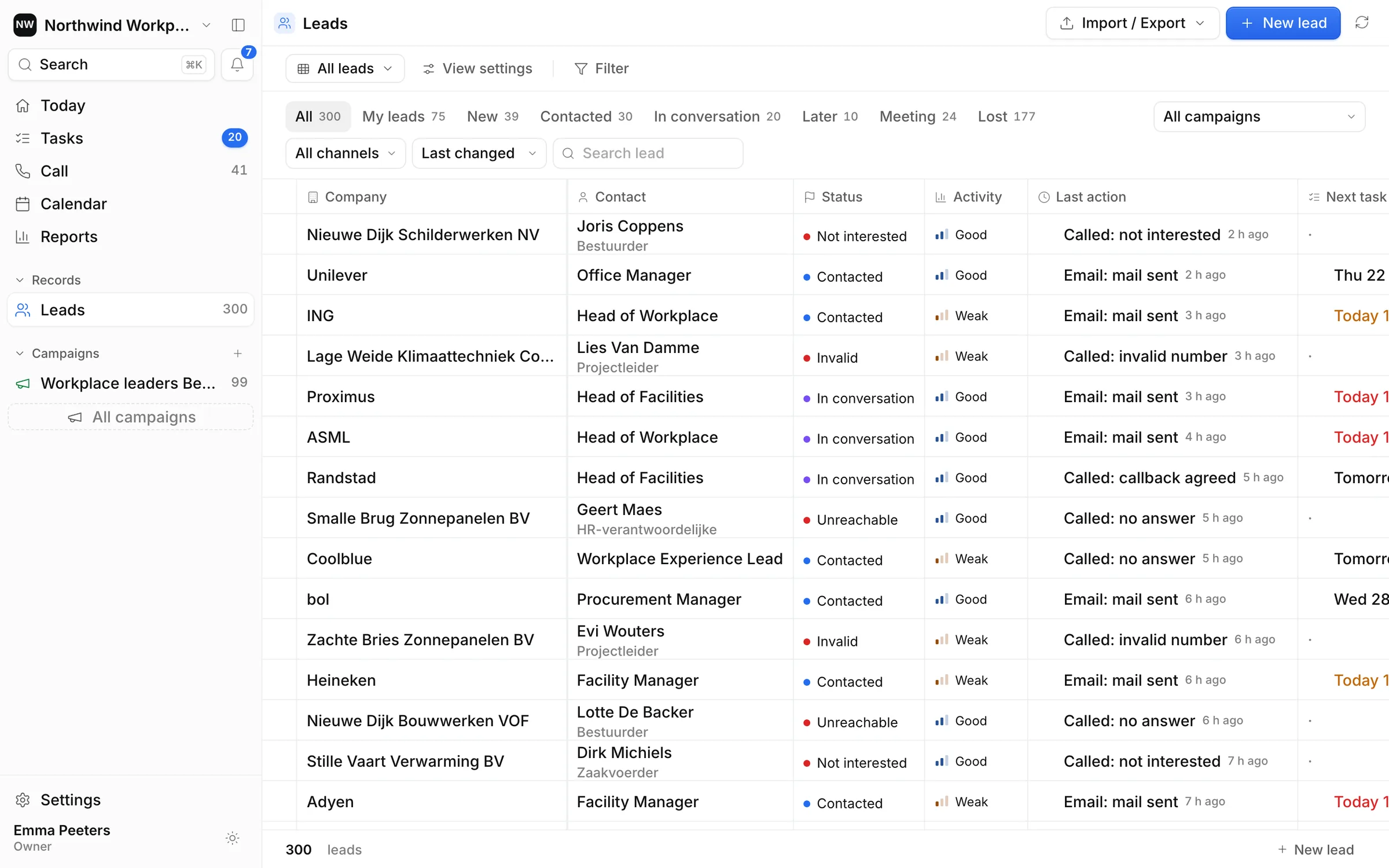
Your lists, in one place
Import Excel, CSV or a Bizzy export into a campaign. Every lead shows its status, last action and next task.
In this industry: Import a Bizzy export of companies with 5 to 100 employees in your region into one campaign per segment, so each caller works one clear list of businesses that still decide locally.
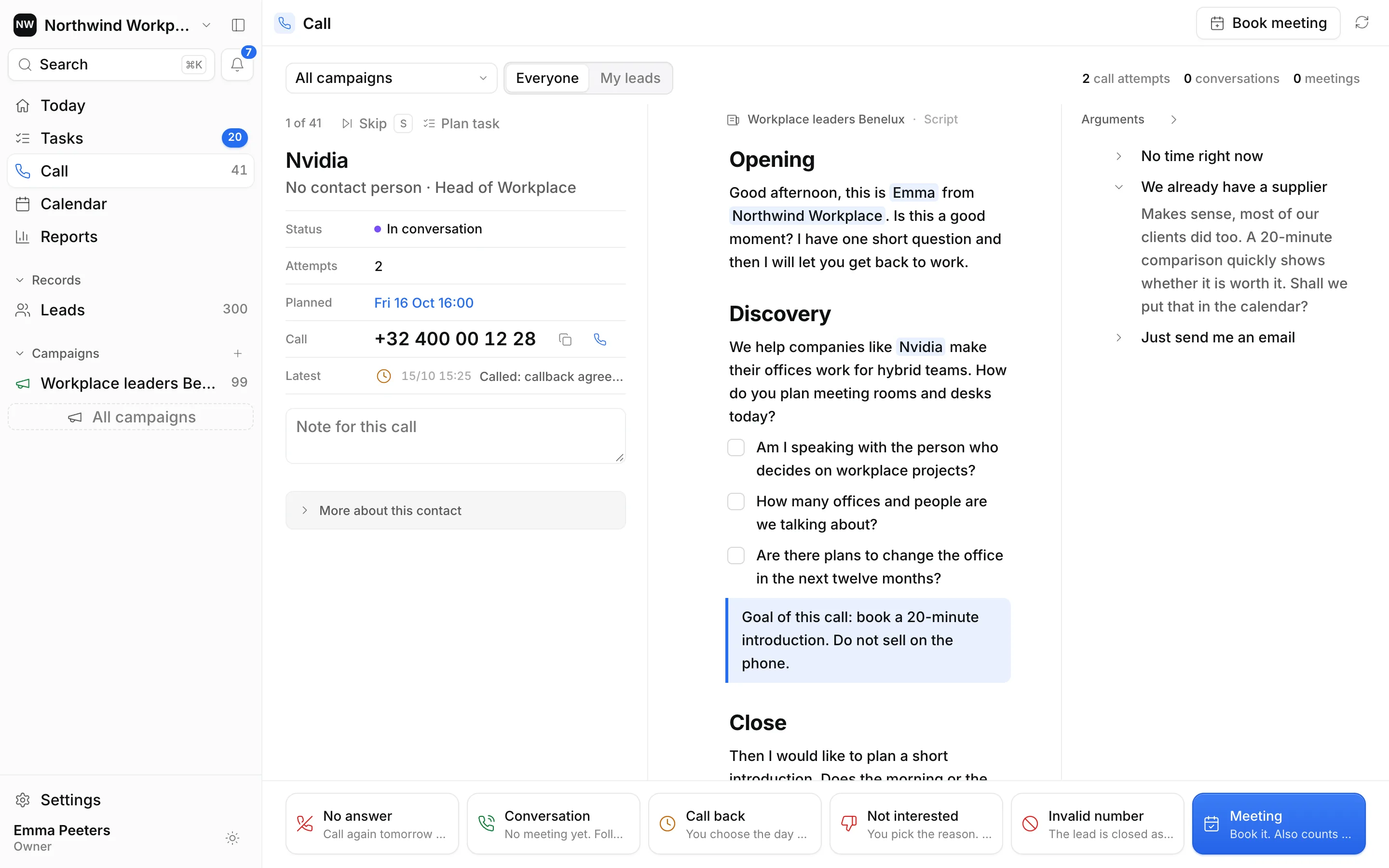
One screen for the call
The lead on the left, the script in the middle with the company name and your own name filled in. Click the number to call from your own phone.
In this industry: Put the questions about the current provider, contract end date, number of mobile users, fixed lines and the internet connection in the script, so every caller asks them and nobody forgets one.
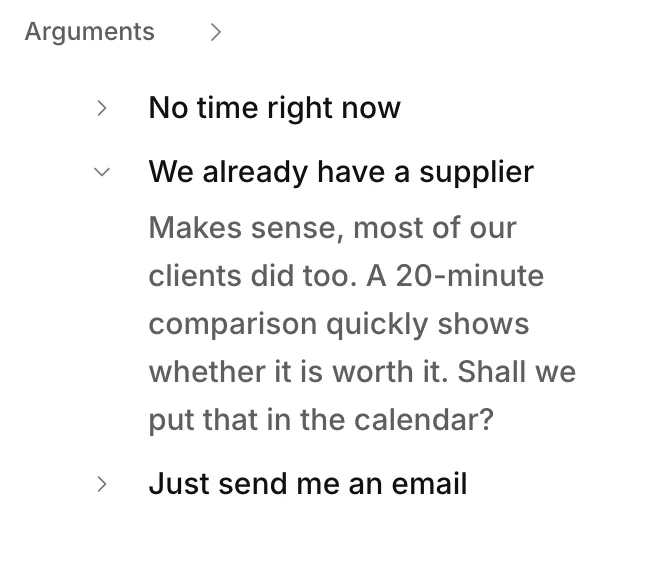
The answer to every objection
Common objections sit in a panel next to the script, so the right answer is one click away.
In this industry: Keep answers to "we are with the big operator", "switching is a hassle" and "our contract runs for two more years" next to the script, each ending with a question about the renewal date.
One key per call, the next step planned
N (not reached) plans a new attempt the next working day, G (conversation) a follow-up call in three days, T (call back) the moment you pick. A records a meeting; X (not interested, with a reason) and O (invalid number) close the lead.
In this industry: Owners and office managers rarely pick up at the first try. N plans the next attempt for the next working day, and T lets you call back at the moment they name.

Follow-up on every channel
Calls and emails land in your week. You write emails in Ringlane and send them from your own Gmail; LinkedIn and WhatsApp you send yourself and log by hand. The Today view puts overdue call-backs first.
In this industry: After a conversation, send a short note asking for a recent invoice to compare from your own Gmail. The history with that lead shows what you asked for.
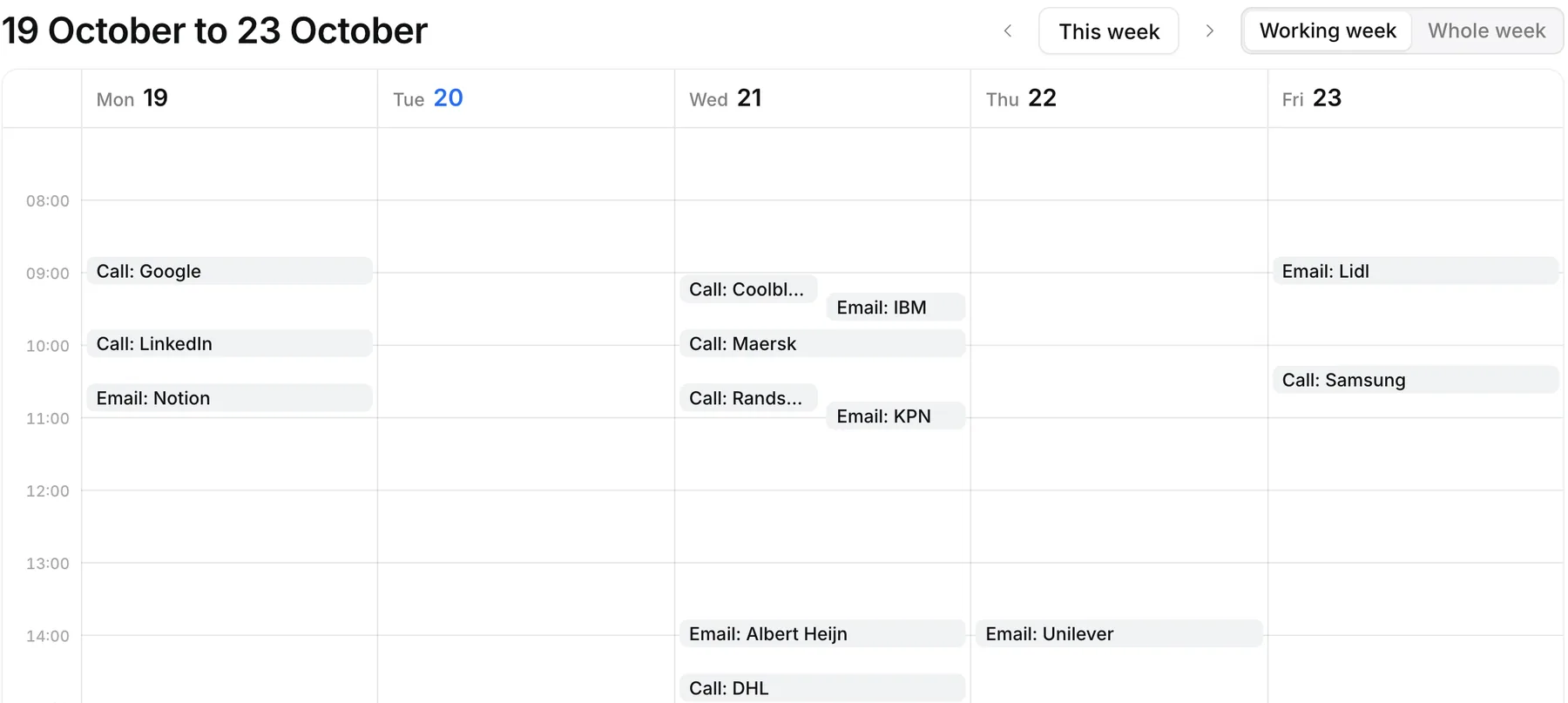
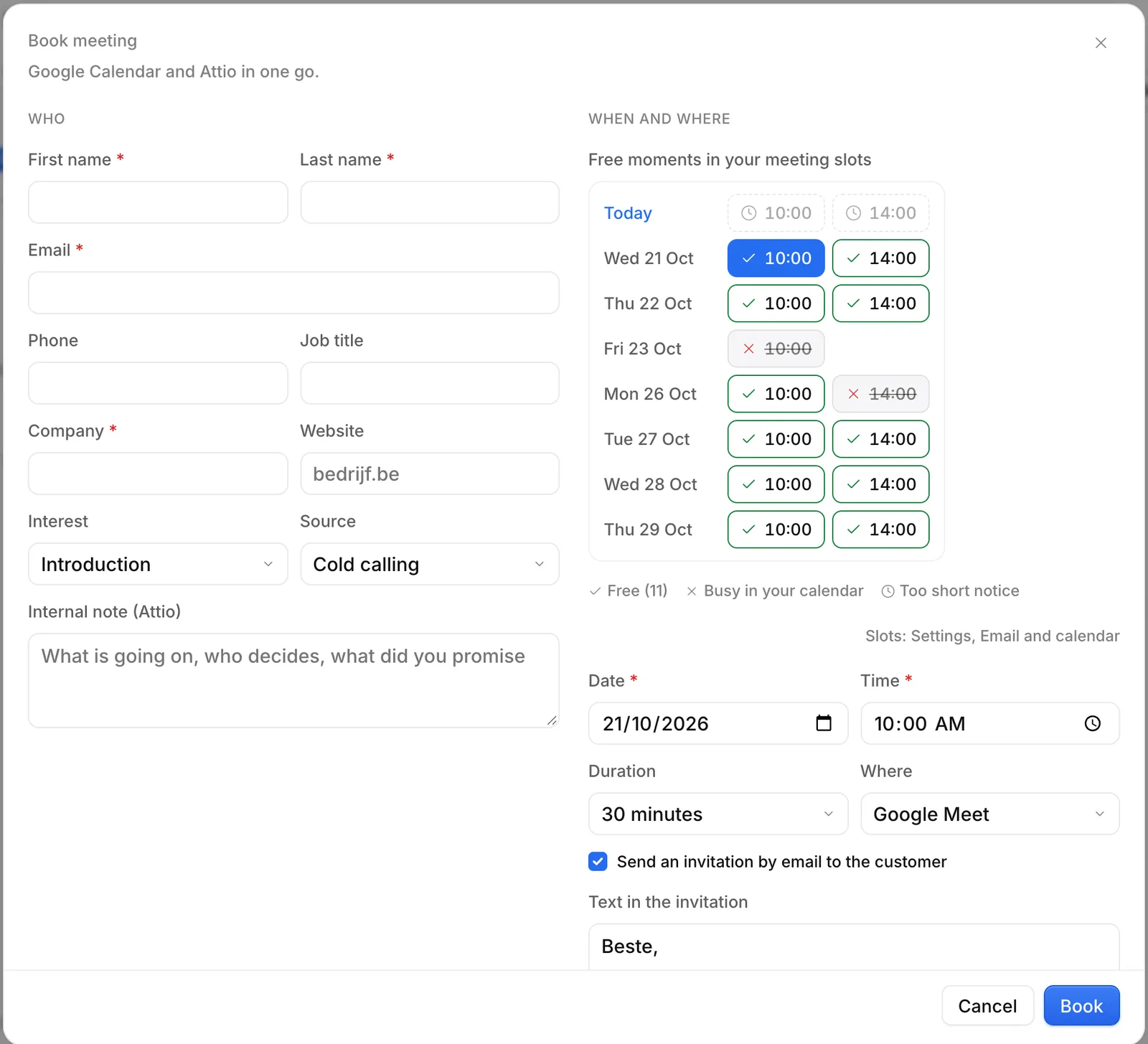
Book while they are on the line
Ringlane shows your free moments in Google Calendar, adds a Google Meet link and sends the invitation. Booked meetings go to Attio.
In this industry: When the owner agrees to an invoice review or an on-site check of the lines, book it in Google Calendar while they are still on the line. The meeting goes to Attio.
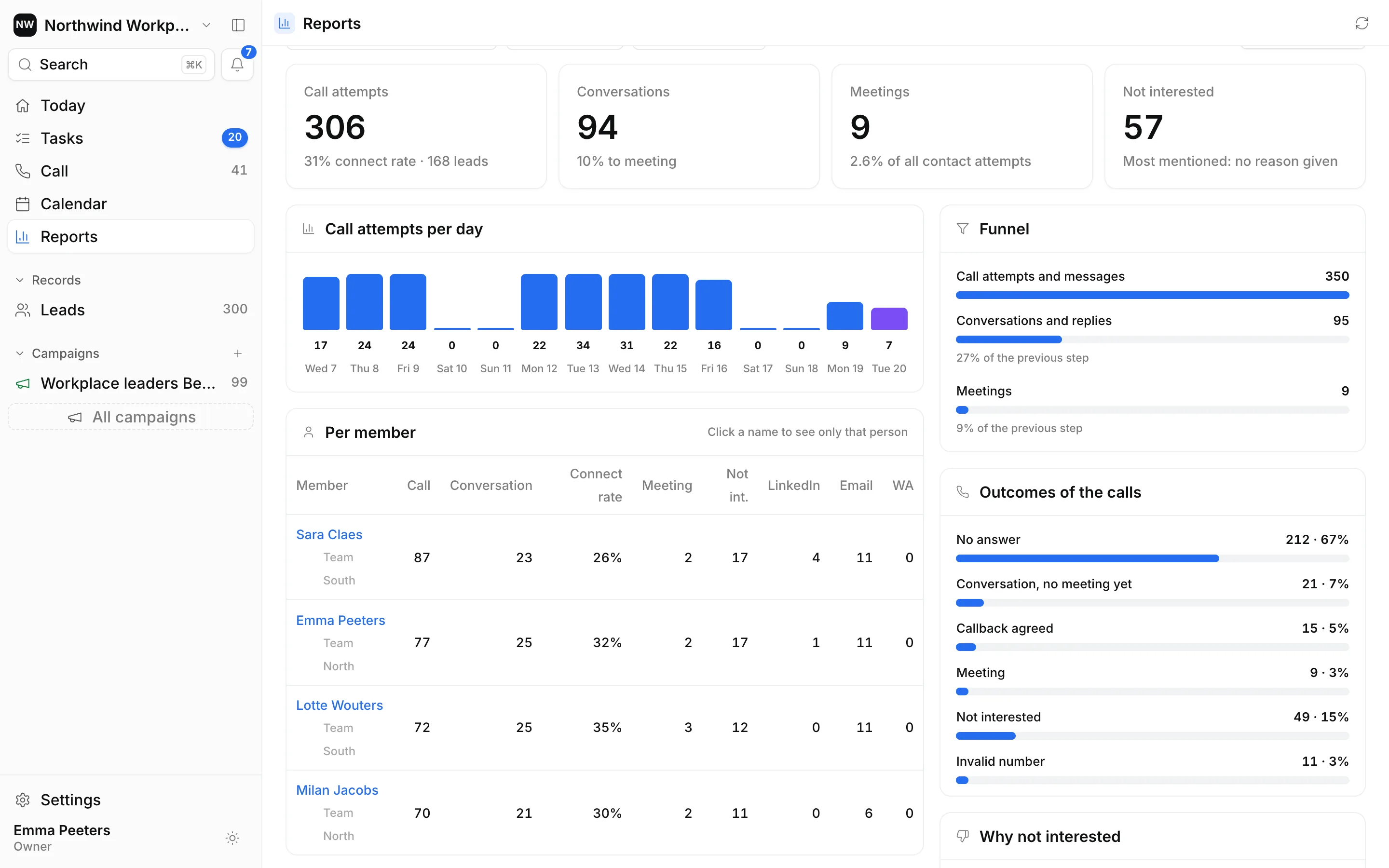
Your numbers, per caller and campaign
Call attempts, connect rate, conversations, meetings, the funnel and the reasons for "not interested", per person, team and campaign.
In this industry: Compare campaigns per segment and read the reasons for not interested. If "contract until 2027" keeps coming back, plan those leads for the renewal window instead of dropping them.
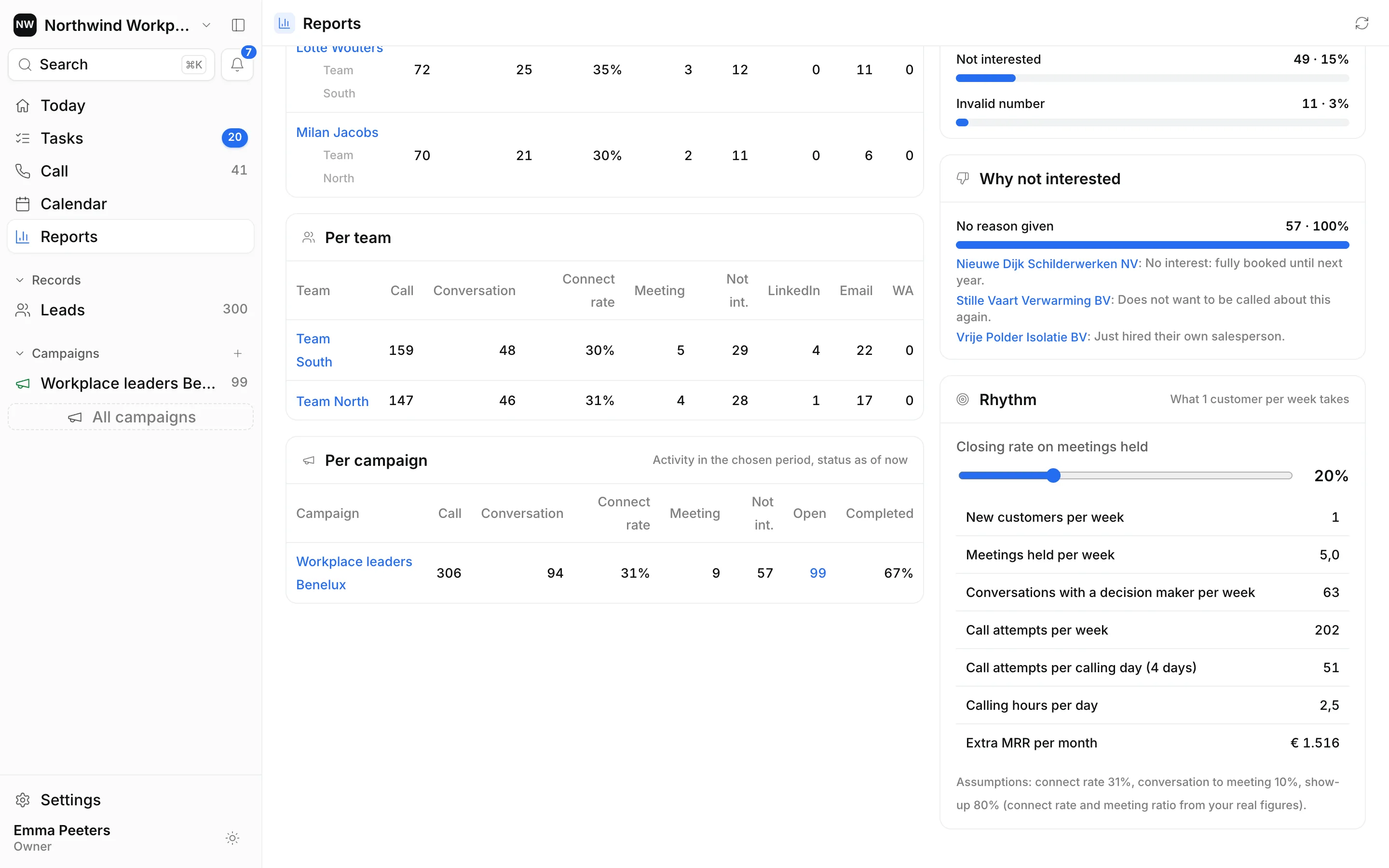
What one new customer takes
Based on your own rates, Ringlane calculates how many calls per week and per day one new customer per week takes.
In this industry: Fill in your own connect and meeting rates and see how many calls per week one new business customer per week takes, so a sales manager can plan a target that fits.
Real screens from the Ringlane app with demo data. No affiliation with the companies shown.
What it can bring you: efficiency, money and more
Business telecom is recurring revenue, so each new customer pays every month for years. The table below is an example with assumed numbers, not a forecast. Replace every figure with your own.
| Example with assumed numbers: one caller, one month | Value |
|---|---|
| Call attempts | 500 |
| Conversations with a decision maker (assumed 24%) | 120 |
| Invoice reviews or meetings booked (assumed 10% of conversations) | 12 |
| New customers (assumed 25% of meetings) | 3 |
| Value of one customer (assumed 300 euro per month over 24 months) | 7,200 euro |
In this example, three new customers a month are worth 21,600 euro over their contract. Your numbers will differ, so measure them. See how many calls it takes to win one customer.
Efficiency is the other half. Measure for one week how long your team spends after each call on notes, finding a date for the next call and remembering who promised to send an invoice. Logging an outcome with one key and having the next call planned is meant to take much of that away; measure the difference after a few weeks. And follow-up happens: a lead whose contract renews in five months is in the calendar. Read how to follow up leads for a simple cadence.
Want to see the calling screen first? Try the demo.
Rules to know
Telecom sales by phone is under extra scrutiny, both for how you call and for the contracts you offer. The rules on calling businesses differ between Belgium and the Netherlands; read the cold calling rules in Belgium and the Netherlands. On contracts, business customers in both countries have specific cancellation rights, as described above. Be clear on the phone about contract length and cancellation. This is general information, not legal advice.
Frequently asked questions
Does cold calling still work for business telecom?
Who decides on telecom in a small or mid-sized company?
How large is the telecom sector in Belgium and the Netherlands?
Can business customers leave a telecom contract early?
Is the copper switch-off a good reason to call?
Sources
- Eurostat: Enterprises by detailed NACE Rev. 2 activity (sbs_ovw_act), NACE 61, Belgium and the Netherlands, 2024
- Eurostat: Enterprises by size class (sbs_sc_ovw), NACE 61, 2023
- Proximus: End of the copper network
- BIPT: Communication of 20 June 2023 about the Proximus copper network switch-off
- KPN: Glas aan, koper uit (4 May 2022)
- Overheid.nl: Telecommunicatiewet, article 7.2ab (current text, checked October 2026)
- Justel: Law of 13 June 2005 on electronic communications, article 111/3 (consolidated text, checked October 2026)
All industries
- Accounting firms
- Business events and venues
- Business finance
- Commercial cleaning
- Commercial real estate
- Commercial solar and energy
- Consultancy
- Corporate catering
- Corporate training
- Fleet, leasing and EV charging
- HR and payroll services
- HVAC and building services
- Industrial manufacturing
- Insurance brokers
- IT services and MSPs
- Logistics and transport
- Marketing agencies
- Office furniture and workplace
- Printing and packaging
- Recruitment and staffing
- SaaS and software
- Security services
- Wholesale and distribution
- Workwear and PPE