Win business clients with calls planned around their renewal dates
For insurance brokers and independent advisory firms in Belgium and the Netherlands: who to call at a company, which moments make a policy review relevant, and how to follow up until the renewal date comes.
Business insurance is a broker's market in both Belgium and the Netherlands. Most companies already have a broker or an adviser, and policies renew on fixed dates. A broker who wants new business clients has to find the right moment, usually a few months before renewal or right after the company changed, and stay in touch until that moment comes.
The market: brokers dominate business insurance
In Belgium, brokers are the main channel for companies. According to Assuralia's distribution study for 2021, brokers handled 60.9% of all non-life premiums and 72.3% of non-life premiums paid by companies. Large brokers, which Assuralia calls megabrokers, accounted for 26.0% of company premiums and other brokers for 46.3%, although Assuralia notes that the megabroker share is underestimated. These figures are from 2021, so treat them as an indication. Statbel counted 10,467 VAT-registered enterprises in financial and insurance activities at the end of December 2025, a section that also includes banks and other financial services.
In the Netherlands, the picture is similar. According to Adfiz's Advies in Cijfers 2025 to 2026, independent advisers handled 64% of business non-life premiums in 2023, based on IG&H figures. Adfiz counted 5,602 advisory firms at the start of 2025, down from 6,296 in 2019, and 86% have fewer than six full-time employees. The sector is consolidating, with 258 acquisitions in 2024 according to BHB Dullemond. Adfiz's own survey shows that growth in the business market is a top-five priority for 51% of offices.
The buyers are mostly small. Adfiz cites about 424,000 Dutch SMEs and 1.96 million self-employed people. At these companies the owner decides, often based on trust and the relationship with the current adviser.
Who you call and what you ask
- Owner or managing director: signs the policies at small and mid-sized companies.
- Finance director at larger companies: looks at premiums, deductibles and the overall programme.
- HR manager: involved in group insurance, income protection and absence.
- Fleet manager or IT manager: for vehicle fleets or cyber cover.
Moments that make a call relevant:
- The renewal date of the main policies. Ask for it in the first call; it decides when the next call should happen.
- Changes in the company: first employees, a new building, new vehicles, a takeover, export to new countries.
- New risks. ABN AMRO research from May 2025, also cited by Adfiz, found that almost one in five Dutch companies suffered damage from cybercrime in the past year.
- A change at the current broker, such as a takeover by a consolidator or a retiring adviser.
Discovery questions that work with business owners:
- When was the last time someone went through all your company's policies with you?
- When do your main policies renew?
- What has changed in the company since then: people, buildings, vehicles, activities?
- If something happened tomorrow, which risk would worry you most?
- Who besides you is involved in choosing your broker?
What slows a calling team down in this sector
- Loyalty. Many owners have known their broker for years. A call that criticises the current adviser rarely works; a call that offers a second look sometimes does.
- Fixed renewal dates. A prospect who just renewed cannot switch for months. Without a planned call back, that lead is gone.
- Bank insurance. Some owners insure through their bank and do not see a broker as an option.
- Busy advisers. Claims and portfolio work always come first, so acquisition happens in gaps and outcomes are not written down.
- Regulation. Advice is regulated, so the call needs to gather facts and lead to a proper review, not to a quick product pitch.
Offices that win business clients by phone usually work with a simple rhythm. They pick one sector at a time, so advisers know the typical risks and can ask sharp questions. They ask for the renewal date in every first conversation and plan the next call around it, even if that is ten months away. And they treat "just renewed" as a timing answer, not as a no. Over a year, a list worked this way becomes a calendar of renewal moments that a single phone call at random would never find.
How Ringlane works for insurance brokers
Real screens from the app, with what each feature does in this industry.
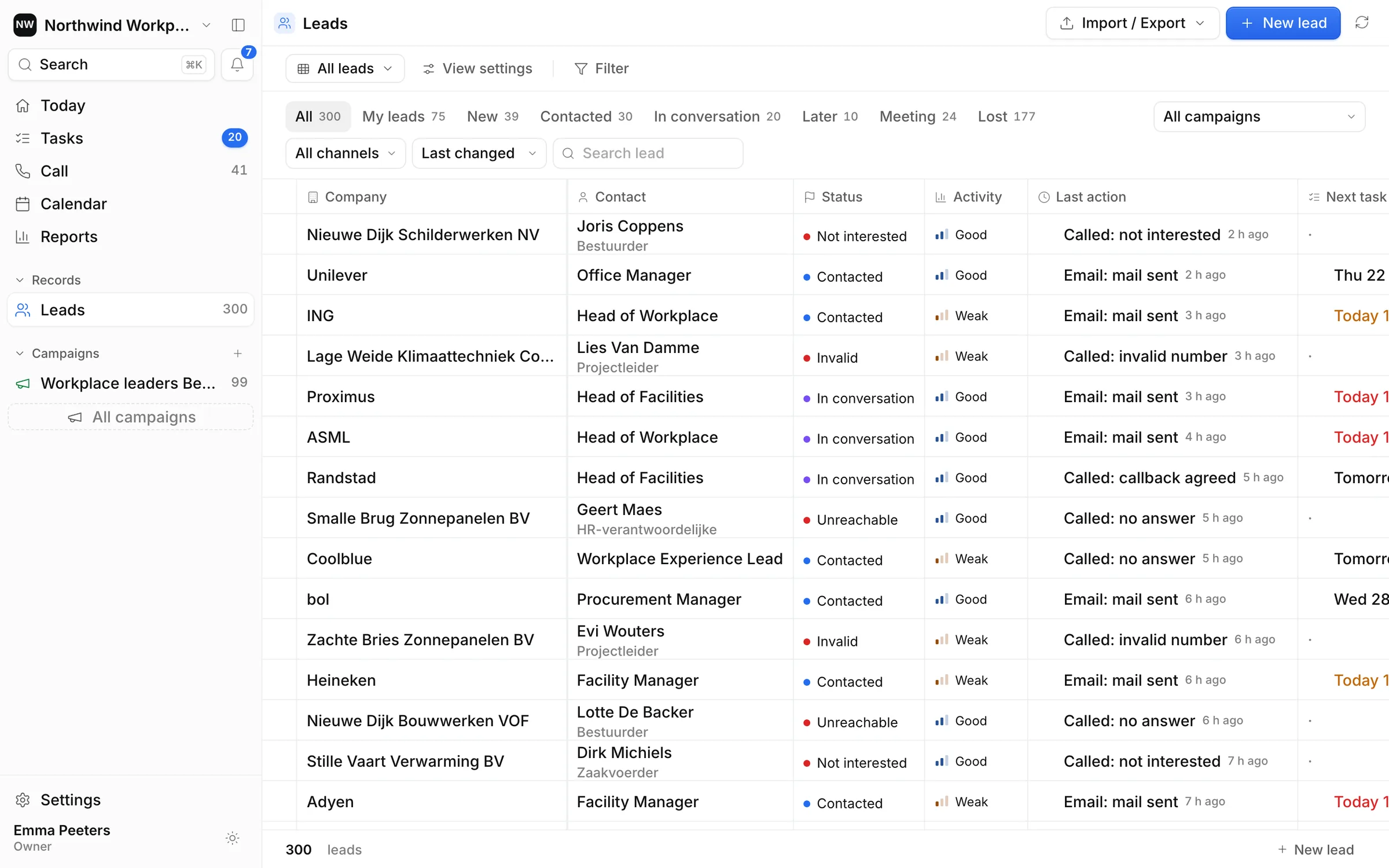
Your lists, in one place
Import Excel, CSV or a Bizzy export into a campaign. Every lead shows its status, last action and next task.
In this industry: Import a Bizzy export of companies by sector and headcount, for example construction firms with 5 to 50 employees in your province, into one campaign per sector, so each adviser works a list whose risks they know.
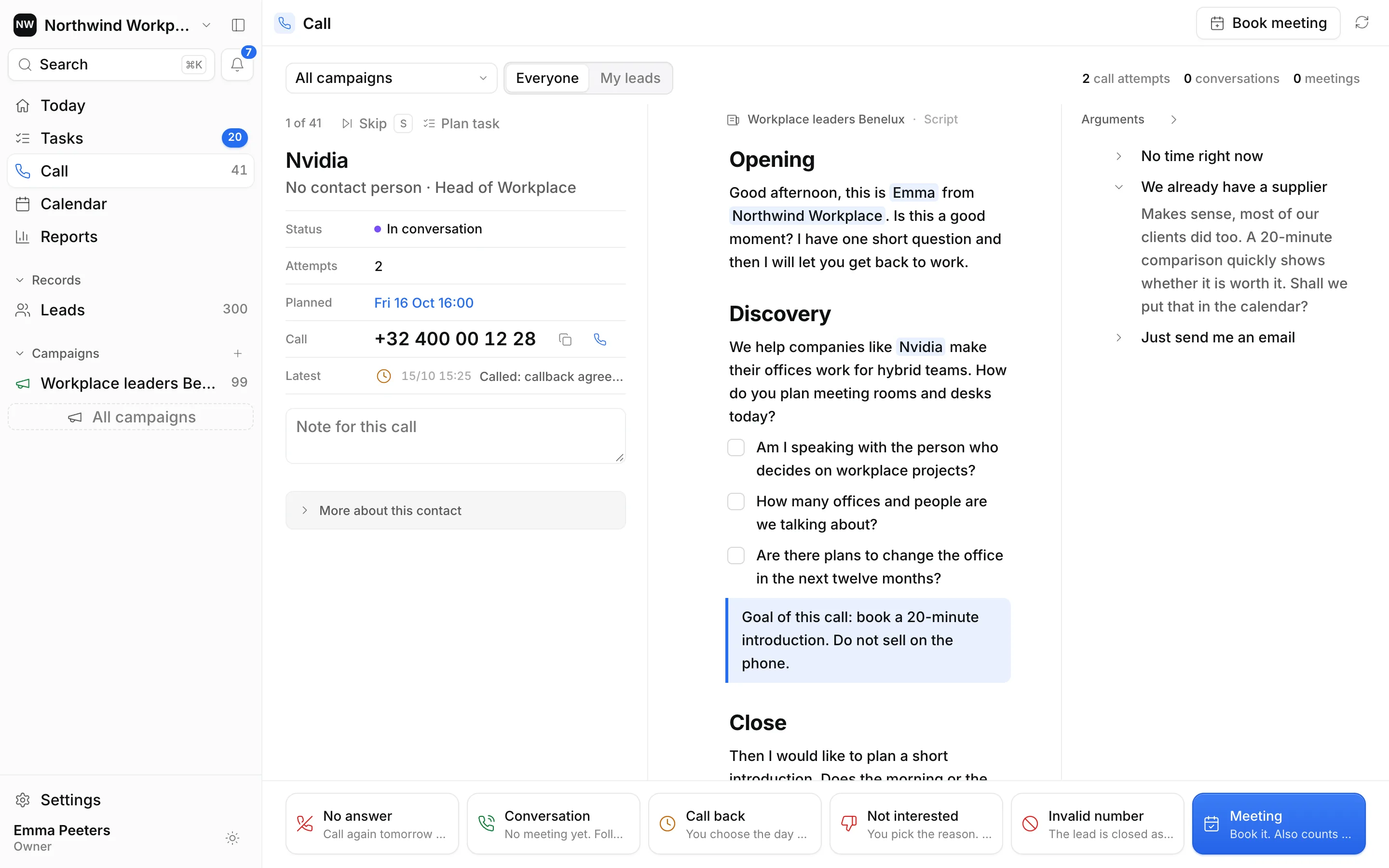
One screen for the call
The lead on the left, the script in the middle with the company name and your own name filled in. Click the number to call from your own phone.
In this industry: Put the questions about current broker or insurer, main policies, renewal dates and recent changes in the company in the script, so every caller collects the same facts.
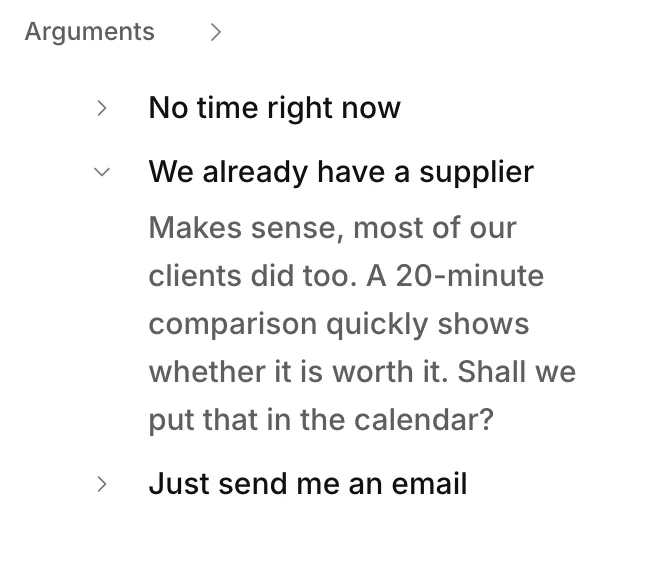
The answer to every objection
Common objections sit in a panel next to the script, so the right answer is one click away.
In this industry: Keep answers to "we are insured through the bank", "our broker is a friend" and "insurance is too expensive already" next to the script, each one steering toward a short policy review.
One key per call, the next step planned
N (not reached) plans a new attempt the next working day, G (conversation) a follow-up call in three days, T (call back) the moment you pick. A records a meeting; X (not interested, with a reason) and O (invalid number) close the lead.
In this industry: When the owner says the policies just renewed, T plans the call back a few months before the next renewal date, so the lead is parked at the right moment instead of lost.

Follow-up on every channel
Calls and emails land in your week. You write emails in Ringlane and send them from your own Gmail; LinkedIn and WhatsApp you send yourself and log by hand. The Today view puts overdue call-backs first.
In this industry: After a call, send the list of documents you need for a policy review from your own Gmail and see the thread with that lead, so a colleague knows what was asked and received.
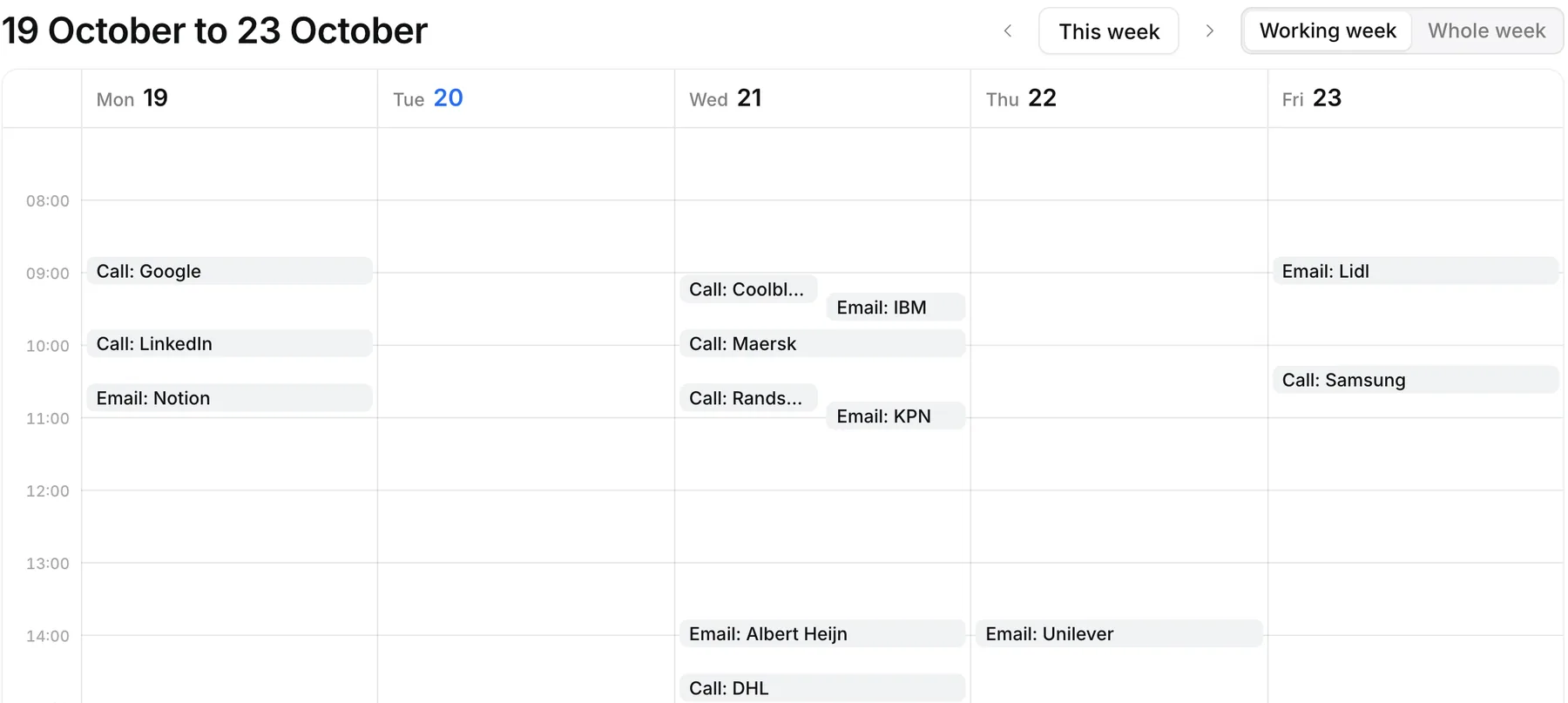
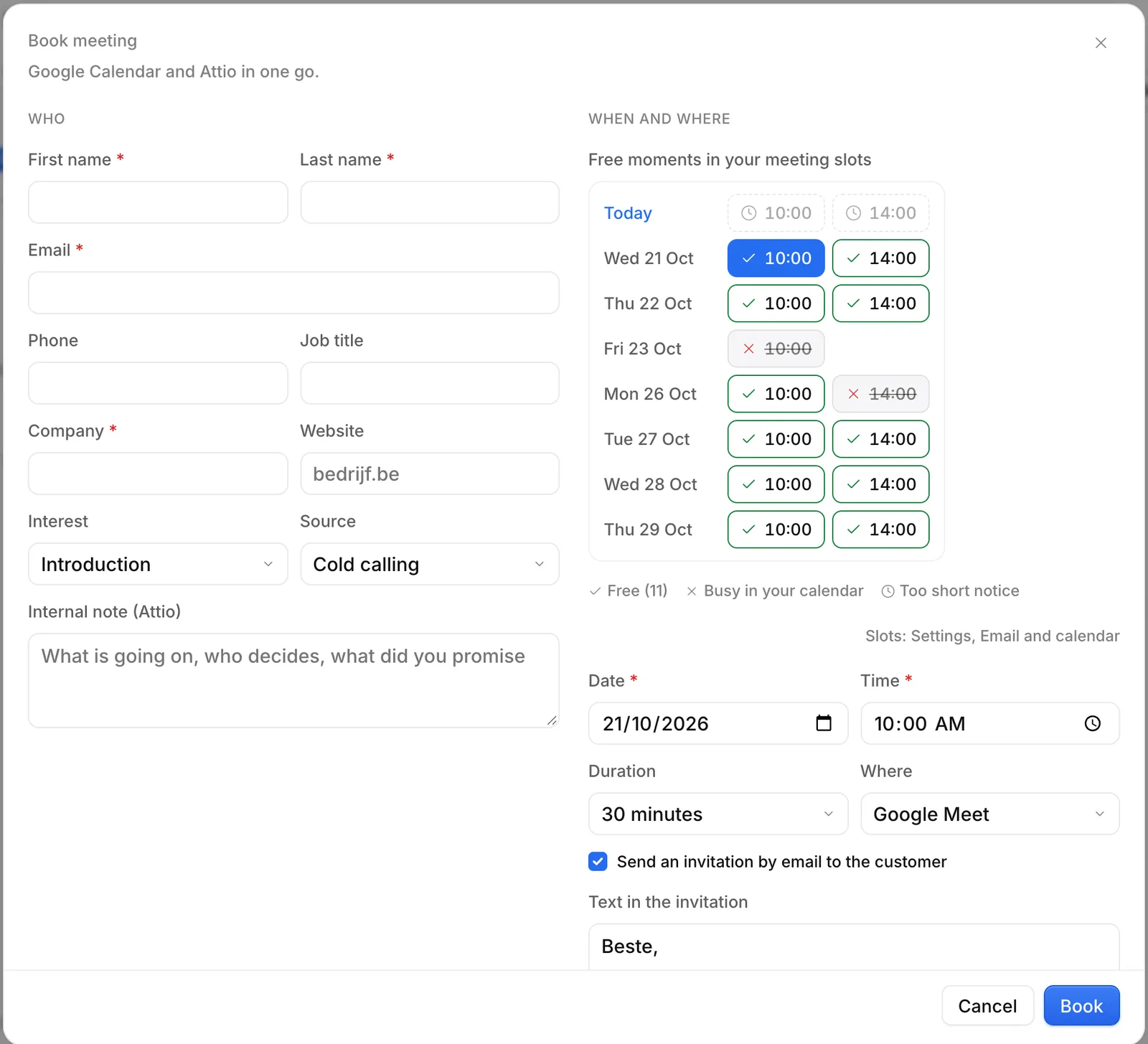
Book while they are on the line
Ringlane shows your free moments in Google Calendar, adds a Google Meet link and sends the invitation. Booked meetings go to Attio.
In this industry: When an owner agrees to a review of the company's policies, book it in Google Calendar with a Meet link while they are on the line; the meeting goes to Attio.
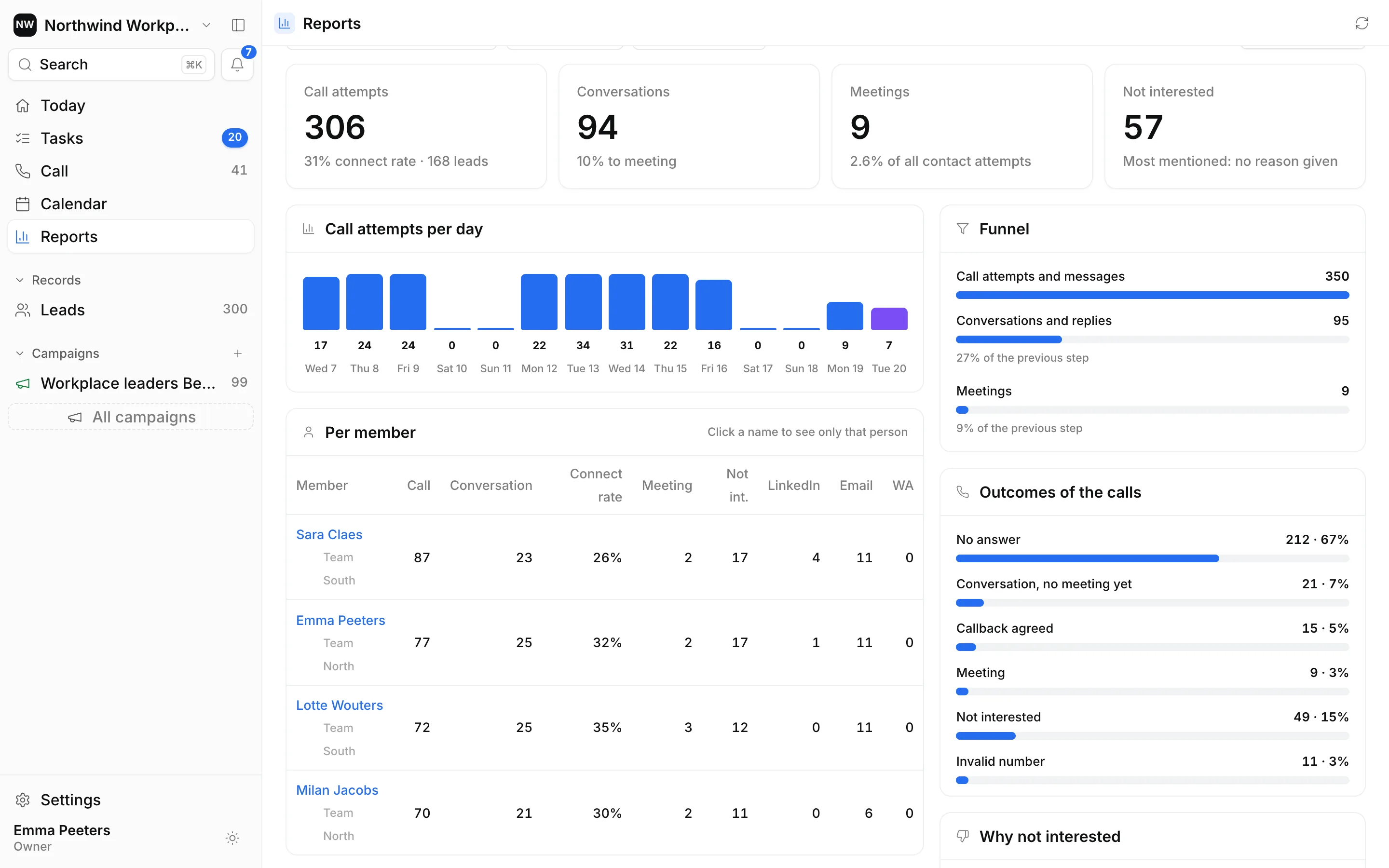
Your numbers, per caller and campaign
Call attempts, connect rate, conversations, meetings, the funnel and the reasons for "not interested", per person, team and campaign.
In this industry: Compare campaigns per sector and read the reasons for not interested to see whether "just renewed", "bank insurance" or "loyal to our broker" is the real block in each segment.
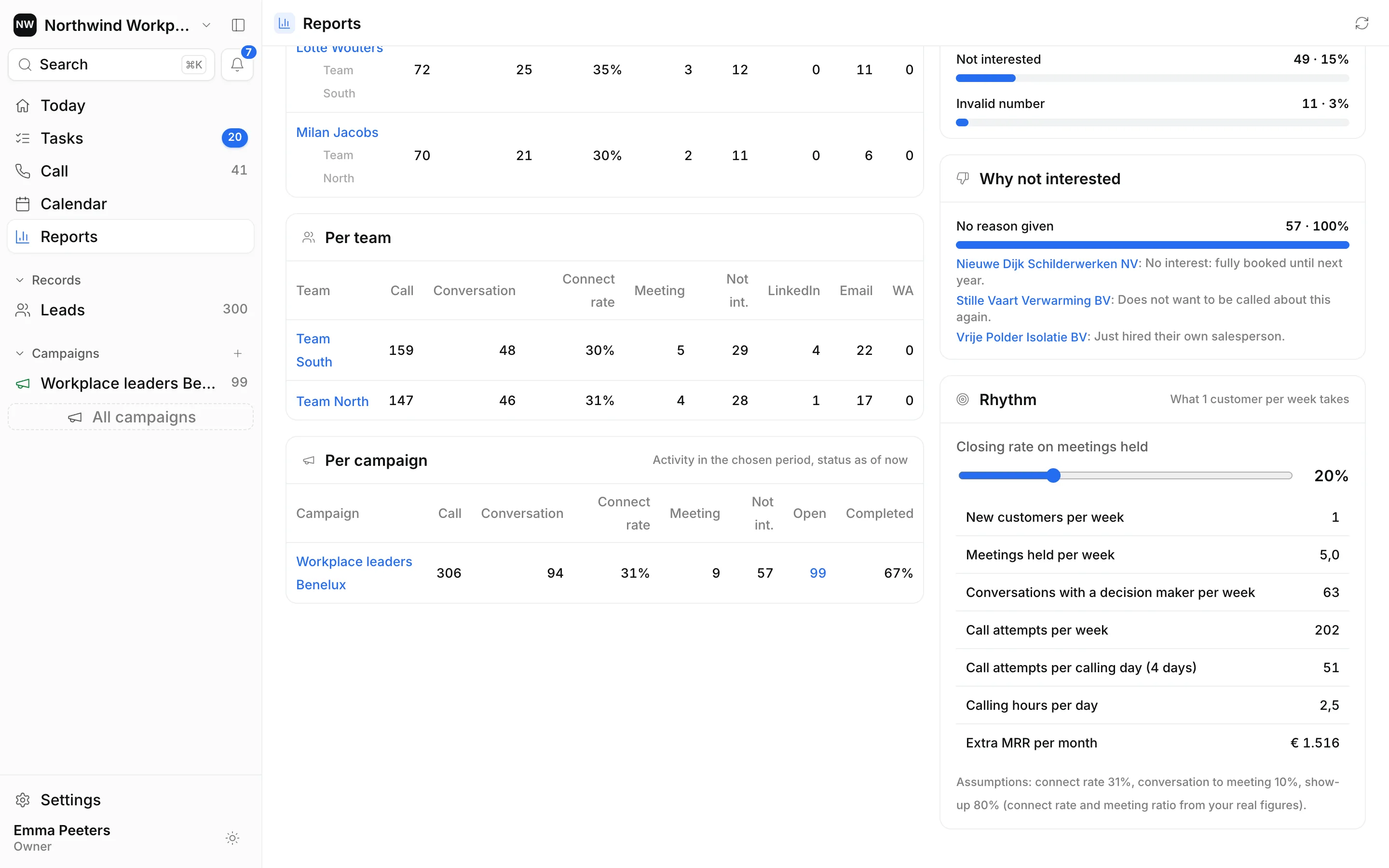
What one new customer takes
Based on your own rates, Ringlane calculates how many calls per week and per day one new customer per week takes.
In this industry: Fill in your own rates and see how many calls per week one new business client per week takes, so an office can plan acquisition next to claims and portfolio work.
Real screens from the Ringlane app with demo data. No affiliation with the companies shown.
What it can bring you: efficiency, money and more
A business client usually brings several policies and stays for years. The table below is an example with assumed numbers, not a forecast. Replace every figure with your own.
| Example with assumed numbers: one adviser, one month | Value |
|---|---|
| Call attempts | 300 |
| Conversations with the owner (assumed 30%) | 90 |
| Policy reviews booked (assumed 10% of conversations) | 9 |
| New business clients (assumed 25% of reviews) | 2 |
| Value of one client (assumed 3,000 euro commission per year over five years) | 15,000 euro |
In this example, two new business clients a month represent 30,000 euro in commission over five years. Your own commission and retention decide the real figure, so measure them.
Efficiency is measurable too. Track for a week how long advisers spend after each call on notes and on remembering when a prospect's policies renew. Logging the outcome with one key and seeing the call back planned months ahead means the renewal moment is not missed. See how to follow up leads, and loss aversion in sales for why owners often stay with what they have.
Rules to know
Calling businesses about insurance is common, but two sets of rules apply. The general rules on direct marketing and data protection decide who you may call and how you handle their data. Insurance distribution rules, supervised by the FSMA in Belgium and the AFM in the Netherlands, decide how you advise once the conversation becomes concrete. Our guide on cold calling rules in Belgium and the Netherlands gives an overview. This is general information, not legal advice.
Want to see the calling screen first? Try the demo.
Frequently asked questions
Can insurance brokers cold call business owners?
Who should a broker call at a company?
How important are brokers for business insurance?
How many advisory firms are there in the Netherlands?
When is the best moment to call a business about insurance?
Sources
All industries
- Accounting firms
- Business events and venues
- Business finance
- Commercial cleaning
- Commercial real estate
- Commercial solar and energy
- Consultancy
- Corporate catering
- Corporate training
- Fleet, leasing and EV charging
- HR and payroll services
- HVAC and building services
- Industrial manufacturing
- IT services and MSPs
- Logistics and transport
- Marketing agencies
- Office furniture and workplace
- Printing and packaging
- Recruitment and staffing
- SaaS and software
- Security services
- Telecom and connectivity
- Wholesale and distribution
- Workwear and PPE